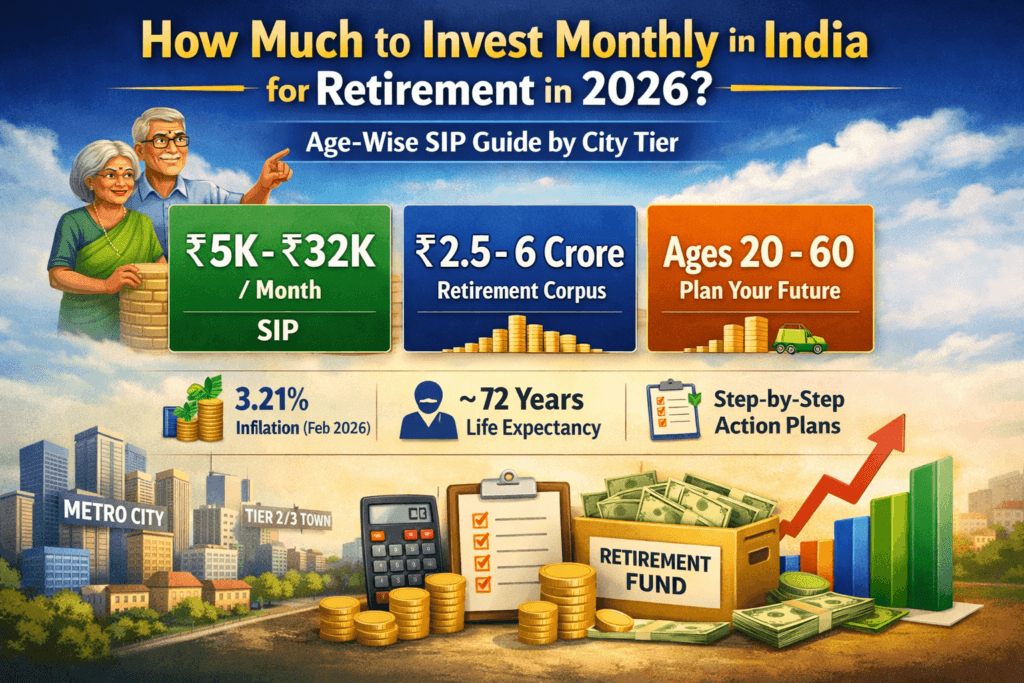

Most Indians believe retirement will “sort itself out.” They trust their children, assume their savings are enough, or simply avoid thinking about it. And then, quietly, they reach 60 — underprepared, financially dependent, and overwhelmed by the gap between the life they imagined and the reality in front of them.
This is not a rare story. It is the story of crores of Indian families.
But it doesn’t have to be yours.
In this comprehensive guide, we cover everything you need to know about retirement planning in India — from the brutal truths about inflation and lifestyle creep, to the psychological toll of financial unpreparedness, to a step-by-step breakdown of the most powerful free tool available today: the Wealthpedia Multi-Goal FIRE Planner.
Whether you are 28 and just starting out, or 48 and racing against time, this guide is for you.
The Retirement Crisis in India: Why Most Indians Are Not Prepared
India has a retirement problem — and it is hiding in plain sight.
According to various surveys and financial planning reports, fewer than 10% of Indian households actively plan for retirement using structured investment strategies. The National Pension System (NPS), introduced in 2004, covers only a small fraction of the working population. The Employees’ Provident Fund (EPF), while widespread, is often treated as a “savings account” — withdrawn at job changes, rarely allowed to compound over decades.
The cultural safety net — children supporting aging parents — is eroding rapidly. Urban migration, nuclear families, rising cost of living, and changing social values mean that the next generation simply may not be in a position to carry the financial burden of retired parents. And yet millions of Indians continue to plan their retirement around this assumption.
Why Indians Fail to Plan Retirement Properly
Understanding the root causes is the first step toward changing them:
“My children will take care of me” — The Dependency Trap
This deeply cultural belief keeps retirement planning off the table for most Indian families. It is not irresponsible; it is simply outdated. Children today face their own EMIs, education loans, childcare costs, and career pressures. Depending on them for financial support adds emotional and financial strain to relationships that should be nurturing, not transactional.
Present Bias — The Psychological Blind Spot
The human brain is wired to value immediate rewards over distant ones. A retirement 25 years away feels abstract. A vacation this summer feels real. This cognitive bias — called present bias — makes it incredibly easy to defer retirement savings “just one more year,” year after year, until it is too late to course-correct.
No Financial Education
India’s school curriculum teaches calculus and chemistry but almost nothing about compound interest, SIPs, inflation, or asset allocation. Most Indians learn about money from parents, colleagues, or social media — often too late and often incorrectly.
Complexity Avoidance
“I don’t understand mutual funds.” “The stock market is too risky.” “I’ll start when I know more.” The complexity of financial products — real or perceived — becomes a convenient excuse to avoid planning altogether.
Real Estate Over-Reliance
A large segment of Indian households considers a house to be the retirement plan. But a house you live in generates no income. It cannot pay for medical bills. It is illiquid. It often comes with a 20-year EMI that itself delays wealth accumulation.
Fragmented Goal Planning
Most people save separately — “some money for education, some for a car, some somewhere else.” Without a unified strategy, money never compounds meaningfully and each goal cannibalizes the next. This is the exact problem a tool like the Multi-Goal FIRE Planner from Wealthpedia is built to solve.
The Psychological Impact of Not Planning for Retirement
Retirement unpreparedness is not just a financial problem. It is a mental health crisis in slow motion.
Chronic Financial Stress
Financial anxiety is one of the most pervasive and underreported forms of stress in India. When people sense — even subconsciously — that their future is financially uncertain, they carry a background hum of dread that affects concentration, sleep quality, relationships, and decision-making. Studies consistently show that financial stress is among the top contributors to depression and anxiety in working adults.
The cruelest part? The avoidance of thinking about retirement does not reduce this stress — it amplifies it. Every year without a plan is another year closer to crisis.
Insecurity and Loss of Dignity
In India’s context, financial dependence in old age often translates directly into loss of dignity and autonomy. Elders who depend on children for monthly expenses often feel they cannot express opinions, make decisions, or even speak freely. The phrase “I am a burden to my children” is one of the most heartbreaking sentences a parent can say — and it is tragically common.
Retirement planning, at its core, is about preserving your dignity and freedom in the years when you have earned the right to rest.
Retirement Shock
When retirement arrives suddenly — through health issues, company downsizing, or simply reaching 60 — people who have not planned experience what researchers call “retirement shock.” It is a jarring collision between the identity and routine they had as working professionals, and the financial and social void that follows.
This manifests as depression, anxiety, strained relationships, and in some cases, serious health deterioration. The stress of managing finances on a fixed corpus, watching prices rise faster than returns, and feeling powerless creates a feedback loop of fear and helplessness.
The Burden Effect on the Next Generation
Unprepared retirement does not affect only the retiree. Children who bear the financial responsibility of aging parents often sacrifice their own financial goals — delaying home ownership, putting off children, withdrawing savings prematurely. The psychological burden of this “intergenerational financial obligation” generates resentment, guilt, and family conflict — all of which could be avoided with proper planning.
Planning your retirement is, in a profound sense, a gift to your children as much as to yourself.
Understanding Inflation in India: The Silent Wealth Destroyer
Ask most people what their biggest retirement planning risk is, and they will say “market crashes” or “job loss.” The real answer is inflation — slow, invisible, relentless, and extraordinarily powerful over long time horizons.
General Inflation
India’s Consumer Price Index (CPI) inflation has historically averaged around 5–7% per year. This means that ₹1 lakh today will have the purchasing power of roughly ₹55,000–₹60,000 just 10 years from now. Over 25 years — a typical retirement horizon — the same ₹1 lakh shrinks to less than ₹25,000 in real value.
This is not theoretical. It is arithmetic. And most retirement plans in India completely ignore it.
Medical Inflation: The Most Dangerous Number
Healthcare inflation in India runs at 10–14% annually — almost double general inflation. Let that sink in for a moment.
A hospitalisation that costs ₹2 lakh today will cost approximately ₹5–7 lakh a decade from now, and ₹15–20 lakh in 20 years. A cardiac bypass that costs ₹4 lakh today could cost ₹30–40 lakh by the time you are 75.
And here is the cruel intersection: you need medical care most during retirement, precisely when your income has stopped and your corpus is under stress from withdrawals.
Most Indian retirement calculations either ignore medical inflation entirely or grossly underestimate it. The result is retirees who exhaust their entire savings on two or three major health events — leaving nothing for their remaining years.
Smart retirement planning must include a dedicated healthcare corpus, separate from the lifestyle withdrawal corpus — ideally 20–30% extra buffer on top of your main retirement number.
Educational Inflation: Planning for Your Children’s Future While Planning Your Own
Education inflation in India runs at 8–12% per year. An undergraduate engineering or medical degree that costs ₹10 lakh today may cost ₹30–50 lakh in 10–15 years. An MBA at a premier institution that costs ₹25 lakh today could cost ₹80–100 lakh by the time your child is ready.
Here is the painful reality that most Indian families face: they are simultaneously trying to save for children’s education and their own retirement — often with the same limited monthly income.
This is exactly where fragmented, single-goal financial planning breaks down completely. You need a system that allocates the same SIP across multiple goals intelligently — which is precisely what the Wealthpedia Multi-Goal FIRE Planner does through its waterfall priority engine. You can set your child’s education as Priority 1, your retirement as Priority 2, and watch the tool allocate your monthly SIP across both — showing you exactly where you are on track and where you have a shortfall.
Lifestyle Inflation: The Enemy That Wears a Friendly Face
Lifestyle inflation is the tendency to upgrade your standard of living as your income rises — bigger home, better car, more vacations, premium schools for children, dining out more frequently.
This is not morally wrong. It is deeply human. But it becomes financially catastrophic when it consistently outpaces savings growth.
The Indian middle class has been particularly vulnerable to lifestyle inflation over the past two decades, as disposable incomes rose with the IT and services boom. Families that earned ₹40,000 a month in 2005 and now earn ₹2 lakh a month have, in many cases, proportionally increased their spending — while their retirement savings have lagged far behind.
The problem compounds in retirement planning because people anchor their retirement corpus calculation to their current lifestyle — which itself has been inflated. If your current monthly expense is ₹1.5 lakh and you have been increasing your lifestyle by 8% a year, your retirement expense assumption needs to account for this ongoing lifestyle trajectory, not just CPI inflation.
Lifestyle inflation also makes it psychologically harder to “sacrifice” for retirement. When you are used to business class, flying economy for retirement feels like deprivation. When your children attend private school, sending them to government college feels unthinkable. These anchors make financial discipline increasingly difficult as income rises — one of the great paradoxes of India’s growing middle class.
What is FIRE, and Why It Matters for Indian Retirement Planning
FIRE stands for Financial Independence, Retire Early. It is both a philosophy and a mathematical framework that has gained enormous traction among Indian millennials — particularly those in high-income sectors like technology, finance, and consulting.
At its core, FIRE is simple: save aggressively, invest wisely, and build a corpus large enough that your investment returns can cover your living expenses indefinitely. When that point is reached, work becomes optional — not because you hate your job, but because you no longer need the income.
The FIRE Number: How to Calculate What You Need
The classic FIRE formula uses the “25x rule”: multiply your annual expenses by 25. This assumes a 4% Safe Withdrawal Rate (SWR) — meaning you withdraw 4% of your corpus each year, and the remaining corpus continues to grow, sustaining you for 30+ years.
However, for Indians, a more conservative approach is recommended:
- Use a 3–3.5% SWR instead of 4%, because India’s inflation is higher and retirement horizons are longer.
- This implies a 33x–40x annual expenses corpus target.
- Add 20–30% buffer for healthcare inflation.
Quick Example:
Monthly expenses today: ₹75,000 → Annual: ₹9 lakh
Retire in 15 years at 6% inflation → Future annual expenses: ~₹21.5 lakh
Corpus needed at 3% SWR: ₹21.5 lakh ÷ 0.03 = ₹7.2 crore
Add 25% healthcare buffer: ₹9 crore total target
That number may look terrifying at first. But here is what changes everything: compound interest, step-up SIPs, and time. The earlier you start, the more the math works in your favour — not against you.
Lean FIRE vs Fat FIRE: Which One Is Right for You?
Lean FIRE targets a minimalist lifestyle post-retirement — lower expenses, smaller city, simpler living. A corpus of ₹3–6 crore may be sufficient for a frugal couple in a Tier-2 city. This approach requires aggressive saving but is achievable for many middle-income Indian professionals.
Fat FIRE maintains or enhances your current lifestyle — travel, premium healthcare, children’s support, social obligations. This typically requires ₹10–20+ crore and demands either very high income, early starting, or both.
Most Indians will find themselves somewhere in the middle — what some call “Regular FIRE” or “Chubby FIRE” — needing ₹5–12 crore depending on location, lifestyle, and family obligations.
Retirement Planning in India: A Step-by-Step Framework
Step 1: Know Your Numbers
Start by honestly tracking your current monthly expenses. Not your income — your actual outgo. Include housing (rent or EMI equivalent), food, utilities, transport, insurance premiums, entertainment, eating out, children’s education, medical, and miscellaneous. Most people overestimate their savings because they underestimate their spending.
Step 2: Define Your Retirement Vision
When do you want to retire? What will retirement look like for you — same city or smaller town? Same lifestyle or simplified? Will you work part-time? Support parents? Fund children’s weddings? Each answer changes the corpus number significantly.
Step 3: Calculate Your FIRE Number
Use the framework above — project future expenses with inflation, apply a conservative SWR, add a healthcare buffer. Do not use a static number. Revisit this calculation every year. Use Walthepdia’s Multi Goal FIRE Planner which give your comprehensive views and numbers about your FIRE journey.
Step 4: Identify All Goals Between Now and Retirement
Retirement is never your only financial goal. Most Indians are simultaneously working toward children’s education, a home purchase, a vehicle upgrade, family vacations, and building an emergency fund. Each of these competes for the same monthly savings.
This is where single-goal calculators utterly fail you. You need a tool that can hold all these goals at once and show you how they interact with each other — and with your retirement corpus. The Multi-Goal FIRE Planner by Wealthpedia is the only free tool in India that does exactly this.
Step 5: Start (or Increase) Your SIP
A Systematic Investment Plan in diversified equity mutual funds or index funds is the single most powerful retirement tool available to ordinary Indians. Even ₹10,000 per month, started at age 30 and invested at 11% annual returns, grows to approximately ₹2.3 crore by age 60. Add a 10% annual step-up, and that number exceeds ₹5.5 crore.
The formula is simple: start early, increase regularly, stay invested.
Step 6: Protect Yourself with Insurance
No retirement plan survives a major health crisis without adequate insurance. A term life insurance policy (for income replacement if you die early) and a comprehensive health insurance policy (for hospitalisation and critical illness) are non-negotiable. Without these, a single event can wipe out years of careful saving.
Step 7: Review Annually and Adjust
Life changes. Income changes. Goals change. Review your retirement plan every year — ideally using a tool that can instantly show you the impact of any change. Increase your SIP whenever your income grows. Recalculate your FIRE number with updated expense data. Adjust asset allocation as you approach retirement.
The Best Free Retirement Planning Tool for Indians in 2026
If you have been following this guide closely, you already know the central challenge: most Indians have multiple financial goals competing for a limited monthly savings capacity — and retirement is just one of them.
No single-goal calculator can solve this problem. And no spreadsheet most people can practically maintain will either.
That is why the Wealthpedia Multi-Goal FIRE Planner represents a genuine breakthrough in free financial planning tools for Indian households. Let us go through every feature in detail.
What Is the Multi-Goal FIRE Planner?
The Wealthpedia Multi-Goal FIRE Planner is a free, browser-based interactive financial calculator that does something uniquely powerful: it takes one single monthly SIP — the total amount you can invest per month — and automatically distributes it across all your financial goals plus your FIRE/retirement target, using a priority-based “waterfall” allocation engine.
The result is a complete, integrated financial life simulation — from today until age 100 — showing you exactly how much each goal gets, whether you are on track, where you have shortfalls, and what happens to your wealth in both the accumulation and withdrawal phases of your life.
It is not just a calculator. It is a financial co-pilot.
Feature 1: Core Inputs — Simple, Realistic, Powerful
The calculator begins with five core inputs that capture your complete financial snapshot:
- Monthly SIP (₹) — The single total amount you can invest each month. This is the only “income” the calculator uses across all goals and your retirement.
- Current Portfolio (₹) — Your existing investments: mutual funds, stocks, PPF, or any liquid savings. The tool compounds this separately and adds it to the allocation engine.
- Current Age — Used to calculate all timelines and generate the portfolio journey chart till age 100.
- Expected Equity Return (8–15%) — A slider for realistic long-term return assumptions. The tool allows you to test conservative (8%) and optimistic (12–15%) scenarios instantly.
- Inflation Rate (4–10%) — Applied across all goal targets and post-retirement expense projections. Getting this number right is critical for Indian investors, given our historically higher inflation.
Feature 2: Step-Up SIP — Because Your Salary Will Grow
One of the most practically useful features in the tool is the Step-Up SIP toggle. Toggle it ON and choose an annual increase percentage (5–25%). The calculator then automatically simulates a growing SIP — exactly as your salary grows.
It even gives you a live preview: “Year 1: ₹50,000 → Year 3: ₹60,500 → Year 5: ₹73,200.”
This matters enormously. Most Indian professionals receive salary hikes of 8–12% annually. If you commit to increasing your SIP by even 10% every year, your retirement corpus can grow by 60–80% more than a flat SIP over 20 years. Most calculators ignore this entirely. The Wealthpedia planner models it accurately.
Feature 3: FIRE Mode — Retirement Planning Done Right
Toggle FIRE Mode ON and the tool transforms into a comprehensive retirement simulator. You enter:
- Desired FIRE Age — When you want to stop working.
- Current Monthly Expenses — Your real expenses today, which the tool will project forward with inflation to estimate retirement-day expenses.
- Safe Withdrawal Rate (SWR) — 2.5–4% — Choose conservatively for India. 3–3.5% is the recommended range for longer Indian retirement horizons.
- Post-FIRE Conservative Return (5–12%) — Because in retirement, you shift to a less aggressive portfolio for capital preservation.
- LTCG Tax Toggle (12.5%) — This is an extraordinarily rare feature in free tools. When enabled, the calculator grosses up your required withdrawal amount so that after paying Long-Term Capital Gains tax, you actually receive the full amount you need. Most other tools completely ignore this, leading to dangerously optimistic corpus projections.
When FIRE mode is active, your retirement corpus target becomes the last goal in the priority waterfall — everything else gets funded first, and then retirement gets whatever remains. This is exactly how real-world financial planning works.
Feature 4: Multiple Goals with Priority Ranking
Click “+ Add Goal” to add as many financial goals as you need. For each goal you specify:
- Goal name (e.g., Child’s Education, House Down Payment, Wedding Fund)
- Target amount (₹)
- Years from now when you need this money
- Priority level (P1 = highest, funded first)
The tool automatically sorts goals by priority and applies the waterfall logic. You can delete, reorder, or modify goals at any time — and the results update instantly.
Feature 5: The Smart Waterfall Allocation Engine
This is the beating heart of the tool — and the feature that makes it categorically different from every other free calculator in India.
Here is how it works, step by step:
- Every month, your SIP is added to the portfolio, which grows with monthly compounding.
- As each goal’s year arrives, the engine attempts to fund it fully from the accumulated corpus.
- If the corpus is sufficient, the goal is marked “Funded” — and surplus continues growing for remaining goals.
- If the corpus is insufficient, the tool shows you the exact shortfall in rupees.
- Higher-priority goals are always protected first — lower-priority goals get only what remains.
This is how professional financial planners think. No other free Indian tool replicates this logic with an existing portfolio, step-up SIP, inflation, and FIRE combined.
Feature 6: The Live Results Dashboard
Results update in real time as you change any input. The dashboard shows:
Three Pill Summary Cards at the top — your Year-1 SIP amount, projected corpus at FIRE age, and FIRE status (On Track / Shortfall).
Detailed FIRE Explanation Card — breaks down exactly how your retirement corpus was calculated: today’s expenses → inflated future expenses → SWR applied → LTCG gross-up → final corpus target. No other tool explains its logic this transparently.
Goals Table — For each goal, you see: standalone SIP required, future value target, projected corpus from waterfall, present value of target, and status (Funded or Shortfall with exact rupee gap).
Feature 7: The Portfolio Journey Chart — Your Financial Life Visualised
This is where most users have their “aha” moment.
The chart shows your complete wealth trajectory from today until age 100:
- Green line = Accumulation phase (building wealth while working)
- Gold line = Withdrawal phase (drawing down in retirement)
You can see exactly when your corpus peaks, how quickly withdrawals deplete it, and whether your money lasts to age 100. Change one input — say, increase your SIP by ₹10,000 — and watch the chart update instantly, showing you the direct impact of that decision on your 100-year financial story.
No other free tool in India produces this level of visual clarity.
Feature 8: Instant What-If Analysis
The tool’s real-time calculation engine means every change you make is immediately reflected. Want to know what happens if you:
- Delay retirement by 2 years?
- Increase your SIP step-up from 8% to 12%?
- Change your SWR from 3.5% to 3%?
- Shift child’s education from Priority 1 to Priority 2?
- Add a house down payment goal in Year 4?
Every scenario updates in less than a second. This kind of interactive, consequences-visible planning is what separates financially confident people from financially anxious ones. You stop guessing and start knowing.
How to Use the Multi-Goal FIRE Planner: A Step-by-Step Walkthrough
Open the calculator at wealthpedia.in/multi-goal-fire-planner-india and follow these steps:
Step 1: Enter your monthly SIP capacity — the total you can commit to investing every month across all goals.
Step 2: Enter your current portfolio value — all existing investments combined.
Step 3: Set your current age, expected return (use 10–11% for realistic equity returns), and inflation (use 6–7% for India).
Step 4: Toggle Step-Up SIP ON. Set 10% annual increase (conservative and realistic).
Step 5: Toggle FIRE Mode ON. Enter your retirement age, current monthly expenses, and choose a 3% SWR. Enable LTCG tax for accurate projections.
Step 6: Add your goals. Example: House Down Payment (₹30 lakh, 5 years, P1), Child’s Education (₹50 lakh, 12 years, P2). FIRE becomes automatic P3.
Step 7: Read the results. Check the three pills first, then the FIRE card, then the goals table, then the chart.
Step 8: Experiment. Change one number at a time and observe the impact. This is where real financial clarity happens.
Why This Tool Is Superior to Every Other Free Option in India
To appreciate how different this tool is, consider what other popular platforms offer:
Tools on platforms like Groww, ET Money, or Wealthify provide goal calculators — but they treat each goal in isolation. You set a goal, they calculate a SIP. You have five goals? You get five separate SIPs that almost certainly add up to more than you can afford. And none of them integrate retirement planning with the other goals.
The Wealthpedia Multi-Goal FIRE Planner is the only free tool that simultaneously handles multiple goals, one unified SIP, priority-based waterfall allocation, step-up SIP, existing portfolio compounding, FIRE planning with conservative SWR, LTCG tax on withdrawals, and a full portfolio journey chart to age 100. It is a professional-grade financial planning engine wrapped in a completely free, no-login, no-data-collection interface.
Real-Life Scenarios: How the Planner Changes Decisions
Scenario A: The 35-Year-Old IT Professional
Monthly SIP: ₹80,000 | Current portfolio: ₹40 lakh | Goals: House down payment in 5 years (₹30L, P1), child’s education in 11 years (₹55L, P2), FIRE at 52.
Without the tool: Would have split savings haphazardly, likely underfunded retirement.
With the tool: Discovers the house and education are fully funded, but FIRE at 52 has a ₹1.4 crore shortfall. Solution: Increase step-up to 12% — shortfall disappears.
Scenario B: The 42-Year-Old Couple Starting Late
Monthly SIP: ₹55,000 | Current portfolio: ₹25 lakh | Goal: Retire at 60 comfortably.
Without the tool: Would have assumed ₹55,000 SIP + ₹25 lakh corpus is “enough.”
With the tool: Discovers that at 6% inflation and 3% SWR with LTCG tax, there is a ₹2.3 crore shortfall. Solution: Increase SIP to ₹70,000 and enable 10% step-up — now on track.
Scenario C: The 28-Year-Old Starting Early
Monthly SIP: ₹25,000 | Current portfolio: ₹3 lakh | Goals: Marriage fund (₹15L, 4 years), home down payment (₹20L, 8 years), FIRE at 50.
With the tool: Sees that all goals are funded and FIRE at 50 has a surplus — with a step-up SIP of 12%. Gets the visual confirmation needed to stay disciplined over 22 years.
The Pros and Cons of Retirement Planning in India
Pros
Strong equity market returns: The Indian equity market (Nifty 50, Sensex) has historically delivered 10–13% nominal returns over long periods — among the best in the world. Combined with mutual fund SIPs, this creates powerful wealth-building opportunities for patient investors.
Tax-advantaged instruments: India offers multiple tax-efficient retirement savings options: PPF (Public Provident Fund) with tax-free returns, NPS (National Pension System) with additional ₹50,000 deduction under Section 80CCD(1B), and ELSS funds for tax saving with growth potential.
Geo-arbitrage opportunity: Unlike many Western countries, India’s vast geographic and cost-of-living diversity allows retirees to significantly reduce expenses by moving from a metro to a Tier-2 or smaller city — potentially stretching a corpus 30–50% further.
Early retirement is culturally more accepted: The FIRE movement has a natural fit in India, where social structures (joint family support, community living) can supplement financial resources for Lean FIRE practitioners.
Growing financial tools and literacy: The availability of high-quality free tools like the Multi-Goal FIRE Planner, combined with increasing financial education through platforms, podcasts, and content creators, is rapidly improving India’s planning culture.
Cons
High and volatile inflation: Especially healthcare inflation (10–14%), which makes retirement corpus requirements larger and less predictable than in lower-inflation economies.
Thin social security net: Unlike Western countries with state pensions, India has no universal retirement benefit. EPF covers formal workers; NPS is optional. Most Indians are entirely on their own.
Market volatility risk: India’s equity markets, while high-returning over the long term, can be extremely volatile in the short to medium term. A bad sequence of returns early in retirement can permanently impair a corpus.
Healthcare system gaps: Despite growing private healthcare quality, the absence of universal coverage and high out-of-pocket costs make medical expenses one of the biggest risks to retirement security.
Cultural and family pressures: The expectation to support children’s weddings, parents’ healthcare, or other family obligations can create significant and unpredictable drains on retirement savings.
Behavioural and emotional barriers: Present bias, complexity avoidance, and the cultural assumption that “children will provide” remain powerful psychological obstacles to early and consistent retirement planning.
Key Strategies to Make Your Retirement Plan Bulletproof
Diversify Beyond Equities
While equity mutual funds are the primary wealth-building vehicle, a retirement portfolio should include debt instruments (bonds, debt mutual funds), gold (physical or sovereign gold bonds), and potentially international equity exposure (to hedge against rupee depreciation). As you approach retirement, gradually shift allocation from equity to debt — a standard “lifecycle investing” approach.
Build a Separate Emergency and Healthcare Corpus
Never rely on your retirement corpus to handle emergencies or healthcare. Maintain a liquid emergency fund of 12–24 months of expenses in liquid instruments. Build a separate healthcare buffer — either through a robust super top-up health insurance policy or a dedicated medical fund — to insulate your main retirement corpus from healthcare shocks.
Minimise Debt Before Retirement
Entering retirement with active EMIs is one of the fastest ways to deplete a corpus. Aim to be completely debt-free by the time you retire. This may mean delaying certain purchases or choosing less expensive options to preserve financial freedom.
Consider Rental Income
A well-chosen investment property generating rental income can significantly reduce the withdrawal pressure on your equity corpus — effectively lowering the SWR needed and extending portfolio longevity. Factor in property taxes, maintenance costs, and vacancy risks when calculating net rental yield.
Plan for a Long Life
India’s average life expectancy is rising steadily. Plan for your money to last to at least age 90–95, even if you retire at 60. The portfolio journey chart in the Wealthpedia Multi-Goal FIRE Planner extends to age 100 specifically because of this — showing you the full picture, not just a comfortable 20-year horizon.
FAQs on Retirement Planning in India
What is the ideal age to start retirement planning in India?
The ideal age is as early as possible — ideally in your mid-20s when you start earning. Even small SIPs of ₹5,000–10,000 per month at age 25, increasing annually, can build a corpus of several crores by 60. However, starting at any age is better than not starting. A 40-year-old with 20 working years remaining can still build a substantial corpus with a structured, aggressive plan.
How much money do I need to retire comfortably in India?
A rough rule of thumb for India: 33x your inflation-adjusted annual retirement expenses, plus a 25% healthcare buffer. For example, if you need ₹1 lakh per month (₹12 lakh per year) in today’s terms and you retire in 15 years, that inflates to roughly ₹28–30 lakh per year. At 3% SWR: ₹9–10 crore. This number varies widely based on lifestyle, city, family obligations, and health insurance coverage.
Is ₹1 crore enough to retire in India?
For most urban Indians with a standard lifestyle, ₹1 crore is woefully insufficient. At a 3% SWR with inflation, ₹1 crore provides roughly ₹3 lakh per year — or ₹25,000 per month — and that will fall in real terms every year due to inflation. ₹1 crore might be viable for a very frugal retiree in a small town with zero medical expenses and additional income from rental or pension — but it should not be the aspiration for most families.
What is the best investment for retirement in India?
There is no single “best” investment. An optimal retirement portfolio typically combines equity mutual funds or index funds (for long-term growth), PPF (for tax-free assured returns), NPS (for pension income and tax benefits), debt mutual funds (for stability), gold (for inflation hedge), and health insurance (to protect the corpus). The allocation shifts toward safety as retirement approaches.
How does the Multi-Goal FIRE Planner help with retirement planning?
The Multi-Goal FIRE Planner integrates your retirement goal with all your other financial goals under one unified monthly SIP. It allocates your SIP using a priority waterfall, projects corpus to age 100, applies inflation and LTCG tax, simulates step-up SIP, and shows you real-time shortfalls or surpluses for every goal including retirement. No other free tool does all of this together.
What is the Safe Withdrawal Rate (SWR) for Indian retirees?
The traditionally cited 4% SWR (from US research) is considered too aggressive for Indian retirees due to higher inflation and longer retirement horizons. Most Indian financial planners recommend a SWR of 2.5–3.5%. Using 3% is a reasonable middle ground — it implies saving 33x your annual retirement expenses, providing a good balance between corpus size and sustainability.
How does medical inflation affect retirement planning?
Medical inflation in India runs at 10–14% annually — far higher than general CPI inflation. This means healthcare costs double approximately every 6–7 years. A retired couple spending ₹1 lakh per year on healthcare today may need ₹4–6 lakh annually in 15 years. A dedicated healthcare corpus or comprehensive super top-up health insurance is essential to avoid this eroding your main retirement savings.
What is a Step-Up SIP and why is it important for retirement?
A Step-Up SIP automatically increases your monthly investment by a fixed percentage each year — typically 10–15%. Since most professionals receive annual salary increments, a Step-Up SIP ensures your savings rate grows in proportion to your income. Over 20–25 years, a 10% annual step-up can more than double the final corpus compared to a flat SIP of the same starting amount.
Should I invest in NPS for retirement in India?
NPS is a valuable component of a retirement portfolio, particularly for the additional ₹50,000 tax deduction under Section 80CCD(1B). However, NPS has a mandatory 40% annuity requirement at retirement, which means you must purchase an annuity with 40% of your corpus — and annuity rates in India are relatively low. NPS works best as a complement to equity mutual funds, not as a standalone retirement solution.
How does lifestyle inflation affect my retirement corpus requirement?
Lifestyle inflation increases your current monthly expenses — meaning your retirement corpus target also increases proportionally. If you upgrade your lifestyle by 8% annually (beyond general CPI inflation), your retirement corpus requirement grows much faster than you realise. The solution is to track expenses carefully, apply inflation-adjusted targets in your planning tool, and commit to saving a fixed percentage of every income increase rather than spending it entirely.
What is the 4% rule and does it work in India?
The 4% rule states that you can withdraw 4% of your retirement corpus annually (adjusting for inflation) and have a very high probability of your money lasting 30 years. It was derived from US market data. In India, the higher inflation rate (6–8% vs 2–3% in the US) and potentially longer retirement periods make 4% too aggressive. A 3–3.5% SWR is more appropriate, implying a 28–33x corpus multiplier instead of 25x.
How do I plan retirement if I have a home loan EMI?
Ideally, your home loan should be fully repaid before retirement so your corpus is not burdened by fixed monthly obligations. If that is not possible, factor your EMI into your retirement expense projection and add it to the corpus requirement. Alternatively, consider prepaying the loan aggressively in your peak earning years so you enter retirement debt-free. The Multi-Goal FIRE Planner allows you to model this as a separate goal alongside retirement.
Can I retire early in India? What is the minimum I need?
Early retirement in India is absolutely possible, but it requires significantly higher savings rates and larger corpus targets. Retiring at 50 instead of 60 adds 10 more years of withdrawals — requiring at least 40x annual expenses instead of 33x. You also lose 10 years of income and compounding. The feasibility depends entirely on your savings rate, investment returns, and lifestyle expectations. Use the Multi-Goal FIRE Planner to model exactly what early retirement would require from you today.
What is the psychological impact of not having a retirement plan?
The psychological impact is significant and well-documented: chronic financial anxiety, reduced sleep quality, strained relationships, impaired decision-making, and in older age, depression, loss of dignity, and feelings of being a burden. Ironically, the avoidance of planning — which feels like relief — amplifies these negative psychological outcomes over time. Having a plan, even an imperfect one, dramatically reduces financial anxiety by replacing uncertainty with known numbers and an actionable path.
How much should I save for my child’s education without hurting retirement?
The golden rule is: prioritise retirement savings first. You can borrow for education (through education loans, scholarships, or part-time work) but you cannot borrow for retirement. Aim to fund education through a dedicated goal-based SIP started early, ensuring it does not cannibalise retirement contributions. The Multi-Goal FIRE Planner shows you exactly how to allocate one SIP across both goals simultaneously — with priority controls to protect whichever matters more to you first.
Is EPF alone sufficient for retirement?
No. EPF provides a fixed guaranteed return (currently 8.15%) on accumulated contributions, but for most employees, the total EPF corpus at retirement is far below what is needed for a comfortable 25–30 year retirement. EPF should be treated as the stable, conservative portion of a retirement portfolio — complemented by equity mutual funds, NPS, and other instruments for the additional corpus needed.
How does LTCG tax affect my retirement corpus planning?
Long-Term Capital Gains (LTCG) tax at 12.5% on equity gains above ₹1.25 lakh per year reduces your effective withdrawal amount. Most retirement calculators ignore this, giving you an overly optimistic picture. If you need ₹10 lakh per year from your corpus, you may actually need to withdraw ₹11–12 lakh to receive ₹10 lakh after LTCG tax — requiring a larger corpus than standard calculations suggest. The Wealthpedia Multi-Goal FIRE Planner’s LTCG tax toggle accurately accounts for this.
What role does gold play in an Indian retirement portfolio?
Gold has historically served as an inflation hedge and a portfolio stabiliser in Indian households. For a retirement portfolio, 5–10% allocation to gold (through Sovereign Gold Bonds, which also pay 2.5% interest, or gold ETFs) provides diversification and protection against currency depreciation. Avoid physical gold for investment purposes due to storage costs, purity risks, and lack of income generation.
Should I choose equity or debt mutual funds for retirement in India?
The right answer depends on your time horizon. For decades-long accumulation (20+ years away from retirement), equity mutual funds — particularly diversified large-cap, flexi-cap, or index funds — offer the best long-term returns. As you approach retirement (5–7 years away), gradually shift allocation toward debt mutual funds for capital preservation. In retirement itself, maintain a mix — enough equity for growth to beat inflation, enough debt for stability and withdrawals.
How do I account for my spouse in retirement planning?
Retirement planning should be done as a household unit. Consider both partners’ ages, retirement dates, income contributions, and individual health risks. A couple retiring at different times has a more complex income-expense timeline. Build a joint corpus that can sustain both partners through their respective lifespans — accounting for the fact that one partner may outlive the other by 5–10 years. The Wealthpedia planner allows you to model this as a single household with combined SIP and shared goals.
What is the difference between retirement planning and FIRE planning in India?
Traditional retirement planning targets financial security at conventional retirement age (58–60), with EPF, NPS, PPF, and moderate equity exposure. FIRE planning targets financial independence at a much earlier age (35–55) through aggressive savings (40–70% of income), heavy equity allocation, and a large corpus that generates sustainable passive income via withdrawals. Both require the same fundamental discipline; FIRE simply demands higher savings rates and longer planning horizons.
How do I choose between PPF and ELSS for retirement savings?
PPF offers guaranteed, tax-free returns (currently ~7.1%) with a 15-year lock-in — ideal for the stable, guaranteed portion of a retirement portfolio. ELSS (Equity Linked Savings Scheme) offers market-linked returns with potential for 10–14% long-term growth, a 3-year lock-in, and Section 80C tax benefits. For retirement, ELSS is better suited for the growth component (start early), while PPF serves as the safe, debt-like anchor. Both complement each other well in a comprehensive retirement portfolio.
What happens if the market crashes just before I retire?
This is called “sequence of returns risk” — a market crash in your final working years or early retirement can severely deplete your corpus if you are forced to sell at low prices to fund withdrawals. Mitigation strategies include: building a 2–3 year cash/debt buffer before retirement, maintaining a “bucket strategy” (short-term bucket in debt, long-term bucket in equity), delaying retirement by 1–2 years if markets crash near your target date, and using a flexible withdrawal strategy (reduce spending during market downturns).
How often should I review my retirement plan?
At minimum, once a year — ideally tied to your salary revision cycle so you can immediately redirect any income increases into higher SIPs. Also review after any major life event: job change, marriage, child, health diagnosis, major purchase, or inheritance. Use the Multi-Goal FIRE Planner each year to update your inputs and check whether you are still on track — or need to course-correct.
Is the Wealthpedia Multi-Goal FIRE Planner free to use?
Yes — completely free. No registration, no email, no subscription, no data collection. Simply open the tool on Wealthpedia, enter your numbers, and get your complete multi-goal FIRE plan instantly. You can take screenshots of the results for your records. Given the professional-grade logic built into the tool — waterfall allocation, step-up SIP, LTCG tax, portfolio journey to age 100 — it is arguably the best free financial planning tool available to Indian investors in 2026.
Conclusion: The Time to Plan Is Always Now
Retirement planning in India is not about being rich. It is about being ready.
It is about knowing that when you stop working — by choice or by circumstance — you will not be a burden to your children, you will not lie awake at night calculating whether you can afford medicine, and you will not be forced to make desperate financial decisions in your most vulnerable years.
The inflation is real. The medical costs are rising. The social safety net is thin. And the psychological cost of unpreparedness — stress, insecurity, loss of dignity — is enormous and entirely avoidable.
You do not need to be a financial expert. You do not need a financial advisor charging you a percentage of your assets. You need a clear plan, a consistent SIP, and a tool powerful enough to hold all your goals together without letting retirement slip through the cracks.
The Wealthpedia Multi-Goal FIRE Planner is that tool. It is free, instant, comprehensive, and built specifically for the complex financial reality of the Indian household — where retirement is just one of five competing goals, where inflation is higher than global averages, and where most of us are on our own without a pension safety net.
Open it today. Enter your numbers. Play with the scenarios. You will walk away with more financial clarity in 15 minutes than most people gain in years of vague, anxious worrying.
Your future self — healthy, free, and financially secure — is counting on the decision you make today.
Start planning now. Use the Multi-Goal FIRE Planner — India’s most advanced free retirement planning tool — and take the first step toward a retirement you have actually designed, not one that simply happens to you.
Disclaimer: This article is for educational and informational purposes only and does not constitute financial advice. Please consult a SEBI-registered financial advisor for personalised guidance.

Vishal Jhaveri is the founder of Wealthpedia and an MBA Finance professional with over 10 years of experience in financial planning, investing, and wealth creation. He specializes in FIRE (Financial Independence, Retire Early), retirement planning, investing, and personal finance education. Through Wealthpedia, he develops financial calculators and publishes evidence-based content to help Indian investors make informed financial decisions. He regularly reviews and updates Wealthpedia articles to reflect changes in tax, laws, investment regulations, and personal finance best practices.
Quick Wrap up