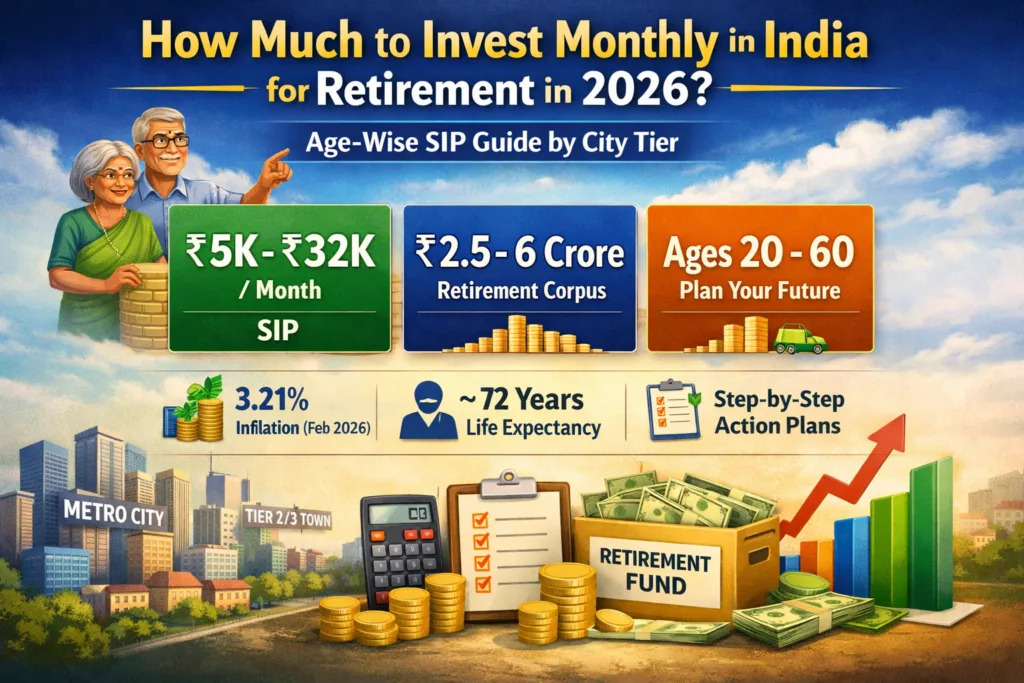

Imagine waking up on a Tuesday morning — no alarm, no office commute, no quarterly targets breathing down your neck. Instead, you brew a cup of filter coffee, step onto your balcony in Coorg, and check your investment portfolio that is quietly funding your life. This is the essence of FIRE — Financial Independence, Retire Early — and it is no longer just an American concept. It is rapidly becoming the most aspirational financial movement in urban India.
But here is where most people get stuck: Which type of FIRE should you aim for? Should you retire on ₹30,000 a month in a quiet Tier-2 city (Lean FIRE), or should you build a war chest large enough to fund business-class holidays, premium healthcare, and your children’s foreign education (Fat FIRE)?
This guide answers that question — completely, honestly, and with numbers that make sense in the Indian context. We will walk through real-life examples, corpus calculations, investment strategies, tax implications, and help you decide which path is right for your life goals. And if you want to model your own numbers, the Multi-Goal FIRE Planner for India is the most India-specific tool available online today.
What is the FIRE Movement? (India Context)
FIRE stands for Financial Independence, Retire Early. The core idea is deceptively simple: accumulate enough wealth so that your passive investment returns can fund your lifestyle indefinitely — without you ever needing to work again.
The movement originated in the United States in the 1990s with Vicki Robin’s book Your Money or Your Life, but it has found extraordinary resonance in India over the last decade. The reasons are uniquely Indian:
- High savings culture: Indian households have one of the highest savings rates in the world, historically averaging 30–35% of income.
- Geographic arbitrage: The cost differential between metros like Mumbai or Bengaluru and Tier-2/3 cities like Mysuru, Pondicherry, or Dehradun is enormous — often 50–60% cheaper.
- Joint family support: Many Indians can rely on family networks for emotional support and reduced housing costs in retirement.
- Growing equity markets: Indian equities (Nifty 50) have delivered approximately 12–14% CAGR over 20-year rolling periods, making long-term wealth creation very achievable.
- Burnout among urban professionals: Gruelling work cultures in IT, finance, and consulting are pushing high earners to question the 9-to-60 trajectory.
At its core, FIRE requires you to answer one question: How much money do I need so my investments can pay my bills forever? The answer depends entirely on what your bills look like — and that is where Lean FIRE and Fat FIRE diverge dramatically.
💡 Pro Tip: Before reading further, open the Multi-Goal FIRE Planner for India in a new tab and enter your current expenses. It will give you both your Lean FIRE and Fat FIRE numbers instantly.
Understanding Lean FIRE in India
What is Lean FIRE?
Lean FIRE is early retirement on a deliberately minimalist budget. You consciously strip your lifestyle down to essentials — comfortable, but not lavish. The philosophy is rooted in the belief that time and freedom are more valuable than luxury. You are trading some material comfort for years of freedom.
In the Indian context, a Lean FIRE lifestyle typically involves:
- Living in a Tier-2 or Tier-3 city (Coimbatore, Mysuru, Jaipur, Nashik, Thrissur)
- Owning your home (or living in a very affordable rented flat)
- Cooking at home, minimal eating out
- Domestic travel, not international holidays every year
- A reliable second-hand car or good public transport
- Government schools or mid-range private schools for children
- Basic but sufficient health insurance (₹10–15 lakh family floater)
Lean FIRE Numbers: What Do You Actually Need?
The widely used rule is the 25x rule: multiply your annual expenses by 25 to get your FIRE corpus. This corresponds to a 4% annual withdrawal rate — a number derived from long-term market data suggesting a portfolio can sustain this withdrawal rate indefinitely.
For India, many planners prefer a slightly more conservative 30x to 33x multiple, given India’s higher inflation (5–7% vs 2–3% in the US) and the fact that Indian market return data over 30+ year periods is less established.
A Lean FIRE budget for a family of three in a Tier-2 Indian city (monthly):
| Expense Category | Monthly Amount |
|---|---|
| Housing (own home — zero rent; or ₹8,000 rent) | ₹0 – ₹8,000 |
| Groceries and food (home cooking) | ₹8,000 – ₹10,000 |
| Utilities (electricity, gas, internet, water) | ₹3,000 – ₹4,000 |
| Transportation (public + one scooter) | ₹2,000 – ₹3,500 |
| Health insurance premium | ₹3,000 – ₹4,000 |
| Education (mid-range private school) | ₹5,000 – ₹8,000 |
| Personal care, clothing, misc | ₹2,000 – ₹3,000 |
| Entertainment and dining out (occasional) | ₹2,000 – ₹3,000 |
| Annual travel (domestic x2 per year / 12) | ₹2,500 – ₹4,000 |
| Emergency fund buffer | ₹2,000 |
| TOTAL MONTHLY | ₹29,500 – ₹49,500 |
Let us take a round figure of ₹40,000/month = ₹4.8 lakh/year as a typical Lean FIRE budget.
Lean FIRE corpus calculation (at age 40 retirement, planning to live to 85):
- Annual expenses today: ₹4.8 lakh
- Using 25x rule: ₹4.8L × 25 = ₹1.2 crore
- Using 30x (more conservative): ₹4.8L × 30 = ₹1.44 crore
- If inflating expenses at 6% over 10 years to retirement age: ~₹8.6 lakh/year needed at retirement
- Revised corpus (30x future expenses): ₹8.6L × 30 = ₹2.58 crore
So a realistic Lean FIRE corpus for a family in a Tier-2 city, retiring at 40–45, is ₹1.5 crore to ₹2.5 crore depending on inflation assumptions and lifestyle choices.
Want to see your own Lean FIRE number? The Multi-Goal FIRE Planner for India lets you input your exact expenses and retirement age to get your personalised corpus target.
Understanding Fat FIRE in India
What is Fat FIRE?
Fat FIRE is early retirement with zero lifestyle compromise — and often with a lifestyle upgrade. You retire early, but you retire well. International holidays, premium healthcare, club memberships, business-class flights, children’s education abroad, household help, restaurant dinners twice a week — all of it stays in the picture.
Fat FIRE is the path most corporate CXOs, serial entrepreneurs, and high-earning professionals in India secretly aspire to. It requires a much larger corpus but gives you genuine peace of mind that you will never run out of money — even if markets underperform for a decade.
Fat FIRE Numbers: What Do You Actually Need?
The Fat FIRE corpus is typically calculated at 40x to 50x annual expenses, implying a safer 2–2.5% withdrawal rate. This lower withdrawal rate creates a massive buffer against inflation spikes, medical emergencies, market downturns, and lifestyle creep over a 40–50 year retirement period.
A Fat FIRE budget for a family of three in a Metro Indian city (monthly):
| Expense Category | Monthly Amount |
|---|---|
| Housing (premium apartment or owned home, maintenance) | ₹20,000 – ₹30,000 |
| Groceries, dining, home cook/chef | ₹25,000 – ₹35,000 |
| Utilities and premium internet/OTT | ₹8,000 – ₹10,000 |
| Transportation (car EMI/fuel or leased luxury car) | ₹20,000 – ₹30,000 |
| Super top-up + family health insurance | ₹12,000 – ₹18,000 |
| Children’s international/premium school | ₹25,000 – ₹50,000 |
| Household help (cook, driver, cleaner) | ₹15,000 – ₹20,000 |
| Personal care, shopping, clothes | ₹10,000 – ₹20,000 |
| Travel (2 international + domestic per year / 12) | ₹15,000 – ₹25,000 |
| Entertainment, clubs, hobbies | ₹10,000 – ₹15,000 |
| Miscellaneous buffer | ₹10,000 – ₹15,000 |
| TOTAL MONTHLY | ₹1.7 lakh – ₹2.7 lakh |
Let us use ₹2 lakh/month = ₹24 lakh/year as a typical Fat FIRE budget.
Fat FIRE corpus calculation (retiring at 45, planning to live to 85):
- Annual expenses today: ₹24 lakh
- Inflated at 6% over 15 years to retirement age: ~₹57.6 lakh/year
- Using 40x rule: ₹57.6L × 40 = ₹23 crore
- Using 33x (moderate): ₹57.6L × 33 = ₹19 crore
A realistic Fat FIRE corpus for a metro family in India is ₹10 crore to ₹25 crore depending on current expenses, retirement age, and inflation assumptions.
These numbers sound daunting, but they are achievable for dual-income IT couples, senior executives, business owners, and high-earning professionals who start early and invest aggressively. Use the Multi-Goal FIRE Planner for India to calculate exactly when you can hit your Fat FIRE number given your current savings and investment rate.
Lean FIRE vs Fat FIRE: Head-to-Head Comparison
| Parameter | Lean FIRE | Fat FIRE |
|---|---|---|
| Monthly Expenses | ₹20,000 – ₹50,000 | ₹1.5 lakh – ₹3+ lakh |
| Required Corpus | ₹60 lakh – ₹2.5 crore | ₹8 crore – ₹25 crore+ |
| Corpus Multiple Used | 25x – 30x annual expenses | 40x – 50x annual expenses |
| Years to Achieve | 8 – 15 years (from age 25) | 15 – 25 years (from age 25) |
| Lifestyle | Minimalist, frugal, intentional | Comfortable, premium, no compromise |
| Location | Tier-2/3 city or rural India | Metro or premium suburb |
| Travel | Domestic travel, rare international | Annual international travel |
| Healthcare | Family floater ₹10–15 lakh | Super top-up + floater ₹1–2 crore |
| Children’s Education | Government or mid-range private schools | Premium private or international schools |
| Stress Level | Higher (margin of safety is thin) | Lower (large buffer absorbs shocks) |
| Who It Suits | Minimalists, single/childless, already in Tier-2 | Families, metro dwellers, lifestyle-conscious |
| Withdrawal Rate | 3.5% – 4% | 2% – 2.5% |
| Biggest Risk | Medical emergency, inflation spike | Market crash at retirement; corpus depletion |
| Flexibility Post-FIRE | Very low (no room for lifestyle upgrades) | Very high (can upgrade or donate surplus) |
Real-Life Indian Examples: Lean FIRE Stories
Example 1: Rohan and Priya — The IT Couple from Pune Who FIRE’d at 42
Rohan (software engineer) and Priya (UX designer) lived in Pune earning a combined ₹3.2 lakh per month. They had one child and were spending ₹1.4 lakh a month. They read about the FIRE movement in 2016 and made a radical decision: cut lifestyle expenses, invest aggressively, and retire at 42.
Their plan:
- Reduced monthly expenses to ₹75,000 by eliminating subscriptions, eating out twice (not 10 times) a month, and buying a used car instead of a new SUV
- Invested ₹2 lakh/month via SIPs in equity mutual funds (Nifty 50 index + mid-cap)
- Bought a 3BHK flat in Nashik (Tier-2 city) for ₹55 lakh in 2018 — paid off by 2023
- Built a corpus of ₹2.8 crore by age 42
- Moved to Nashik where their monthly expenses dropped to ₹38,000/month
Their Lean FIRE math:
- Monthly expenses in Nashik: ₹38,000 → Annual: ₹4.56 lakh
- Corpus needed at 30x: ₹4.56L × 30 = ₹1.37 crore
- Actual corpus built: ₹2.8 crore (gives them a cushion for their son’s higher education)
- Investment returns at 8% post-FIRE: ₹22.4 lakh/year → withdrawing ₹4.56 lakh → surplus reinvested
Rohan now writes open-source code for passion projects. Priya teaches design workshops online for ₹15,000–20,000/month — not because she needs to, but because she enjoys it. Their Lean FIRE is working beautifully — but only because they owned their home and chose a low-cost city.
Key Lean FIRE Lesson: Geographic arbitrage is the single biggest lever in Indian Lean FIRE. Moving from Pune to Nashik saved this couple ₹37,000/month — reducing their required corpus by over ₹1 crore.
Example 2: Ananya — The Solo Woman Who FIRE’d at 38 in Pondicherry
Ananya was a UX researcher earning ₹1.8 lakh/month working for a Singapore-based firm remotely from Bengaluru. Single, no dependents, deeply intentional about money. She set her Lean FIRE target at ₹1.2 crore and retired to Pondicherry at 38.
Her monthly budget in Pondicherry:
- Rent (1BHK near the beach): ₹9,000
- Food: ₹6,000
- Travel, entertainment: ₹5,000
- Health insurance: ₹2,500
- Miscellaneous: ₹3,000
- Total: ₹25,500/month
With a corpus of ₹1.3 crore invested in a mix of equity mutual funds (70%) and debt (30%), her portfolio generates approximately ₹9–10 lakh/year at 7.5% blended return. She withdraws ₹3.06 lakh/year — a 2.35% withdrawal rate. Her corpus is actually growing, not depleting.
She runs a small blog about slow living that earns ₹8,000–12,000/month via affiliate commissions — income she never planned on but happily accepts. This is textbook Lean FIRE, and for her lifestyle, it is perfect.
Example 3: Vijay — The Teacher Who Used Lean FIRE Differently
Vijay was a school principal in Ahmedabad earning ₹85,000/month. Not a tech salary by any means. He FIRE’d at 55 (not 40, but still 5 years early) with a corpus of ₹90 lakh — modest by FIRE standards, but enough for his lifestyle in Rajkot where he moved with his wife.
Their joint pension from Vijay’s wife (a government employee) of ₹28,000/month covers 70% of their expenses. The ₹90 lakh corpus provides the remaining income and a buffer for medical costs. This is Lean FIRE built on a teacher’s salary — proof that high income is not a prerequisite.
Real-Life Indian Examples: Fat FIRE Stories
Example 1: Sanjay — The IIT-IIM Product Manager Who FIRE’d at 44 with ₹15 Crore
Sanjay worked at a top-tier tech company earning ₹1.2 crore/year (including ESOPs). He lived in Bengaluru with his family of four — wife, two kids in an international school. His monthly expenses were ₹2.5 lakh.
His Fat FIRE journey:
- Started FIRE planning at 32 with ₹15 lakh corpus
- Invested ₹4–5 lakh/month consistently for 12 years via SIPs, index funds, and direct equity
- His ESOP vesting from three companies added ₹4.2 crore to his corpus
- Built ₹15 crore corpus by age 44
His Fat FIRE math:
- Annual expenses: ₹30 lakh (₹2.5 lakh/month)
- Corpus: ₹15 crore
- Withdrawal rate: ₹30L ÷ ₹1500L = 2% — extremely sustainable
- At 8% return: ₹1.2 crore/year income → spending ₹30 lakh → surplus ₹90 lakh reinvested annually
Sanjay continues to stay in Bengaluru (no geographic arbitrage needed), sends his kids to an international school, holidays in Europe twice a year, and drives a premium car. His Fat FIRE corpus gives him absolute peace of mind. He consults for 2–3 startups for ₹2–3 lakh/month — again, not out of necessity, but because he enjoys staying sharp.
Fat FIRE Key Insight: ESOPs and windfall events (business sale, inheritance, property appreciation) are often the accelerator that takes people from “almost there” to Fat FIRE much faster than linear savings would allow.
Example 2: Deepa and Rakesh — The NRI Couple Who Returned to India for Fat FIRE
Deepa (doctor) and Rakesh (finance professional) lived in Dubai for 14 years. They saved aggressively in USD, invested in Indian equity mutual funds via NRI accounts, and owned two properties in Hyderabad. They returned to India at 48 with ₹22 crore — a textbook Fat FIRE scenario enabled by geographic arbitrage in reverse (earning in USD, retiring in India).
Their Fat FIRE setup in Hyderabad:
- Live in their own 4BHK apartment (₹2.8 crore market value — zero rent)
- Monthly expenses: ₹2.2 lakh
- One property rented out at ₹45,000/month (passive income)
- Portfolio at ₹22 crore generating ~₹1.76 crore/year at 8%
- Annual withdrawal: ₹26.4 lakh
- Effective withdrawal rate: 1.2% — the corpus will compound to well over ₹40 crore by age 70
Deepa practices medicine 3 days a week at a private hospital not because she must, but because she loves patient care. Rakesh angel invests in startups. This is Fat FIRE at its most elegant — abundance, freedom, and continued purpose.
Example 3: The 35-Year-Old Startup Founder Who FIRE’d Post-Exit
Karthik co-founded a SaaS startup at 27. At 34, the company was acquired for ₹45 crore — his post-tax share was approximately ₹18 crore after capital gains tax. He FIRE’d immediately.
His strategy was to invest ₹15 crore across equity (50%), debt (30%), and real estate (20%), keeping ₹3 crore as a liquid buffer. His conservative portfolio generates ₹75–90 lakh/year. He spends ₹35–40 lakh a year — giving his family a genuinely luxurious life. He has also started angel investing, finding it intellectually stimulating without the pressure of running a company again.
Key Fat FIRE Lesson: Business exits, ESOPs, and property sales are not predictable — but for those who experience them, they can compress a 20-year FIRE journey into one event. Having a FIRE plan in place before the windfall ensures the money gets invested intelligently rather than squandered.
The Mathematics: How to Calculate Your FIRE Number in India
Step 1: Calculate Your Annual Expenses
Track every rupee you spend for 3 months, then annualise. Be honest — include everything from school fees to the annual family vacation to the occasional gadget purchase.
Step 2: Decide Your Retirement Age and Life Expectancy
For Indian planning, assume life expectancy of 85–90 years. India’s life expectancy is rising rapidly. If you retire at 40, you need your money to last 45–50 years — not 20.
Step 3: Account for Inflation
India’s CPI inflation has averaged 5.5–6.5% over the last 15 years. Medical inflation in India runs even higher at 10–15% annually. Use 6–7% inflation for expense projections.
Formula to find future annual expenses at retirement:
Future Expenses = Current Annual Expenses × (1 + Inflation Rate)^(Years to Retirement)
Example: Current expenses ₹6 lakh/year, 15 years to retirement, 6% inflation:
₹6 lakh × (1.06)^15 = ₹6 lakh × 2.397 = ₹14.38 lakh/year at retirement
Step 4: Apply the Multiplier
| FIRE Type | Multiplier | Withdrawal Rate | Safety Level |
|---|---|---|---|
| Lean FIRE | 25x | 4% | Moderate (some risk in bad markets) |
| Standard FIRE | 30x–33x | 3–3.3% | Good |
| Fat FIRE | 40x–50x | 2–2.5% | Very High |
Continuing the example:
- Future annual expenses: ₹14.38 lakh
- Lean FIRE corpus: ₹14.38L × 25 = ₹3.6 crore
- Standard FIRE corpus: ₹14.38L × 30 = ₹4.3 crore
- Fat FIRE corpus: ₹14.38L × 40 = ₹5.75 crore
Step 5: Factor in Your Existing Corpus
If you already have ₹50 lakh invested today, calculate its future value at retirement:
Future Value = ₹50L × (1.12)^15 = ₹50L × 5.47 = ₹2.74 crore (assuming 12% equity returns)
Remaining corpus to build: ₹4.3 crore − ₹2.74 crore = ₹1.56 crore more to accumulate via SIPs
The Multi-Goal FIRE Planner for India does all of this automatically — including multi-goal tracking (children’s education, home purchase, and FIRE in one unified view). It is the most comprehensive India-specific FIRE planning tool available online.
Investment Strategies to Achieve Lean FIRE in India
Since Lean FIRE targets a smaller corpus, the emphasis is on reaching the target quickly — which means high savings rate + aggressive equity allocation.
The Lean FIRE Investment Blueprint
Phase 1: Accumulation (Age 25–40)
- Equity Mutual Funds (70–80%): Nifty 50 Index Fund, Nifty Next 50, Flexi-Cap funds. Equity gives the highest long-term returns (12–14% CAGR historically). SIPs in these funds are the backbone.
- PPF (10–15%): Risk-free, tax-free returns at 7.1%. Max ₹1.5 lakh/year. Essential for debt portion of a Lean FIRE portfolio.
- NPS (5–10%): Additional tax deduction under 80CCD(1B) of ₹50,000. Equity-heavy NPS can deliver 10–11% returns.
- Emergency Fund (3–6 months expenses): Keep in a liquid mutual fund or high-yield savings account. Never touch this for investments.
Phase 2: Post-FIRE Portfolio (Age 40–85)
- Equity (50–60%): Continue to hold equity for growth to beat inflation over a 45-year retirement.
- Debt (30–40%): RBI Floating Rate Bonds, Debt Mutual Funds, Senior Citizen Savings Scheme (at 60+).
- Liquid Buffer (10%): 2 years of expenses in ultra-short-term funds for withdrawals. Prevents you from selling equity in a crash.
- SWP (Systematic Withdrawal Plan): Set up a monthly SWP from debt funds for tax-efficient income post-FIRE.
Lean FIRE Savings Rate Target
To FIRE in 10 years from your mid-30s, you typically need a savings rate of 50–60% of take-home income. This sounds extreme but is achievable with geographic arbitrage, a paid-off home, and intentional lifestyle choices.
Investment Strategies to Achieve Fat FIRE in India
Fat FIRE requires a larger corpus, which means the strategy is less about frugality and more about wealth acceleration — maximising income growth, asset diversification, and tax efficiency.
The Fat FIRE Investment Blueprint
Phase 1: Aggressive Accumulation (Age 25–45)
- Equity Mutual Funds + Direct Equity (50–60%): Focus on quality large-cap and mid-cap funds. Consider direct equity in fundamentally strong businesses for alpha generation.
- ESOPs and RSUs: If you work in tech or a growth company, systematically vest and sell ESOPs and diversify into mutual funds. Many Fat FIRE stories in India are primarily ESOP stories.
- Real Estate (15–20%): One or two quality rental properties can provide passive income and hedge against inflation. Focus on metros with strong rental yields (Bengaluru, Pune, Hyderabad).
- PPF + ELSS + NPS (10%): Maximise all tax-saving instruments. The saved tax is investable capital.
- Startups / Angel Investing (5%): High risk, but a single 10x return can catapult your timeline. Only invest what you can afford to lose entirely.
Phase 2: Fat FIRE Post-Retirement Portfolio
- Equity (55–65%): At Fat FIRE levels, your corpus is large enough that even a 40% market crash does not threaten your lifestyle. Stay heavily in equity for long-term compounding.
- Debt (25–30%): Bonds, debt funds, FD ladders for predictable income.
- Real Estate Rental Income: If properties are owned, rental yield provides a floor of passive income independent of market volatility.
- International Diversification: Consider US ETFs via the LRS route (up to $250,000/year). Global diversification protects against INR depreciation and India-specific risks.
- Health Insurance: A comprehensive super top-up (₹1–2 crore coverage) is non-negotiable. Fat FIRE can be destroyed by catastrophic medical bills without insurance.
Tax Efficiency in Fat FIRE
At high corpus levels, tax efficiency becomes critical:
- LTCG on equity above ₹1.25 lakh/year is taxed at 12.5%. Structure withdrawals to stay near this threshold where possible.
- Use the basic exemption limit effectively — withdraw from multiple family members’ accounts.
- Debt fund taxation (STCG at slab rates, no indexation benefit post-2023 changes) — prefer equity for long-term holding periods.
- Consider HUF (Hindu Undivided Family) structures for tax splitting at high corpus levels — consult a CA.
Key Risks: What Can Go Wrong?
Lean FIRE Risks
- Medical Emergencies: A single cancer diagnosis or cardiac event can cost ₹15–50 lakh. With a ₹1.5 crore corpus, this wipes out 10–30% of your nest egg. Solution: Robust health insurance of ₹25–50 lakh, including a super top-up.
- Sequence of Returns Risk: If markets crash in year 1 of your FIRE, and you sell units to fund expenses, your depleted corpus may never fully recover. Solution: Keep 2–3 years of expenses in liquid/debt funds as a buffer.
- Lifestyle Creep: The temptation to slowly upgrade lifestyle — better phone, occasional five-star stay, kids wanting premium gear — can erode a lean budget over time. Solution: Annual expense review and strong financial discipline.
- Inflation Surprises: India’s inflation history shows occasional spikes (food, fuel, education costs). A lean budget has almost no room to absorb a 10% inflation year. Solution: Maintain 10–15% equity in portfolio even post-FIRE for growth above inflation.
- Longevity Risk: What if you live to 95? A 25x corpus calculated for 40 years may run dry by year 42. Solution: Use 30x minimum; prefer 33x for safety.
Fat FIRE Risks
- Large Corpus = Large Volatility: A 20% market crash on a ₹20 crore corpus means ₹4 crore gone on paper in months. Psychologically difficult even if the math says wait it out. Solution: Asset allocation with meaningful debt allocation.
- Wealth Erosion via Wrong Advice: Large corpora attract bad investment advice — from churning insurance-cum-investment products to unregistered advisors pitching guaranteed 18% returns. Solution: Work only with SEBI-registered fee-only advisors.
- Children and Lifestyle Expectations: Fat FIRE families often face the challenge of children accustomed to premium living who have unrealistic financial expectations. Solution: Financial literacy conversations with children from early on.
- Loss of Purpose: After the initial honeymoon of freedom, many Fat FIRE retirees report boredom and existential drift. Research shows that purposeful work is critical to wellbeing. Solution: Define your “why” before pulling the FIRE trigger — hobbies, volunteering, consulting, passion projects.
Which One is Better — Lean FIRE or Fat FIRE?
The honest answer: neither is universally better. The right one is whichever aligns with your values, circumstances, and life vision.
However, if pushed for a practical recommendation for most Indian professionals in their 30s and 40s, here is a nuanced view:
Choose Lean FIRE if:
- You genuinely value simplicity and find joy in minimal consumption
- You are single or have a partner who shares the minimalist philosophy
- You are already comfortable living in or relocating to a Tier-2/3 city
- You have no dependents with significant future financial needs (aging parents, children’s foreign education)
- Freedom at 35 means more to you than a luxurious life at 45
- You plan to earn some supplemental income post-FIRE (which makes Lean FIRE more robust)
Choose Fat FIRE if:
- You have children whose education, lifestyle, and opportunities you want to fund fully
- You love to travel internationally and eat well — and these are genuine sources of joy, not just habits
- You want to live in a metro city without financial anxiety
- Peace of mind and margin of safety matter deeply to you
- You are on a high-income trajectory (₹40 lakh+ per year) and can realistically achieve Fat FIRE numbers
- You want to leave a meaningful financial legacy for children or charity
The Case for Standard FIRE (The Pragmatic Middle)
For most Indian dual-income urban families, the best answer is often Standard FIRE — a corpus of 30–35x annual expenses that allows a comfortable (not lavish) lifestyle without extreme frugality. This means:
- Monthly expenses of ₹80,000 – ₹1.2 lakh for a family of three/four
- Required corpus: ₹3–6 crore depending on age and city
- Achievable for a couple earning ₹25–50 lakh combined, starting at 28–30
The Multi-Goal FIRE Planner for India lets you model Standard FIRE, Lean FIRE, and Fat FIRE side by side — showing you exactly how many more years each option requires and what monthly SIP you need for each. It is perhaps the most practical decision-making tool for someone on the fence between these two paths.
The Middle Path: Standard FIRE and Barista FIRE
Barista FIRE — The Smart Bridge Strategy
Barista FIRE (named after the idea of working a low-stress barista job post-FIRE for supplemental income) is an increasingly popular strategy in India. It works like this:
- You build a corpus smaller than your full FIRE number (say, 20x annual expenses instead of 30x)
- You quit your stressful corporate job
- You work part-time, consult, or freelance for ₹20,000–50,000/month
- This supplemental income covers a significant chunk of expenses, allowing your corpus to keep compounding
- After 3–5 years, you transition to full FIRE
Why Barista FIRE makes enormous sense in India:
- Skills built over a corporate career (consulting, teaching, design, coaching) can easily monetise at ₹20–60K/month with minimal effort
- Even ₹25,000/month of income reduces your required corpus by ₹75 lakh (25x × ₹3 lakh/year)
- It gives you a psychological safety net while your corpus matures
- The Indian gig economy (freelancing platforms, consulting networks, YouTube, digital courses) has never been more viable for Barista FIRE
Using the Multi-Goal FIRE Planner for India
One of the biggest gaps in Indian FIRE planning is that most calculators treat FIRE as a single isolated goal. In reality, most Indian families are simultaneously planning for:
- Children’s higher education (10–18 years away)
- Children’s marriage expenses
- Home purchase or upgrade
- Aging parents’ healthcare
- Their own FIRE date
The Multi-Goal FIRE Planner for India is specifically designed for this reality. Unlike generic FIRE calculators, it allows you to:
- Input multiple financial goals simultaneously with different timelines
- See how each goal affects your FIRE date
- Model Lean FIRE vs Fat FIRE scenarios side by side
- Account for India-specific inflation rates, tax laws, and investment options
- Calculate the exact monthly SIP needed across all goals
If you are serious about FIRE planning in India, this should be your first and most frequently revisited tool. Most Indian families discover — upon proper multi-goal planning — that their FIRE date is either earlier than they thought (if they plan well) or that they have been dangerously underfunding key goals like their children’s education while overfunding others.
FAQs — Lean FIRE vs Fat FIRE India
What is the minimum corpus for Lean FIRE in India?
The minimum realistic corpus for Lean FIRE in India depends heavily on your location and lifestyle. For a single person in a Tier-2 city with expenses of ₹20,000–25,000/month, a corpus of ₹60 lakh to ₹90 lakh using the 25x rule may suffice. For a family of three with ₹40,000/month in expenses in a Tier-2 city, ₹1.2 crore to ₹1.5 crore is a reasonable minimum. These numbers assume a paid-off home and comprehensive health insurance. Without your own property, add at least ₹40–60 lakh to these figures.
What is the minimum corpus for Fat FIRE in India?
Fat FIRE in India generally starts at ₹5–6 crore for a family with modest metro expenses and goes up to ₹25 crore+ for premium lifestyles. A practical minimum for a Bengaluru or Mumbai family spending ₹1.5 lakh/month would be approximately ₹8–9 crore (using the 40x multiplier on inflation-adjusted expenses). Below ₹5 crore, you are more in the Standard FIRE territory rather than true Fat FIRE.
What is the 4% rule and does it work in India?
The 4% rule (withdraw 4% of your corpus annually; this equals a 25x corpus requirement) was derived from US market data by William Bengen in 1994. In India, its applicability is debated. India’s inflation has historically been higher (5–7%) than the US (2–3%), and while Indian equity returns are also higher (12–14% vs 7–10%), the data for Indian markets over 40+ year retirement periods is limited. Most Indian financial planners recommend using a more conservative 3% to 3.3% withdrawal rate (30x–33x multiplier) for safety, especially for long retirements starting before age 45.
Which is better — Lean FIRE or Fat FIRE for a family with kids in India?
For families with children, Fat FIRE or at minimum Standard FIRE is strongly recommended. Children’s education costs in India are rising at 10–12% per year. Premium engineering/medical colleges cost ₹20–40 lakh for 4 years today; foreign university education costs ₹80 lakh to ₹2 crore. These costs can devastate a Lean FIRE corpus. If you have children who are young, your FIRE planning must include separate, dedicated education goal funds — and the Multi-Goal FIRE Planner for India is specifically designed to model these goals alongside your FIRE target.
Can I achieve Lean FIRE on a salary of ₹50,000/month?
Yes, but it requires extraordinary discipline and patience. On ₹50,000/month take-home, achieving a savings rate of 40–50% (₹20,000–25,000/month) is challenging but possible if you live at home with family, have minimal fixed expenses, and no EMIs. At ₹20,000/month SIP in Nifty 50 Index Fund, you would accumulate approximately ₹1.2 crore in 17 years at 12% CAGR — enough for a very frugal Lean FIRE in a low-cost city. However, this timeline also assumes your salary increases and savings grow over time.
What savings rate is needed for Lean FIRE vs Fat FIRE?
Lean FIRE typically requires a savings rate of 40–60% of net take-home income and can be achieved in 10–15 years. Fat FIRE requires a savings rate of 50–70% from a much higher income base (₹80 lakh+ combined household income for metropolitan Fat FIRE) and typically takes 18–25 years. The key insight: Fat FIRE isn’t just about saving more — it is about growing your income significantly over time so that even at the same savings rate percentage, the absolute rupee amount invested is much larger.
How does healthcare factor into Lean FIRE vs Fat FIRE planning?
Healthcare is arguably the single biggest risk factor in any FIRE plan in India. Medical inflation runs at 10–15% annually. For Lean FIRE, the minimum acceptable health insurance is a ₹15–25 lakh family floater with a ₹50 lakh super top-up — total cost of ₹3,000–5,000/month. For Fat FIRE, a comprehensive ₹1–2 crore coverage with critical illness riders and a dedicated medical emergency corpus of ₹15–20 lakh is essential. Never underestimate healthcare costs in a long retirement — the last 10 years often cost more than the first 30.
Is real estate a good investment for reaching FIRE in India?
Real estate plays a specific but limited role in FIRE planning. Owning your home (zero rent post-FIRE) is extremely valuable — it effectively reduces your required corpus by 20–30%. Beyond that, rental properties can provide passive income, but yields in Indian metros are low (2–3% gross). Real estate also lacks liquidity — you cannot “withdraw” ₹2 lakh from a flat in a market downturn. For FIRE portfolio building, equity mutual funds should be the primary vehicle, with real estate as a supplementary component. Never include your primary residence in your FIRE corpus calculation.
What are the biggest mistakes in Lean FIRE planning in India?
The five most common Lean FIRE mistakes in India are: (1) Underestimating healthcare costs; (2) Not accounting for inflation adequately — especially education and medical inflation; (3) Including home value in FIRE corpus; (4) Not planning for aging parents’ healthcare (many Indians informally support parents well into retirement); (5) Using too aggressive a withdrawal rate (4%+) without a buffer. A Lean FIRE failure is not just uncomfortable — it means having to re-enter the workforce at 50+, which can be very difficult psychologically and practically.
Can a government employee achieve FIRE in India?
Yes — and often more easily than a private sector employee, because of one word: pension. A government employee with a defined benefit pension of ₹30,000–50,000/month in retirement effectively has a pre-built Lean FIRE income stream (the pension alone covers much of the corpus function). By building even a modest SIP corpus of ₹50–75 lakh alongside their pension, many government employees can achieve a comfortable Standard FIRE at 55–58 with very little financial stress. The NPS (for newer government employees) is less generous than the old pension scheme but still provides a meaningful foundation.
What is the role of PPF in FIRE planning?
PPF (Public Provident Fund) is an excellent instrument for the debt portion of a FIRE portfolio. It offers 7.1% tax-free returns, EEE (Exempt-Exempt-Exempt) tax status — meaning contributions, interest, and maturity amount are all tax-free. Maximum ₹1.5 lakh/year, 15-year lock-in (extendable in 5-year blocks). For Lean FIRE, PPF can form the backbone of the debt allocation. For Fat FIRE at high corpus levels, PPF’s contribution is relatively small, but its tax efficiency makes it a must-have for anyone building toward FIRE.
How does geographic arbitrage work in Indian FIRE planning?
Geographic arbitrage — earning in a high-cost city and retiring in a low-cost one — is one of the most powerful Lean FIRE tools in India. Consider: a family spending ₹1.2 lakh/month in Mumbai might spend only ₹45,000/month in Mysuru, Nashik, Thrissur, or Pondicherry. This 62% reduction in expenses means they need 62% less corpus to FIRE. They could retire 8–10 years earlier by simply relocating. The challenge is social (family, friends, identity) and professional (often one needs to be location-agnostic or retired first). But for those willing, it is the most mathematically powerful FIRE lever available in India.
What is Coast FIRE, and how does it relate to Lean and Fat FIRE?
Coast FIRE is a milestone rather than a final destination. You have achieved Coast FIRE when your existing corpus, left untouched, will grow to your full FIRE number by your planned retirement age — without any additional contributions. At this point, you only need to earn enough to cover current living expenses (no more heavy investing required). Many Indians unknowingly hit Coast FIRE in their late 30s if they started investing diligently at 25. Coast FIRE is relevant to both Lean and Fat FIRE — the difference is just the final target size.
How should I invest ₹1 crore as a lump sum for FIRE?
A ₹1 crore lump sum windfall (ESOP vesting, property sale, bonus, etc.) should be handled carefully. Do not invest it all at once in equity during market peaks. Use Systematic Transfer Plans (STPs): park the entire amount in a liquid or ultra-short-term fund, then transfer ₹5–8 lakh/month into your chosen equity funds over 12–18 months. This reduces timing risk. Allocate approximately 70–75% to equity (large-cap index + mid-cap fund), 15–20% to debt (RBI bonds, PPF top-up), and 5–10% to liquid buffer. Avoid complex products — simple is sustainable for FIRE.
What is a realistic FIRE age for an Indian IT professional?
For a dual-income IT couple in Bengaluru earning ₹50–80 lakh combined in their late 20s, who invest aggressively, Standard FIRE at age 42–48 is a realistic and increasingly common target. Lean FIRE can be achieved at 38–42, and Fat FIRE at 48–55 depending on ESOP outcomes and income growth trajectory. The single biggest variable is not income level but savings rate. Many IT professionals earning ₹60 lakh/year who spend ₹50 lakh will achieve FIRE much later than a couple earning ₹40 lakh who live on ₹15 lakh and invest ₹25 lakh annually.
Do I need a financial advisor for FIRE planning?
For Lean FIRE with a corpus under ₹2 crore and a simple portfolio (index funds + PPF + NPS), you can likely self-manage with tools like the Multi-Goal FIRE Planner for India and basic financial literacy. For Fat FIRE with a corpus above ₹5 crore, involving real estate, ESOPs, complex tax planning, and multi-generational wealth considerations, a SEBI-registered fee-only financial planner is highly recommended. Avoid commission-based advisors at high corpus levels — their incentive to churn products can cost you lakhs annually in unnecessary fees and suboptimal products.
What happens if I FIRE too early and run out of money?
This is the nightmare scenario of FIRE — “one more year” syndrome’s fear — and it is valid. If markets severely underperform for a sustained decade (Japan in the 1990s, for example), a 4% withdrawal rate can deplete even a 25x corpus. Mitigation strategies include: maintaining Barista FIRE income for 3–5 years post-FIRE, using a conservative 3–3.3% withdrawal rate (30–33x corpus), maintaining an emergency buffer of 3 years’ expenses in debt, having flexibility to reduce expenses by 20–30% if needed, and annual portfolio reviews to adjust withdrawal rates. The critical mistake is FIRE-ing with exactly the minimum corpus and no margin for error.
Is ₹5 crore enough for Fat FIRE in India in 2025?
₹5 crore is enough for Fat FIRE today if your current annual expenses are ₹10–12.5 lakh (₹85,000–1 lakh/month) and you are retiring in a Tier-2 city with a paid-off home. In a metro with expenses of ₹1.5–2 lakh/month, ₹5 crore falls in the Standard FIRE range rather than true Fat FIRE. The answer also depends heavily on your age at retirement — ₹5 crore at 55 is very different from ₹5 crore at 40. Use the Multi-Goal FIRE Planner for India to see exactly how ₹5 crore works against your specific expense profile and retirement timeline.
How do NRIs use Lean FIRE and Fat FIRE strategies for India?
NRIs have a unique and powerful FIRE advantage: they earn in hard currencies (USD, AED, GBP) while planning to retire in India where costs are far lower. An NRI earning $150,000/year in the US who moves back to India can effectively achieve Fat FIRE in India with a corpus that would only support a bare-bones retirement in America. The NRI FIRE strategy typically involves: investing in Indian equity mutual funds via NRI accounts (HDFC, SBI Funds allow this), building a property asset base in India, maximising FCNR/NRE deposits for tax-free interest income, and planning the tax implications of both-country residency carefully. The Dubai-to-Hyderabad and Singapore-to-Bengaluru return FIRE stories are increasingly common.
Should I aim for Lean FIRE first and then upgrade to Fat FIRE?
This is actually an excellent strategy that many seasoned FIRE planners in India recommend. The approach: aim for Lean FIRE corpus first (achievable in 8–12 years), achieve it, quit your stressful job, do some Barista FIRE consulting or passion work, and let your corpus compound while you continue earning modestly. After another 5–8 years, your corpus may naturally grow to Standard or Fat FIRE territory without you needing to be in a high-pressure job at all. This “step-up FIRE” strategy allows you to exit the corporate grind earlier while giving your corpus time to grow — the best of both worlds. Start modelling this approach with the Multi-Goal FIRE Planner for India to see if your numbers support it.
Conclusion: Your FIRE Journey Starts with One Number
The Lean FIRE vs Fat FIRE debate is ultimately not about spreadsheets and corpus multiples — it is about one deeply personal question: What does your ideal life look like?
If freedom at 38 in a quiet beach town in Kerala, writing, gardening, and teaching yoga sounds like your version of paradise — Lean FIRE is your path. If freedom at 47 in Bengaluru, travelling to Japan twice a year, putting your children through IIM, and having a world-class home library sounds like your dream — Fat FIRE is your goal.
Neither is morally superior. Both require discipline, intentionality, and a willingness to make trade-offs that most people never even consider. The very act of calculating your FIRE number puts you in the top 1% of financially aware Indians.
Here is your action plan for today:
- Track your expenses meticulously for 30 days. Know your actual monthly burn rate.
- Open the Multi-Goal FIRE Planner for India and input your numbers. See your Lean and Fat FIRE timelines.
- Start a SIP today — even ₹5,000/month in a Nifty 50 Index Fund is the start of a FIRE journey.
- Get comprehensive health insurance immediately — it is non-negotiable for any FIRE plan.
- Review annually — your income grows, expenses change, and your FIRE plan must evolve with your life.
The fire of financial freedom is not lit by a single dramatic decision. It is a slow, deliberate burn — maintained by consistent savings, intelligent investing, and clarity of purpose. Start today. Your future self — sitting on that balcony, coffee in hand, completely free — is counting on you.
Disclaimer: This article is for educational and informational purposes only. It does not constitute personalised financial advice. Please consult a SEBI-registered financial advisor before making investment decisions. All corpus figures are illustrative and based on assumed rates of return and inflation — actual returns may vary.

Vishal Jhaveri is the founder of Wealthpedia and an MBA Finance professional with over 10 years of experience in financial planning, investing, and wealth creation. He specializes in FIRE (Financial Independence, Retire Early), retirement planning, investing, and personal finance education. Through Wealthpedia, he develops financial calculators and publishes evidence-based content to help Indian investors make informed financial decisions. He regularly reviews and updates Wealthpedia articles to reflect changes in tax, laws, investment regulations, and personal finance best practices.
Quick Wrap up