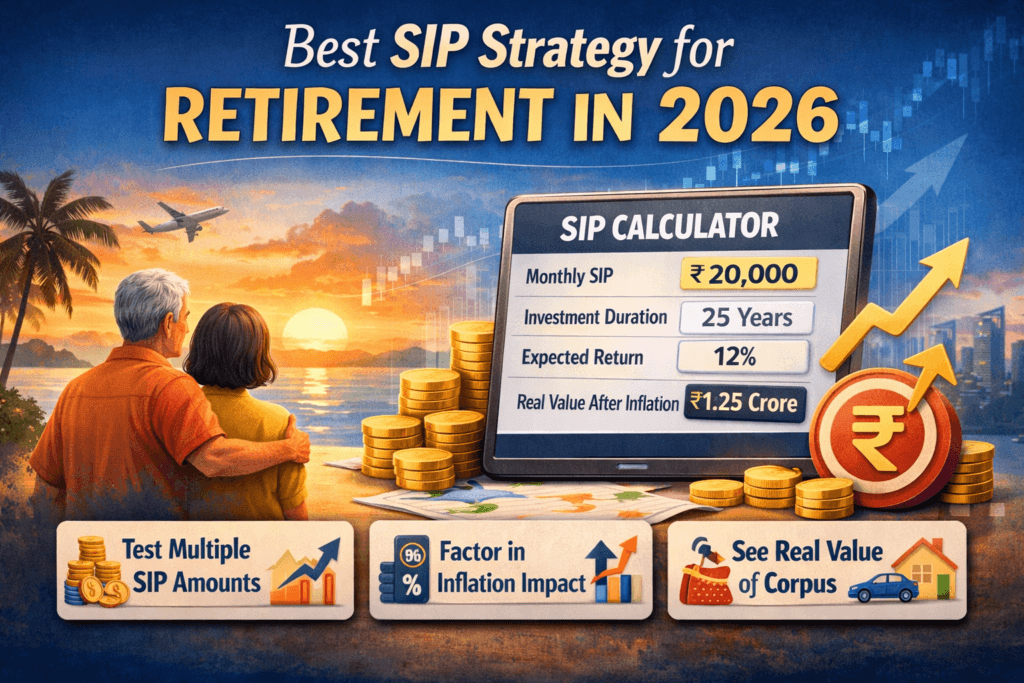
In today’s India, planning for a child’s education isn’t just about saving—it’s about outsmarting inflation that’s quietly doubling or tripling costs every decade. Parents in Ahmedabad, Mumbai, Delhi, or any Tier-1 or Tier-2 city know the drill: school fees that have jumped from ₹20,000 a decade ago to ₹2 lakh today, plus college dreams that now demand ₹20 lakh to ₹1 crore or more. If your child is 5–10 years away from higher education (or you’re starting fresh with a 10-15 year horizon), a Systematic Investment Plan (SIP) in mutual funds can turn modest monthly contributions into a powerful corpus.
This detailed guide breaks down exactly how much monthly SIP you need for your child’s education in 10 or 15 years. We’ll use real 2025-2026 data on current costs, realistic education inflation (8-10%), and conservative equity returns (12% p.a.). You’ll see side-by-side comparisons showing why doing nothing—or parking money in a savings account—falls short, while SIP harnesses compounding to beat inflation handsomely. By the end, you’ll have actionable numbers tailored to Indian families and a clear roadmap.
To personalize these calculations instantly with your child’s age, preferred course, and risk appetite, try our SIP Comparison Calculator—it factors in step-up options, multiple scenarios, and inflation-adjusted projections in seconds.
The Escalating Cost of Education in India: Why You Can’t Afford to Wait
Education costs in India have outpaced general inflation for years. According to recent analyses, a four-year engineering degree from a premier private institute now costs ₹8-25 lakh total (tuition + hostel + living). Top government seats (IITs/NITs) are cheaper at ₹6-14 lakh, but competition is fierce. Medical (MBBS, 5+ years) is steeper: government colleges ₹50,000–10 lakh total, private ones ₹50 lakh to ₹1 crore+ in many states. An MBA from a top institute? ₹20-25 lakh easily.
Add school fees: preschool ₹5,000–50,000/year, primary ₹20,000–1 lakh, high school (9-12) ₹80,000–3 lakh annually depending on board and city. For a middle-class family in Gujarat or elsewhere, total K-12 + higher education can easily hit ₹30-50 lakh today without foreign studies or extras like coaching.
Projecting forward with even moderate 8% annual education inflation (higher than the current CPI education index of ~3.4% because actual fee hikes, infrastructure costs, and demand push it up faster in private institutions):
- A ₹20 lakh course today becomes ₹43.18 lakh in 10 years or ₹63.44 lakh in 15 years.
- A ₹50 lakh medical degree today? ₹1.08 crore in 10 years or ₹1.59 crore in 15 years.
These aren’t hypotheticals—fee hikes of 8-12% are common in private colleges, as seen in recent Karnataka or Maharashtra notifications. Living expenses, books, and coaching add another 20-30%. Without planning, families dip into loans (education loans at 8-12% interest) or delay dreams. Early SIP planning changes that equation entirely.
How Inflation Erodes Your Savings: The Silent Thief of Education Dreams
General CPI inflation hovers around 4-6% lately, but education inflation feels closer to 8-10% because of privatization, quality upgrades, and rising aspirations. Historical trends from NSSO data and mutual fund houses show education costs rising 1.5-2x faster than wages in many households.
Example: Your child needs ₹20 lakh for engineering in 2026. At 8% inflation:
- In 10 years (child aged ~15-18): ₹43.18 lakh needed.
- In 15 years: ₹63.44 lakh.
If you simply save the current ₹20 lakh in a bank FD at 7% (post-tax ~5-6%), it grows to only ~₹39-42 lakh in 10 years—short by ₹1-4 lakh even before extras. Savings accounts or fixed deposits rarely beat education-specific inflation long-term. That’s where equity-oriented SIPs shine: they aim for 12-15% long-term returns (historical average for diversified equity funds over 10+ years, per AMFI and CRISIL data), turning time into your ally.
Why SIPs Are the Ideal Vehicle for Child Education Goals
A SIP lets you invest a fixed amount monthly in mutual funds (equity, hybrid, or debt based on horizon). Key advantages for 10-15 year goals:
- Rupee Cost Averaging: Buy more units when markets dip, fewer when high—reducing average cost per unit.
- Power of Compounding: Every rupee works harder over time. ₹10,000/month at 12% for 15 years grows far beyond the sum invested.
- Flexibility: Start with ₹500-1,000; step-up 10% annually as salary grows. Pause or redeem partially if needed (though not ideal).
- Tax Efficiency: ELSS funds qualify for Section 80C (up to ₹1.5 lakh deduction); long-term capital gains >₹1.25 lakh taxed at 12.5% (with indexation benefits in some cases).
- Disciplined Automation: Bank auto-debit ensures consistency—no emotional timing.
For 10-15 year horizons, allocate 70-100% to equity/large-mid-flexi cap funds initially, shifting to hybrid/debt closer to goal for capital protection. Historical data shows equity SIPs delivering 12-18% XIRR over 10-15 years in many categories.
Step-by-Step: Calculating Your Monthly SIP Requirement
Here’s the transparent math (using standard SIP formula: future value accounts for monthly compounding). Assumptions for our examples (conservative and realistic for 2026 planning):
- Current goal corpus needed today: ₹20 lakh (mid-range engineering + living; scale up for medical/MBA/abroad).
- Education inflation: 8% p.a.
- Expected SIP return: 12% p.a. (achievable with diversified equity funds; past performance not guarantee, but long-term average).
- No existing savings/lump sum (add yours to reduce SIP).
- Regular monthly SIP (we’ll cover step-up later).
10-Year Horizon (e.g., child in primary school now):
- Future cost: ₹43.18 lakh.
- Required monthly SIP: ≈ ₹18,770.
- Total invested: ₹22.52 lakh.
- Wealth created via returns: ≈ ₹20.66 lakh (compounding magic).
15-Year Horizon (e.g., newborn or toddler):
- Future cost: ₹63.44 lakh.
- Required monthly SIP: ≈ ₹12,699.
- Total invested: ₹22.86 lakh.
- Wealth created: ≈ ₹40.58 lakh.
Notice the beauty: longer horizon lowers monthly outgo dramatically because compounding has more time. For a higher ₹50 lakh current goal (medical): 10-year SIP jumps to ~₹46,925; 15-year to ~₹31,747.
Use our SIP Comparison Calculator to tweak these—input exact current cost, your child’s current age, step-up rate, and different return scenarios for instant results.
Side-by-Side Comparison: SIP vs. Inflation (and Low-Return Options)
Let’s visualize the gap with the same ₹20 lakh current goal.
Scenario Table (10 Years):
| Option | Monthly Outgo | Total Invested | Corpus at Goal | Shortfall vs. ₹43.18L Future Cost |
| SIP @12% (Equity) | ₹18,770 | ₹22.52L | ₹43.18L | None (exact match) |
| Inflation-matched (8%) | ₹23,602 | ₹28.32L | ₹43.18L | None |
| Bank FD/Savings @7% | ₹24,946 | ₹29.94L | ₹43.18L | None (but higher effort) |
| No investment (cash) | N/A | ₹43.18L lump | ₹43.18L | Requires impossible upfront |
15-Year Table (same goal):
| Option | Monthly Outgo | Total Invested | Corpus at Goal | Shortfall |
| SIP @12% | ₹12,699 | ₹22.86L | ₹63.44L | None |
| Inflation-matched (8%) | ₹15,860 | ₹28.55L | ₹63.44L | None |
| Bank @7% | ₹16,800 | ₹30.24L | ₹63.44L | None |
Key insight: SIP at 12% requires 20-25% less monthly commitment than low-return options while delivering the same corpus. Over 15 years, you invest roughly the same absolute amount as in 10 years but achieve a 47% higher goal because time multiplies returns. Inflation alone forces you to save more just to stay even.
Step-up SIP (10% annual increase, common in India as salaries rise) reduces initial outgo further: for 15 years, start at ~₹8,500/month and step up—total corpus still hits target with lower early burden.
Real-Life Case Studies: 10-Year vs. 15-Year Planning
Case 1: 10-Year Horizon (Ahmedabad Family)
Rahul (35) has a 8-year-old. Target: ₹25 lakh current engineering cost. Future need: ~₹54 lakh. At 12% SIP: ~₹23,460/month. He chooses large-cap + flexi-cap mix. By goal, market volatility averages out; he reviews annually. Without SIP, bank savings would demand ₹29,000+/month—₹5,500 more every month for 10 years.
Case 2: 15-Year Horizon (Young Parents)
Priya (28) starts for her newborn. Same ₹25 lakh goal → future ₹79 lakh. SIP: ~₹15,870/month initially. With 10% step-up, it feels effortless. Compounding turns her ₹28.5 lakh total contributions into ₹79+ lakh. She uses our SIP Comparison Calculator yearly to rebalance as child’s interests evolve (engineering vs. liberal arts).
Both cases beat inflation by 4-5% net, creating a buffer for fee hikes or abroad options.
Key Factors That Influence Your Exact SIP Amount
- Child’s Age & Horizon: 15+ years = lower SIP, more equity. Under 10 years = hybrid tilt.
- Course Choice: Scale the current cost (medical 2-3x engineering).
- Step-Up & Existing Savings: 10% step-up cuts initial SIP by 30-40%. Lump sum reduces monthly need proportionally.
- Returns & Risk: 12% is realistic but not guaranteed—stress-test at 10% in the calculator.
- Inflation Assumption: Use 8% base; bump to 10% for private/premium institutes.
- Taxes & Charges: Factor 0.5-1% expense ratio; STCG/LTCG apply on redemption.
Optimizing Your Child Education SIP Portfolio
Diversify across 4-6 funds: 40% large-cap, 30% flexi/mid-cap, 20% hybrid, 10% debt (adjust by horizon). Review every 6-12 months. Use ELSS for tax savings in early years. Avoid single-stock or sectoral bets—stick to broad indices. As goal nears (5 years left), shift 20-30% to debt to protect corpus.
Common Mistakes Parents Make (and How to Avoid Them)
- Starting too late or with debt funds only (misses compounding).
- Ignoring step-up or inflation adjustment.
- Chasing past returns instead of consistent categories.
- Not accounting for living expenses beyond tuition.
- Panic-redeeming during market dips (SIP’s averaging prevents this).
Solution: Automate via our SIP Comparison Calculator, set alerts, and consult a fiduciary advisor annually.
Technology Makes Planning Effortless: Use Our SIP Comparison Calculator
Manual Excel sheets or generic tools miss your family’s unique variables—current savings, exact inflation view, or step-up comfort. Our SIP Comparison Calculator solves this: input child’s timeline, goal amount, risk profile, and it instantly compares regular vs. step-up SIP, different return/inflation scenarios, and even suggests fund categories. Thousands of parents have used it to fine-tune plans and sleep better knowing their child’s future is inflation-proof. Try it now—it takes 60 seconds and gives you a downloadable report.
Conclusion: Start Your SIP Today for a Debt-Free Education Future
A monthly SIP of ₹12,000-20,000 (depending on horizon and goal) can secure ₹40-80 lakh+ for your child’s education in 10-15 years, comfortably beating 8% inflation. The side-by-side numbers prove it: time + disciplined equity investing creates wealth that savings accounts simply cannot match. Don’t let inflation steal your child’s opportunities—start small, stay consistent, and review with data.
Ready to calculate your exact figure? Open our SIP Comparison Calculator, plug in your details, and take the first step toward a brighter, financially secure future for your child. Your future self (and your kid) will thank you.
FAQs
Why is education inflation higher than general CPI inflation in India, and what rate should I use for planning?
General CPI inflation in India has hovered around 4-6% in recent years (with periods dipping lower, as seen in late 2025 data around 0.7-5%). However, education-specific costs rise much faster—typically 8-12% annually in private institutions due to infrastructure upgrades, faculty salaries, demand for quality seats, and privatization trends.026
Official CPI Education sub-index shows lower figures (around 3.3-3.7% in late 2025), but household experiences and private college fee hikes often reflect 8-12%. For conservative planning, use 8% as a base and 10% for premium or private medical/engineering courses. This ensures your corpus has a buffer. Always revisit assumptions every 2-3 years as your child’s preferred stream becomes clearer.
What are realistic current costs for popular courses in 2026, and how do they project forward?
Current approximate total costs (tuition + basic living/hostel, excluding extras like coaching):
Engineering (B.Tech, 4 years): Government/IIT-NIT ~₹8-20 lakh; Private good colleges ~₹15-40 lakh.
Medical (MBBS, 5+ years): Government ~₹1-10 lakh (highly competitive); Private/deemed ~₹50 lakh to ₹1+ crore (many deemed universities crossed ₹1 crore total by 2025).1219
MBA or other professional courses: ₹15-30 lakh at top institutes.
At 8% education inflation:
A ₹20 lakh current goal becomes ~₹43 lakh in 10 years and ~₹63-64 lakh in 15 years.
A ₹50 lakh medical goal: ~₹1.08 crore in 10 years, ~₹1.59 crore in 15 years.
Add 20-30% for living expenses, books, travel, and inflation on those too. Abroad options multiply costs further due to currency and higher fees. Use a goal-specific current cost when calculating—our SIP Comparison Calculator lets you input exact figures for your target institute or stream.
How much monthly SIP do I need for a child’s education goal in 10 vs 15 years?
It depends on the future corpus required, expected returns, and whether you use step-up. Using realistic assumptions (8% inflation, 12% annual SIP returns from diversified equity funds):
For a ₹20 lakh current goal (mid-range engineering + basics):
10-year horizon: Future need ≈ ₹43.2 lakh → Monthly SIP ≈ ₹18,800 (total invested ~₹22.5 lakh).
15-year horizon: Future need ≈ ₹63.4 lakh → Monthly SIP ≈ ₹12,700 (total invested ~₹22.9 lakh).
For a higher ₹50 lakh current goal (e.g., private medical):
10 years: SIP ≈ ₹47,000.
15 years: SIP ≈ ₹31,700.
Longer horizons significantly reduce monthly burden because compounding has more time to work. Historical equity SIP returns over 10-15+ years average 10-15%+ XIRR for many flexi-cap, large-cap, and diversified funds (though past performance is not a guarantee; 12% is a conservative estimate).20
Step-up SIP (increasing contribution by 10% annually) can lower the starting amount substantially—often by 30-40% in the initial years—making it more salary-friendly as your income grows.
How does SIP compare side-by-side with inflation-only saving or bank options?
Here’s a clear comparison for the ₹20 lakh current goal (12% SIP return vs 8% inflation-matched vs 7% bank FD post-tax approximate):
10-Year Horizon (Future need ~₹43.2 lakh)
Equity SIP @12%: Monthly ₹18,800 | Total invested ₹22.5L | Achieves target comfortably.
Saving at inflation rate (8%): Monthly ~₹23,600 | Higher outgo just to break even.
Bank FD/Savings @7%: Monthly ~₹25,000 | Requires more effort and still lower growth buffer.
15-Year Horizon (Future need ~₹63.4 lakh)
Equity SIP @12%: Monthly ₹12,700 | Total invested ~₹22.9L | Significant wealth creation via returns (~₹40L+ from compounding).
Inflation-matched (8%): Monthly ~₹15,900.
Bank @7%: Monthly ~₹16,800.
SIP at equity returns typically needs 20-30% less monthly investment than low-return options while building the same (or larger) corpus. Doing nothing or saving in cash leaves you short by the full inflated amount. The gap widens dramatically with higher goals or longer delays.
What expected return should I assume for child education SIPs, and is 12% realistic?
For 10-15 year horizons, a 10-12% p.a. assumption is prudent and widely used. Historical data shows diversified equity mutual funds delivering 10-15%+ annualized SIP XIRR over 10+ years in many categories (large-cap ~10-14%, flexi/mid ~12-18%, though small-cap can be more volatile).2021
Equity markets are volatile short-term, but rupee-cost averaging in SIP smooths this over long periods. Closer to the goal (last 3-5 years), gradually shift 30-50% to hybrid or debt funds for capital protection. Always stress-test your plan at 10% return in the calculator to stay conservative. Returns are not guaranteed—market risks apply.
Q6: Should I use a regular SIP or step-up SIP for education planning?
Step-up SIP is highly recommended for most parents. Increase your monthly contribution by 5-15% every year (commonly 10%) to align with salary hikes and inflation. This reduces the initial burden significantly while still reaching the goal.
Example: For the 15-year ₹63 lakh target, a 10% annual step-up might let you start at ~₹8,500-9,500 instead of ₹12,700, with gradual increases feeling manageable. Our SIP Comparison Calculator instantly shows both regular and step-up scenarios side-by-side so you can choose what fits your cash flow best.
How do I choose the right mutual funds for a 10-15 year child education goal?
Early years (10+ years left): 70-100% equity — large-cap, flexi-cap, multi-cap for stability + growth.
Mid horizon (5-10 years): Add mid/small-cap exposure carefully; maintain equity tilt.
Last 5 years: Shift progressively to aggressive hybrid, balanced advantage, or debt funds to reduce volatility.
Diversify across 4-6 funds from different AMCs. Consider ELSS for tax benefits under Section 80C in the initial years. Review portfolio annually or use goal-based trackers. Avoid sectoral or thematic funds for core education corpus—stick to broad diversified categories.
What if I already have some savings or a lump sum? How does that affect the SIP?
Any existing corpus reduces the required monthly SIP proportionally. For example, if you already have ₹5 lakh saved for the ₹20 lakh current goal, it lowers the 10-year SIP need noticeably after adjusting for future growth. Input your current savings and expected lump-sum additions into the SIP Comparison Calculator—it recalculates the exact monthly requirement instantly, including different scenarios.
Are there tax implications when using SIPs for child education?
Investments: ELSS funds offer deduction up to ₹1.5 lakh u/s 80C.
Gains: Equity-oriented funds — Long-term capital gains (LTCG) above ₹1.25 lakh taxed at 12.5% (holding >1 year). Short-term if redeemed earlier.
Debt/hybrid components have different taxation.
Plan redemptions strategically near the goal (e.g., in lower income years). Indexation benefits may apply in some debt cases. Consult a tax advisor for your specific situation.
When should I start the SIP, and what common mistakes should I avoid?
Start as early as possible—even ₹5,000-10,000 monthly for a newborn creates a massive advantage over starting at age 8-10. Every extra year of compounding matters hugely.
Common mistakes:
Delaying the start.
Choosing only debt funds (insufficient growth vs education inflation).
Ignoring step-up or regular reviews.
Panic selling during market corrections (SIP averaging helps here).
Underestimating living/coaching costs beyond tuition.
Solution: Automate the SIP, review asset allocation yearly, and adjust as your child’s interests or fee structures change.
How accurate are these calculations, and what tools should I use?
All figures are illustrative based on standard SIP future value formulas, conservative 12% return, and 8% inflation. Actual market returns vary, and fee hikes differ by institute. Treat projections as directional guidance, not guarantees.
For precise, personalized numbers tailored to your child’s age, exact goal amount, existing savings, step-up preference, and multiple return/inflation scenarios, use our SIP Comparison Calculator. It factors everything in seconds, provides downloadable reports, and lets you compare regular vs step-up options visually—making complex planning simple and actionable for busy parents.
Can SIP alone cover the entire education cost, or do I need other instruments?
SIP in equity mutual funds is excellent for the growth portion over 10-15 years. Complement it with:
Child education insurance plans (for risk cover + some savings, though returns are usually lower).
PPF or Sukanya Samriddhi (for girl child, tax-free but lower returns).
Recurring deposits or bonds for shorter buffers.
Education loans as a last resort (interest is tax-deductible, but avoid heavy debt).
A well-diversified SIP often forms 60-80% of the corpus for long horizons, with other tools providing safety nets.
How often should I review or rebalance my child education portfolio?
Review every 6-12 months or after major life events (salary change, market crash, new fee announcements). Rebalance asset allocation as the goal approaches. Use the calculator annually to check if you’re on track and adjust SIP amount if needed.
Conclusion
A disciplined monthly SIP—whether ₹10,000-20,000 starting range for typical goals—can effectively beat education inflation and secure your child’s future without heavy loans. The key is starting early, using step-up where possible, staying diversified, and regularly comparing scenarios.
Have more questions specific to your family’s situation? Plug your details into our SIP Comparison Calculator right away—it’s designed to answer “what if” questions instantly and help you build a robust, inflation-beating plan.
Select Your Favorite Section