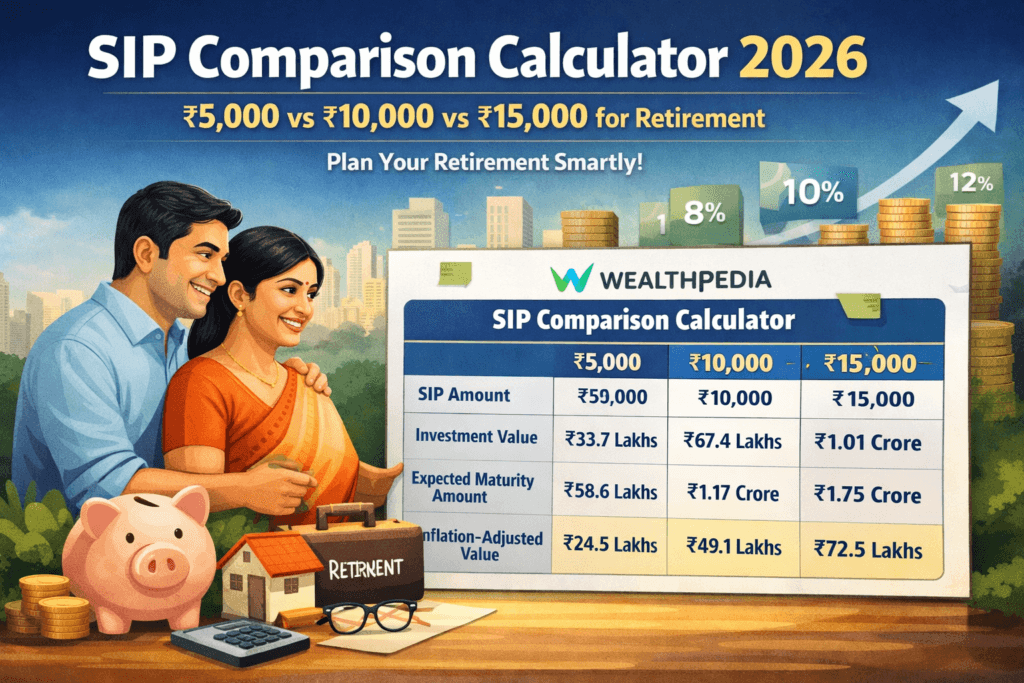

Most SIP investors plan for one return number and one retirement date. History says equity delivers somewhere between 10% and 14% over long horizons — but that 4% spread is the difference between retiring comfortably and retiring underfunded. This article runs every scenario in full, with inflation baked in at every step, so you know exactly what each return assumption means for your financial future.
The ₹1 Crore Illusion
Open any SIP calculator in India. Type ₹10,000/month, 12% returns, 20 years. The result: ₹99.9 lakh.
Just under ₹1 crore. Feels good. Feels like a plan.
Now change the return to 10%. Same SIP, same 20 years. Result: ₹75.9 lakh.
That 2% difference in return assumption — 12% vs 10% — costs you ₹24 lakh on the same investment. And that is just on ₹10,000/month. Scale this to ₹25,000 or ₹50,000/month and the gap becomes ₹60 lakh to ₹2 crore.
Now apply inflation to both numbers. At 6% over 20 years, the ₹99.9 lakh at 12% CAGR has the real purchasing power of just ₹31.2 lakh in today’s money. The ₹75.9 lakh at 10% CAGR is worth ₹23.7 lakh.
You are not building a ₹1 crore retirement fund. You are building one worth ₹31 lakh in today’s terms — at best. At worst, ₹23.7 lakh.
This is the inflation-adjusted SIP truth that no marketing brochure will ever show you.
This article does exactly that. It runs every combination of SIP amount, return scenario (10%, 12%, 14%), and inflation (5%, 6%, 7%) across multiple time horizons — and shows you both the nominal number and the real number that actually matters.
Before you read any further, open the Wealthpedia SIP Comparison Calculator in another tab. As you read through each scenario below, you can plug in your own numbers and see exactly where you stand.
Quick Summary
Small assumptions in SIP returns create large differences over time. A ₹10,000 monthly investment for 20 years at 12% grows to ₹99.9 lakh, but at 10% only ₹75.9 lakh—a ₹24 lakh gap driven by just 2% lower returns. When adjusted for 6% inflation, these amounts shrink drastically to ₹31.2 lakh and ₹23.7 lakh in today’s value. This reveals the real challenge: nominal wealth can mislead, while purchasing power tells the true story. The article highlights how return assumptions, inflation, SIP size, and time horizon combine to shape realistic outcomes, emphasizing the importance of inflation-adjusted financial planning.
Why 10%, 12%, and 14% — Where Do These Numbers Come From?
These three return assumptions map directly to the spectrum of realistic long-run outcomes for Indian equity mutual fund investors.
The 14% Scenario: Optimistic but Historically Supported
The Nifty 500 has delivered a 30-year CAGR of approximately 15.2% (TRI, 1995–2025). The Nifty Next 50 has delivered 15–16% over similar periods. Mid-cap index funds have historically compounded at 17–19% over 15+ year windows.
A well-constructed aggressive portfolio — 40% Nifty 50 + 20% Nifty Next 50 + 20% Mid Cap + 15% International + 5% Small Cap — with 10–12% annual step-up has historically delivered 13–14% blended CAGR over 20-year windows.
14% is achievable but requires: All-equity allocation, genuine long-horizon discipline, ability to hold through 50–60% drawdowns, and no panic-selling during market crises.
The 12% Scenario: The Base Case
The Nifty 50 has delivered approximately 12.8–13% CAGR as a rolling SIP return over 20-year periods (rupee cost averaging effect). A balanced portfolio — 50–55% Nifty 50 + 15% Nifty Next 50 + 15% Mid Cap + 10% International + 10% Debt — delivers approximately 11.5–12.5% blended CAGR over long horizons.
12% is the planning standard for most Indian equity SIP investors — calibrated to historical data while accounting for costs and realistic portfolio composition.
The 10% Scenario: The Conservative Floor
Over 25 years, the Nifty 50 has delivered CAGR returns in a band of 8.7%–13.2% depending on the start and end year. The 10-year CAGR from Jan 2015 to Jan 2025 was approximately 10.2% — a period that included two major crashes (2018–2019 slowdown, 2020 COVID).
A conservative portfolio — 55% Nifty 50 + 25% Short Duration Debt + 10% Gold + 10% Conservative Hybrid — typically delivers 9.5–10.5% blended CAGR.
10% represents the conservative floor: the return you should be able to sustain even through extended periods of equity underperformance, for investors who cannot hold a pure equity portfolio.
The gap between these three scenarios — 10% to 14% — is not a matter of fund selection or timing skill. It is primarily a function of asset allocation and step-up discipline. As explored in the best SIP allocation strategy guide, the difference between a 10% and 14% blended return is determined almost entirely by how much of the portfolio is in high-growth equity categories and whether step-up SIPs are implemented.
The Master Comparison: All Scenarios, All Time Horizons
The most important table in this article. Every scenario runs on a ₹10,000/month starting SIP. The step-up column is 10% annual (the standard recommendation). Inflation adjustment uses 6% (India’s 30-year average).
Nominal vs Real Corpus — ₹10,000/Month SIP, 10% Annual Step-Up
| Years | 10% CAGR Nominal | 10% Real | 12% CAGR Nominal | 12% Real | 14% CAGR Nominal | 14% Real |
|---|---|---|---|---|---|---|
| 10 years | ₹23.3L | ₹13.0L | ₹27.2L | ₹15.2L | ₹31.8L | ₹17.7L |
| 15 years | ₹60.4L | ₹25.2L | ₹77.0L | ₹32.1L | ₹98.6L | ₹41.1L |
| 20 years | ₹1.39 Cr | ₹43.4L | ₹1.98 Cr | ₹61.8L | ₹2.84 Cr | ₹88.5L |
| 25 years | ₹3.13 Cr | ₹73.0L | ₹4.98 Cr | ₹1.16 Cr | ₹7.97 Cr | ₹1.86 Cr |
| 30 years | ₹6.98 Cr | ₹1.22 Cr | ₹12.4 Cr | ₹2.16 Cr | ₹22.2 Cr | ₹3.86 Cr |
Real value calculated by deflating nominal corpus at 6% annual inflation for the investment period.
The real corpus column is the one you should be planning from. Let us walk through what this means in practical terms.
At 20 years:
- 10% CAGR: ₹43.4 lakh in today’s purchasing power
- 12% CAGR: ₹61.8 lakh in today’s purchasing power
- 14% CAGR: ₹88.5 lakh in today’s purchasing power
On a ₹10,000/month starting SIP, the difference between 10% and 14% over 20 years is ₹45.1 lakh in real wealth — almost as much as the 10% scenario’s entire real corpus. This is not fund selection alpha. This is the asset allocation premium, compounded over two decades.
At 30 years:
- 10% CAGR: ₹1.22 crore real value
- 12% CAGR: ₹2.16 crore real value
- 14% CAGR: ₹3.86 crore real value
At 30 years, the 14% scenario builds 3.16x the real wealth of the 10% scenario on identical monthly investments. The difference: ₹2.64 crore in real terms. Enough to retire comfortably or remain underfunded — entirely determined by which scenario your portfolio actually delivers.
Scaling Up: What ₹25,000 and ₹50,000/Month Produces
₹10,000/month is a starting point for illustration. Most serious FIRE planners invest ₹25,000–₹75,000/month across goals. Here is what the three scenarios produce at higher investment levels:
Nominal Corpus at 25 Years — ₹25K and ₹50K/Month, 10% Annual Step-Up
| Monthly SIP | 10% CAGR | 12% CAGR | 14% CAGR | Difference (10% vs 14%) |
|---|---|---|---|---|
| ₹25,000 | ₹7.83 Cr | ₹12.5 Cr | ₹19.9 Cr | ₹12.07 Cr |
| ₹50,000 | ₹15.6 Cr | ₹24.9 Cr | ₹39.9 Cr | ₹24.3 Cr |
The ₹24.3 crore difference between 10% and 14% CAGR on a ₹50,000/month SIP over 25 years is not a rounding error. It is the difference between a ₹15.6 crore corpus (modest FIRE for most urban Indians) and a ₹39.9 crore corpus (Fat FIRE territory). On the same monthly contribution.
This is why the SIP Comparison Calculator is the most important tool in your financial planning kit — not because it tells you one number, but because it lets you run all three scenarios simultaneously and see the cumulative divergence visualised across every year of the investment horizon.
The Inflation Sensitivity Analysis: What If Inflation Is Higher Than 6%?
Most SIP planning uses 6% as the inflation benchmark. But India’s inflation is not constant. In 2009, CPI hit 15%. In 2022, it sustained above 7%. Healthcare inflation runs 12–15% perennially.
Here is how the real corpus changes when you vary the inflation assumption:
Real Corpus Sensitivity to Inflation — ₹10,000/Month, 10% Step-Up, 25 Years
| CAGR | 5% Inflation | 6% Inflation | 7% Inflation |
|---|---|---|---|
| 10% | ₹87.2L | ₹73.0L | ₹61.0L |
| 12% | ₹1.39 Cr | ₹1.16 Cr | ₹96.8L |
| 14% | ₹2.22 Cr | ₹1.86 Cr | ₹1.55 Cr |
The inflation sensitivity analysis reveals something critical: at 10% CAGR with 7% inflation, your real return is only 2.8% per annum (10% − 7%). Over 25 years, this barely sustains purchasing power — let alone builds meaningful retirement wealth.
The real return hierarchy:
- 10% CAGR − 6% inflation = 3.77% real CAGR — barely above savings account territory
- 12% CAGR − 6% inflation = 5.66% real CAGR — meaningful wealth creation
- 14% CAGR − 6% inflation = 7.55% real CAGR — strong real wealth building
As we covered in the SIP Planning for 30-year-olds guide, the only scenarios that produce genuinely retirement-sustaining real wealth are 12%+ CAGR with controlled inflation. The 10% scenario at 6–7% inflation is the equivalent of treading water — you are investing, growing nominally, but barely outpacing the erosion of purchasing power.
The Retirement Income Test: What Monthly Income Does Each Scenario Generate?
Corpus numbers are abstract. Monthly income is concrete. Here is the translation:
For a 30-year-old investing ₹15,000/month with 10% annual step-up, retiring at age 60 (30-year horizon):
Monthly Retirement Income by Scenario (3.5% SWR, Inflation-Adjusted)
| Scenario | Nominal Corpus at 60 | Real Corpus (Today’s ₹) | Monthly Income (3.5% SWR, Today’s ₹) |
|---|---|---|---|
| 10% CAGR | ₹10.5 Cr | ₹1.83 Cr | ₹53,375/month |
| 12% CAGR | ₹18.6 Cr | ₹3.24 Cr | ₹94,500/month |
| 14% CAGR | ₹33.3 Cr | ₹5.79 Cr | ₹1,68,875/month |
On the same ₹15,000/month starting SIP:
- 10% scenario: ₹53,375/month retirement income in today’s purchasing power
- 12% scenario: ₹94,500/month — almost double the 10% scenario
- 14% scenario: ₹1,68,875/month — more than 3x the 10% scenario
If your target retirement income is ₹1 lakh/month (today’s terms), the 10% scenario leaves you ₹46,625/month short. The 12% scenario covers it with ₹94,500. The 14% scenario provides 1.7x your target — giving you Fat FIRE breathing room.
The Safe Withdrawal Rate Calculator at Wealthpedia connects the corpus number to sustainable monthly income — accounting for Indian inflation rates, retirement duration, and the equity-debt mix of the withdrawal portfolio. Use it alongside the SIP Comparison Calculator to see the complete picture: accumulation trajectory at each scenario, plus the withdrawal sustainability check.
The Step-Up Interaction: How Step-Up Rate Amplifies the Return Difference
The scenario comparison above uses a 10% annual step-up. But what happens when you vary the step-up rate alongside the return assumption? This is where the compounding becomes truly exponential.
Nominal Corpus — ₹10,000/Month Starting SIP, 25 Years, Varying Step-Up and Return
| Step-Up Rate | 10% CAGR | 12% CAGR | 14% CAGR |
|---|---|---|---|
| 0% (flat) | ₹1.33 Cr | ₹1.89 Cr | ₹2.73 Cr |
| 5% | ₹2.01 Cr | ₹2.94 Cr | ₹4.37 Cr |
| 8% | ₹2.82 Cr | ₹4.23 Cr | ₹6.44 Cr |
| 10% | ₹3.13 Cr | ₹4.98 Cr | ₹7.97 Cr |
| 12% | ₹3.57 Cr | ₹5.84 Cr | ₹9.60 Cr |
| 15% | ₹4.63 Cr | ₹7.82 Cr | ₹13.5 Cr |
The most important finding from this table: a 10% step-up at 14% CAGR (₹7.97 crore) produces nearly 2.5x the corpus of a 10% step-up at 10% CAGR (₹3.13 crore) — on the same starting SIP.
But here is the equally important finding: a 15% step-up at 10% CAGR (₹4.63 crore) beats a 0% step-up at 14% CAGR (₹2.73 crore). Step-up discipline can compensate for a lower return assumption. An investor with a conservative portfolio who implements aggressive step-ups can outperform an aggressive investor who treats the SIP as fixed.
This is the core insight the SIP Comparison Calculator is designed to reveal — letting you vary both the return assumption and the step-up simultaneously to find the combination that meets your FIRE target with the portfolio you can actually maintain.
What Causes Returns to Be Lower Than Expected? The Real-World Risk Factors
Understanding the 10% scenario is not just about pessimism. There are specific, real conditions under which a long-term SIP delivers 10% rather than 12–14%:
Risk Factor 1: Conservative Asset Allocation
The most common cause. An investor who holds 50% debt in their SIP portfolio “for safety” has capped their blended CAGR to approximately 9.5–10.5% — below what an equity-dominant portfolio delivers.
For a 30-year-old with a 25-year horizon, 50% debt is a category mismatch. It is the financial equivalent of using a braking system designed for highways on an open track — the safety feels reassuring, but the performance penalty is permanent.
The asset allocation for FIRE guide establishes clearly: for goals 15+ years away, equity allocation should be 75–85%. Debt serves near-term goals and bucket strategies — not long-term wealth creation.
Risk Factor 2: High Expense Ratios
An active large-cap fund with a 2% expense ratio running at 14% gross return actually delivers 12% to the investor. A mid-cap active fund at 2.5% expense ratio delivering 16% gross returns delivers 13.5%.
Compare this to a Nifty 50 index fund at 0.10% expense ratio — what it earns, the investor largely keeps.
Over 25 years, the 1.5–2% annual expense drag compounds to a devastating corpus difference: Expense Ratio Gross Return Net Return 25-Year Corpus (₹10K/month, 10% step-up) 2.0% (active large-cap) 14% 12% ₹4.98 Cr 0.10% (Nifty 50 index) 12.5% 12.4% ₹5.25 Cr 0.15% (Nifty Next 50 index) 15% 14.85% ₹8.4 Cr+
The index fund at lower gross return but near-zero expense ratio routinely outperforms the active fund at higher gross return with a 2% fee. This is why index funds vs active funds is not an academic debate — it directly determines which return scenario your portfolio actually delivers.
Risk Factor 3: Behavioural Drag — The Investor Return Gap
AMFI data consistently shows a 2–3% gap between the return a fund earns (CAGR) and the return the average investor earns (XIRR). The cause: investors buy after strong performance (paying peak prices), sell during corrections (locking in losses), and re-enter after recovery (missing the bounce).
A fund delivering 13% CAGR to a disciplined investor might deliver only 10–11% to a reactive investor — through no fault of the fund.
The behavioural gap is the most expensive and most preventable drag on SIP returns. It is eliminated by one action: automated monthly SIP with annual step-up and no market-event-triggered changes. Use the SIP Comparison Calculator to run your actual portfolio history against each return scenario — the gap between what you theoretically should have earned and what you actually earned reveals your personal behavioural drag.
Risk Factor 4: Inconsistent Step-Up Implementation
As shown in Table 5, a flat SIP at 14% CAGR (₹2.73 crore) underperforms a 10% step-up SIP at 10% CAGR (₹3.13 crore) over 25 years. Investors who intend to step up annually but never get around to implementing it are effectively choosing the flat scenario — and paying the compounding price for it.
Risk Factor 5: Early SIP Interruptions
Stopping a SIP for 12 months in Year 5 and restarting does more damage than it appears. The Year 5 contributions have 20 more years of compounding ahead of them. Losing 12 months of Year 5 SIPs at ₹14,600/month (after 4 annual step-ups on ₹10,000) costs approximately ₹23–28 lakh in final corpus at 12% CAGR — not ₹1.75 lakh of “missed contributions.”
Three Complete Investor Profiles: What Each Scenario Actually Looks Like
Profile 1: Meera, 28, Marketing Manager, Mumbai, ₹90,000/month
Investment goal: FIRE at 52 (24-year horizon)
Current SIP: ₹18,000/month (equity index, balanced allocation)
Step-up: 10% annually
Target: ₹80,000/month in today’s terms at retirement
Inflation-adjusted corpus needed:
₹80,000 × (1.06)^24 = ₹80,000 × 4.049 = ₹3.24 lakh/month at retirement
Corpus at 3.2% SWR (40-year FIRE horizon): ₹3.24 lakh × 12 ÷ 0.032 = ₹12.15 crore
What each scenario delivers at 52 (₹18K starting, 10% step-up, 24 years):
| Scenario | Nominal Corpus | Real Corpus (Today’s ₹) | vs Target (₹12.15 Cr nominal) |
|---|---|---|---|
| 10% CAGR | ₹7.12 Cr | ₹3.08 Cr | ₹5.03 Cr short |
| 12% CAGR | ₹11.4 Cr | ₹4.93 Cr | ₹0.75 Cr short |
| 14% CAGR | ₹18.3 Cr | ₹7.92 Cr | ₹6.15 Cr surplus |
The verdict: At 10% CAGR, Meera is ₹5.03 crore short of her FIRE target — she cannot retire at 52. At 12%, she is ₹75 lakh short — achievable with a 3-year delay to 55 or a modest SIP increase. At 14%, she has a ₹6.15 crore surplus — Fat FIRE territory with a 3-year cushion.
What Meera should do: Use the Multi-Goal FIRE Planner to model all three scenarios simultaneously. If the 12% scenario is within 10% of her target, she is on track with balanced allocation. If the gap is larger, a 13% step-up (vs 10%) or a 5% SIP increase each year beyond the step-up can close it without changing the fundamental allocation.
Profile 2: Kiran, 35, Engineer, Hyderabad, ₹1.3 lakh/month
Investment goal: Retire at 58 (23-year horizon), ₹1 lakh/month today’s terms
Current SIP: ₹30,000/month (60% Nifty 50, 20% Mid Cap, 10% International, 10% Debt)
Step-up: 10% annually
Inflation-adjusted corpus needed:
₹1 lakh × (1.06)^23 = ₹1 lakh × 3.82 = ₹3.82 lakh/month
Corpus at 3.5% SWR: ₹3.82 lakh × 12 ÷ 0.035 = ₹13.1 crore
What each scenario delivers at 58 (₹30K, 10% step-up, 23 years):
| Scenario | Nominal Corpus | Real Corpus (Today’s ₹) | vs ₹13.1 Cr Target |
|---|---|---|---|
| 10% CAGR | ₹9.52 Cr | ₹4.48 Cr | ₹3.62 Cr short |
| 12% CAGR | ₹15.6 Cr | ₹7.34 Cr | ₹2.5 Cr surplus |
| 14% CAGR | ₹25.7 Cr | ₹12.1 Cr | ₹12.6 Cr surplus |
The verdict: Kiran’s 12% balanced allocation delivers a ₹2.5 crore nominal surplus over target — his plan is on track. If returns disappoint at 10%, he is ₹3.62 crore short — meaning he either needs to work until 63 or reduce target income to ₹75,000/month (today’s terms). The 14% scenario gives him the option to retire 2–3 years early.
The risk management insight: Kiran’s portfolio is 70% equity (Nifty 50 + Mid Cap + International) — appropriate for 23 years. But if he drifts to 50% equity due to risk aversion as he ages, his blended CAGR falls toward 10%, and the shortfall materialises. Maintaining allocation discipline — specifically resisting the urge to de-risk too early — is the difference between the 12% and 10% scenario.
Profile 3: Suresh, 45, Business Owner, Chennai, ₹1.8 lakh/month average
Investment goal: Retire at 60 (15-year horizon), ₹1.5 lakh/month today’s terms
Current SIP: ₹50,000/month (conservative allocation — 40% equity, 35% debt, 15% gold, 10% hybrid)
Step-up: 8% annually
Inflation-adjusted corpus needed:
₹1.5 lakh × (1.06)^15 = ₹1.5 lakh × 2.397 = ₹3.60 lakh/month
Corpus at 4% SWR (30-year retirement from age 60): ₹3.60 lakh × 12 ÷ 0.04 = ₹10.8 crore
What each scenario delivers at 60 (₹50K, 8% step-up, 15 years):
| Scenario | Nominal Corpus | Real Corpus (Today’s ₹) | vs ₹10.8 Cr Target |
|---|---|---|---|
| 10% CAGR | ₹4.72 Cr | ₹1.97 Cr | ₹6.08 Cr short |
| 12% CAGR | ₹5.68 Cr | ₹2.37 Cr | ₹5.12 Cr short |
| 14% CAGR | ₹6.85 Cr | ₹2.86 Cr | ₹3.95 Cr short |
The verdict: Suresh is underfunded in all three scenarios. His conservative allocation (40% equity, blended 10% CAGR) over only 15 years cannot build the corpus his target requires — regardless of whether markets deliver 10% or 14%.
The problem is not the return scenario. The problem is the combination of conservative allocation + short horizon + insufficient SIP relative to the target corpus.
What Suresh must do:
- Immediately model this in the Retirement Corpus Calculator — his deficit is severe enough to require structural changes
- Increase equity allocation to 60–65% (he has 15 years — sufficient for moderate equity recovery after a crash)
- Increase SIP to ₹80,000–₹90,000/month and implement 12% step-up
- Use the financial health score to audit all spending leakages redirectable to SIP
Suresh’s scenario illustrates a critical principle: no return scenario compensates for insufficient investment rate and mismatched allocation. A 10% CAGR shortfall cannot be fixed by hoping for 14%. It requires more capital deployed, longer runway, or a reduced corpus target.
How to Use Return Scenario Planning in Practice
The three scenarios are not predictions. They are planning guardrails. Here is how to use them:
Step 1: Model All Three in the SIP Comparison Calculator
Never plan with a single return assumption. Use the SIP Comparison Calculator to run your current SIP amount simultaneously at 10%, 12%, and 14% CAGR. The output tells you:
- At 10%: Are you catastrophically underfunded? (change action required now)
- At 12%: Are you roughly on track? (maintain plan)
- At 14%: Do you have a significant surplus? (could retire earlier or reduce SIP)
The planning rule: Your FIRE target should be achievable at the 10% scenario. If it requires 12% or 14% to work, you are relying on optimistic assumptions that may not materialise.
Step 2: Identify Which Scenario Your Current Portfolio Actually Targets
Your portfolio allocation determines your CAGR target. Map your current allocation:
| Portfolio Composition | Expected Blended CAGR |
|---|---|
| 100% FD / Debt | 7–8% |
| 30% Equity + 70% Debt | 8.5–9.5% |
| 50% Equity + 50% Debt | 9.5–10.5% |
| 65% Equity + 35% Debt/Gold | 10.5–11.5% |
| 75% Equity + 25% Debt/Gold | 11.5–12.5% |
| 85% Equity + 15% Debt/Gold | 12.5–13.5% |
| 100% Equity (Index Funds) | 13–14% |
If your FIRE target requires 12% but your allocation is 50:50, you are targeting 9.5–10.5%. There is a structural mismatch. Fix the allocation first — the mutual fund portfolio allocator guide gives the specific category-level allocation for each scenario.
Step 3: Use the Step-Up as the Lever Between Scenarios
As Table 5 demonstrated, a 15% step-up at 10% CAGR can produce a larger corpus than a 10% step-up at 12% CAGR. Before changing your asset allocation (which carries more risk), check whether increasing your step-up rate bridges the gap between the 10% scenario outcome and your target.
The SIP Allocation Optimizer calculates the exact step-up rate required to hit a target corpus at each return assumption — giving you the actionable monthly number without guesswork.
Step 4: Run the Annual Review with Scenario Tracking
Once per year, compare your actual portfolio value against the 10%, 12%, and 14% scenario projections. If your actual corpus is:
- Above the 12% projection: You are outperforming. No action needed — consider slightly reducing step-up if cash flow requires it.
- Between 10% and 12% projection: You are in the expected range. Maintain plan.
- Below 10% projection: Investigate. Either the market has underperformed significantly (check if allocation is correct and hold), or there is a structural issue (check for fund overlap, high expense ratios, or missed step-ups).
The Multi-Goal FIRE Planner supports this annual tracking — showing projected vs actual corpus at each scenario for each goal.
The Inflation Adjustment Checklist: What You Must Do Differently
Every investor who reads the real corpus numbers above has the same reaction: “The nominal numbers look great. The real numbers look scary.” That reaction is correct — and it should drive three specific planning changes:
1. Set your FIRE target in today’s rupees, not future rupees
If you need ₹80,000/month at retirement and retirement is 25 years away, do not target a ₹80,000 monthly income. Target the inflation-adjusted equivalent — ₹3.43 lakh/month (at 6% inflation). Your corpus target must be large enough to fund that inflated expense, not your current expense.
2. Use category-specific inflation for specific goals
Education: 10–12% inflation. Healthcare: 12–15%. General lifestyle: 6–7%. Travel: 5–6%. Building a single corpus for all goals using 6% inflation will systematically underestimate education and healthcare needs. The SIP for child education guide models education inflation separately — the correct approach for any goal with above-CPI cost escalation.
3. Build the healthcare corpus separately
As detailed in the healthcare inflation FIRE guide, medical costs in India inflate at 12–15% annually. At this rate, a hospitalisation costing ₹3 lakh today costs ₹9.3 lakh in 10 years and ₹29 lakh in 20 years. No SIP scenario — not even 14% CAGR — can sustainably absorb healthcare inflation if it is bundled into the general retirement corpus without a separate allocation.
The Honest Summary: Which Scenario Should You Plan For?
Here is the Wealthpedia position, based on everything in this article:
Plan for 10%. Build for 12%. Hope for 14%.
Planning for 10% means your FIRE target is achievable even in the conservative scenario — you are not dependent on equity outperformance to retire comfortably.
Building for 12% means your portfolio allocation is calibrated for the realistic base case — 70–75% equity, low-cost index funds, 10% annual step-up, no premature de-risking.
Hoping for 14% means if markets deliver the historical long-run return of 13–15%, you have a significant surplus — which you can use to retire earlier, gift more, or simply live with greater financial freedom.
The SIP Comparison Calculator is built for exactly this three-scenario planning approach. Run your numbers today. See where the 10% scenario lands against your FIRE target. If it is not close enough, you have three levers: increase the monthly SIP, increase the step-up rate, or extend the investment horizon. None of these require predicting whether markets deliver 10%, 12%, or 14%.
That is the only honest answer to the return scenario question — and the only one that leads to a retirement plan robust enough to survive the uncertainty that markets will inevitably deliver.
Frequently Asked Questions
What is a realistic SIP return expectation in India in 2026?
A realistic planning range for an equity mutual fund SIP in India is 10–14% CAGR over 15+ year horizons. The Nifty 50 has delivered approximately 12.8–13% as a rolling SIP CAGR over 20-year periods. Conservative blended portfolios (55% equity + 45% debt/gold) deliver 9.5–10.5%. Aggressive all-equity portfolios with mid-cap exposure can deliver 13–14%. Use 10% as your conservative planning floor and 12% as the base case.
How does a 2% difference in SIP return affect the final corpus?
Significantly. On a ₹10,000/month SIP with 10% annual step-up over 25 years: 10% CAGR builds ₹3.13 crore; 12% CAGR builds ₹4.98 crore — a difference of ₹1.85 crore. Over 30 years, the gap between 10% and 12% grows to ₹5.42 crore on the same monthly investment. The compounding of a 2% return differential over decades is not linear — it accelerates dramatically in later years.
What is the inflation-adjusted return of a 12% CAGR SIP?
At 6% annual inflation, the real return of a 12% CAGR SIP is approximately 5.66% per annum. This means your corpus grows at 5.66% in real (purchasing power) terms — sufficient for meaningful wealth creation over 20–30 years. At 10% CAGR and 6% inflation, the real return is only 3.77% — barely above a savings account in real terms.
How do I calculate the real value of my SIP corpus?
Divide the nominal corpus by (1 + inflation rate)^years. For a ₹2 crore corpus in 20 years at 6% inflation: ₹2 crore ÷ (1.06)^20 = ₹2 crore ÷ 3.207 = ₹62.4 lakh in today’s purchasing power. Use the SIP Calculator with Inflation for instant side-by-side nominal and real value projections.
What SIP amount is needed to retire on ₹1 lakh/month (today’s terms) in 25 years?
At 6% inflation for 25 years: ₹1 lakh/month becomes ₹4.29 lakh/month. Corpus needed at 3.5% SWR: ₹4.29 lakh × 12 ÷ 0.035 = ₹14.7 crore. Required starting SIP with 10% step-up: at 12% CAGR — approximately ₹28,000/month; at 10% CAGR — approximately ₹45,000/month; at 14% CAGR — approximately ₹18,000/month.
Does using index funds vs active funds change the return scenario I target?
Yes. An active large-cap fund with a 2% expense ratio and 14% gross return delivers 12% net. A Nifty 50 index fund with 0.10% expense ratio and 12.5% gross return delivers 12.4% net. The index fund at lower gross return but near-zero cost can produce a higher net return than the active fund — meaning index investors may effectively be in the 12% scenario while paying for 14% gross performance in active funds.
How does step-up rate interact with the return scenario?
A 15% annual step-up at 10% CAGR produces a larger 25-year corpus than a 10% step-up at 12% CAGR. This means step-up discipline can compensate for lower returns — making it the highest-leverage variable in your control. Use the SIP Comparison Calculator to find the step-up rate that makes the 10% scenario viable for your FIRE target.
What return scenario should a 30-year-old plan for?
A 30-year-old with a 25–30 year horizon should plan conservatively at 10% (to stress-test the plan), build the portfolio for 12% (balanced equity-dominant allocation), and be pleased if 14% materialises. The SIP planning for 30-year-olds guide shows in detail how each scenario maps to specific fund allocations and step-up rates.
What return should I assume for a conservative (50% equity) portfolio?
A 50% equity + 50% debt/gold portfolio typically delivers 9.5–10.5% blended CAGR over 15+ years. Use 9.5–10% as the planning assumption. For goals 15+ years away, this allocation significantly underperforms the 12–14% achievable with 70–80% equity. Conservative allocation is appropriate for near-term goals (under 7 years) but represents a costly mis-allocation for long-horizon goals.
Is 14% SIP return realistic or optimistic?
Historically supported but not guaranteed. The Nifty 500 has delivered 15.2% CAGR over 30 years; the Nifty Next 50 has delivered 15–16%; mid-cap indices 17–19% over long periods. However, these are historical figures and future returns may differ. An aggressive portfolio targeting 14% requires all-equity allocation with mid-cap and international exposure, genuine 20+ year horizon, and ability to hold through 50–60% market crashes.
How does SIP return scenario planning differ from lump sum planning?
SIP investors benefit from rupee cost averaging — buying more units during crashes and fewer during rallies. This typically produces a 1–2% higher effective CAGR than the underlying fund’s point-to-point return. A fund with a 11% point-to-point CAGR often delivers 12–12.5% SIP CAGR over the same period. Plan with SIP-specific return assumptions, not lump sum CAGR figures from fund fact sheets.
What happens to my FIRE plan if markets deliver 10% for 5 consecutive years?
A 5-year period of 10% returns in a portfolio targeting 12% will leave your corpus approximately 9–12% below projection. This is not catastrophic if discovered early — increasing the SIP or extending the timeline by 1–2 years closes most of the gap. The damage from sustained 10% returns is recoverable if you catch it at the 5-year checkpoint. Use the annual tracking framework to compare actual corpus against all three scenario projections.
Should I change my SIP fund if it consistently delivers 10% when I expected 12%?
Not immediately. Check three things first: (1) Is the underperformance due to market conditions (which affect all funds equally) or fund-specific issues? (2) Is the fund beating its benchmark? (3) Is the expense ratio appropriate? If a fund consistently underperforms its benchmark by 1%+ over 3+ years at high cost, consider switching to a lower-cost index fund in the same category. Do not chase performance — switch based on cost and benchmark alignment.
How does inflation uncertainty affect scenario planning?
The real return is the difference between CAGR and inflation. If inflation rises from 6% to 8% (as it did during 2008–2010), a 12% CAGR portfolio’s real return drops from 5.66% to 3.70%. At 7% inflation, the 10% scenario’s real return (3%) barely exceeds long-run PPF returns. This is why the ideal savings rate guide recommends 25–30% of gross income in investment — to buffer against both return disappointment and inflation surprise simultaneously.
Is the SIP Comparison Calculator useful for scenario analysis?
Yes — it is specifically designed for this. The SIP Comparison Calculator lets you run multiple return scenarios side by side, with or without step-up, at different investment amounts and tenures. The visual comparison of corpus trajectories across scenarios makes the divergence over time concrete and actionable.
Can a higher SIP amount compensate for a lower return scenario?
Yes, directly. If the 12% scenario requires ₹20,000/month to hit a ₹5 crore target in 25 years, the 10% scenario requires approximately ₹30,000/month for the same outcome. The relationship is not linear — lower returns require disproportionately higher SIP amounts because the compounding deficit accumulates over decades. This is why getting the allocation right (and therefore the return scenario) matters more than simply increasing contributions.
What is the relationship between risk tolerance and return scenario?
Higher return scenarios require higher equity allocation, which means higher volatility and deeper maximum drawdowns. The 14% scenario assumes 85–100% equity — a portfolio that can fall 50–60% in a crash year. The 10% scenario (50% equity) might fall only 25–30% in the same crash. Your actual return scenario is bounded by the maximum drawdown you can sustain without selling — because selling during a crash permanently moves you from a 14% trajectory to a 10% outcome.
Does the return scenario change based on investment tenure?
Yes. For tenures under 7 years, equity returns are highly unpredictable — the 10% scenario might actually be optimistic (equity can deliver negative real returns in short windows). For 7–15 year tenures, the range narrows to 8–14%. For 15+ year tenures, the range historically narrows to 10–14%, with most periods clustering around 11–13%. Long tenures compress return uncertainty — another reason why starting early is the most powerful FIRE decision.
How should I adjust my SIP plan if returns drop to 10% in the early years?
Do not panic and do not change the plan immediately. Early-year underperformance matters less than late-year underperformance due to smaller corpus size. If the Nifty delivers 8–10% for 3 consecutive years (as it did 2000–2002), continue SIP — you are buying units cheaply. The only action warranted is checking that your fund’s expense ratio has not increased and that the fund is not significantly underperforming its index.
What is the effect of missing one year of SIP on the scenario projections?
More damaging than most investors realise. Missing 12 months of SIP in Year 8 of a 25-year plan at ₹21,436/month (after 7 annual 10% step-ups on ₹11,000 starting SIP) at 12% CAGR costs approximately ₹42–52 lakh in final corpus — because those contributions had 17 years of compounding ahead of them. Never pause a long-term SIP. Reduce the step-up if cash flow is tight — but keep the base SIP running.
How do I use the three scenarios to decide between FIRE at 50 vs 55?
Model the 10% conservative scenario at your current SIP. If it delivers your FIRE corpus by 55 but not by 50, your plan is viable at 55 on conservative assumptions. To pull FIRE to 50, calculate the additional SIP required to make the 10% scenario work at 50. If that additional SIP is unaffordable, plan for 55 — and treat any 12% or 14% return outcome as an opportunity to retire earlier, not as a requirement.
Should FIRE planners use the 10%, 12%, or 14% scenario for corpus calculation?
Use all three. Target the FIRE corpus that the 12% scenario delivers. Stress-test that target against the 10% scenario — if you are underfunded at 10%, either increase SIP or extend timeline. Use the 14% scenario as the aspirational “retire early” trigger — if your corpus reaches the 14% projection level before your planned FIRE date, evaluate whether early retirement is viable.
How does portfolio rebalancing affect the return scenario?
Annual rebalancing — selling overweight assets and buying underweight ones — typically adds 0.2–0.5% to long-run CAGR through systematic buy-low-sell-high behaviour. Over 25 years, this can add ₹15–40 lakh to the final corpus at ₹10,000/month SIP levels. Rebalancing keeps the portfolio in its intended scenario (e.g., 75% equity for a 12% target) rather than drifting to a more conservative allocation after a bull run.
What is the biggest mistake investors make about return scenarios?
Treating the 14% scenario as the base case. Most Indian investors, seeing recent 3-year Nifty returns of 15–18%, anchor their planning to these elevated figures — then are blindsided when the long-run mean reversion brings 10-year CAGR back to 10–12%. The historical data clearly shows 10.2% 10-year CAGR from 2015–2025 (a period including strong bull runs). Plan conservatively. Be pleasantly surprised by outperformance.
What is the single most important action for an investor worried about the 10% scenario?
Increase the annual step-up rate. As shown in Table 5, a 15% step-up at 10% CAGR over 25 years (₹4.63 crore) beats a 5% step-up at 14% CAGR (₹4.37 crore). The step-up is entirely in your control — unlike market returns. Open the SIP Comparison Calculator today, run your numbers at all three scenarios, find the step-up rate that makes the 10% scenario viable, and implement it as an automated annual instruction. That single action eliminates most return scenario risk.
Disclaimer: All return projections are based on historical data and illustrative assumptions. Future market returns are uncertain and may differ materially. This article is for educational purposes only. Wealthpedia is not a SEBI-registered investment advisor. Consult a qualified financial planner before making investment decisions. Wealthpedia® is a registered trademark (TM No. 4910385).

Vishal Jhaveri is the founder of Wealthpedia and an MBA Finance professional with over 10 years of experience in financial planning, investing, and wealth creation. He specializes in FIRE (Financial Independence, Retire Early), retirement planning, investing, and personal finance education. Through Wealthpedia, he develops financial calculators and publishes evidence-based content to help Indian investors make informed financial decisions. He regularly reviews and updates Wealthpedia articles to reflect changes in tax, laws, investment regulations, and personal finance best practices.
Quick Wrap up