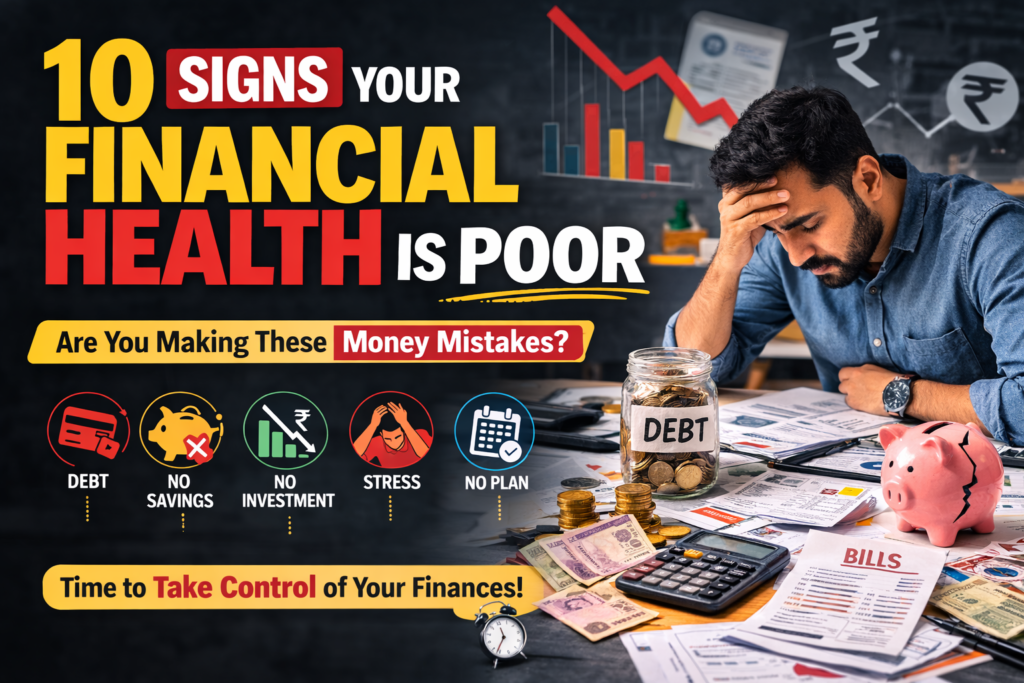
Most people judge financial success by salary, job title, or lifestyle.
But real financial strength is not about how much money you earn.
It’s about how well your finances are structured.
Two people earning ₹20 lakh per year can have completely different financial situations:
- One may be drowning in EMIs
- The other may have investments, savings, and zero financial stress
This is where the concept of financial health becomes important.
Financial health measures how stable, secure, and sustainable your finances are.
If you want to evaluate yourself, the best method is to measure your Financial Health Score across savings, debt, investments, and risk protection.
In this guide, we will explore 10 powerful signs that indicate you are financially healthy.
Why Financial Health Matters in India
Financial stability has become increasingly important in India due to changing economic trends.
Recent economic data highlights several financial challenges Indian households face:
| Financial Indicator | Latest Data |
|---|---|
| Household savings rate | 18.1% of GDP |
| Household financial liabilities | 6.2% of GDP |
| Net financial savings | 5.2% of GDP |
| Gross savings rate | 30.7% of GDP |
India’s household savings rate has been declining in recent years while debt levels have increased, indicating rising financial stress among households.
At the same time, there are positive trends.
More Indians are investing in capital markets:
- Equity and mutual fund allocation in household savings increased from 2% in FY12 to over 15% in FY25.
This shift shows that Indians are gradually moving toward more sophisticated financial planning.
What Does It Mean to Be Financially Healthy?
A financially healthy person typically has:
- Stable income
- Adequate savings
- Manageable debt
- Investments for future goals
- Insurance protection
Financial health is not about becoming rich overnight.
It is about creating long-term financial resilience.
Let’s explore the 10 most important signs of financial health.
Sign 1: You Have a Strong Emergency Fund
One of the clearest signs of financial stability is having an emergency fund.
An emergency fund protects you from unexpected events such as:
- Job loss
- Medical emergencies
- Business losses
- Economic downturns
Recommended Emergency Fund in India
| Monthly Expense | Ideal Emergency Fund |
|---|---|
| ₹40,000 | ₹2.4 lakh – ₹3 lakh |
| ₹60,000 | ₹3.6 lakh – ₹4.5 lakh |
| ₹1 lakh | ₹6 lakh – ₹7.5 lakh |
Experts generally recommend maintaining 6–9 months of living expenses.
Without an emergency fund, even a small crisis can lead to high-interest borrowing.
Sign 2: Your Debt Is Under Control
Debt is not necessarily bad.
However, excessive debt is a major indicator of poor financial health.
Ideal Debt-to-Income Ratio
| Debt Level | Financial Health |
|---|---|
| Below 20% | Excellent |
| 20% – 35% | Healthy |
| 35% – 50% | Risky |
| Above 50% | Dangerous |
Financially healthy individuals ensure their total EMIs do not exceed 30–35% of income.
In India, household borrowing has been rising due to increased consumption and easier credit access.
This makes debt management an essential aspect of financial health.
Sign 3: You Save Consistently
Saving regularly is one of the strongest indicators of financial discipline.
Financial advisors often recommend the 50-30-20 rule:
| Category | Percentage of Income |
|---|---|
| Needs | 50% |
| Wants | 30% |
| Savings/Investments | 20% |
A financially healthy individual saves at least 20% of income.
In India, the declining household savings rate shows that many people are prioritizing consumption over long-term savings.
Those who maintain a disciplined savings habit are better positioned for future financial security.
Sign 4: You Invest for Long-Term Wealth
Saving money alone is not enough.
Inflation reduces the purchasing power of idle money.
That’s why financially healthy individuals invest in growth assets.
Common Investment Options in India
| Asset Class | Expected Long-Term Return |
|---|---|
| Equity mutual funds | 10–14% |
| Stocks | 12–15% |
| Fixed deposits | 6–7% |
| Government bonds | 6–8% |
| Gold | 7–9% |
The growing participation of Indians in mutual funds and equities shows increasing financial awareness.
Mutual funds now account for around 6% of household savings, reflecting rising investor participation.
Sign 5: You Have Adequate Insurance Protection
Financially healthy individuals protect their wealth from risks.
Two essential insurance products are:
1. Term Life Insurance
Provides financial protection to family members.
Recommended coverage:
| Annual Income | Ideal Life Cover |
|---|---|
| ₹10 lakh | ₹1–1.5 crore |
| ₹20 lakh | ₹2–3 crore |
2. Health Insurance
Medical costs in India are rising rapidly.
A good health insurance policy should cover:
- ₹10–20 lakh for urban families
- ₹5–10 lakh minimum coverage
Insurance ensures that medical emergencies do not destroy financial stability.
Sign 6: Your Net Worth Is Growing
Financially healthy individuals track their net worth regularly.
Net Worth Formula
Net Worth = Assets – Liabilities
Example:
| Assets | Value |
|---|---|
| Investments | ₹15 lakh |
| Property | ₹50 lakh |
| Cash | ₹3 lakh |
| Liabilities | Value |
|---|---|
| Home loan | ₹25 lakh |
| Car loan | ₹5 lakh |
Net worth = ₹38 lakh
A rising net worth over time indicates improving financial health.
Sign 7: You Are Investing for Retirement
Many Indians underestimate retirement planning.
Without proper investments, retirement can become financially stressful.
Retirement Corpus Example
| Monthly Expense | Corpus Required |
|---|---|
| ₹50,000 | ₹1.5 crore |
| ₹75,000 | ₹2.2 crore |
| ₹1 lakh | ₹3 crore |
Early investing significantly reduces the required savings effort.
Starting at age 25 instead of 35 can reduce investment requirements by more than 40% due to compounding.
Sign 8: You Avoid Lifestyle Inflation
One of the biggest threats to financial health is lifestyle inflation.
When income rises, many people increase spending instead of investing.
Example:
| Salary Increase | Spending Behaviour |
|---|---|
| Salary doubles | Expenses double |
| Salary doubles | Expenses increase only 30% |
Financially healthy individuals control lifestyle inflation and allocate additional income to investments.
Sign 9: You Track Your Finances
Financial awareness is a key habit of financially healthy individuals.
They regularly track:
- Expenses
- Investments
- Net worth
- Debt levels
Tracking finances helps people make better financial decisions.
Today, many Indians use digital tools to track finances due to the growth of fintech platforms and digital banking.
Sign 10: Money Does Not Cause You Stress
The final and most important indicator of financial health is peace of mind.
If you:
- Do not worry about paying bills
- Can handle emergencies
- Are confident about retirement
Then you are financially healthy.
Financial health ultimately means financial freedom and emotional stability.
Financial Health Checklist
You can quickly evaluate yourself using this checklist.
| Indicator | Healthy Status |
|---|---|
| Emergency fund | 6–9 months expenses |
| Debt ratio | Below 35% |
| Savings rate | 20% or more |
| Insurance | Life + health coverage |
| Investments | Long-term assets |
| Retirement planning | Active investments |
| Net worth growth | Increasing annually |
| Expense tracking | Monthly review |
| Lifestyle inflation | Controlled |
| Financial stress | Minimal |
If you satisfy most of these criteria, your financial health is strong.
Financial Health Trends in India
India’s financial landscape is changing rapidly.
Key trends include:
Rising Debt
Household debt has increased significantly in recent years due to personal loans and credit card usage.
Declining Savings
Household savings have fallen to around 18.1% of GDP, raising concerns about long-term financial resilience.
Increasing Market Participation
Investments in equities and mutual funds have surged significantly in the past decade.
These trends highlight the importance of financial literacy and planning.
How to Improve Your Financial Health
If you are not financially healthy yet, don’t worry.
Financial health can be improved with simple steps:
Step 1: Start budgeting
Track income and expenses.
Step 2: Build emergency fund
Save 6 months of expenses.
Step 3: Reduce high-interest debt
Pay off credit cards and personal loans first.
Step 4: Start investing early
Use SIPs in mutual funds.
Step 5: Protect with insurance
Life and health coverage are essential.
Final Thoughts
Financial health is not determined by how much money you earn.
It depends on how effectively you manage your finances.
A financially healthy person:
- Saves consistently
- Invests for the future
- Avoids excessive debt
- Maintains financial discipline
In a rapidly evolving economy like India, building strong financial habits early can significantly improve long-term financial security.
If you want to evaluate yourself more accurately, you can use a Financial Health Score Calculator to measure your financial stability across savings, debt, investments, and risk protection.
Your financial health today will determine your financial freedom tomorrow.
Select Your Favorite Section