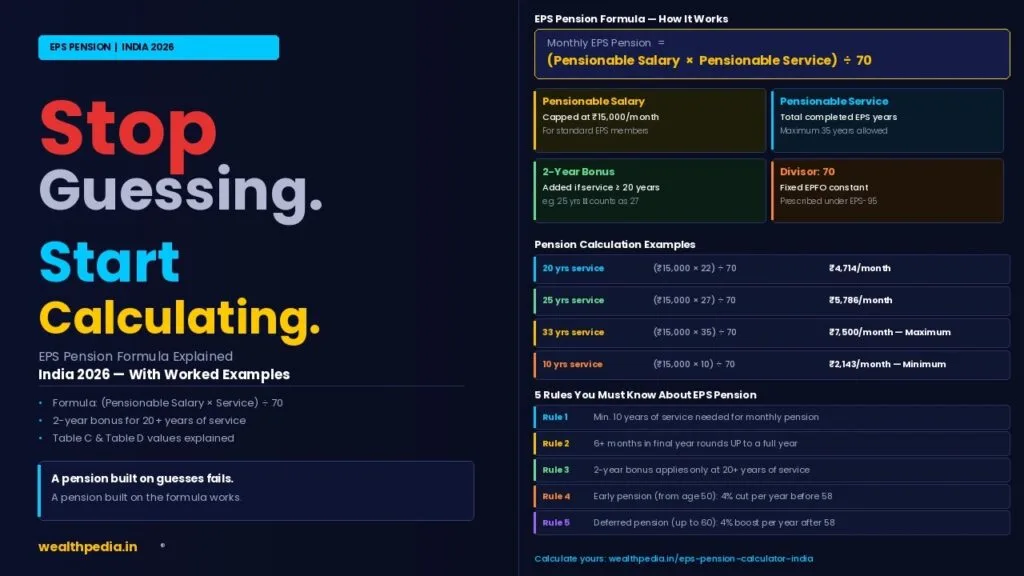

For EPS members with low pensionable salary or limited service, the standard formula — (Pensionable Salary × Pensionable Service) ÷ 70 — can produce a monthly pension below what most would consider a meaningful income. To address this, EPFO maintains a guaranteed minimum pension floor, ensuring no qualifying member or family beneficiary receives less than a specified amount, regardless of the formula outcome.
This guide explains the minimum EPS pension rule in full — who it protects, how the calculation interacts with the floor, and the ongoing policy debate about whether ₹1,000/month remains adequate in 2026.
Use the EPS Pension Calculator India to check whether your expected pension falls above the minimum floor or would actually be topped up to it.
Quick Summary
EPFO guarantees a minimum monthly EPS pension of ₹1,000 to all qualifying members, regardless of how low their formula-based calculation works out to be. This floor applies independently to the member’s own pension, widow pension, child pension, and orphan pension — each beneficiary’s payment is topped up to ₹1,000/month if the calculated amount falls below this threshold. The minimum has remained unchanged since 2014 despite inflation, and trade unions have long campaigned for an increase. This article explains exactly who the floor applies to, worked examples, the broader debate around its adequacy, and what members should know. Use the EPS Pension Calculator India to check whether your pension falls above or at this floor.
Join Now →
What Is the Minimum EPS Pension?
The minimum EPS pension is a government-guaranteed floor of ₹1,000 per month, applicable to all qualifying EPS pension beneficiaries — including the member’s own pension, widow pension, child pension, and orphan pension — regardless of how low the formula-based calculation works out to be.
This minimum has been in effect since September 1, 2014, introduced alongside the wage ceiling increase from ₹6,500 to ₹15,000. The Central Government funds the shortfall between the formula-calculated amount and the ₹1,000 floor through a budgetary allocation to EPFO’s pension fund.
Who Does the Minimum Pension Apply To?
The ₹1,000/month minimum applies independently to each of the following beneficiary categories: Beneficiary Minimum Pension EPS Member (own pension) ₹1,000/month Widow / Widower ₹1,000/month Each Child (up to 2) ₹1,000/month Orphan (per child, up to 2) ₹1,000/month Dependent Parent ₹1,000/month
Important: The floor applies separately to each beneficiary, not as a combined family total. A family with a widow and 2 children, all of whom would otherwise fall below the formula threshold, could collectively receive ₹3,000/month (₹1,000 each) — even though their combined formula-based calculation might be much lower.
When Does the Minimum Pension Floor Actually Apply?
The floor only becomes relevant when the formula-based calculation produces an amount below ₹1,000/month. This typically occurs in the following scenarios:
Scenario 1 — Very Short Service
A member with exactly 10 years of service (the minimum for pension eligibility) at a low pensionable salary:
- Pensionable Salary: ₹6,500 (historical lower ceiling, for illustration)
- Pensionable Service: 10 years
- Formula Pension = (6,500 × 10) ÷ 70 = ₹929/month → floor applies → ₹1,000/month
Scenario 2 — Death in Service With Very Short Tenure
A member dies after only 2 years of EPS-covered service:
- EPFO applies the 2-year notional minimum service for calculation (since actual service is already at this minimum)
- Pensionable Salary: ₹15,000
- Notional Pension = (15,000 × 2) ÷ 70 = ₹429/month → floor applies → ₹1,000/month
- Widow Pension = 50% × ₹1,000 (the floor-adjusted member pension) = ₹500/month → floor applies independently → ₹1,000/month
Scenario 3 — Child Pension for a Low-Pension Member
A member’s pension (after the floor has already been applied) is ₹1,000/month:
- Child Pension (25%) = 25% × ₹1,000 = ₹250/month → floor applies independently → ₹1,000/month
This demonstrates how the floor can apply at multiple levels — first to the member’s own pension, and then again independently to each derived family pension benefit.
At the ₹15,000 Ceiling, When Does the Floor Become Irrelevant?
For most standard EPS members at the ₹15,000 wage ceiling with 10+ years of service, the formula-based pension already exceeds ₹1,000/month comfortably.
| Service Years | Formula Pension (at ₹15,000 salary) | Floor Relevant? |
|---|---|---|
| 10 years | ₹2,143 | No — already above floor |
| 15 years | ₹3,214 | No |
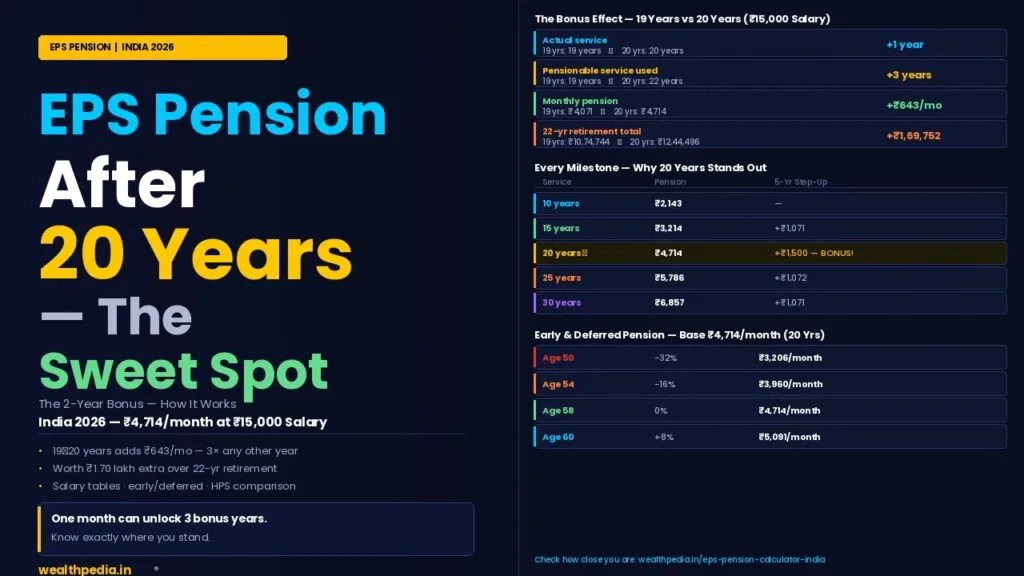
| 20 years | ₹4,714 | No |
| 25 years | ₹5,786 | No |
The floor becomes relevant primarily for: members with pensionable salary significantly below ₹15,000, members with very short service combined with low salary, and family pension beneficiaries whose calculated share (50%, 25%, or 75% of an already-low member pension) falls below ₹1,000.
Has the Minimum Pension Been Raised Since 2014?
No. The ₹1,000/month minimum EPS pension has remained unchanged since its introduction in September 2014, despite over a decade of inflation eroding its real purchasing power.
The Inflation Erosion Problem
₹1,000 in September 2014 had substantially more purchasing power than ₹1,000 in 2026. Using a conservative average inflation estimate of around 5–6% per year over this period, the real value of the ₹1,000 minimum has eroded considerably — meaning pensioners relying primarily on this floor have experienced a real-terms reduction in their standard of living, even though the nominal amount has stayed the same.
The Campaign to Raise the Minimum Pension
Trade unions, pensioner associations, and labour rights organisations have campaigned for years to raise the EPS minimum pension, with commonly proposed figures ranging from ₹3,000 to ₹7,500 per month (the latter figure notably matching the maximum standard EPS pension, which campaigners argue highlights the inadequacy of a ₹1,000 floor by comparison).
Key Arguments For Raising the Minimum
- ₹1,000/month is widely considered insufficient to meet even basic subsistence needs in most parts of India as of 2026
- The amount has not been revised in over a decade, unlike many other social security benchmarks
- EPS pensioners relying primarily on the minimum floor are disproportionately low-income workers who have limited other retirement resources
Government and EPFO Position
As of the most recent available information, the government has periodically reviewed but not implemented an increase to the ₹1,000 floor. Any future revision would require a Cabinet-level decision and corresponding budgetary allocation, since the floor is funded through government subsidy rather than the EPS contribution pool alone. Members should monitor official EPFO and Ministry of Labour and Employment announcements for any updates, since this is a policy area that has seen periodic public discussion without a confirmed implementation timeline as of this article’s preparation.
How the Minimum Pension Interacts With Early and Deferred Pension
The ₹1,000 floor applies to the final calculated pension amount — meaning if early pension reduction or deferred pension enhancement is applied, the floor is checked against the post-adjustment figure.
Early Pension and the Floor
A member with a very low base pension claiming early pension (with reduction) is more likely to encounter the floor:
- Base Pension: ₹1,200/month (very short service, low salary)
- Early Pension at age 50 (32% reduction): ₹1,200 × 0.68 = ₹816/month → floor applies → ₹1,000/month
In this case, the early pension reduction is effectively “absorbed” by the floor — the member receives ₹1,000/month regardless of the reduction percentage, since the floor takes precedence over the formula result when the formula result falls below it.
Deferred Pension and the Floor
Deferred pension only increases the pension amount, so it is highly unlikely to ever trigger the floor — deferral moves the calculated amount further away from (not closer to) the ₹1,000 threshold.
Minimum Pension and the Table D Withdrawal Benefit — Important Distinction
The ₹1,000/month minimum pension floor applies only to monthly pension (for members with 10+ years of service). It does not apply to the Table D withdrawal benefit, which is a one-time lump sum for members with less than 10 years of service. There is no equivalent “minimum withdrawal amount” floor — the Table D benefit is calculated purely by formula (Table D Factor × Pensionable Salary), with no government top-up provision.
See EPS Withdrawal Benefit Calculator for the complete Table D mechanics.
Minimum Pension — Worked Examples Across Scenarios
| Scenario | Formula-Based Pension | Final Pension (After Floor) |
|---|---|---|
| 10 years service, ₹15,000 salary | ₹2,143 | ₹2,143 (floor not needed) |
| 10 years service, ₹6,500 salary | ₹929 | ₹1,000 (floor applied) |
| Death in service, 1 year tenure, notional 2 yrs | ₹429 | ₹1,000 (floor applied) |
| Widow pension on a ₹1,000 floor-adjusted member pension | ₹500 | ₹1,000 (floor applied independently) |
| Child pension on the same scenario | ₹250 | ₹1,000 (floor applied independently) |
| Early pension at 50, low base of ₹1,200 | ₹816 | ₹1,000 (floor applied) |
Minimum Pension — Quick Reference Summary
| Aspect | Detail |
|---|---|
| Minimum pension amount | ₹1,000/month |
| In effect since | September 1, 2014 |
| Last revised | Never (as of 2026) |
| Applies to | Member pension, widow pension, child pension, orphan pension, dependent parent pension |
| Application basis | Independently per beneficiary, not combined family total |
| Funded by | Central Government subsidy to EPFO pension fund |
| Applies to Table D withdrawal? | No — only to monthly pension |
| Affected by early pension reduction? | Floor still applies if reduced amount falls below ₹1,000 |
| Affected by deferred pension enhancement? | Rarely relevant — deferral increases pension away from the floor |
Frequently Asked Questions — Minimum EPS Pension
What is the minimum EPS pension in India?
The minimum EPS pension guaranteed by EPFO is ₹1,000 per month, applicable to all qualifying pension beneficiaries (member, widow, child, orphan, dependent parent) regardless of how low their formula-based calculation works out to be. This has been in effect since September 2014.
Has the minimum EPS pension been increased recently?
No. The ₹1,000/month minimum has remained unchanged since its introduction in September 2014. Trade unions and pensioner associations have campaigned for an increase, but no revision has been implemented as of 2026.
Does the minimum pension apply to widow pension too?
Yes. The ₹1,000/month floor applies independently to widow pension, separate from the member’s own pension floor. If the calculated widow pension (50% of the member’s pension) falls below ₹1,000, it is topped up to ₹1,000/month.
Who funds the minimum pension top-up?
The Central Government funds the difference between the formula-calculated pension and the ₹1,000 minimum through a budgetary subsidy to EPFO’s pension fund. This funding comes from outside the standard EPS contribution pool.
Does the minimum pension apply to the EPS withdrawal benefit (Table D)?
No. The ₹1,000/month minimum applies only to monthly pension for members with 10+ years of service. The Table D lump-sum withdrawal benefit (for members with less than 10 years of service) has no equivalent minimum floor — it is calculated purely by the Table D factor formula.
Can a family receive multiple ₹1,000 minimum pensions simultaneously?
Yes. The floor applies independently to each beneficiary. A widow and 2 children, each falling below the formula threshold, could collectively receive ₹3,000/month (₹1,000 each) — even if their combined formula-based calculation is lower than this total.
What is the minimum pension for someone with 10 years of service at ₹15,000 salary?
At ₹15,000 salary and 10 years of service, the formula-based pension is ₹2,143/month — already well above the ₹1,000 floor, so the floor is not triggered. The floor primarily affects members with lower pensionable salary or very short service combined with low salary.
Is there a campaign to increase the minimum EPS pension to ₹3,000 or more?
Yes. Various trade unions and pensioner advocacy groups have long campaigned for an increase, with proposed figures ranging from ₹3,000 to ₹7,500/month. As of 2026, no such increase has been implemented, though the matter remains a subject of ongoing public and policy discussion.
Does early pension reduction ever push a member below the minimum floor?
Yes, particularly for members with already-low base pensions. If a low base pension (e.g., ₹1,200/month) is reduced by the early pension penalty (up to 32% at age 50), the resulting amount could fall below ₹1,000/month — in which case the floor applies, and the member receives ₹1,000/month regardless of the calculated reduction.
Is the minimum pension taxable?
Yes, technically the minimum pension is taxable as “Income from Other Sources” like any other EPS pension. However, at ₹1,000/month (₹12,000/year), this falls far below the basic exemption limit for virtually all taxpayers, meaning no actual tax liability arises from this income alone.
Where can I check if my EPS pension would be topped up to the minimum?
Use the EPS Pension Calculator India on Wealthpedia. Enter your service years and pensionable salary — if the calculated formula result falls below ₹1,000/month, the calculator will indicate that the minimum floor applies to your situation.
Disclaimer: The information on this page is for educational purposes only and does not constitute investment or financial advice. The minimum EPS pension rule is governed by EPFO regulations under EPS-95 and may be updated by the Government of India. Any potential future revision to the ₹1,000 minimum would be subject to government notification — this article reflects the rule as understood as of 2026. For personalised guidance, consult a SEBI-registered financial planner or visit your nearest EPFO office. Wealthpedia™ (Trademark Reg. No. 4910385) is not a SEBI-registered investment advisor. All mutual fund references on this site are for Direct Plan, Growth option only.

Vishal Jhaveri is the founder of Wealthpedia and an MBA Finance professional with over 10 years of experience in financial planning, investing, and wealth creation. He specializes in FIRE (Financial Independence, Retire Early), retirement planning, investing, and personal finance education. Through Wealthpedia, he develops financial calculators and publishes evidence-based content to help Indian investors make informed financial decisions. He regularly reviews and updates Wealthpedia articles to reflect changes in tax, laws, investment regulations, and personal finance best practices.
Quick Wrap up