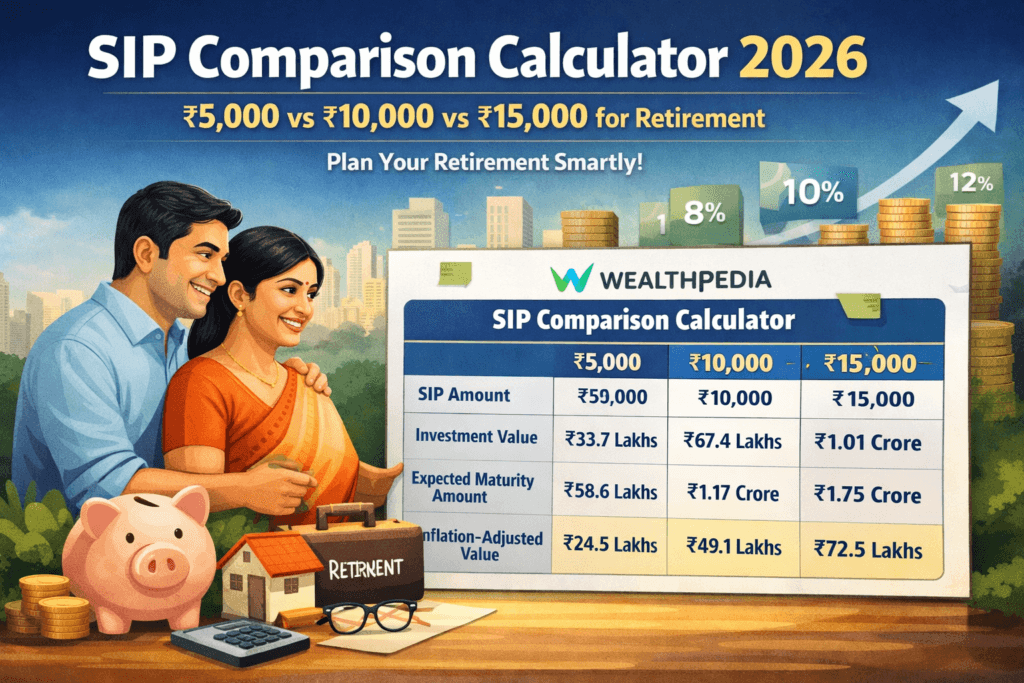

You are 30. You have 25–30 working years ahead. You have heard that SIPs build wealth. What nobody has told you is that the return assumption you choose today — aggressive or conservative — will determine whether you retire with ₹2 crore or ₹7 crore on the exact same monthly investment. This article runs the full comparison, with inflation baked in at every step.
Age 30: The Most Financially Consequential Decade of Your Life
There is a calculation that every 30-year-old in India should run — and almost none of them do.
A ₹10,000/month SIP started at age 25 grows to ₹3.53 crore by age 60 at 12% CAGR.
The same ₹10,000/month SIP started at age 30? ₹1.89 crore.
The 5-year delay cost: ₹1.64 crore. On the same monthly amount. In the same fund. For 5 fewer years.
That ₹1.64 crore gap is not recoverable by working harder, earning more, or switching to a better fund manager. It is the mathematical tax on delay — and it is permanent.
But here is what makes age 30 genuinely special: you still have 25–30 years of compounding ahead. The 25-year-old who did not start has a longer runway, yes. But the 30-year-old who starts now still sits at the steepest part of the compounding curve — the section where time does the heaviest lifting.
The question is not whether to start. The question is: how aggressively?
And the answer to that question depends on something most SIP articles never discuss clearly: the interaction between your portfolio’s return assumption, India’s 6.25% average inflation, and the real purchasing power of the corpus you build.
That is exactly what this article covers — in full, with numbers, with three complete investor profiles, and with the aggressive vs conservative comparison run side-by-side so you can see, in rupees, what each path actually produces.
The Inflation Trap That Destroys Most SIP Plans
Before comparing scenarios, the single most important concept must be understood: nominal returns are meaningless. Real returns are everything.
Most SIP calculators show you a big number. ₹1.5 crore. ₹3 crore. ₹6 crore. These are nominal — the face value of money in the future. What they do not show you is what that money actually buys.
At 6% annual inflation — India’s 30-year average — here is what happens to the purchasing power of ₹1 crore:
| Years from Now | Nominal Value | Real Value (Today’s ₹) | Buying Power vs Today (₹1 Cr) |
|---|---|---|---|
| 5 years | ₹1 crore | ₹74.7 lakh | 74.7% |
| 10 years | ₹1 crore | ₹55.8 lakh | 55.8% |
| 15 years | ₹1 crore | ₹41.7 lakh | 41.7% |
| 20 years | ₹1 crore | ₹31.2 lakh | 31.2% |
| 25 years | ₹1 crore | ₹23.3 lakh | 23.3% |
| 30 years | ₹1 crore | ₹17.4 lakh | 17.4% |
The ₹3 crore corpus you build by age 60 at a 12% CAGR on a ₹10,000/month SIP starting today? In today’s purchasing power, it is worth approximately ₹70 lakh.
Is ₹70 lakh (in today’s terms) enough for a 25–30 year retirement? For most Indian households spending ₹60,000–₹80,000/month today — where that same monthly expense will be ₹2.57–₹3.43 lakh by age 60 at 6% inflation — no. Not remotely.
This is the inflation trap. And it is why understanding how inflation silently eats your SIP corpus is not a peripheral concern — it is the central variable in every SIP planning decision you make at 30.
The correct approach: set your corpus target in today’s rupees, apply inflation to calculate the future rupee requirement, then reverse-calculate the SIP needed. Anything else is planning with a broken compass.
Defining the Scenarios: What “Aggressive” and “Conservative” Actually Mean
Before running the numbers, these terms need precise definition — because most people conflate “aggressive” with “risky” and “conservative” with “safe.” The reality is more nuanced.
The Conservative Scenario
Return assumption: 10% CAGR (post-cost blended return on a large-cap index + debt portfolio)
Portfolio: 55% Nifty 50 Index Fund + 25% Short Duration Debt Fund + 20% Gold (SGB)
Step-up: 8% annually
Inflation assumption used in planning: 7% (slightly above historical average — conservative buffer)
Risk profile: Moderate. Will not lose sleep in a 30% market correction. Would survive a 2008-style crash without restructuring the plan. May underperform pure equity portfolios in strong bull markets.
Best for: 30-year-olds with EMIs, dependents, or who are first-time equity investors who need to build conviction before increasing equity exposure. Also appropriate for those within 10 years of a major goal (house, education).
The Aggressive Scenario
Return assumption: 13% CAGR (post-cost blended return on an equity-heavy index portfolio with mid-cap and international exposure)
Portfolio: 40% Nifty 50 + 20% Nifty Next 50 + 20% Midcap 150 + 15% International S&P 500 + 5% Small Cap
Step-up: 12% annually
Inflation assumption used in planning: 6% (standard)
Risk profile: High. Accepts 40–55% drawdown in crash years. Does not panic-sell during corrections. Has 7+ year horizon with zero near-term liquidity need from this corpus.
Best for: 30-year-olds with high income growth trajectory, no near-term goals dependent on this corpus, high emotional tolerance for volatility, and a genuine 25+ year investment horizon.
The Middle Path: Balanced Scenario
Return assumption: 11.5% CAGR
Portfolio: 50% Nifty 50 + 15% Nifty Next 50 + 15% Mid Cap + 10% International + 10% Short Duration Debt
Step-up: 10% annually
Inflation assumption: 6.5%
Best for: Most 30-year-olds. Enough equity to meaningfully beat inflation over 25 years. Enough stability to survive market cycles without plan-destroying panic.
The Master Comparison Table: Same ₹15,000 Starting SIP, Age 30 to 60
The most important data in this article. Every row uses the same ₹15,000/month starting SIP. The only variables are the annual return assumption and the annual step-up rate.
Nominal Corpus at Age 60 (₹15,000/month starting SIP)
| Scenario | CAGR | Annual Step-Up | Total Invested | Nominal Corpus | Real Corpus (Today’s ₹, 6% inflation) |
|---|---|---|---|---|---|
| Conservative | 10% | 8% | ₹55.6 lakh | ₹2.91 crore | ₹60.5 lakh |
| Balanced | 11.5% | 10% | ₹65.4 lakh | ₹5.18 crore | ₹1.08 crore |
| Aggressive | 13% | 12% | ₹80.2 lakh | ₹9.14 crore | ₹1.90 crore |
| Flat Conservative | 10% | 0% | ₹54 lakh | ₹1.13 crore | ₹23.5 lakh |
| Flat Aggressive | 13% | 0% | ₹54 lakh | ₹2.35 crore | ₹48.9 lakh |
The real corpus column is the one that matters. After 30 years of 6% annual inflation:
- Conservative with step-up: ₹60.5 lakh in today’s purchasing power
- Balanced with step-up: ₹1.08 crore in today’s purchasing power
- Aggressive with step-up: ₹1.90 crore in today’s purchasing power
At a 3.5% safe withdrawal rate, what monthly income does each corpus generate in retirement? Scenario Real Corpus Monthly Income (3.5% SWR, today’s ₹) Conservative + step-up ₹60.5 lakh ₹17,646/month Balanced + step-up ₹1.08 crore ₹31,500/month Aggressive + step-up ₹1.90 crore ₹55,417/month
On a starting SIP of ₹15,000/month — which is about 15% of gross income for a ₹1 lakh/month earner — even the aggressive scenario generates only ₹55,417/month in today’s purchasing power.
This is the uncomfortable truth that no SIP calculator poster in an AMC office will show you: ₹15,000/month is a starting point, not a retirement plan by itself. The step-up is non-negotiable. And the inflation-adjusted real corpus is the only number that matters.
The SIP Calculator with Inflation displays both nominal and real-terms projections simultaneously — making this comparison instantly visible for your specific numbers.
The Inflation-Adjusted Target: Working Backwards from the Goal
The correct SIP planning framework does not start with “how much can I invest?” It starts with “how much do I need?” — in inflation-adjusted terms — and works backward.
Here is the framework for a 30-year-old targeting retirement at 58 (28-year horizon):
Step 1: Set today’s monthly expense target at retirement
A 30-year-old expecting to spend ₹1.2 lakh/month in today’s terms at retirement (accounting for a slightly leaner lifestyle post-children’s independence, but higher healthcare costs) picks ₹1.2 lakh/month as the base.
Step 2: Apply inflation to find future monthly expense
₹1.2 lakh × (1.06)^28 = ₹1.2 lakh × 5.111 = ₹6.13 lakh/month needed at retirement.
Step 3: Calculate required corpus at 3.5% SWR
₹6.13 lakh/month × 12 ÷ 0.035 = ₹21.0 crore required corpus at retirement.
Step 4: Find the required starting SIP Scenario Required SIP (Starting, with step-up) With 10% step-up With 15% step-up 10% CAGR ₹1.17 lakh/month ₹65,000/month ₹42,000/month 12% CAGR ₹55,000/month ₹31,000/month ₹20,000/month 13% CAGR ₹38,000/month ₹21,500/month ₹14,000/month
This table contains the most important insight in this entire article: the difference between 10% CAGR and 13% CAGR, combined with a 15% step-up vs no step-up, is the difference between needing ₹1.17 lakh/month and ₹14,000/month starting SIP to reach the same retirement target.
That is an 8x difference in starting SIP requirement — on identical goals.
This is why return assumption and step-up discipline are not secondary planning parameters. They are the primary levers. And this is why the best SIP allocation strategy prioritises getting both right from Day 1.
Three Complete 30-Year-Old Investor Profiles: Full Scenario Analysis
Profile 1: Arnav, 30, Software Engineer, Hyderabad, ₹1.1 lakh/month in-hand
Situation: Single, renting, no EMIs. High income growth trajectory (tech sector, 12–15% annual increment history). FIRE target: retire at 52, needs ₹80,000/month in today’s terms.
Inflation-adjusted corpus required:
₹80,000 × (1.06)^22 = ₹80,000 × 3.604 = ₹2.88 lakh/month at retirement.
Corpus at 3.2% SWR (40-year FIRE horizon): ₹2.88 lakh × 12 ÷ 0.032 = ₹10.8 crore.
Conservative scenario (10% CAGR, 8% step-up, starting ₹20,000/month):
Corpus at 52 (22 years): approximately ₹2.38 crore. Gap: ₹8.42 crore. Not viable.
Balanced scenario (11.5% CAGR, 10% step-up, starting ₹25,000/month):
Corpus at 52 (22 years): approximately ₹5.14 crore. Gap: ₹5.66 crore. Still insufficient.
Aggressive scenario (13% CAGR, 12% step-up, starting ₹30,000/month):
Corpus at 52 (22 years): approximately ₹10.9 crore. Target met. ✓
Conclusion for Arnav: FIRE at 52 on his income and goals requires the aggressive scenario. Conservative or balanced allocations at his target retirement age will leave him with a multi-crore shortfall. For Arnav, the risk of under-investing in equity is far greater than the risk of market volatility.
But here is the discipline requirement: Arnav must genuinely hold through market corrections. In 2008, an aggressive equity portfolio fell 56%. In 2011, it fell 21.7%. In 2018, it fell 0.8% (mild but still negative). Arnav’s aggressive allocation is only valid if he has tested his psychological ability to hold — not just assumed it.
Use the FIRE Number Calculator to validate corpus targets before committing to an aggressive allocation — because the plan is only robust if the number is right.
Profile 2: Deepika and Sameer, Both 30, Dual Income, Mumbai, ₹2.4 lakh combined
Situation: Married 2 years. Planning first child in 1–2 years. Home loan EMI ₹38,000/month. Multiple goals: child’s education, house upgrade in 10 years, retirement at 58.
Available monthly SIP surplus: ₹60,000 (after EMI, household expenses, insurance).
Goal 1 — Child Education (15-year horizon, ₹40 lakh in today’s terms):
Future value at 10% education inflation for 15 years: ₹40 lakh × 4.177 = ₹1.67 crore.
Required SIP: Conservative (10% CAGR, 8% step-up, starting ₹7,000/month) → ₹1.69 crore ✓
Goal 2 — House Upgrade (10-year horizon, ₹25 lakh own contribution today):
Future value at 6% inflation for 10 years: ₹25 lakh × 1.791 = ₹44.8 lakh.
Required: Conservative hybrid + short duration debt SIP (9% blended), starting ₹20,000/month → ₹44.9 lakh ✓
Goal 3 — Retirement at 58 (28-year horizon, ₹1 lakh/month today’s terms):
Future value at 6% inflation for 28 years: ₹1 lakh × 5.111 = ₹5.11 lakh/month.
Corpus at 3.5% SWR: ₹5.11 lakh × 12 ÷ 0.035 = ₹17.5 crore.
Required: Balanced scenario (11.5% CAGR, 10% step-up, starting ₹33,000/month) → ₹17.6 crore ✓
Total starting SIP: ₹60,000/month — perfectly matching their surplus. With 10–12% annual step-ups on the retirement SIP, the plan is self-funding as income grows.
The critical insight from Deepika and Sameer’s scenario: They cannot afford the aggressive scenario for all goals. The house upgrade goal (10-year horizon) must be conservative — too short a horizon for high equity exposure. The education goal (15-year horizon) can be balanced. Only the retirement goal (28-year horizon) justifies aggressive-to-balanced equity allocation.
This is goal-based allocation in its purest form: the scenario is not chosen globally for the investor — it is chosen specifically per goal, per timeline. As we explored in the SIP allocation strategy guide, different goals require different risk profiles even for the same investor at the same time.
Profile 3: Nikhil, 30, Business Owner, Jaipur, ₹80,000/month average (variable income)
Situation: Self-employed, income fluctuates between ₹60,000 and ₹1.2 lakh/month seasonally. No EPF. Needs to self-fund retirement entirely. Risk-averse due to business income variability — a bad market year coinciding with a slow business year is psychologically and financially devastating.
Conservative scenario is not a choice — it is a necessity. Nikhil’s irregular income means he cannot commit to large fixed monthly SIPs reliably. A step-up SIP that auto-increases during good months but requires manual effort to reduce in slow months creates compliance failure.
The right approach for Nikhil:
Base SIP (always runs): ₹15,000/month, conservative allocation (10% CAGR), flat — no step-up on this tranche. This is his guaranteed, non-negotiable retirement foundation.
Variable SIP (added during high-income months, paused in slow months): ₹10,000–₹30,000/month, balanced allocation (11.5% CAGR), added as a manual lump sum or short SIP burst when business is strong.
PPF (mandatory ₹1.5 lakh/year regardless of income): Provides guaranteed 7.1% EEE return — the bedrock of Nikhil’s plan when business income is weak.
Projected corpus at 60 (30-year horizon):
- Base conservative SIP (₹15K flat, 30 years, 10% CAGR): ₹3.39 crore
- Variable balanced SIP (average ₹15K/month, 10% step-up, 30 years, 11.5% CAGR): ₹3.47 crore
- PPF (₹1.5L/year, 30 years, 7.1% EEE): ₹1.58 crore
- Total: ₹8.44 crore
Real value at 6% inflation: approximately ₹1.47 crore in today’s purchasing power. Monthly income at 3.5% SWR: ₹42,875/month.
Is this enough? At ₹80,000/month current expenses, probably not. But Nikhil also has business equity value, potentially paid-off real estate, and a likely reduction in expenses at 60. The conservative-plus-variable approach is the right structure for his income profile — even if the corpus target requires future calibration.
This is the key lesson: the correct scenario is the one you will actually execute, not the one that theoretically maximises returns. An aggressive allocation abandoned during a market crash is infinitely worse than a conservative allocation maintained through every cycle. Consistency beats optimisation.
The Step-Up Multiplier: Why 12% vs 8% Step-Up Changes Everything
In all scenarios, the step-up percentage is the second most powerful variable after starting early. Here is the step-up comparison in isolation, holding everything else constant:
Impact of Step-Up Rate on ₹15,000/month SIP, 12% CAGR, 30 Years
| Step-Up Rate | Total Invested | Nominal Corpus | Additional Corpus vs 0% | Monthly Income (3.5% SWR) |
|---|---|---|---|---|
| 0% (flat) | ₹54 lakh | ₹2.96 crore | — | ₹86,500/month |
| 5% | ₹68.5 lakh | ₹4.52 crore | +₹1.56 crore | ₹1.32 lakh/month |
| 8% | ₹85.4 lakh | ₹6.34 crore | +₹3.38 crore | ₹1.85 lakh/month |
| 10% | ₹1.00 crore | ₹8.03 crore | +₹5.07 crore | ₹2.34 lakh/month |
| 12% | ₹1.22 crore | ₹10.2 crore | +₹7.24 crore | ₹2.97 lakh/month |
| 15% | ₹1.66 crore | ₹14.7 crore | +₹11.74 crore | ₹4.29 lakh/month |
The 10% step-up produces ₹5.07 crore more than a flat SIP — on ₹46 lakh of additional total contribution. That additional ₹46 lakh generates ₹5.07 crore in corpus. That is the compounding multiplier: roughly 11x return on the additional contribution, earned because those extra contributions went in early enough to compound.
The practical implementation: most AMC platforms support an automated “top-up SIP” instruction — you set the base amount, the step-up percentage, and the frequency (annual), and it executes automatically. The SIP Allocation Optimizer calculates the optimal starting amount and step-up combination for any target corpus.
The Asset Allocation Behind Each Scenario: Fund-Level Detail
The return assumption in each scenario is only achievable if the underlying fund allocation actually delivers it. Here is what the portfolio looks like in each case.
Conservative Scenario Portfolio (10% blended CAGR target)
Fund Allocation Expected Return Role Nifty 50 Index Fund 45% 13–14% Growth anchor Short Duration Debt Fund 25% 7.5–8% Stability Conservative Hybrid Fund 20% 9–10% Balanced anchor Sovereign Gold Bond 10% 10–12% Inflation + crisis hedge
Blended expected return: ~10.3% | Volatility: Low-Moderate | Max expected drawdown: 25–30%
When to use this: 30-year-olds with near-term goals (house in 5–7 years), first-time equity investors, those with variable income, or those carrying significant EMI obligations. The conservative scenario is not inferior — it is appropriate for a specific risk profile and financial situation.
Balanced Scenario Portfolio (11.5% blended CAGR target)
| Fund Allocation | Allocation | Expected Return | Role |
|---|---|---|---|
| Nifty 50 Index Fund | 40% | 13–14% | Core large-cap |
| Nifty Next 50 Index | 15% | 15–16% | Growth premium |
| Mid Cap Index Fund | 15% | 16–18% | Long-horizon upside |
| International Index (S&P 500) | 15% | 13–14% | Geographic + currency hedge |
| Short Duration Debt | 10% | 7.5–8% | Stability anchor |
| Gold (SGB) | 5% | 10–12% | Crisis insurance |
Blended expected return: ~12.0% | Volatility: Moderate-High | Max expected drawdown: 35–45%
When to use this: Most 30-year-olds with 15+ year FIRE or retirement horizon, stable income, no major near-term equity-funded goals. The balanced scenario is the Wealthpedia default recommendation for a 30-year-old starting fresh with a single long-term retirement SIP.
Aggressive Scenario Portfolio (13% blended CAGR target)
| Fund Allocation | Allocation | Expected Return | Role |
|---|---|---|---|
| Nifty 50 Index Fund | 35% | 13–14% | Core stability |
| Nifty Next 50 Index | 20% | 15–16% | High-quality growth |
| Mid Cap Index Fund | 20% | 16–18% | Mid-cap compounding |
| International Index (S&P 500) | 15% | 13–14% | Diversification + USD |
| Small Cap Active Fund | 10% | 18–22% | High-risk satellite |
Blended expected return: ~13.5% | Volatility: High | Max expected drawdown: 50–60%
When to use this: 30-year-olds with 22+ years to retirement, no liquidity requirement from this corpus, proven ability to hold through major market crashes, and income stable enough that a severe market downturn does not also compromise monthly SIP contributions.
The portfolio allocation calculator helps you validate whether your current or planned allocation actually maps to your assumed return, or whether the mismatch means your corpus projection is based on assumptions your portfolio cannot deliver.
The Inflation Tax on Each Scenario: Side-by-Side Real Returns
All projections above are nominal. Here is the full picture — nominal and real — for each scenario on a ₹20,000/month starting SIP with 10% annual step-up, 30-year horizon:
Nominal vs Real Corpus Comparison (₹20,000/month, 10% step-up, 30 years)
| Scenario | CAGR | Nominal Corpus | Real Corpus (6% inflation) | Real Corpus (7% inflation) |
|---|---|---|---|---|
| Conservative | 10% | ₹5.24 crore | ₹91.2 lakh | ₹72.5 lakh |
| Balanced | 11.5% | ₹8.86 crore | ₹1.54 crore | ₹1.22 crore |
| Aggressive | 13% | ₹15.1 crore | ₹2.62 crore | ₹2.09 crore |
| Super Conservative | 8% | ₹2.89 crore | ₹50.3 lakh | ₹40.0 lakh |
| FD-only (7%) | 7% | ₹2.19 crore | ₹38.1 lakh | ₹30.3 lakh |
The FD-only row is the most sobering. ₹20,000/month for 30 years in FD builds a corpus with real purchasing power of just ₹38.1 lakh — less than 2 years of monthly expenses for a household currently spending ₹1.8 lakh/month. This is the mathematical proof that FD-based retirement planning is not conservative — it is catastrophic.
The conservative equity scenario (10% CAGR) produces nearly 2.4x the real wealth of FD-only planning. The aggressive scenario produces 6.9x. The difference is not the monthly amount. It is the asset allocation.
The ideal savings rate guide addresses this directly — showing that the appropriate equity exposure for a 30-year-old with a 25+ year horizon is non-negotiable if real wealth preservation is the goal.
The Scenario Selection Framework: How to Choose Your Path
Given the data, here is a decision framework for every 30-year-old choosing between scenarios:
Question 1: What is your time horizon to the primary goal?
- Under 10 years → Conservative mandatory (insufficient time to recover from equity crashes)
- 10–15 years → Balanced appropriate (enough time for equity recovery after a severe crash)
- 15–25 years → Aggressive justified (3–4 full market cycles available for compounding)
- 25+ years → Aggressive recommended (time eliminates most sequence risk)
Question 2: How stable is your monthly income?
- Variable (business, freelance, commission-based) → Conservative base + variable supplement
- Stable but moderate growth expected → Balanced
- Stable + high income growth (tech, finance, medicine) → Aggressive
Question 3: Have you stress-tested your emotional response to market crashes?
- “I have never experienced a significant portfolio drawdown” → Start balanced, move to aggressive after 2+ years
- “I held through 2020 or 2022 corrections without panic-selling” → Aggressive appropriate
- “I sold during 2020 or any correction and rebought higher” → Conservative or balanced only
This question is the most important and most honest. The aggressive scenario’s 13% CAGR assumption requires holding through 50–60% equity drawdowns without selling. An investor who switches to FD at the bottom of a market crash — even once — destroys years of compounding advantage. The correct scenario is not the one with the highest theoretical return. It is the one you will actually execute without disruption through a full market cycle.
Question 4: What is your current savings rate?
- Under 15% of gross income → Aggressive step-up is critical (starting small, must grow fast)
- 15–25% → Balanced with 10% step-up
- Above 25% → Choose scenario based on timeline and risk, not savings pressure
Use the financial health score as a baseline — it tells you whether your overall financial structure supports the chosen scenario, or whether gaps in emergency fund, insurance, or debt management need to be addressed before increasing equity exposure.
The 5-Year Checkpoint: How to Know If You’re On Track
Choosing a scenario at 30 is the beginning. Staying on track through 35 requires active monitoring. Here is the checkpoint framework:
At age 35 (Year 5 review), your portfolio should show: Scenario Target Corpus at 35 (₹20K starting, 10% step-up) If Below Target by 20%+ Conservative (10%) ₹23.8 lakh Increase SIP by 15% immediately Balanced (11.5%) ₹27.1 lakh Check if step-up instructions executed; reset if missed Aggressive (13%) ₹31.0 lakh Verify allocation is correct; overlapping funds may be causing return drag
If your corpus at 35 is significantly below the trajectory, the cause is almost always one of three things: SIPs were paused during a market downturn (behavioural failure), the step-up instruction was never implemented (implementation failure), or the fund allocation is generating lower returns than assumed (allocation failure).
The Multi-Goal FIRE Planner tracks projected vs actual corpus for each goal annually — showing you at a glance whether you are ahead of, on, or behind the trajectory for each scenario.
The 30-Year-Old’s Action Plan: What to Do This Week
All analysis is useless without execution. Here is the specific action sequence:
Day 1: Calculate your FIRE number
Use the FIRE Number Calculator. Enter your target monthly expenses in today’s terms, target retirement age, and expected retirement duration. Get the inflation-adjusted corpus target. This is your destination.
Day 2: Choose your scenario
Use the four-question framework above. Be honest about income stability and emotional risk tolerance. Most 30-year-olds in stable employment should choose balanced or aggressive — but only if they have genuinely assessed their response to a 40% portfolio drawdown.
Day 3: Set up the SIP architecture
Separate SIPs for each goal. Goal-based investment planner to calculate required starting SIP for each goal. Set up automated step-up instruction from Day 1 — not as a future intention but as a binding automated instruction.
Day 4: Build the emergency fund first
If your emergency fund is below 6 months of expenses, pause the investment SIP setup momentarily and direct ₹5,000–₹10,000/month to a liquid fund until the emergency fund is complete. As detailed in the 3-month emergency fund is outdated article, 6 months is the new minimum for Indian households — especially those with variable income or dependents.
Day 5: Set the annual review date
Mark April 1 on your calendar. Every year. Review corpus vs target, implement step-up, rebalance if allocation has drifted. That is the entire annual maintenance requirement.
Conclusion: The 30s Are Not a Practice Run
Every decade of Indian financial life has a different function. The 20s are for building habits. The 40s are for accelerating. The 50s are for protecting. The 60s are for harvesting.
The 30s are for executing.
You have enough income to invest meaningfully. You have enough time for compounding to do the heavy lifting. You have enough financial literacy — especially if you have read this far — to choose the right scenario.
The aggressive vs conservative debate is not resolved by the data alone. It is resolved by a clear-eyed assessment of your timeline, your income stability, your emotional profile, and the goals you are actually building toward.
What the data says unambiguously:
- Inflation-adjusted returns, not nominal returns, are the only metric that matters
- Step-up SIPs are not optional — they are the primary wealth multiplier
- FD-based retirement planning is not conservative — it is a guaranteed inflation loss
- The right scenario is the one you will maintain through every market cycle, not the one with the highest theoretical return
Start. Choose the scenario that fits your profile. Build in the step-up from Day 1. Review annually. Leave the rest to compounding.
That is the entire playbook for a 30-year-old building real wealth in India in 2026.
Frequently Asked Questions: SIP Planning for 30-Year-Olds
How much SIP should a 30-year-old do in India in 2026?
The minimum is 20–25% of gross monthly income invested across all goals. For a ₹1 lakh/month gross income, this means ₹20,000–₹25,000/month in total SIPs. The exact split depends on goals — retirement, education, home — each with its own dedicated SIP. Start with what is affordable today and implement a 10–12% annual step-up to grow the investment in line with income.
Is aggressive SIP better than conservative SIP for a 30-year-old?
For goals 20+ years away, aggressive allocation (75–85% equity index funds) significantly outperforms conservative allocation in real terms. At 13% CAGR vs 10% CAGR over 30 years on the same SIP, the aggressive scenario produces nearly 3x the real corpus. However, aggressive is only appropriate if you have the emotional discipline to hold through 40–55% market drawdowns without selling.
How does inflation affect SIP returns for a 30-year-old?
Profoundly. At 6% inflation over 30 years, the purchasing power of money halves approximately every 12 years. A ₹3 crore nominal corpus in 2056 has the purchasing power of just ₹52 lakh in today’s terms. This means SIP planning must target inflation-adjusted corpus, not nominal corpus. Always use a SIP Calculator with Inflation for retirement projections.
What is the best SIP portfolio for a 30-year-old in India?
For a balanced scenario (recommended for most): 40% Nifty 50 Index + 15% Nifty Next 50 + 15% Mid Cap Index + 15% International Index + 10% Short Duration Debt + 5% Gold (SGB). This produces approximately 11.5% blended CAGR with manageable volatility — appropriate for 25+ year horizons without requiring extreme emotional tolerance for market crashes.
How much corpus does a 30-year-old need for retirement at 60?
It depends on monthly expenses and inflation. For a household spending ₹80,000/month today, the inflation-adjusted monthly need at 60 (at 6% inflation for 30 years) is ₹4.59 lakh/month. Required corpus at 3.5% SWR for 25-year retirement: ₹4.59 lakh × 12 ÷ 0.035 = ₹15.74 crore. Use the Retirement Corpus Calculator for personalised figures.
Should I invest in index funds or active funds at age 30?
For large-cap equity (Nifty 50, Nifty Next 50): index funds definitively. Fewer than 15% of active large-cap funds beat their benchmark after fees over 10 years. The 1.5–2% expense ratio of active funds vs 0.1–0.2% for index funds compounds to ₹20–30 lakh difference over 25 years. For mid-cap and small-cap: quality active funds with 10+ year track records can outperform — limit to 10–15% of portfolio.
What is the step-up SIP and why is it critical at 30?
A step-up SIP automatically increases your monthly investment by a fixed percentage each year. A 10% step-up on a ₹15,000/month SIP over 30 years at 12% CAGR builds ₹8.03 crore vs ₹2.96 crore for the same flat SIP — a ₹5.07 crore difference. At age 30, with income typically growing 8–15% annually, a 10% step-up keeps investment growth proportional to income growth without requiring manual discipline.
How do I compare aggressive vs conservative SIP scenarios?
Compare them on three metrics: (1) real corpus (inflation-adjusted), (2) required starting SIP to reach the same target, and (3) maximum drawdown tolerance required. The aggressive scenario requires less starting SIP for the same real corpus but demands greater emotional tolerance. Use the SIP Comparison Calculator to run side-by-side projections.
Is PPF still relevant for a 30-year-old in 2026?
Yes — as the debt component of the retirement portfolio. PPF at 7.1% EEE is India’s best guaranteed return after tax for investors in the 20–30% bracket. Maximise the ₹1.5 lakh/year contribution (₹12,500/month equivalent). PPF is not a standalone retirement strategy — it is the guaranteed debt anchor that complements equity SIPs.
How much mid-cap and small-cap should a 30-year-old hold?
Mid-cap: 15–20% of portfolio for 20+ year goals. Small-cap: 5–10% maximum, only for goals 20+ years away. Higher allocations increase return potential but also increase maximum drawdown — small-cap fell 72% in 2008. Never make mid or small-cap the dominant allocation. Always anchor the portfolio with Nifty 50 or Nifty Next 50 as the core.
What return should I assume for SIP planning in India?
Use conservative (10%), base (12%), and optimistic (14%) scenarios and plan to be sufficient at 10%. Long-run Nifty 500 CAGR is 15.2% (30 years), but this includes exceptional bull runs. For planning: 10% for conservative blended portfolio, 12% for balanced equity-focused, 13–14% for aggressive all-equity. Never use recent 3-year returns as a future assumption.
Should a 30-year-old with a home loan invest aggressively in SIPs?
Yes, with one important qualification: ensure the EMI + SIP combination leaves 20–25% of income free for lifestyle and emergency expenses. A home loan EMI of ₹35,000/month on ₹1 lakh income means maximum investible surplus is ₹30,000–₹40,000. Within that surplus, aggressive allocation is still appropriate for retirement SIPs with 25+ year horizons. The loan reduces available surplus — it does not change the appropriate equity allocation for long-term goals.
How does a variable income affect scenario choice for a 30-year-old?
Variable income (business, freelance) requires a conservative base SIP that runs regardless of income level, supplemented by variable top-ups during high-income months. The base SIP should be set at 70% of the minimum expected monthly income. The step-up SIP concept is replaced by a “bonus investment” approach — parking income spikes in a liquid fund and systematically transferring to equity SIP via STP.
What is the real return of each SIP scenario after inflation?
After 6% annual inflation over 30 years:
Conservative (10% CAGR): real return ~3.77% per annum
Balanced (11.5% CAGR): real return ~5.19% per annum
Aggressive (13% CAGR): real return ~6.60% per annum
FD (7% CAGR): real return ~0.94% per annum
Only equity-dominated scenarios produce real returns above 5% — the minimum needed to meaningfully grow wealth faster than lifestyle inflation.
How do I know if my SIP is on track at age 35?
Calculate the target corpus for your chosen scenario at age 35 (5 years in). If your actual corpus is within 15% of the target, you are on track. If it is more than 20% below, investigate: missed SIPs, step-up not implemented, or fund underperformance. Use the Multi-Goal FIRE Planner for annual tracking against inflation-adjusted targets.
Should I invest in NPS as a 30-year-old?
NPS is worth using for the additional ₹50,000 80CCD(1B) deduction (saves ₹15,600/year at 30% bracket) beyond the ₹1.5 lakh 80C limit. However, NPS mandatory annuity at 60 (40% of corpus) creates a tax-inefficient income stream. Use NPS for the tax deduction benefit, not as a primary retirement vehicle. Primary retirement corpus should be built via equity mutual fund SIPs which offer more flexibility at withdrawal.
What happens to my aggressive SIP if I need money in 5 years?
If you have a genuine need within 5 years, do not fund it from the aggressive equity SIP. Set up a separate conservative SIP or debt fund for that goal. The aggressive equity SIP is for goals 20+ years away and should be treated as completely inaccessible capital. Premature withdrawal from equity SIPs in years 1–10 destroys a disproportionate share of long-term compounding — the exact years when compounding impact is lowest but momentum is building.
Is ₹50,000/month enough SIP for a 30-year-old?
It depends on target corpus and retirement age. ₹50,000/month at 12% CAGR with 10% step-up over 30 years builds ₹26.7 crore nominal — approximately ₹4.64 crore in today’s real terms. At 3.5% SWR, this generates ₹1.35 lakh/month in today’s purchasing power. For most Indian households, ₹50,000/month is a strong foundation — but the step-up remains essential. See our detailed guide on how much to invest monthly.
Should I start with aggressive allocation and become conservative over time?
Yes — this is the glide path principle. Start at 30 with 75–85% equity. Gradually shift toward 60–65% equity by age 45, 50% by age 55, and 35–40% by retirement at 60. This captures equity’s maximum compounding in the early high-growth years and de-risks as the goal approaches. The asset allocation for FIRE guide details the decade-by-decade glide path.
How does gold fit into SIP planning for a 30-year-old?
Gold (Sovereign Gold Bond) at 5–10% of portfolio provides crisis insurance without dragging long-run returns significantly. As demonstrated in the 30-year Indian asset class data, gold rose +25.3% in 2008 when equity fell −56%. A 10% gold allocation reduces portfolio maximum drawdown meaningfully. For a conservative scenario, allocate 10%. For aggressive, 5% is sufficient.
Can a 30-year-old achieve FIRE before 50 with SIP?
Yes — but it requires aggressive allocation, high savings rate (30%+), and consistent 12–15% step-ups. As shown in the Arnav scenario, a ₹1.1 lakh income professional starting at 30 with ₹30,000/month aggressive SIP (13% CAGR, 12% step-up) reaches ₹10.9 crore by 52. That is ₹1.90 crore in real terms — enough for a moderate FIRE. For FIRE at 40, the same approach requires starting at 25 or significantly higher monthly amounts.
What is the biggest SIP mistake a 30-year-old makes?
Choosing aggressive funds but behaving conservatively — selling during market corrections. The entire return advantage of aggressive allocation comes from holding through drawdowns. Investors who switch to FD during a crash and re-enter after recovery (as many did in March 2020, missing the 90% recovery) effectively earn less than a flat conservative SIP at lower volatility. Choose a scenario you can emotionally maintain — not the one with the highest theoretical return.
Should SIPs be paused during a recession or market crash?
Never paused — ideally increased. Market crashes during accumulation are buying opportunities: your fixed SIP amount purchases more units at lower NAVs, lowering your average cost. An investor who increased SIP by 50% in March 2020 (COVID crash) and held through the recovery earned dramatically higher long-run returns. If cash flow is genuinely stressed, pause the optional step-up contribution — but never the base SIP.
How do I choose between the three scenarios as a 30-year-old?
Answer four questions: (1) Is your goal horizon 20+ years? (2) Is your income stable? (3) Have you held through a market correction without panic-selling? (4) Is your savings rate above 20% of gross income? If yes to all four: aggressive. Yes to three: balanced. Two or fewer: conservative with a plan to migrate to balanced in 3–5 years as confidence builds.
What is the single most important SIP decision a 30-year-old can make today?
Setting up the annual step-up instruction from Day 1. The starting SIP amount is constrained by today’s income. The step-up is not. A ₹10,000/month SIP with 12% annual step-up over 30 years at 12% CAGR builds ₹6.8 crore. The same SIP flat builds ₹2.96 crore. That ₹3.84 crore difference — earned on ₹68.2 lakh of additional contributions — is the compounding return on discipline. Set the step-up instruction today. The 40-year-old version of you will have no way to recover the years you waited.
Disclaimer: All return projections are based on historical data and illustrative assumptions. Actual returns depend on market conditions, fund selection, and macro environment. This article is for educational purposes only. Wealthpedia is not a SEBI-registered investment advisor. Please consult a qualified financial planner before making investment decisions. Wealthpedia® is a registered trademark (TM No. 4910385).

Vishal Jhaveri is the founder of Wealthpedia and an MBA Finance professional with over 10 years of experience in financial planning, investing, and wealth creation. He specializes in FIRE (Financial Independence, Retire Early), retirement planning, investing, and personal finance education. Through Wealthpedia, he develops financial calculators and publishes evidence-based content to help Indian investors make informed financial decisions. He regularly reviews and updates Wealthpedia articles to reflect changes in tax, laws, investment regulations, and personal finance best practices.
Quick Wrap up