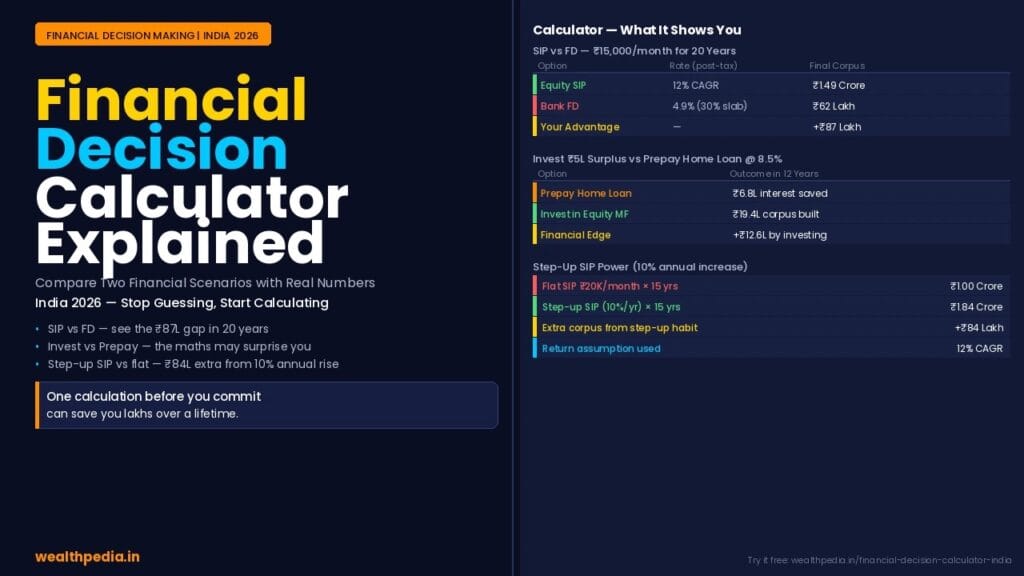

Financial decision making is, at its core, the act of choosing what to do with your money. But that simple definition hides a great deal of complexity. Every rupee you earn presents you with at least four choices: spend it now, save it, invest it, or use it to repay debt. Each of those choices has consequences that ripple across weeks, months, and decades. The quality of your financial decisions — made consistently, over time — will do more to determine your net worth than your salary, your job title, or even your inheritance.
In the academic sense, financial decision making refers to the cognitive and analytical process by which individuals and organisations evaluate monetary alternatives. It draws from economics (opportunity cost, utility maximisation), psychology (cognitive biases, emotional regulation), and mathematics (compound interest, probability). But for a salaried professional in Bengaluru or a small business owner in Surat, it simply means: given my income, my goals, and my current situation, what is the smartest thing to do with this money right now?
What separates good financial decision makers from poor ones is not intelligence or education — it is process. Research consistently shows that people who follow a structured decision-making process achieve better financial outcomes than those who rely on intuition alone, regardless of income level. This is the central insight of behavioural economics: our brains are not naturally wired for rational financial thinking. We prefer immediate rewards over future ones, fear losses more than we value equivalent gains, and are heavily influenced by what those around us are doing.
Every financial decision has three dimensions that must be evaluated together. The first is the time dimension — when does the cost occur, and when does the benefit arrive? Buying a term insurance policy costs money today but delivers its benefit at some uncertain future point. Starting a SIP costs money monthly but builds wealth over 10–20 years. The second is the risk dimension — what is the probability that the expected outcome actually occurs? An equity mutual fund may deliver 12% annually on average, but in any given year it could fall 30%. A fixed deposit delivers certainty at the cost of lower returns. The third is the opportunity cost dimension — what are you giving up by making this choice? Every rupee spent on a new smartphone is a rupee not invested. Every year you delay starting your retirement corpus is a year of compounding foregone.
Understanding financial decision making as a disciplined, repeatable process — rather than a series of isolated gut calls — is the first and most important step toward building lasting wealth in India.
Quick Summary
Financial decision making is the process of evaluating money-related choices — spending, saving, investing, borrowing — using logic, data, and personal goals rather than emotion or impulse. For Indian investors navigating rising inflation, complex tax rules, and a rapidly expanding investment landscape, strong financial decision-making skills are not optional — they are the foundation of long-term wealth. This guide explains what financial decision making is, why it matters, the common traps that derail Indians, and a practical five-step framework you can apply today. Use the Financial Decision Calculator to model your next major money choice with real numbers.
Join Now →
Why Financial Decision Making Matters in India
The stakes of financial decision making in India are unusually high for several interconnected reasons, and understanding them helps explain why a structured approach matters more here than in many other countries.
India’s average CPI inflation over the last two decades has been approximately 6–7% per year. At 7% inflation, the purchasing power of your money halves roughly every 10 years. A family that needs ₹1 lakh per month today will need ₹2 lakh per month in 2035 just to maintain the same lifestyle. Poor financial decisions — like keeping all savings in a savings bank account earning 3.5% — guarantee a slow, invisible erosion of real wealth. Our article on how inflation affects your SIP corpus explores this dynamic in detail.
Social security in India is minimal for most workers. Unlike developed countries with robust pension systems, India’s government support in retirement is negligible for the vast majority of salaried professionals. The EPS pension from EPFO, while valuable, is capped and rarely sufficient as a primary retirement income source. Most Indians must fund their own retirement almost entirely through personal savings and investment — which means every financial decision made during the earning years has a compounding impact on retirement readiness.
The Indian investment landscape is simultaneously vast and confusing. Today’s investor can choose from direct equities, equity mutual funds, debt mutual funds, PPF, EPF, NPS, gold, REITs, sovereign gold bonds, fixed deposits, recurring deposits, real estate, and now digital assets. The volume of options — combined with aggressive mis-selling in the financial services industry — makes poor decisions easy and good ones hard. A financial decision-making framework is your primary defence against this complexity.
India’s dual tax regime, capital gains tax rules, Section 80C deductions, and LTCG exemption limits mean that the same investment can produce wildly different after-tax returns depending on how thoughtfully it is structured. A disciplined financial decision maker captures these benefits; an impulsive one leaves significant money on the table. Indian households also carry multi-generational financial responsibilities — children’s education, parents’ healthcare, weddings, property purchases — alongside individual retirement goals. Navigating these simultaneous obligations requires especially careful financial decision making and goal prioritisation.
The Five-Step Financial Decision Making Framework
A five-step framework — Define, Gather, Analyse, Decide, Review — transforms financial decisions from emotional reactions into structured, repeatable processes. This framework applies to decisions large and small, from whether to prepay your home loan to which mutual fund category to choose for your 15-year retirement SIP.
Step 1: Define the Decision and Your Goal
Before making a good financial decision, be crystal clear about what decision you are actually making and why. Most financial mistakes happen because people conflate the decision with the solution. “I should buy a flat” is not a clearly defined decision — it is already a conclusion. The actual decision might be: “Should I continue renting or purchase property in the next 12 months?” That framing opens up genuine analysis. Equally important is connecting the decision to a specific goal. A SMART financial goal is Specific, Measurable, Achievable, Relevant, and Time-bound. “I want to retire comfortably” is a wish. “I want to accumulate a retirement corpus of ₹5 crore by age 55, funded through monthly SIP investments” is a goal you can build a decision tree around.
Step 2: Gather Relevant Information
Once the decision is defined, gather the data you need — your current financial position (income, expenses, assets, liabilities), the costs and benefits of each option including hidden costs like exit loads and tax implications, the time horizon, historical performance data where relevant, and expert guidance where the decision is complex. For major decisions — taking a home loan, changing jobs, restructuring your investment portfolio — spend significant time on information gathering. For smaller decisions, a quick mental checklist suffices.
Step 3: Analyse Your Options
With information in hand, compare your options systematically. For most financial decisions, this means calculating the numbers. Use the Financial Decision Calculator at Wealthpedia to model different scenarios — what happens if you invest ₹10,000 per month in equity versus FD over 20 years? What is the break-even point if you prepay your home loan versus investing the same amount in mutual funds? At this stage, also assess the risks of each option — not just market risk, but liquidity risk, inflation risk, and execution risk.
Step 4: Make the Decision and Document It
Choose the option that best aligns with your goals, risk tolerance, and time horizon. Critically, document the decision: write down what you chose, why you chose it, and what conditions would cause you to revisit it. This documentation forces honesty about your reasoning and gives you a reference point for the review stage. Avoid the paralysis of waiting for perfect information — it never arrives. Make the best decision you can with what you have, and build in a review date.
Step 5: Review and Learn
Financial decisions are not one-and-done events. Life changes — income rises or falls, inflation shifts, tax laws change, family responsibilities evolve. Schedule a review of major financial decisions at least annually. Compare actual outcomes to expected ones. If a decision is underperforming, understand whether it is due to a flawed original decision or temporary market conditions. The review stage is where financial wisdom accumulates. Over time, you build a personal database of what works, what does not, and why — which makes every subsequent decision better than the last.
Types of Financial Decisions Every Indian Faces
Financial decisions fall into four broad categories — spending, saving, investing, and borrowing — and mastery in each is essential for holistic wealth building.
Spending decisions are the most frequent financial decisions you make. Every purchase — from your morning chai to a new car — is a spending decision. The key principle here is distinguishing needs from wants, and ensuring your spending aligns with your values and goals rather than social pressure or impulse. Indians are particularly susceptible to lifestyle inflation — the tendency for expenses to rise in lockstep with income — which silently destroys the savings rate needed for financial independence. You can benchmark your spending patterns against ideal savings rates for Indians to understand how you compare.
Saving decisions involve how much of your income to set aside and where to park it. Your savings rate is arguably the single most powerful lever in your financial life. As our analysis of savings rates and the FIRE journey in India shows, the difference between saving 20% and 40% of income can translate to a decade’s difference in retirement age. Saving decisions also include emergency fund sizing — how many months of expenses should you maintain in liquid, accessible form.
Investing decisions involve deploying your saved capital into assets that will grow in real terms. These decisions require understanding risk tolerance, time horizon, asset allocation, and tax efficiency. Poor investing decisions — like chasing last year’s top-performing fund, panic-selling during market corrections, or avoiding equity entirely due to fear — are among the most costly financial mistakes Indian investors make consistently.
Borrowing decisions involve loans, which are tools. Used wisely, they can accelerate wealth creation — a home loan to buy a property that appreciates, an education loan to fund a qualification that multiplies earnings. Used carelessly, they destroy wealth through high interest costs and compounding debt. The question is never simply “should I borrow” but “does this borrowing help me reach my goals faster than the alternatives?”
The Role of Opportunity Cost
Every financial decision has an opportunity cost — the value of the best alternative foregone — and making this cost visible is one of the most powerful habits you can build as a financial decision maker.
Consider a common scenario: you receive a ₹5 lakh bonus and use it to pay off your car loan at 9% interest. The opportunity cost of that decision is the return you could have earned by investing those ₹5 lakh in an equity mutual fund over 10 years. If equity delivers 12% CAGR, your ₹5 lakh would have become approximately ₹15.5 lakh. At 9% loan interest, your interest saving over the remaining loan tenure may be significantly less. In this case, investing might have been the superior financial decision — but only if you are disciplined enough to maintain the SIP and not spend the freed-up cash.
Opportunity cost thinking also applies to time. Every year you delay starting to invest carries a compounding cost. Our analysis of the real cost of waiting to start investing shows that a 5-year delay in starting a ₹10,000 per month SIP can reduce your eventual corpus by ₹1 crore or more over a 25-year horizon. The Financial Decision Calculator on Wealthpedia is specifically designed to make opportunity costs visible and comparable — enter two scenarios and immediately see the long-term financial difference between them.
Common Errors in Financial Decision Making
The most costly financial mistakes in India are not caused by lack of knowledge — they are caused by predictable cognitive errors that a structured process can prevent.
Recency bias means judging the future by the recent past. After a bull market, investors pile into equity expecting it to continue. After a crash, they flee to FDs just as recovery begins. This pattern is chronically expensive for Indian retail investors.
Analysis paralysis is waiting for more information before making a decision, indefinitely. It is particularly common with investing — people spend years researching the perfect mutual fund instead of starting with a reasonable choice. The cost of delay almost always exceeds the benefit of additional research.
Herd following means making financial decisions based on what friends, family, or social media are doing rather than on personal goals and data. This is the primary driver of mass investment into hot IPOs, thematic funds at peak valuations, and speculative real estate in oversupplied markets.
Ignoring inflation means making projections using nominal figures rather than inflation-adjusted ones. A corpus of ₹1 crore sounds large until you realise it will buy far less in 2040 than it does today. Every financial decision involving a multi-year horizon must be evaluated in real terms.
Confusing insurance with investment means buying endowment plans, money-back policies, or ULIPs as combination products that deliver neither adequate protection nor meaningful investment returns. Pure term insurance combined with diversified mutual fund investment is almost always the financially superior approach.
Anchoring to purchase price means refusing to sell an underperforming investment because you are waiting to break even. The purchase price is a sunk cost — what matters is the future expected return of this asset versus the alternatives available today.
Neglecting tax efficiency means making investment decisions without accounting for their tax impact. This is particularly relevant for mutual fund redemptions (STCG vs LTCG rules), FD interest (fully taxable at slab rate), and the optimal use of Section 80C instruments. The Financial Decision Calculator factors in post-tax returns when comparing scenarios.
How Emotions Hijack Your Financial Decisions
Fear and greed are the two dominant emotions that distort financial decision making — and recognising them in real time is a skill that separates wealth builders from wealth destroyers.
Emotions are not enemies — they are signals. But in financial decision making, emotional signals are frequently misleading. Fear shows up as avoiding equity because the market might fall, withdrawing SIPs during corrections, refusing to take a home loan because of job insecurity, or keeping excessive cash in savings accounts earning 3–4%. Fear prioritises the short-term comfort of certainty over long-term wealth accumulation.
Greed shows up as chasing momentum stocks or sectoral funds after a run-up, investing in unregulated schemes promising guaranteed 20% plus returns, taking excessive concentrated bets on a single stock or theme, or borrowing to invest during a euphoric market phase. Both emotions feel rational in the moment. The investor who exits equities after a 20% fall genuinely believes they are being prudent. The investor who pours money into a hot IPO genuinely believes they have identified a winning opportunity.
The antidote to both is a pre-committed, rules-based financial decision-making process — one that removes discretion at the exact moments when emotions are highest. This is why a written financial plan and a calculator-based analysis tool like the Financial Decision Calculator are so valuable: they anchor you to data and logic precisely when your instincts are most unreliable.
Tools and Calculators That Improve Your Financial Decisions
The right financial tools transform abstract decisions into concrete numbers, making better choices easier and more consistent. The gap between knowing what you should do and actually doing it is frequently bridged by the right tool.
The Financial Decision Calculator is the primary tool for this purpose on Wealthpedia. It allows you to compare two financial scenarios side by side — invest vs prepay, SIP vs FD, buy vs rent — and see the long-term monetary impact of each choice. Use it before any major financial decision.
The Multi-Goal FIRE Planner handles holistic financial planning across multiple simultaneous goals — retirement, child’s education, home purchase — showing how much you need to save and invest monthly to hit every target on time.
The Financial Health Score diagnoses the current state of your personal finances across six pillars: savings rate, debt ratio, emergency fund, investments, net worth, and insurance. Your score tells you exactly where your financial decision-making attention is most needed right now.
The SIP Calculator with Inflation Adjustment shows the real, purchasing-power-adjusted value of your monthly SIP over time — essential for making accurate retirement planning decisions.
The Retirement Corpus Calculator answers the foundational retirement question: how much do I need, and how much should I be saving and investing today to get there?
Financial Decision Making at Different Life Stages
The optimal financial decisions change significantly across life stages — what is right at 25 is often wrong at 45 — making age-appropriate decision frameworks essential for every investor.
In your twenties (ages 22–30), the most powerful asset you have is time. Decisions made in this decade have the greatest compounding impact of any in your financial life. The priority framework here is: build an emergency fund first, eliminate high-interest debt, maximise equity exposure through regular SIPs, and secure term insurance and health insurance coverage. A common mistake at this stage is delaying investment because income feels low. Even a ₹2,000–₹5,000 monthly SIP started at 22 will significantly outperform a ₹20,000 SIP started at 32 in absolute corpus terms.
In your thirties and early forties (ages 30–45), income typically accelerates and financial responsibilities multiply — home loan, children’s education planning, aging parents. Financial decision making in this phase must balance multiple competing goals simultaneously. The Multi-Goal FIRE Planner is specifically designed for this life stage. Key decisions include optimal home loan sizing, education savings vehicle selection, annual SIP step-ups, and insurance coverage reviews as liabilities grow.
In your pre-retirement years (ages 45–55), the nature of financial decisions shifts from accumulation to optimisation and risk reduction. Asset allocation should gradually de-risk — reducing equity exposure from perhaps 80–90% toward 60–70% as retirement approaches. Tax planning becomes increasingly important, particularly around LTCG harvesting and retirement account structuring. Tools like the early retirement calculator help you model whether you are on track or need to course-correct.
Post-retirement (ages 55+) financial decisions focus on wealth preservation and income generation. Key decisions involve withdrawal strategy, asset allocation in an income-generating portfolio, healthcare cost provisioning (with India’s medical inflation running at 10–14% annually), and estate planning. The safe withdrawal rate calculator helps determine how much you can withdraw annually without depleting your corpus.
Building a Personal Financial Decision Making System
The most effective financial decision makers in India do not rely on willpower or intelligence — they build systems that make good decisions the default and remove the conditions under which bad decisions thrive.
A personal financial decision-making system has four components. First, a written financial policy statement — your personal constitution for money. It documents your financial goals with amounts and timelines, your risk tolerance, your asset allocation targets, your savings rate target, and your rules for specific decision types. When you face a financial decision, you check it against this policy first, before emotions enter the picture.
Second, a regular financial review calendar. Monthly: review budget versus actual spending. Quarterly: review portfolio performance and rebalance if needed. Annually: update your financial plan, increase SIP amounts in line with income growth, review insurance coverage adequacy.
Third, pre-committed rules for high-emotion situations. Write these in advance: “If the market falls more than 20%, I will increase my SIP by 50% rather than reduce it.” “I will not make any investment decision within 48 hours of seeing a social media tip.” “Any windfall above ₹1 lakh will be split — 50% toward goals, 25% toward an experience, 25% toward debt or emergency fund.” These rules protect you from your worst-case decision-making self.
Fourth, the right tools used consistently. Use the Financial Decision Calculator before any decision involving more than ₹1 lakh. Check your Financial Health Score quarterly to monitor the overall health of your financial life. These tools convert vague intentions into precise numbers and dramatically improve decision quality over time.
Building this system takes effort upfront, but the payoff is enormous: you convert financial decision making from a stressful, ad-hoc activity into a calm, data-driven process. Over a 20–30-year wealth-building journey in India, that shift is worth crores.
Frequently Asked Questions
What is the simplest definition of financial decision making?
Financial decision making is the process of choosing what to do with your money — spend, save, invest, or repay debt — using a structured analysis of costs, benefits, risks, and goals rather than emotion or impulse.
Why do many Indians struggle with financial decision making?
Several factors contribute: limited formal financial education in schools and colleges, aggressive mis-selling by commission-based financial product distributors, cultural pressure to spend on social occasions, family obligations that create competing priorities, and the sheer complexity of the Indian tax and investment landscape. The solution is building a structured, personalised decision-making process anchored to your own goals.
What is the most important financial decision a young Indian can make?
Starting to invest early — even in small amounts — is the single highest-impact financial decision for young Indians. At 12% CAGR, ₹5,000 invested monthly from age 22 grows to approximately ₹3.5 crore by age 55. Starting at 32 instead reduces this to approximately ₹1 crore. No other single decision produces a larger compounding gap over a lifetime.
How does opportunity cost affect everyday financial decisions?
Every financial choice has an opportunity cost — the value of the best alternative you did not choose. Keeping ₹5 lakh in a savings account at 3.5% has an opportunity cost of approximately ₹2.9 lakh over 5 years compared to equity investment at 12% CAGR. Making opportunity costs explicit using a calculator is one of the fastest ways to improve the quality of your financial decisions.
What is a financial decision framework and why do I need one?
A financial decision framework is a structured, repeatable process for evaluating money choices. Without one, decisions default to emotion, social pressure, or habit — which consistently produce worse outcomes. The five-step framework in this guide — Define, Gather, Analyse, Decide, Review — is practical enough to apply to everyday decisions and rigorous enough for major financial choices.
How do I avoid making emotional financial decisions?
Build a written financial policy statement before emotions are elevated. Use data and calculators rather than intuition. Impose a mandatory 48–72 hour waiting period before any investment decision above a certain threshold. Discuss major decisions with a trusted, financially literate person. Recognise that fear and greed feel like logic in the moment — the only reliable defence is a pre-committed process.
Is there a calculator to help me compare two financial decisions?
Yes. The Financial Decision Calculator on Wealthpedia allows you to model and compare two financial scenarios side by side — such as SIP vs FD, invest vs prepay loan, or buy vs rent — and see the projected long-term impact of each choice with real numbers.
What is the difference between short-term and long-term financial decisions?
Short-term financial decisions (under 3 years) prioritise capital preservation and liquidity — emergency funds, short-term savings goals, debt repayment. Long-term decisions (7 years and beyond) can tolerate more risk in exchange for higher expected returns — equity mutual funds, NPS, ELSS. Mixing up time horizons — parking retirement funds in FDs, or using an emergency fund to invest in equity — is a consistently costly mistake.
How much of my income should I save to make good long-term financial decisions?
A savings rate of 20–30% of net income is the widely accepted minimum for building meaningful long-term wealth in India. FIRE practitioners typically target 40–60%. The right number depends on your goals, timeline, and current age. Use the ideal savings rate guide to find your personal target.
What role does inflation play in financial decision making?
Inflation is the silent benchmark every financial decision must beat. At 6–7% annual inflation, an FD returning 6.5% barely breaks even in real terms after tax. All financial decisions involving multi-year horizons must be evaluated in real, inflation-adjusted terms. The SIP calculator with inflation adjusts projections for this and prevents the common mistake of overestimating future purchasing power.
Should I consult a financial advisor or make decisions myself?
Both approaches can work — the key is having a clear process either way. Self-directed financial decision making works when you have the time, interest, and discipline to build and follow a system. A fee-only financial advisor adds value for complex situations — high-net-worth portfolios, business owner tax planning, or cross-generational wealth transfer. Avoid commission-based agents who recommend products without first understanding your complete financial situation.
What is the first step to improving my financial decision making today?
Calculate your current Financial Health Score — it takes under five minutes and gives you a clear picture of where your financial decisions are currently strong and where they most need attention. Then use the Financial Decision Calculator to model your next major financial choice with actual numbers before committing to it.
Disclaimer: The information on this page is for educational purposes only and does not constitute investment or financial advice. Please consult a SEBI-registered financial planner for personalised guidance. Wealthpedia™ (Trademark Reg. No. 4910385) is not a SEBI-registered investment advisor. All mutual fund references on this site are for Direct Plan, Growth option only.

Vishal Jhaveri is the founder of Wealthpedia and an MBA Finance professional with over 10 years of experience in financial planning, investing, and wealth creation. He specializes in FIRE (Financial Independence, Retire Early), retirement planning, investing, and personal finance education. Through Wealthpedia, he develops financial calculators and publishes evidence-based content to help Indian investors make informed financial decisions. He regularly reviews and updates Wealthpedia articles to reflect changes in tax, laws, investment regulations, and personal finance best practices.
Quick Wrap up