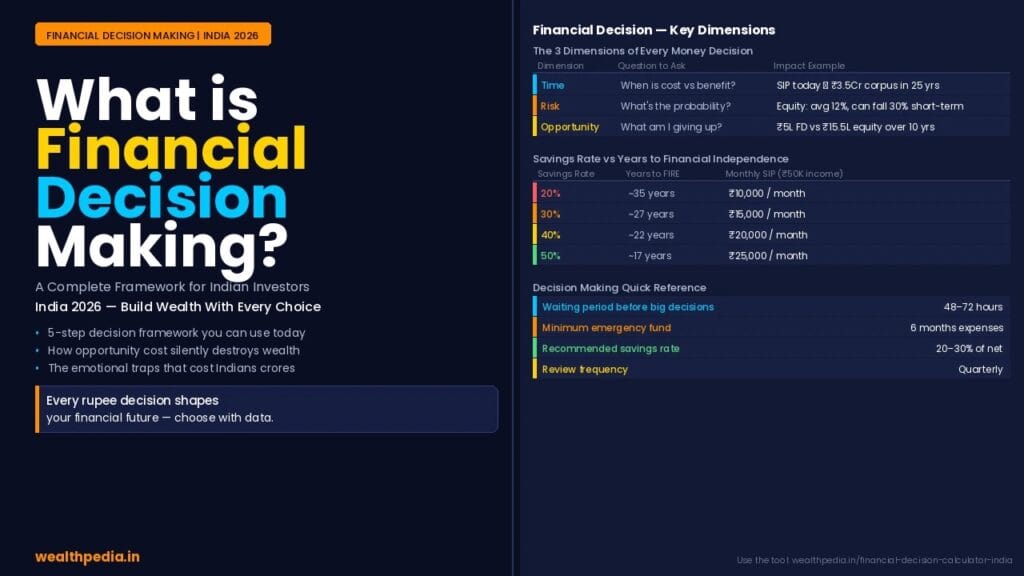

A common misconception in Indian personal finance is that financial outcomes are primarily determined by income. If you earn more, you will be wealthier. If you earn less, wealth is out of reach. The data does not support this view.
Across every income level, the gap between the best and worst financial outcomes among people with similar incomes is enormous — and it is explained almost entirely by the quality of financial decisions made over time, not by income differences within the cohort. A software engineer earning Rs 20 lakh per year who starts a Rs 25,000 monthly SIP at 28 and steps it up 10% annually will accumulate approximately Rs 5.8 crore by age 55. A colleague earning the same salary who spends lifestyle-inflated expenses, keeps savings in FDs, and starts investing seriously only at 38 might accumulate Rs 1.2 crore over the same period — on the same income.
The Rs 4.6 crore gap between these two outcomes is not a function of salary. It is entirely a function of decision quality: when to start, how much to invest, which instruments to use, and whether to stay invested through market cycles. This is the most important and most liberating insight in personal finance: your financial destiny is more within your control than you think, and it is shaped more by your decision quality than by factors outside your control.
This final article in the financial decision making cluster brings together every framework, tool, and principle covered in Articles 1–9 into a unified, practical guide for making consistently better financial decisions as an Indian investor. Think of it as the integration article — where the pieces come together into a complete picture.
Quick Summary
Making better financial decisions is not about being smarter — it is about having a better process. Every major financial outcome in your life is the product of decisions made over years and decades: when to start investing, how much to save, which instruments to use, whether to prepay debt or invest, how to respond to market corrections. Each decision, made well or poorly, compounds over time. This guide brings together the complete framework for making consistently better financial decisions as an Indian investor — from goal setting and opportunity cost to emotional control, risk assessment, and systematic review. Use the Financial Decision Calculator as your anchor tool throughout.
Join Now →
The Four Pillars of Better Financial Decision Making
Consistently better financial decisions rest on four pillars. Master all four, and your financial outcomes will improve reliably over time — not through luck or market timing, but through the compounding power of better choices applied consistently.
Pillar 1 — Clarity on Goals and Values
The foundation of every good financial decision is knowing what you are deciding toward. Without clear financial goals — specific, measurable, time-bound targets — financial decisions default to short-term optimisation, social comparison, and habit. You spend because others spend. You invest in what your colleague invested in. You avoid equity because your father avoided equity.
Clear financial goals reframe every decision. Instead of “should I buy this phone?” the question becomes “does this purchase advance or set back my goal of building a Rs 2 crore retirement corpus by age 55?” The goal provides a decision filter — a reference point against which every financial choice can be evaluated.
As covered in our SMART financial goals guide, effective goals are Specific (named with a rupee amount), Measurable (trackable with milestones), Achievable (calibrated to your income), Relevant (aligned with your actual priorities), and Time-bound (with a deadline that generates a monthly investment requirement).
Before improving anything else about your financial decision making, get crystal clear on your goals. Write them down. Assign rupee targets and timelines to each one. Calculate the monthly investment required for each goal using the Financial Decision Calculator. These numbers become your financial compass — the reference point for every decision that follows.
Pillar 2 — Systematic Analysis Before Commitment
Good financial decisions are characterised by analysis that happens before commitment, not rationalisation that happens after. The difference sounds obvious, but most financial decisions in practice involve the reverse: an emotional or intuitive initial response followed by selective information gathering that confirms the initial inclination.
Systematic analysis means applying the right analytical framework to each type of decision before acting. For investment comparisons, it means using the Financial Decision Calculator to model both options with real numbers and compare outcomes. For major financial commitments, it means running a cost benefit analysis that captures all costs — including opportunity costs — and all benefits. For investment portfolio construction, it means determining your risk tolerance before selecting instruments, not after.
The key analytical concepts that apply across financial decisions are:
The time value of money — understanding that the timing of costs and benefits matters as much as their magnitude. A rupee invested today at 12% is worth dramatically more than a rupee invested 10 years from now. See our complete time value of money guide.
Opportunity cost — every financial decision has a cost beyond its direct price: the return foregone on the best alternative. Keeping Rs 5 lakh in a savings account has an opportunity cost of approximately Rs 4 lakh over 10 years versus a liquid fund. See our opportunity cost guide.
Cost benefit analysis — the structured comparison of all costs and all benefits, converted to a common time basis, for any major financial decision. See our CBA guide for Indian investors.
Risk assessment — understanding your actual risk tolerance and capacity before constructing your investment portfolio. See our risk tolerance guide.
Pillar 3 — Emotional Discipline and Behavioural Systems
The most analytically sound financial decision is useless if you cannot execute it consistently over years and decades. And the greatest threat to consistent execution is emotion — the fear that drives panic selling at market lows, the FOMO that drives investment in hot sectors at market highs, and the inertia that prevents regular portfolio reviews and SIP step-ups.
As explored in our guide on emotional vs rational financial decisions, the solution to emotional financial decision making is not willpower or intelligence — it is systems. Systems that make good financial behaviour automatic and emotional override difficult.
The most effective behavioural systems for Indian investors are: automatic SIP mandates (the investment happens without a monthly decision), pre-committed rules for high-emotion scenarios (written in advance, followed when the scenario arrives), the 72-hour waiting period for large financial decisions, and regular scheduled reviews (which surface issues before they become crises, in a calm analytical environment rather than a reactive one).
Every system you build that reduces the number of real-time financial decisions you make — replacing them with pre-committed automatic behaviour — improves your long-term financial outcomes. The investment that happens automatically every month regardless of market conditions will outperform the investment that requires a fresh monthly decision in a world where market news, social comparison, and cognitive fatigue are constant.
Pillar 4 — Continuous Learning and Systematic Review
Financial decision making is a skill, and like all skills it improves with deliberate practice and feedback. The feedback mechanism for financial decisions is the regular review — comparing actual outcomes to expected outcomes, understanding why they diverged, and updating your decision framework accordingly.
The financial planning checklist introduced in Article 9 provides the structure for this review. The annual 12-point financial audit — checking emergency fund adequacy, insurance coverage, SIP step-ups, asset allocation, tax optimisation, and retirement trajectory — is the practical implementation of this pillar.
Beyond the annual review, building financial literacy continuously improves the quality of future decisions. Each concept you master — compounding, tax efficiency, asset allocation, rupee-cost averaging — becomes a lens that makes the next decision more analytically rigorous and less emotionally driven.
A Decision-by-Decision Framework — 12 Common Financial Decisions Improved
The most practical way to demonstrate better financial decision making is to apply the four pillars to specific, common decisions that Indian investors face. Here is a decision-by-decision application.
Should I Start a SIP Now or Wait Until I Have More Money?
Poor decision process: “I’ll start when I have Rs 10,000 per month to invest. Right now Rs 3,000 feels too small to matter.”
Better decision process: Apply the time value of money. Rs 3,000 per month at 12% CAGR for 30 years produces approximately Rs 1.05 crore. Starting 3 years later with Rs 10,000 (because income grew) produces approximately Rs 1.52 crore — but only if you start immediately when income reaches Rs 10,000. The 3 years of compounding on the Rs 3,000 SIP are worth approximately Rs 18 lakh in additional corpus. Start now with whatever you can invest. Increase as income grows.
Should I Invest in Index Funds or Active Funds?
Poor decision process: “My friend made 40% on a small-cap fund last year. I’ll invest in the same fund.”
Better decision process: Evaluate on risk-adjusted, long-horizon, post-cost returns. Over 15–20 year periods, most active large-cap funds in India have underperformed the Nifty 50 index after accounting for expense ratios. Index funds offer lower costs (0.1–0.2% expense ratio vs 0.5–1.5% for active funds), no fund manager risk, and market-matching returns. A core-satellite portfolio — 60–70% in index funds, 30–40% in carefully selected active funds with strong long-term track records — balances the cost and return arguments without making a binary all-or-nothing choice.
Should I Buy a Home or Continue Renting?
Poor decision process: “Everyone says you should own property. Renting is throwing money away.”
Better decision process: Apply cost benefit analysis with your specific numbers — city, property price, rental amount, loan rate, and investment return assumption. In cities with price-to-rent ratios above 25–30 (Mumbai, south Bengaluru, Delhi NCR), the financial CBA often favours renting and investing the down payment in equity over 15–20 years. In more affordable cities, buying is more competitive. Model your specific scenario using the Financial Decision Calculator and read our home loan vs rent analysis before deciding. Neither renting nor buying is universally correct — the right answer depends entirely on your numbers and life priorities.
Should I Prepay My Home Loan or Invest the Surplus?
Poor decision process: “Being debt-free feels better. I’ll prepay.”
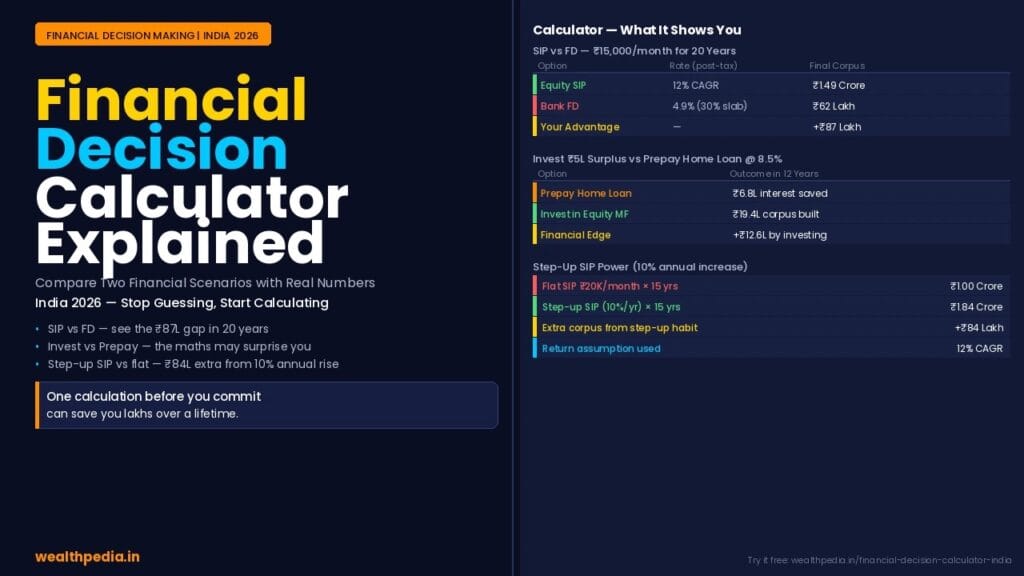
Better decision process: Compare loan interest rate to expected investment return, accounting for the home loan interest tax deduction. If your home loan rate is 8.75% and your effective after-tax loan cost is approximately 6.1% (at 30% tax bracket with full Section 24(b) deduction), and you expect 12% from equity, the financial case for investing over prepaying is strong. But if you are in the final 5 years before retirement and your risk capacity is low, the guaranteed return of debt elimination may outweigh the uncertain higher expected return of equity. Model both scenarios with the Financial Decision Calculator.
Should I Buy Term Insurance or an Endowment Plan?
Poor decision process: “The bank’s relationship manager recommended a savings-cum-insurance plan that gives me my money back at maturity.”
Better decision process: Apply opportunity cost analysis. An endowment plan at Rs 1 lakh annual premium for 20 years returns approximately Rs 28–32 lakh at maturity — an effective return of 4–6% CAGR. The same Rs 1 lakh per year in an equity SIP (after paying Rs 12,000–15,000 per year for a Rs 1 crore term insurance policy) would produce approximately Rs 78–98 lakh at 12% CAGR. The opportunity cost of the endowment plan versus the term plus equity combination is Rs 50–70 lakh over 20 years. Always separate insurance (pure term) from investment (mutual funds).
Should I Increase My SIP or Build a Larger Emergency Fund?
Poor decision process: “I have Rs 2 lakh in my savings account. I’ll just add more to my SIP.”
Better decision process: Check the emergency fund target first. If you spend Rs 60,000 per month and your savings account balance is Rs 2 lakh, you have approximately 3 weeks of emergency coverage — far below the 6-month target of Rs 3.6 lakh. The emergency fund takes priority: direct all surplus toward completing it first (in a liquid fund, not a savings account), then redirect to the investment SIP. A partially funded emergency fund exposes you to the risk of being forced to redeem your SIP investments at a loss during a market downturn coinciding with a personal financial shock.
Should I Choose the Old or New Tax Regime?
Poor decision process: “My HR said the new regime is simpler. I’ll switch.”
Better decision process: Model your tax liability under both regimes with your actual income and actual deductions. The new regime has lower rates but no deductions. If you have significant 80C investments (Rs 1.5 lakh), health insurance premiums (Rs 25,000+), HRA exemption, and home loan interest deduction, the old regime often produces lower total tax for incomes below Rs 15–20 lakh. At higher incomes where the rate differential dominates the deduction benefit, the new regime may win. Calculate your specific position every financial year before filing — the optimal choice changes as income, deductions, and tax slabs evolve.
Should I Invest a Windfall as a Lump Sum or via STP?
Poor decision process: “I got a Rs 15 lakh bonus. Should I put it all in the market now or wait?”
Better decision process: Evaluate through both TVM and behavioural lenses. Purely from a TVM perspective, a lump sum invested today has more compounding time than the same amount deployed gradually — in a rising market, lump sum typically outperforms STP. But the behavioural risk of a large lump sum is real: a sharp correction immediately after a large investment can trigger panic exit, destroying the TVM advantage. For most Indian retail investors who have not experienced a full bear market, deploying a large windfall over 6–12 months via Systematic Transfer Plan (STP) from a liquid fund into equity provides a psychological buffer that protects the investment from emotional exit. The slight theoretical cost of the STP is often worth the behavioural protection it provides.
The Financial Decision Quality Self-Assessment
Use this self-assessment annually to track your financial decision making quality over time. Rate each dimension from 1 (never) to 5 (consistently).
Goal clarity: Do you have written financial goals with specific rupee targets and timelines for each? Pre-analysis habit: Do you run quantitative analysis before committing to any financial decision above Rs 50,000? Opportunity cost awareness: Do you regularly consider the opportunity cost of your financial choices, including idle cash and low-return instruments? Emotional discipline: Do you maintain your investment behaviour during market corrections and resist FOMO during bull markets? Risk alignment: Is your investment portfolio aligned with your actual risk tolerance and capacity? Tax efficiency: Do you actively plan to maximise deductions, harvest LTCG, and choose the optimal tax regime? Review cadence: Do you review your complete financial plan at least annually and after every major life event? Financial literacy: Have you materially increased your financial knowledge in the last 12 months?
A score of 32–40 indicates strong financial decision making habits. A score of 20–31 indicates a solid foundation with clear improvement areas. A score below 20 indicates significant gaps that, if addressed, could meaningfully improve your long-term financial outcomes.
Building Your Personal Financial Decision Making System
The culmination of this entire cluster is a personal financial decision making system — a documented, structured approach to every significant money choice you will face. Here is what that system looks like in practice.
Your system starts with a written financial policy statement: your goals (with amounts, timelines, and monthly SIPs), your target asset allocation, your risk profile, and your pre-committed rules for specific scenarios. This document is your financial constitution — referenced before every significant decision.
It continues with the right tools: the Financial Decision Calculator for comparing any two financial scenarios, the Financial Health Score for quarterly overall health monitoring, the Retirement Corpus Calculator for retirement trajectory tracking, and the Multi-Goal FIRE Planner for holistic multi-goal management.
It is maintained by a regular review cadence: monthly budget versus actual tracking, quarterly portfolio and health score review, annual comprehensive financial plan audit using the financial planning checklist.
And it is protected by behavioural guardrails: the 72-hour rule for large decisions, pre-committed SIP mandates that run without monthly decisions, written rules for market corrections and windfall deployment, and separation of social financial pressure from independent financial analysis.
This system — once built and maintained — does not guarantee perfect outcomes. Markets are uncertain. Life events are unpredictable. But it guarantees a quality of financial decision making that, applied consistently over 20–30 years, produces meaningfully better financial outcomes than the alternative: ad hoc, emotion-driven, socially-influenced financial choices that leave too much of your financial future to chance.
Frequently Asked Questions
How can I make better financial decisions starting today?
Start with three immediate actions: check your Financial Health Score to identify your biggest gaps, write down your top three financial goals with specific rupee targets and timelines, and run your next pending financial decision through the Financial Decision Calculator before committing. These three actions take under an hour and produce immediate clarity on both your current position and your next most important financial decision.
Why do people make poor financial decisions even when they know better?
Knowledge of what to do and actually doing it are separated by two barriers: emotion and inertia. Most people know they should start a SIP, increase their term cover, and stop paying credit card interest — but fear, procrastination, and competing demands prevent action. The solution is systems and automation that remove the decision from the moment of action: auto-SIP mandates, calendar reminders for annual reviews, and pre-committed rules for high-emotion scenarios.
What is the single most impactful financial decision an Indian can make?
Starting to invest in equity mutual funds early — ideally before age 30 — and maintaining the investment consistently through market cycles. The compounding impact of 30 years of equity investment at 12% CAGR transforms even modest monthly amounts into life-changing corpus. No other single decision produces a larger wealth differential over a lifetime.
How do I stop making emotional financial decisions?
Apply the six-part framework from our emotional vs rational decisions guide: the 72-hour rule, pre-mortem analysis, decision journaling, separation of social pressure from financial analysis, pre-committed rules for high-emotion scenarios, and calculator-based data anchoring before every major decision.
What is the role of the Financial Decision Calculator in improving decision quality?
The Financial Decision Calculator serves as the analytical engine for financial decision making — it converts abstract choices into concrete rupee outcomes, making the cost of poor decisions visible and the benefit of good ones motivating. Use it before any decision involving more than Rs 1 lakh or a time horizon of more than 1 year.
How do I know if my financial decisions are improving over time?
Use the financial decision quality self-assessment in this article annually. Track your Financial Health Score quarterly — a score that rises over successive quarters indicates improving financial decision quality in practice. Review your corpus trajectory against your goal projections annually — if actual corpus is tracking close to projected corpus, your investment decisions are producing the expected outcomes.
Is it better to make my own financial decisions or hire an advisor?
Both approaches can produce good outcomes. Self-directed financial decision making using the framework in this series is effective for most Indian investors with moderate complexity — salaried income, straightforward investment goals, standard tax situation. A fee-only financial advisor (not commission-based) adds genuine value for high-net-worth situations, complex tax structures, business owner planning, or investors who lack the time or inclination to develop financial literacy. Avoid commission-based agents whose incentives are not aligned with your financial outcomes.
How does improving financial decision making compound over time?
Every better financial decision produces a slightly improved financial position, which creates more options for the next decision. Starting SIP earlier means more corpus at the first correction — which means less emotional pressure to exit. More corpus means more flexibility to make long-term decisions rather than short-term reactive ones. More financial knowledge means faster, more confident analysis. The quality of financial decision making is itself subject to compounding — and a deliberate investment in decision making skill now pays dividends across every financial decision for the rest of your life.
What is the most common financial decision mistake Indian investors make?
Delaying the start of equity investment — waiting for the “right time,” waiting until income is higher, or simply defaulting to FDs because equity feels risky. The rupee cost of this delay, measured in foregone compounding, is the single largest wealth gap between Indian investors who achieve financial independence and those who struggle despite adequate income.
How does goal clarity improve financial decision making?
Goals provide a decision filter for every financial choice. When you have a clear written goal — “Rs 2 crore retirement corpus by age 55, funded through a Rs 22,000 monthly equity SIP” — every financial decision can be evaluated against this benchmark. A Rs 3 lakh car upgrade costs Rs 15+ lakh in 15-year future value. An endowment plan costs Rs 50–70 lakh in 20-year opportunity cost. These costs become visible only when you have a goal to measure them against.
What resources on Wealthpedia help me make better financial decisions?
The Financial Decision Calculator for scenario comparison, the Financial Health Score for overall health monitoring, the Retirement Corpus Calculator for retirement planning, the Multi-Goal FIRE Planner for holistic goal management, and this complete 10-article Financial Decision Making series — covering opportunity cost, time value of money, SMART goals, CBA, emotional bias, risk tolerance, and financial planning checklist.
What is the best next step after reading this guide?
Check your Financial Health Score to identify your current financial decision making gaps. Then work through the financial planning checklist to address each priority item in sequence. Use the Financial Decision Calculator for every major financial decision going forward. And return to this series annually — re-reading the articles on opportunity cost, emotional decisions, and risk tolerance at each annual review reinforces the framework and surfaces new applications as your financial situation evolves.
Disclaimer: The information on this page is for educational purposes only and does not constitute investment or financial advice. Please consult a SEBI-registered financial planner for personalised guidance. Wealthpedia (Trademark Reg. No. 4910385) is not a SEBI-registered investment advisor. All mutual fund references on this site are for Direct Plan, Growth option only.

Vishal Jhaveri is the founder of Wealthpedia and an MBA Finance professional with over 10 years of experience in financial planning, investing, and wealth creation. He specializes in FIRE (Financial Independence, Retire Early), retirement planning, investing, and personal finance education. Through Wealthpedia, he develops financial calculators and publishes evidence-based content to help Indian investors make informed financial decisions. He regularly reviews and updates Wealthpedia articles to reflect changes in tax, laws, investment regulations, and personal finance best practices.
Quick Wrap up