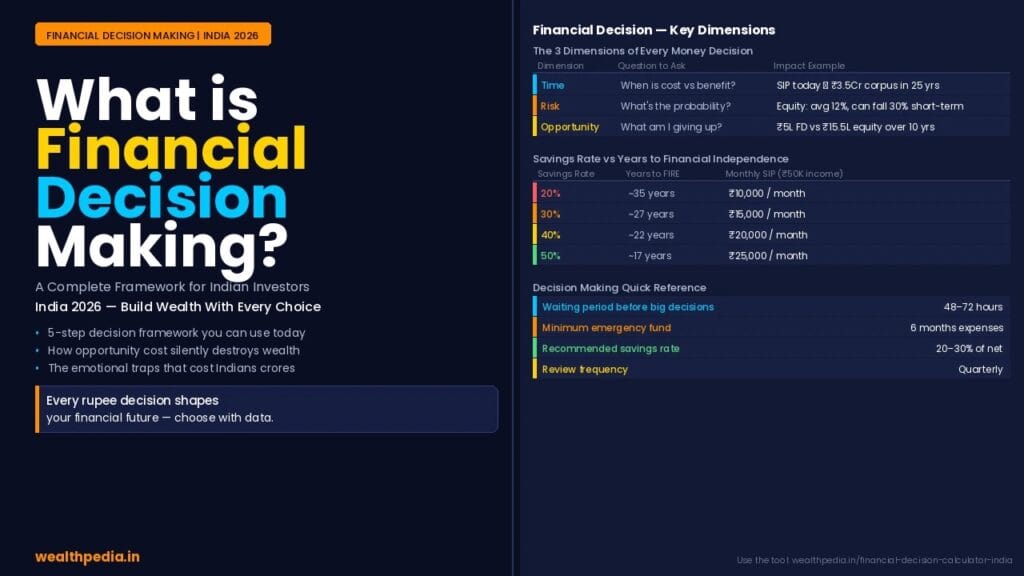

The time value of money is the idea that a rupee available today is worth more than the same rupee available at some point in the future. This is not inflation hedging or investment theory — it is a fundamental economic principle rooted in a simple observation: money available now can be put to work immediately, generating returns that accumulate over time. Money available in the future cannot do this. Therefore, the further in the future you receive a sum, the less it is worth to you today.
This principle underpins virtually every concept in personal finance — compound interest, SIP planning, retirement corpus calculations, loan amortisation, insurance valuation, and the comparison of investment alternatives. Understanding the time value of money is not optional for Indian investors who want to make sound financial decisions. It is the lens through which every significant money choice should be evaluated.
Think of it this way. If someone offered you the choice between receiving ₹1 lakh today or ₹1 lakh exactly one year from now, which would you choose? The rational answer is to take it today — not because you are greedy or impatient, but because ₹1 lakh invested today at even a modest 7% would become ₹1.07 lakh by next year. The future payment is economically inferior to the present one. If the future payment were ₹1.07 lakh instead of ₹1 lakh, the offers would be equivalent in financial terms — the additional ₹7,000 compensating you precisely for the one-year delay.
This exchange rate between money today and money in the future is determined by the interest rate or expected return — which is why interest rates are so central to all of finance. They are the price of time.
In practical Indian financial life, the time value of money governs the most important decisions you will ever make with your money — when to start investing, how long to stay invested, whether to prepay a loan or invest the surplus, and how much you need to save today to fund a goal decades away. The Financial Decision Calculator applies TVM calculations automatically whenever you compare two financial scenarios — making this abstract principle concrete and immediately actionable.
Quick Summary
The time value of money (TVM) is the foundational principle of all personal finance: a rupee today is worth more than a rupee tomorrow, because today’s rupee can be invested and compounded into a larger sum. For Indian investors, TVM explains why starting a SIP at 25 is worth dramatically more than starting at 35, why inflation erodes the real value of idle cash, and why every year of delay in building a retirement corpus carries a compounding cost. This guide explains TVM in plain terms, shows the maths with real Indian examples, and connects it directly to the Financial Decision Calculator so you can apply it to your own money decisions today.
Join Now →
The Two Core TVM Concepts — Present Value and Future Value
All time value of money applications rest on two core concepts: present value and future value. Understanding both is essential for applying TVM to real financial decisions.
Future Value (FV) answers the question: if I invest a sum of money today at a given return rate, how much will it be worth at some point in the future? This is the calculation you are implicitly running every time you think about whether a SIP will be enough for retirement, or whether a fixed deposit will cover a goal in 5 years.
The future value of a lump sum is calculated as: FV = PV × (1 + r)^n, where PV is the present value (the amount you have today), r is the annual return rate expressed as a decimal, and n is the number of years.
A practical example: ₹5 lakh invested today at 12% CAGR for 15 years. FV = 5,00,000 × (1.12)^15 = 5,00,000 × 5.47 = ₹27.4 lakh. Your ₹5 lakh becomes ₹27.4 lakh simply by staying invested for 15 years at a realistic long-term equity return. The ₹22.4 lakh of growth — nearly 4.5 times your original investment — is the reward for respecting the time value of money.
Present Value (PV) answers the reverse question: how much do I need today to reach a specific financial goal in the future? This is the calculation behind retirement planning — if you want ₹2 crore in 20 years and expect 12% returns, how much do you need to invest in a lump sum today to get there?
PV = FV ÷ (1 + r)^n. For ₹2 crore in 20 years at 12%: PV = 2,00,00,000 ÷ (1.12)^20 = 2,00,00,000 ÷ 9.65 = approximately ₹20.7 lakh. You need to invest approximately ₹20.7 lakh today in a lump sum at 12% CAGR to have ₹2 crore in 20 years. If you do not have ₹20.7 lakh as a lump sum, the equivalent monthly SIP would be approximately ₹22,000 per month — a calculation the Financial Decision Calculator and Retirement Corpus Calculator can run for your specific numbers.
Compound Interest — The Engine of TVM
The time value of money derives most of its power from compound interest — the process by which returns are earned not just on the original principal but on all previously accumulated returns as well. Albert Einstein is famously (though apocryphally) credited with calling compound interest the eighth wonder of the world. Whether or not he said it, the principle is correct.
Simple interest on ₹1 lakh at 10% for 10 years produces ₹10,000 per year × 10 years = ₹1 lakh in total interest — your corpus grows from ₹1 lakh to ₹2 lakh.
Compound interest on the same ₹1 lakh at 10% for 10 years produces: FV = 1,00,000 × (1.10)^10 = ₹2.59 lakh — your corpus grows to ₹2.59 lakh, approximately 30% more than simple interest over the same period.
Extend the horizon to 20 years and the gap becomes dramatic. Simple interest: ₹3 lakh total corpus. Compound interest: FV = 1,00,000 × (1.10)^20 = ₹6.73 lakh. The compounding advantage is ₹3.73 lakh — more than three times the principal — compared to simple interest.
At 30 years, compound interest at 10% turns ₹1 lakh into ₹17.45 lakh. Simple interest produces ₹4 lakh. The compounding advantage at 30 years is ₹13.45 lakh on a ₹1 lakh investment. This is the mathematical foundation of why starting early and staying invested long is the most powerful wealth-building strategy available to any Indian investor.
For SIP investments — where you are adding to your corpus every month — the compounding effect is even more pronounced, because each monthly contribution immediately begins compounding on its own timeline. A ₹10,000 monthly SIP at 12% CAGR over 25 years produces approximately ₹1.89 crore. The total amount invested is ₹30 lakh. The returns from compounding account for ₹1.59 crore — more than five times the invested principal. This is the time value of money working at full power.
The Rule of 72 — A Simple TVM Tool
Before calculators, investors and mathematicians used the Rule of 72 to quickly estimate how long it takes for an investment to double. The rule is simple: divide 72 by the annual return rate to get the approximate number of years it takes for an investment to double.
At 6% (FD rate): 72 ÷ 6 = 12 years to double your money.
At 8% (PPF rate): 72 ÷ 8 = 9 years to double your money.
At 12% (equity MF CAGR): 72 ÷ 12 = 6 years to double your money.
At 15% (aggressive equity): 72 ÷ 15 = 4.8 years to double your money.
The Rule of 72 makes the time value of money viscerally clear. ₹10 lakh in an FD doubles to ₹20 lakh in 12 years, then to ₹40 lakh in 24 years, then to ₹80 lakh in 36 years — three doublings over 36 years.
The same ₹10 lakh in equity at 12% doubles to ₹20 lakh in 6 years, ₹40 lakh in 12 years, ₹80 lakh in 18 years, and ₹1.6 crore in 24 years — four doublings in 24 years. The difference between three doublings and four doublings is the difference between ₹80 lakh and ₹1.6 crore on the same starting capital. That is the time value of money in action — and it is the reason why the opportunity cost of choosing a lower-return instrument for long-horizon goals is so enormous.
The Rule of 72 also works in reverse for inflation. At 6% inflation, your purchasing power halves in 12 years. At 7% inflation, it halves in approximately 10 years. This is why keeping cash idle — in a savings account or under the proverbial mattress — is not a neutral act. It is an active erosion of purchasing power, measurable and compounding.
TVM and the Real Cost of Delay in India
Nothing illustrates the time value of money more powerfully than the cost of delay — the financial gap created by starting an investment one year, five years, or ten years later than you could have.
Consider three investors — all aiming for a ₹2 crore retirement corpus, all investing in equity mutual funds at 12% CAGR, all retiring at age 60.
Investor A starts at age 25. Monthly SIP required: approximately ₹4,200.
Investor B starts at age 30. Monthly SIP required: approximately ₹7,500.
Investor C starts at age 35. Monthly SIP required: approximately ₹14,400.
From age 25 to 35, Investor A invests ₹4,200 × 12 × 10 = ₹5.04 lakh in total contributions over the decade before Investors B and C even begin. Yet Investor C must contribute ₹14,400 per month — more than three times Investor A’s monthly investment — for the remaining 25 years, just to reach the same corpus. The ten extra years of compounding time that Investor A purchased with early action is worth more than three times the monthly investment rate in additional monthly burden for Investor C.
Total lifetime contributions tell the complete story:
- Investor A: ₹4,200 × 12 × 35 years = ₹17.6 lakh total invested
- Investor B: ₹7,500 × 12 × 30 years = ₹27 lakh total invested
- Investor C: ₹14,400 × 12 × 25 years = ₹43.2 lakh total invested
All three end up with ₹2 crore. But Investor A contributed only ₹17.6 lakh from their own pocket, while Investor C contributed ₹43.2 lakh — nearly 2.5 times as much — to reach the same destination. The difference is the time value of money. Starting 10 years earlier bought Investor A ₹25.6 lakh in reduced lifetime contributions on the same outcome.
This is why our article on what is financial decision making identifies starting to invest early as the single most impactful financial decision a young Indian can make. And it is why the Financial Decision Calculator should be the first tool you use whenever you are considering delaying an investment decision — so you can see the rupee cost of that delay before committing to it.
TVM in Practice — Key Indian Financial Decisions
The time value of money is not just a theoretical concept — it directly governs the most important financial decisions Indian investors face.
Retirement Planning
Retirement planning is the purest application of TVM in personal finance. The question “how much do I need to save today to fund a specific monthly income in retirement, 20–30 years from now?” is entirely a present value calculation. The answer depends on three TVM variables: the target retirement corpus (future value), the expected return on investments (the discount rate), and the time horizon (n).
Our Retirement Corpus Calculator runs this calculation automatically for your specific numbers. What TVM teaches us about retirement planning is that the time horizon variable is the most powerful — a 5-year extension of your working life (from retiring at 55 to retiring at 60) dramatically reduces the monthly SIP burden because it gives compounding more time to work.
Home Loan — EMI vs Tenure Decisions
When taking a home loan, the time value of money explains why a shorter tenure costs you far less in total even though the monthly EMI is higher. On a ₹50 lakh home loan at 9% interest, the difference between a 20-year tenure and a 15-year tenure is approximately ₹22 lakh in total interest paid — even though the monthly EMI difference is only around ₹4,000–5,000. Every month of loan tenure is a month during which the outstanding principal is earning interest for the bank, not compounding returns for you.
TVM also explains why prepaying a home loan early in the tenure saves far more interest than prepaying late. In the early years of an EMI schedule, most of the payment goes to interest — so reducing the principal early has a disproportionate impact on total interest. Our article on should you close your loan early models this in detail.
SIP Versus Lump Sum — When Does Each Work Better?
TVM also governs the SIP versus lump sum decision. If you have a windfall of ₹10 lakh, should you invest it all at once or spread it over 12 months via systematic transfer? From a pure TVM perspective, a lump sum invested today has more time to compound than the same amount deployed gradually — which is why, in rising markets, lump sum investing often outperforms STP (systematic transfer plan) on a pure return basis.
However, TVM is not the only variable in this decision — sequence of returns risk matters too. If markets fall sharply after a lump sum investment, the interim loss can be psychologically damaging enough to cause premature exit. The Financial Decision Calculator can model both scenarios with your specific amounts and expected return assumptions so you can make the decision with full numerical context.
Insurance — The TVM Argument for Term Over Endowment
The time value of money is the mathematical foundation for the term insurance argument over endowment and whole-life policies. An endowment policy that returns your premium at maturity looks like a free insurance policy — you pay in, and you get back what you paid. But TVM shows the true cost: the premiums you paid 20 years ago had a much higher present value than the nominal sum returned today. If the same premium amounts had been invested in equity mutual funds, the corpus at maturity would be dramatically larger.
This is exactly the calculation modelled in our article on opportunity cost in personal finance — endowment vs term plus equity is one of the largest single financial decisions where TVM thinking produces a dramatically different outcome than intuitive comparison.
Inflation — The Negative Time Value of Money
Inflation is, in effect, the negative application of the time value of money. Just as investing produces compound growth that increases the future value of your money, inflation produces compound erosion that decreases the future purchasing power of your money.
India’s average CPI inflation over the last 20 years has been approximately 6–7% per year. At 7% inflation, the purchasing power of ₹1 lakh today halves to approximately ₹50,800 in 10 years, and falls to approximately ₹25,800 in 20 years. This means that a retirement corpus of ₹2 crore accumulated by 2045 does not represent ₹2 crore in today’s purchasing power — it represents approximately ₹62 lakh in real terms at 6% inflation over 20 years.
This inflation-adjusted perspective completely changes how you think about retirement planning. The question is not “how do I accumulate ₹2 crore?” It is “how do I accumulate a corpus that has ₹2 crore of purchasing power in today’s terms at my target retirement date?” That requires significantly larger nominal corpus targets and significantly higher investment rates than inflation-blind planning suggests.
Our SIP calculator with inflation adjustment incorporates this into every projection, showing you both the nominal and real values of your SIP at different time horizons. Always use the inflation-adjusted figure as your primary planning benchmark, not the nominal corpus.
For a complete framework on how inflation impacts financial decisions at every stage of wealth building, see our article on how inflation affects your SIP corpus.
Net Present Value — Making TVM Work for Complex Decisions
For more complex financial decisions — such as whether to buy a property as an investment, whether to take an education loan for a premium course, or whether to start a business — the concept of Net Present Value (NPV) provides a rigorous TVM-based framework.
NPV calculates the present value of all future cash flows associated with a decision (returns, rental income, salary increases, etc.) and subtracts the present value of all costs (upfront investment, EMIs, operating costs, etc.). If NPV is positive, the decision creates value in present-value terms. If NPV is negative, the decision destroys value.
In Indian real estate investment, for example, NPV analysis often reveals that rental yields (typically 2–3% in major Indian cities) are far too low to justify the capital locked in a property compared to what the same capital would earn in equity mutual funds over the same period. Our article on buying vs renting a home in India uses NPV concepts to compare these two paths with real city-specific numbers.
How to Use TVM in Your Daily Financial Decisions
Making TVM thinking habitual does not require a finance degree. It requires three practical shifts.
The first is always asking “what is the future value of this money?” before any significant spending decision. Spending ₹1 lakh on a lifestyle upgrade at age 30 is not a ₹1 lakh decision — it is a ₹5+ lakh decision in 15-year future value terms at 12% CAGR. That does not mean you should never spend; it means you should spend consciously, with full awareness of what each rupee could alternatively become.
The second is using the right tools for TVM calculations. The Financial Decision Calculator runs present value and future value calculations for any two scenarios side by side. The Retirement Corpus Calculator runs the reverse calculation — how much do you need to invest today to reach a future target. Use these tools before every major financial decision rather than estimating intuitively.
The third is building a personal financial review cadence. Check your Financial Health Score quarterly to ensure your money is positioned to benefit from the time value of money — not sitting in idle, low-return instruments where time works against you through inflation.
Frequently Asked Questions
What is the time value of money in simple terms?
The time value of money means that a rupee today is worth more than a rupee in the future because today’s rupee can be invested and grown. If you invest ₹1 lakh at 12% CAGR, it becomes ₹3.1 lakh in 10 years and ₹9.6 lakh in 20 years. The longer money is invested, the more the time value compounds in your favour.
Why is the time value of money important for Indian investors?
India has high inflation (6–7% per year), a wide range of investment options with very different returns (3.5% savings account to 12%+ equity), and limited social security — meaning most Indians must self-fund retirement entirely. In this environment, every year of delayed investment and every rupee in a low-return instrument carries a large, compounding opportunity cost. TVM makes these costs visible and quantifiable.
What is the formula for the time value of money?
For a lump sum: Future Value = Present Value × (1 + r)^n, where r is the annual return rate and n is the number of years. For present value: PV = FV ÷ (1 + r)^n. For monthly SIP: use the SIP future value formula, or simply use the Financial Decision Calculator to run both calculations instantly.
What is the Rule of 72?
The Rule of 72 is a quick mental calculation for estimating how long it takes an investment to double. Divide 72 by the annual return rate: at 12% CAGR, money doubles every 6 years. At 6% FD, money doubles every 12 years. At 7% inflation, purchasing power halves every ~10 years.
How does inflation affect the time value of money?
Inflation is the negative time value of money — it erodes the purchasing power of idle cash over time. At 6% inflation, ₹1 lakh today is worth only ₹55,800 in real terms after 10 years. This means every financial goal must be expressed in inflation-adjusted terms, and every investment must beat inflation in real returns to create genuine wealth.
How does TVM explain why I should start my SIP early?
TVM shows that early contributions have far more time to compound, reducing the monthly investment burden required to reach any given goal. Starting a SIP at 25 versus 35 to reach ₹2 crore by 60 requires ₹4,200 per month versus ₹14,400 per month — a 3.4× difference in monthly burden for the same outcome. The 10 extra years of compounding time is worth more than three times the monthly investment rate.
How is TVM applied in home loan decisions?
TVM explains why shorter loan tenures save dramatically more total interest despite higher monthly EMIs, why prepaying early in the loan tenure saves more than prepaying later, and why high home loan interest rates have a high opportunity cost relative to investing the surplus in equity. The Financial Decision Calculator can model your specific loan versus invest scenario.
What is present value vs future value?
Future value (FV) tells you what a sum of money today will be worth at a future date, given a return rate. Present value (PV) tells you what a future sum of money is worth today, discounted at a given rate. Both are applications of the same TVM formula — FV looks forward, PV looks backward. In retirement planning, PV tells you how much you need to invest today to fund a future goal.
What is the relationship between TVM and compound interest?
Compound interest is the mechanism through which TVM creates value. When interest is compounded — earned on both principal and previously accumulated interest — the growth rate accelerates over time. This acceleration is what makes long investment horizons so powerful and delayed starts so costly. Simple interest does not exhibit this non-linear growth, which is why compound interest instruments (equity MFs, PPF, NPS) are so much more powerful for long-horizon goals.
How can I use TVM to improve my financial decisions today?
Start by using the Financial Decision Calculator to run a future value calculation on any investment you are considering — and compare it to your best alternative. Then check your Financial Health Score to see where your money is currently positioned relative to where TVM thinking says it should be. Finally, set a reminder to increase your SIP annually — each year of delay in stepping up costs real compounding value.
Does TVM favour equity over debt instruments?
Over long horizons (7 years and beyond), TVM strongly favours equity over debt because equity’s higher expected return generates a compounding advantage that grows non-linearly over time. Over short horizons (under 3 years), the advantage of equity’s higher return is outweighed by its volatility risk — TVM still applies, but the appropriate return assumption is closer to the debt rate. The Financial Decision Calculator lets you model both at your specific horizon to see which comes out ahead for your situation.
How does TVM relate to the FIRE movement?
FIRE (Financial Independence, Retire Early) is built entirely on TVM. The earlier you start, the more aggressively you save and invest, and the longer your investments compound — the sooner you reach financial independence. Every year of early retirement you target adds approximately 5–8% to your required corpus, because your money must sustain you for longer. The Multi-Goal FIRE Planner models your FIRE timeline using TVM calculations across all your financial goals simultaneously.
Disclaimer: The information on this page is for educational purposes only and does not constitute investment or financial advice. Please consult a SEBI-registered financial planner for personalised guidance. Wealthpedia™ (Trademark Reg. No. 4910385) is not a SEBI-registered investment advisor. All mutual fund references on this site are for Direct Plan, Growth option only.

Vishal Jhaveri is the founder of Wealthpedia and an MBA Finance professional with over 10 years of experience in financial planning, investing, and wealth creation. He specializes in FIRE (Financial Independence, Retire Early), retirement planning, investing, and personal finance education. Through Wealthpedia, he develops financial calculators and publishes evidence-based content to help Indian investors make informed financial decisions. He regularly reviews and updates Wealthpedia articles to reflect changes in tax, laws, investment regulations, and personal finance best practices.
Quick Wrap up