
If someone asked you right now — “Are you financially healthy?” — what would you say?
Most Indians would pause. They’d think about their salary, maybe their savings account balance, perhaps the EMI they pay each month. Some would mention their CIBIL score. But none of that, individually, tells you whether your finances are truly in good shape.
That’s the gap a Financial Health Score fills.
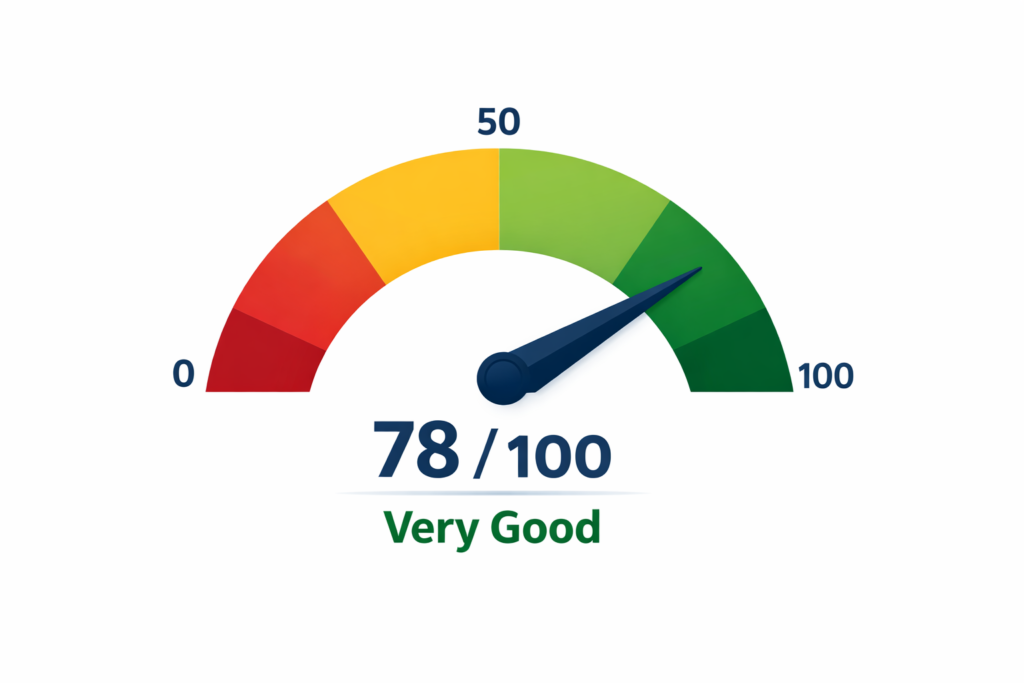
A Financial Health Score is a single composite number — typically out of 100 — that evaluates where you stand across every dimension of personal finance: your income, savings, debt, insurance, investments, and retirement readiness. Think of it as a comprehensive report card for your money life.
This guide breaks down everything an Indian needs to know about financial health scores — what they are, how they’re calculated, what the benchmarks mean for different life stages, and most importantly, what you can do to improve yours.
You can calculate your own score right now using the Wealthpedia Financial Health Score Calculator — a free, India-specific tool that evaluates your finances across six weighted dimensions.
What Is a Financial Health Score?
A Financial Health Score is not the same as your credit score. It is not a number a bank gives you. It’s a self-assessment framework that measures your overall financial wellbeing — not just your creditworthiness, but your ability to handle emergencies, grow wealth, stay out of debt, and retire comfortably.
In India, where a large portion of household wealth sits in physical assets like gold and real estate, and where social obligations (weddings, parental support, children’s education) create financial pressures that Western frameworks ignore, a generic “financial wellness” model doesn’t work. The Indian context demands a different lens.
A well-designed Indian Financial Health Score should account for:
- The role of EPF and PPF as retirement instruments
- Household dependents and joint family obligations
- Healthcare costs in a country with limited public insurance
- India-specific inflation rates (currently ~5–6% CPI, but healthcare inflation runs at 12–14%)
- Tax-advantaged instruments like NPS, ELSS, and Sukanya Samriddhi
The Wealthpedia Financial Health Score Calculator is built specifically for Indian conditions — not adapted from a US or UK model.
Why a Financial Health Score Matters More Than Your CIBIL Score
Most Indians obsess over their CIBIL score. And that makes sense — you need it for loans and credit cards. But a CIBIL score tells you exactly one thing: how reliably you’ve repaid debt in the past.
It says nothing about:
- Whether you have enough saved for emergencies
- Whether your insurance coverage is adequate
- Whether you’re on track for retirement
- Whether your debt burden is sustainable relative to your income
- Whether your net worth is growing year over year
We’ve written a detailed comparison on Financial Health Score vs CIBIL Score — and the short version is this: your CIBIL score tells lenders about you, while your Financial Health Score tells you about yourself.
A person can have a CIBIL score of 800 while being financially fragile — carrying high EMI obligations, zero emergency fund, no life insurance, and no investment portfolio. Conversely, someone with a modest CIBIL score of 720 but a disciplined savings rate, robust insurance coverage, and a growing investment corpus could be genuinely financially healthy.
The Six Pillars of Financial Health in India
The Wealthpedia framework evaluates financial health across six weighted pillars. Understanding each one helps you know where to focus your energy.
1. Emergency Fund Coverage (Weight: ~15–20%)
An emergency fund is money kept liquid and instantly accessible to cover unexpected expenses — a medical emergency, job loss, or sudden home repair — without forcing you to dip into investments or take a loan.
The Indian benchmark: 6 months of total household expenses, kept in a savings account, liquid mutual fund, or short-duration FD.
Many personal finance experts used to say 3 months is enough, but as we’ve argued in our piece on why the 3-month emergency fund rule is outdated, the reality for Indian households — especially self-employed individuals, single-income families, and those with aging parents to support — is that 6 months is the minimum and 12 months is safer.
Scoring logic:
- 0 months coverage: 0 points
- 1–2 months: Low
- 3–5 months: Moderate
- 6+ months: Healthy
- 12+ months: Excellent
You can also calculate how much emergency fund you should have based on your specific life situation.
2. Savings Rate (Weight: ~20%)
Your savings rate is the percentage of your post-tax income that you save and invest each month. It is arguably the single most predictive number in personal finance — more important than your salary, your investment returns, or your asset allocation.
The Indian data:
- The RBI’s Household Finance Survey found that average Indian household financial savings rate was around 11–12% of net disposable income in recent years — significantly lower than the 40%+ gross household savings rate that includes physical assets.
- Most Indian middle-class families save 5–15% of their income in financial instruments.
- Financial independence researchers generally agree that a 20–30% savings rate is required to build real, investable wealth in a career spanning 30–35 years.
The ideal savings rate in India for 2026 article on Wealthpedia breaks this down in detail, with tier-wise recommendations based on age, income, and family obligations.
Scoring logic:
- <5% savings rate: Poor
- 5–14%: Below average
- 15–24%: Moderate
- 25–34%: Good
- 35%+: Excellent (FIRE-grade)
3. Debt-to-Income Ratio (Weight: ~20%)
Your debt-to-income (DTI) ratio is the percentage of your gross monthly income that goes toward EMI payments — home loans, car loans, personal loans, credit card minimums.
This is one of the most underappreciated stress indicators in Indian personal finance. A high DTI leaves you with no financial flexibility. It means a job loss, a pay cut, or a medical emergency instantly becomes a default risk.
Indian benchmark:
- Below 20% DTI: Healthy. You have room to breathe.
- 20–35% DTI: Moderate. Manageable but watch for lifestyle creep.
- 35–50% DTI: Stressed. You’re over-leveraged.
- Above 50% DTI: Danger zone. A single income shock can cascade into default.
The debt-to-income ratio guide on Wealthpedia explains how to calculate this properly for Indian households where income is sometimes irregular or split between spouses.
We’ve also written extensively about how much debt is too much and the debt-free before FIRE philosophy that many Indian FIRE seekers follow.
4. Insurance Adequacy (Weight: ~15%)
India has a massive protection gap. The 2023 Swiss Re Sigma report estimated that India’s insurance protection gap — the difference between economic losses and insured losses — was one of the largest in Asia. For life insurance, most Indians are critically underinsured.
Two components matter:
Life Insurance:
The thumb rule most Indian financial planners use is 10–15x your annual income in term insurance coverage. Someone earning ₹12 lakhs per year should carry ₹1.2–1.8 crore in term life cover. This is pure protection, not investment — which means endowment plans, ULIPs, and LIC whole-life policies do not count toward this number in terms of coverage adequacy.
Health Insurance:
With healthcare inflation running at 12–14% annually (see our deep-dive on healthcare inflation in India), a family health cover of ₹5 lakhs is largely inadequate for families in Tier-1 cities where a single ICU hospitalization can cost ₹3–8 lakhs. The recommended benchmark:
- Individual (30s): ₹10 lakh minimum
- Family of 4 (30s–40s): ₹15–25 lakh, with a super top-up
- Family of 4 with aging parents: ₹25–50 lakh combined (separate senior citizen plans for parents)
Scoring logic for this pillar:
- No term insurance, no health insurance: 0
- Only employer-provided group health cover: Low (group covers lapse with job changes)
- Adequate term + adequate health: Healthy
- Optimal coverage + critical illness rider: Excellent
5. Investment Portfolio & Wealth-Building (Weight: ~15%)
This pillar measures whether you’re accumulating real, inflation-beating wealth. It evaluates:
- Whether you’re investing at all
- Whether your investments are diversified across asset classes
- Whether returns are beating inflation over a 5-year horizon
- The ratio of productive financial assets (equity mutual funds, NPS, EPF) to unproductive assets (cash in savings, gold jewellery, real estate with no rental yield)
India-specific context:
Indian households historically over-allocate to gold and real estate — both of which are illiquid, hard to value, and generate no cash flow. According to RBI data, only about 5–6% of Indian household savings go into equities and equity mutual funds, despite equities being the best wealth-building instrument over 15+ year horizons.
The Historical SIP Outcome Database for India — one of Wealthpedia’s research tools — shows that SIP investments in large-cap equity funds across rolling 10-year periods from 1995–2026 delivered median returns of 12–14% CAGR. Over 15-year periods, the worst historical outcome was still positive, around 9%.
This pillar also considers whether you’re using tax-efficient wrappers: PPF (EEE status), NPS (additional ₹50,000 deduction under 80CCD(1B)), ELSS (LTCG benefits), and the ₹1.25 lakh LTCG exemption on equity mutual funds.
6. Retirement Readiness (Weight: ~15–20%)
This is where most Indians score the lowest — and where the gap between perceived security and actual readiness is widest.
The uncomfortable data:
- According to PFRDA data, as of 2025, total NPS subscribers under the private sector (All Citizen Model) were around 50 lakh — out of a working-age population of 500+ million.
- A 2023 Max Life Insurance survey found that only 18% of Indians had a documented retirement plan.
- The same survey found that 61% of Indians expect to rely on family support during retirement.
- The average Indian EPF balance at retirement (based on EPFO data) is well under ₹10 lakhs for most workers — enough to last perhaps 2–3 years, not 25–30.
Retirement readiness is evaluated by comparing your current corpus trajectory against your required retirement corpus — a calculation that factors in your current age, target retirement age, monthly expenses, inflation, expected investment returns, and life expectancy.
You can calculate your specific number using the Retirement Corpus Calculator or the detailed how much money do you need to retire in India guide.
The Safe Withdrawal Rate for India article is also essential reading here — because the 4% rule from US research doesn’t translate directly to India’s inflation environment.
Financial Health Score Benchmarks by Age in India
A financial health score means different things at different life stages. Here are the benchmarks that matter most.
In Your 20s (22–29)
At this stage, you’re building foundations. Most people in their 20s are early in their careers with relatively low savings, high disposable income relative to obligations, and long investment horizons.
Priority areas:
- Start emergency fund (target: 3 months)
- Get term insurance early (cheapest in your 20s — a 1 crore cover for a 25-year-old costs roughly ₹6,000–9,000/year)
- Begin SIP habit — even ₹2,000/month started at 22 is worth more than ₹20,000/month started at 35
- Avoid lifestyle debt (personal loans for gadgets, travel loans)
Score target: 50–65 is solid in your 20s. Anything above 70 is exceptional.
See our detailed financial health score by age guide for the complete breakdown.
In Your 30s (30–39)
Your 30s are typically when income rises significantly but so do obligations: home EMI, child education planning, aging parent support, insurance premiums.
Priority areas:
- Savings rate should be 20–30% by now
- Emergency fund: 6 months minimum
- DTI should be below 35% even with home loan
- Investment portfolio should show 5+ year track record
- Health insurance for entire family including parents
Score target: 60–75. If you’re above 80 in your 30s, you’re on a FIRE trajectory.
The 10 levels of financial freedom framework is a useful companion read here.
In Your 40s (40–49)
This is the most consequential decade for retirement readiness. The power of compounding is still working hard for you, but the window is narrowing. By 45, many FIRE aspirants want to have achieved “Coast FIRE” — the point where existing investments, left untouched, will compound to a sufficient retirement corpus.
Priority areas:
- Retirement corpus tracking: are you 50–60% of the way there?
- Reduce debt aggressively — you want to enter retirement debt-free
- Begin equity glide path: gradually increase debt allocation as you approach retirement
- Critical illness insurance becomes more important
Score target: 70–80. If you’re below 60 in your mid-40s, you need urgent course correction.
The FIRE at 45 guide and FIRE at 50 guide both have detailed roadmaps.
In Your 50s (50–59)
Pre-retirement decade. Ideally, your biggest wealth-building is done and you’re in wealth preservation mode. The Sequence of Returns Risk Visualizer becomes very relevant here — a market crash in your early retirement years is far more damaging than one later.
Priority areas:
- Retirement corpus should be 70–90% accumulated
- Health insurance: upgrade to super top-up, consider senior citizen covers
- Estate planning: will, nominations updated across all accounts
- Succession planning for business owners
Score target: 75–90. Lower than 65 at age 55 with no pension source is a serious concern.
What Is a Good Financial Health Score in India?
Based on the Wealthpedia framework, here’s how to interpret your score: Score Range Grade What It Means 85–100 Excellent Financially resilient. All six pillars are strong. On track for FIRE or comfortable retirement. 70–84 Good Strong foundations with minor gaps. A few targeted improvements will get you to excellent. 55–69 Moderate Functional but fragile. One financial shock could derail your plan. Focus on the weakest pillar. 40–54 Below Average Multiple vulnerabilities. Prioritize emergency fund and insurance before investments. Below 40 Poor High financial stress risk. Immediate intervention needed across multiple dimensions.
For a deeper dive into what each band means for real Indian households, see what is a good financial health score in India.
How Financial Health Score Differs From Net Worth, Cash Flow, and CIBIL
These four metrics are often confused. Here’s how they differ:
Net Worth = Total assets minus total liabilities. A point-in-time snapshot. A person with a ₹2 crore home loan can have very high net worth (if the property is worth ₹3 crore) while being cash-flow negative. Net worth doesn’t tell you if you can survive a job loss next month.
Cash Flow = Monthly income minus monthly expenses and EMIs. A measure of current financial pressure. Positive cash flow is necessary but not sufficient — you could have positive cash flow while carrying zero insurance and zero retirement savings.
CIBIL Score = Credit history score, 300–900. Tells lenders your repayment reliability. Says nothing about your emergency fund, insurance coverage, or investment portfolio.
Financial Health Score = A composite of all pillars. The only metric that gives you a holistic view.
The Net Worth vs Cash Flow vs Financial Health article explains these relationships in depth with Indian examples.
Common Reasons Indians Score Poorly on Financial Health
Understanding why most Indians score in the 40–60 range helps you avoid the same traps.
1. Zero-Sum Thinking About Insurance and Investment
A huge number of Indian households buy LIC endowment plans or ULIPs thinking they’re “doing both” — insuring and investing. The result: they’re underinsured (coverage is inadequate for the premium paid) and underinvested (returns are 4–6%, well below inflation in the long run). Separating your insurance from your investment is one of the highest-impact financial decisions you can make.
2. The Home Loan Trap
Homeownership is deeply aspirational in India — and the government incentivizes it through tax deductions on home loan interest and principal. But many Indian households take on home loans that push their DTI above 40–50%, leaving no surplus for investments or emergencies. The personal finance mistakes Indians make article has detailed case studies of how this plays out.
3. Procrastinating on Retirement Savings
The real cost of waiting to start FIRE in India is brutal when you do the math. Someone who starts investing ₹10,000/month at age 25 (at 12% CAGR) accumulates approximately ₹3.5 crore by age 55. Someone who starts the same SIP at 35 accumulates only ₹1.1 crore by 55. A 10-year delay costs you ₹2.4 crore in terminal wealth — not ₹12 lakh more in contributions, but ₹2.4 crore in compounding.
4. Ignoring Healthcare Inflation
Indian families chronically underestimate health insurance needs. A ₹5 lakh family floater bought in 2015 and never updated is probably ₹15 lakh short of what a Tier-1 city hospitalization now costs. Healthcare inflation at 12–14% per year means your sum insured needs to increase every 5 years just to stand still in real terms.
5. Over-Allocation to Gold and Physical Real Estate
Gold has delivered approximately 8–10% CAGR over the last 20 years — which sounds decent, but it’s barely above India’s historical CPI inflation. Physical real estate has similar long-term returns when you factor in maintenance, property tax, vacancy periods, and illiquidity. Neither asset generates regular cash flow. A portfolio dominated by these assets scores poorly on the investment pillar.
How to Improve Your Financial Health Score: A Step-by-Step Approach
The key insight here is sequencing. Trying to improve all six pillars simultaneously often leads to paralysis and inaction. Instead, follow this priority waterfall:
Step 1: Plug the Emergency Drain (Month 1–6)
Before you invest a single rupee more, build your emergency fund to 3 months. Open a liquid mutual fund account (Parag Parikh Liquid Fund, ICICI Pru Liquid, or similar) and automate ₹X per month until you hit your target.
If you’re starting from zero, calculate 3× your total monthly household expenses (rent, utilities, groceries, EMIs, school fees) and set that as your first milestone.
Step 2: Get Protected (Month 3–9)
Buy a pure term plan if you don’t already have one. For most Indian families, a 1–2 crore term plan costs less than ₹12,000–18,000 per year for a 30-year-old. This is your family’s financial shield.
Then upgrade your health insurance. If you only have an employer group cover, buy an individual or family floater plan in addition — because your employer plan disappears the moment you change jobs.
Step 3: Kill High-Cost Debt (Month 6–18)
Prioritize paying off personal loans and credit card balances. At 18–40% interest, high-cost debt is a guaranteed negative return on your net worth. No investment in India reliably returns 24%, which means paying off a 24% personal loan is the best investment you can make.
For home loans at 8–9%, the math is different — you might continue them while investing in equity, as long as your DTI stays manageable.
Step 4: Systematize Wealth-Building (Ongoing)
Once protected and debt-managed, systematize your investments. The step-up SIP strategy is the most powerful wealth-building tool available to Indian retail investors — starting a SIP at ₹5,000/month and increasing it by 10–15% annually with each salary hike.
For asset allocation guidance specific to FIRE goals, the asset allocation for FIRE India article is essential reading.
Step 5: Track and Rebalance Annually
Your financial health score isn’t static. Recalculate it every 6–12 months. Major life events — marriage, a child, a job change, a windfall inheritance, a health emergency — can shift multiple pillars simultaneously.
We have a companion article on how to improve your financial health score in India with detailed, actionable steps for each pillar.
The Relationship Between Financial Health Score and FIRE
In India’s growing FIRE (Financial Independence, Retire Early) movement, the Financial Health Score serves as an excellent progress tracker.
Most people chasing FIRE focus almost exclusively on their FIRE number — the corpus required to generate passive income covering their expenses. But FIRE readiness is actually a multi-dimensional state, not just one number.
Someone who has accumulated a ₹3 crore FIRE corpus but carries ₹50 lakhs in liabilities, has inadequate health insurance, and has never stress-tested their portfolio against sequence-of-returns risk is not truly FIRE-ready.
A Financial Health Score above 80 — across all six pillars — is a useful benchmark for true FIRE readiness.
Related FIRE tools and articles from Wealthpedia:
- FIRE Number Calculator India
- Multi-Goal FIRE Planner
- Safe Withdrawal Rate Calculator
- How to Start Your FIRE Journey in India
- Indian FIRE Statistics
- Retirement Withdrawal Strategy
The Sequence of Returns Risk Visualizer is particularly relevant for anyone approaching FIRE — it stress-tests your withdrawal strategy against every historical market scenario in India from 1990–2025.
Financial Health Score for the Salaried vs Self-Employed in India
The same score thresholds apply, but the underlying vulnerability is different.
For salaried individuals:
The EPF and group insurance from employers provide a base layer of financial health that self-employed individuals lack. But salaried individuals often over-rely on this base layer and under-invest independently. They also face concentration risk — a single employer providing income, insurance, and retirement savings simultaneously.
For self-employed / freelancers / business owners:
Income volatility is much higher. This means:
- Emergency fund should be 12 months, not 6
- Insurance must be entirely self-funded (no group covers)
- EPF is not available — NPS becomes the primary retirement vehicle
- DTI management is harder because income isn’t guaranteed
The savings rate for FIRE India article addresses how to adapt financial health benchmarks for irregular incomes.
India-Specific Data Points You Need to Know
When evaluating your Financial Health Score, these India-specific numbers matter:
- Average CPI inflation (10-year): ~5.5–6% per year
- Healthcare inflation: ~12–14% per year
- Average equity (Nifty 50) CAGR — last 25 years: ~13–14% nominal
- EPF interest rate (FY2025–26): 8.25% per annum
- PPF interest rate (current): 7.1% per annum
- NPS historical equity returns (E scheme, Tier 1): 12–14% CAGR over 10+ years
- Term insurance penetration in India: Approximately 3.2% of GDP (global average ~7%)
- Health insurance penetration: ~42% of urban Indians have some cover; under 20% of rural Indians
- Average Indian household financial savings rate: ~11–12% of disposable income
- Percentage of Indians with a written financial plan: Under 20%
These numbers underscore why most Indians score in the 40–60 range on a comprehensive financial health assessment — not because of bad intentions, but because of structural gaps in financial literacy, insurance coverage, and retirement savings infrastructure.
Building a Monthly Financial Health Habit
The most financially healthy people don’t just do an annual review. They have monthly habits that maintain and improve their financial health on autopilot.
Monthly non-negotiables:
- Automate savings before spending. Transfer your SIP, emergency fund contribution, and any debt prepayment amount on the 1st of each month — the day your salary arrives. Don’t leave it to willpower.
- Track your net worth quarterly. A simple spreadsheet tracking your assets (EPF balance, mutual fund portfolio, savings, property equity) and liabilities (loan outstanding) gives you a net worth trend that’s more motivating than any motivational poster.
- Review insurance annually. Your income grows, your family changes, your health cover needs to grow too. Do this at the start of each financial year.
- Use the Personal Finance OS framework to organize all your financial decisions in one system, including your financial health review cadence.
The habits of financially healthy people article documents the common patterns across the most financially resilient Indian households.
Frequently Asked Questions
What is the Financial Health Score tool and how does it work?
The Wealthpedia Financial Health Score Calculator is a free, India-specific online tool that evaluates your financial health across six pillars: emergency fund, savings rate, debt management, insurance coverage, investment portfolio, and retirement readiness. You input your income, expenses, EMIs, savings, insurance coverage, and investment details. The tool calculates a weighted composite score out of 100 and breaks down your performance on each pillar with specific improvement suggestions.
Is the Financial Health Score the same as a CIBIL score?
No. A CIBIL score (range: 300–900) is a credit history metric used by lenders to assess your repayment reliability. A Financial Health Score is a comprehensive wellness metric covering all dimensions of your financial life — including areas completely invisible to CIBIL like your emergency fund size, insurance adequacy, and retirement readiness. Read our full comparison: Financial Health Score vs CIBIL Score.
What is a good financial health score in India?
In the Wealthpedia framework, a score of 70 and above is considered good, and 85 and above is excellent. However, what “good” means also depends on your age and life stage. A score of 60 is reasonable for a 25-year-old just starting out, but should be higher than 75 for a 45-year-old approaching peak earning years. See the detailed financial health score by age benchmarks.
How often should I calculate my Financial Health Score?
At minimum, once a year — ideally at the start of each new financial year (April). But recalculate any time you experience a major life event: a job change, salary hike, marriage, new child, home purchase, or a family medical emergency. Any of these can shift multiple pillars significantly.
I have a home loan and car loan. Can I still have a good financial health score?
Yes — but only if your total EMI burden (home loan + car loan + any other loans) stays below 35–40% of your gross income. A home loan by itself, at a reasonable 25–30% DTI, is manageable. The problem arises when people layer personal loans, car loans, and lifestyle credit on top of a home loan, pushing DTI above 50%. At that point, you have no financial buffer for emergencies.
What is the single most impactful thing I can do to improve my financial health score quickly?
It depends on your lowest-scoring pillar. But for most Indians, the answer is one of two things: (1) building an emergency fund of 3–6 months of expenses if you don’t have one, or (2) buying a pure term insurance plan if you’re currently relying only on employer group cover or an investment-linked policy. Both can be done within 30–60 days and immediately improve your score. See the detailed how to improve your financial health score guide.
Does the Financial Health Score account for EPF and PPF balances?
Yes. In the investment and retirement readiness pillars, EPF, PPF, and NPS balances are included as part of your retirement corpus. The tool accounts for their specific interest rates and withdrawal rules when projecting your retirement readiness.
My parents are financially dependent on me. How does this affect my score?
It’s an important input. The Financial Health Score framework for India acknowledges that many Indian households carry extended family obligations. In the expenses and emergency fund sections, include your parents’ monthly support as part of your household expenses. This will correctly reflect your actual financial obligations rather than understating them.
Can self-employed people use the Financial Health Score calculator?
Absolutely. The Wealthpedia Financial Health Score Calculator works for salaried, self-employed, and business owners. If your income is irregular, use your average monthly income from the last 12 months. Self-employed individuals should target higher emergency funds (9–12 months) and factor in the absence of employer-provided EPF and group insurance.
What’s the relationship between my financial health score and my FIRE number?
Your FIRE number is the total corpus you need to retire. Your financial health score tells you whether your current financial foundations are strong enough to support a FIRE journey — or whether you have hidden vulnerabilities that would derail an early retirement even if you hit your number. Many people chase the FIRE corpus number while ignoring insurance gaps, sequence-of-returns risk, and healthcare inflation — all of which are captured in a comprehensive financial health score. Use the FIRE Number Calculator alongside your financial health score for the complete picture.
Final Thoughts
Your Financial Health Score is not a judgment. It’s a diagnostic. It tells you where you are so you can build a clear path to where you want to be.
Most Indians score between 40 and 65 on a comprehensive financial health assessment — not because they don’t care about money, but because the financial planning ecosystem in India has historically focused on products rather than holistic financial health. The emphasis has been on selling insurance-cum-investment products, pushing home loans, and marketing mutual funds — without a framework that helps individuals see their complete financial picture.
That’s what the Wealthpedia Financial Health Score Calculator is designed to change. Calculate your score today, identify your two lowest-scoring pillars, and focus your energy there first.
Financial health is built pillar by pillar. And the best time to start is always now.
This article is for educational purposes only and does not constitute financial advice. Please consult a SEBI-registered financial advisor for personalised guidance.

Vishal Jhaveri is the founder of Wealthpedia and an MBA Finance professional with over 10 years of experience in financial planning, investing, and wealth creation. He specializes in FIRE (Financial Independence, Retire Early), retirement planning, investing, and personal finance education. Through Wealthpedia, he develops financial calculators and publishes evidence-based content to help Indian investors make informed financial decisions. He regularly reviews and updates Wealthpedia articles to reflect changes in tax, laws, investment regulations, and personal finance best practices.
Quick Wrap up