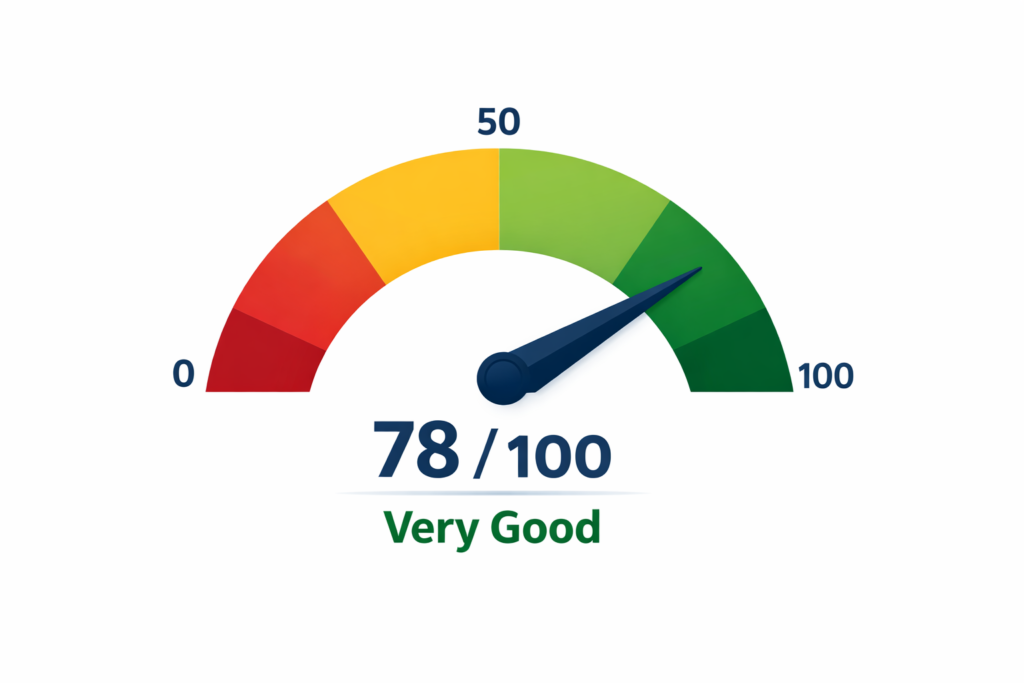

Most Indians track their salary. Some track their CIBIL score. Almost none track their actual financial health — which is why 40% lack an emergency fund, 65% haven’t planned for retirement, and only 38% are debt-free, despite decades of earning. A Financial Health Score changes that by putting a single, honest number on your entire financial life.
Quick Summary
A Financial Health Score is a single 0–100 number that evaluates your complete financial well-being across seven pillars: cash flow, savings rate, debt-to-income ratio, emergency fund, investments, net worth, and insurance. Unlike your CIBIL score (which only measures creditworthiness) or net worth (which is a single balance sheet snapshot), a Financial Health Score gives you the complete picture. The Wealthpedia Financial Health Score tool takes 15 minutes, requires no login, and provides pillar-by-pillar breakdown with actionable improvement recommendations calibrated to Indian financial realities. A score above 70 is good; 80+ is excellent; below 50 needs urgent structural action.
The Number That Most Indians Are Missing
There is a paradox at the heart of Indian personal finance.
India has one of the highest household savings rates in the world. The mutual fund industry manages ₹81.92 lakh crore in AUM. Over 9 crore SIP accounts are active. Financial literacy is growing faster than at any point in our history.
And yet: a 2024 Finnovate survey of 1,727 Indian investors found that the average financial fitness score was just 5.29 out of 20. Only 38% of respondents were debt-free. 40% lacked a sufficient emergency fund. 65% had not planned adequately for retirement.
The disconnect is stark. Indians are investing more than ever — but managing their overall financial health poorly. The reason is not ignorance. It is the absence of a single, clear, honest metric that tells you where you actually stand.
Your CIBIL score tells lenders how reliably you repay debt. It says nothing about whether you are building wealth, protected against emergencies, or on track for retirement.
Your net worth tells you what you own minus what you owe. It does not tell you whether your cash flow is healthy, whether you carry dangerous debt, or whether your income will sustain your lifestyle if you lose your job tomorrow.
Your SIP returns tell you how a specific fund is performing. They say nothing about whether your overall portfolio is diversified, goal-aligned, or proportional to your retirement needs.
The Wealthpedia Financial Health Score fills this gap — combining all of these dimensions into one number between 0 and 100, calibrated specifically for Indian financial realities, and generated in under 15 minutes from actual numerical inputs rather than vague self-assessments.
This article explains the concept in full: what the score measures, how it is calculated, what the seven pillars are, how to interpret your score, and precisely how to improve each pillar that is holding you back.
What Is a Financial Health Score?
A Financial Health Score is a single composite number — typically on a 0–100 scale — that summarises your overall financial well-being across multiple dimensions simultaneously.
Think of it as the equivalent of a health check-up at a doctor’s clinic. A blood pressure reading tells you one thing. A cholesterol reading tells you another. Your BMI tells you a third. The doctor does not look at any one number in isolation — they look at the complete picture and give you an overall assessment.
A Financial Health Score does the same for your money. It does not just ask “are you saving?” or “are you investing?” It asks all seven critical questions simultaneously — and weights each answer according to its real-world impact on your financial resilience.
The Wealthpedia Financial Health Score evaluates seven pillars:
1. Cash Flow Health (Monthly Surplus/Deficit)
2. Savings Rate (% of income saved or invested)
3. Debt-to-Income Ratio (total monthly EMI ÷ gross income)
4. Emergency Fund Adequacy (liquid savings ÷ monthly expenses)
5. Investment Coverage (SIP discipline, diversification, goal alignment)
6. Net Worth Position (total assets − total liabilities)
7. Insurance and Risk Protection (health + term life coverage adequacy)
Each pillar is scored individually, then combined into a single 0–100 final score using a weighted model that reflects the relative importance of each factor to overall financial resilience.
How the Weighted Scoring Works
The approximate weighting of each pillar reflects what Indian financial advisors and planners know from practice — which factors most commonly cause financial crisis or prevent wealth building:
| Pillar | Approximate Weight | Why This Weight |
|---|---|---|
| Savings Rate | 25% | The single biggest predictor of long-term wealth — not income |
| Debt-to-Income Ratio | 20% | High debt is the most common destroyer of financial plans |
| Emergency Fund | 15% | Absence of buffer causes all other plans to collapse |
| Investments | 15% | Growth and goal alignment, beyond just saving |
| Cash Flow | 10% | Monthly surplus enables everything else |
| Net Worth | 10% | Balance sheet health — assets vs liabilities |
| Insurance | 5% | Risk protection — low weight but catastrophic if absent |
The savings rate carries the highest weight — 25% — because it is the most powerful predictor of financial outcomes regardless of income level. A ₹5 lakh/month earner with a 5% savings rate builds less wealth than a ₹80,000/month earner with a 30% savings rate over a 25-year career. The tool is built on this foundational truth: it is not how much you earn — it is how much you save and deploy.
What the Score Means
| Score Range | Rating | What It Means |
|---|---|---|
| 80–100 | Excellent | Strong across all pillars. Minor optimisations possible. |
| 70–79 | Good | Most pillars healthy. 1–2 areas need targeted improvement. |
| 60–69 | Moderate | Foundation is there. Several gaps need active attention. |
| 50–59 | Weak | Multiple vulnerabilities. Structural changes needed. |
| Below 50 | Critical | Significant financial risk. Prioritise urgent fixes. |
A score above 70 means your financial life is broadly on track. A score below 50 means you have meaningful vulnerabilities that could cause a financial crisis in the event of a job loss, medical emergency, or market downturn.
How the Financial Health Score Differs from Your CIBIL Score
This comparison is worth making explicitly because many Indians confuse the two — and because understanding the difference reveals why both are necessary but neither is sufficient alone.
| Dimension | CIBIL Score | Financial Health Score |
|---|---|---|
| What it measures | Creditworthiness (past loan repayment) | Overall financial wellness (current state) |
| Who uses it | Banks and lenders | You — for self-diagnosis |
| Input | Credit history | Income, expenses, savings, investments, debt, insurance |
| Scope | Narrow (borrowing behaviour only) | Comprehensive (7 pillars of personal finance) |
| Inflation adjusted | No | Yes (Indian benchmarks) |
| Investment health | Not considered | Core component |
| Emergency preparedness | Not considered | Core component |
| Goal alignment | Not considered | Assessed |
| How to improve | Repay EMIs on time, reduce credit utilisation | Improve any of 7 pillars |
A person can have a CIBIL score of 780 — excellent by lender standards — and a Financial Health Score of 42. This is not hypothetical. It is common. High CIBIL means you repay loans reliably. It says nothing about whether those loans are consuming 60% of your income, whether you have zero emergency fund, whether your spouse and children have health insurance, or whether you have invested a single rupee toward retirement.
Your CIBIL score tells your bank whether to lend you money. Your Financial Health Score tells you whether your financial life is actually healthy.
Both matter. They measure entirely different things.
The 7 Pillars Explained: What the Tool Actually Measures
Pillar 1: Cash Flow Health (Weight: 10%)
What it measures: Your monthly surplus — the amount left after all income has been received and all expenses (including EMIs) have been paid.
The Indian problem: Lifestyle inflation. As income grows, expenses tend to grow proportionally or faster — leaving the monthly surplus unchanged or smaller in percentage terms despite higher nominal income. A ₹1.5 lakh/month earner spending ₹1.4 lakh/month has worse cash flow health than a ₹60,000/month earner spending ₹42,000/month, despite earning 2.5x more.
What the tool checks:
- Monthly net surplus (positive or negative)
- Surplus as % of income
- Whether the surplus is actually being invested or sitting idle
Benchmark:
- Surplus below 10% of income: Poor
- Surplus 10–20%: Average
- Surplus 20–35%: Good
- Surplus above 35%: Excellent
If your cash flow health is poor, everything else suffers — you cannot build an emergency fund, you cannot service debt aggressively, and you cannot increase SIP contributions. This is why understanding your ideal savings rate is the first step in any financial planning process.
Pillar 2: Savings Rate (Weight: 25%)
What it measures: The percentage of your gross monthly income that you save or invest — across all instruments (SIPs, PPF, EPF, FDs, everything).
Why it carries the most weight: Savings rate is the single variable most correlated with long-term financial independence. The how much to invest monthly guide establishes the target: 20–25% minimum for a working professional; 30–40% for FIRE aspirants.
The Indian savings paradox: India’s household savings rate is roughly 30–32% of GDP — one of the highest globally. But at the individual level, the picture is fragmented. Much of this “saving” is in physical assets (gold, property) rather than liquid, growth-oriented instruments. The Financial Health Score specifically tracks investable savings — the percentage going into instruments that build wealth rather than just preserve it.
What the tool checks:
- Total monthly savings and investments as % of gross income
- Breakdown by instrument type
- Whether savings are automated or discretionary
Benchmark:
- Below 10%: Critical
- 10–20%: Average (needs improvement)
- 20–35%: Good
- 35%+: Excellent
If your savings rate is below 20%, no other financial planning optimisation will compensate. The financial mistakes Indians commonly make consistently includes inadequate savings rate — often disguised by high income that creates a false sense of financial security.
Pillar 3: Debt-to-Income Ratio (Weight: 20%)
What it measures: Your total monthly debt repayments (all EMIs combined) as a percentage of gross monthly income.
Formula: DTI = (Total monthly EMI payments ÷ Gross monthly income) × 100
The Indian EMI crisis: As of 2024–2026, India’s household debt is growing faster than household income. The combination of home loans, car loans, personal loans, and credit card revolving balances means many urban Indians carry DTI ratios of 50–60% — leaving less than half of income for living expenses, savings, and investments.
A 60% DTI on ₹1.2 lakh/month means ₹72,000 goes to EMIs. After rent (if applicable) and household expenses, nothing remains for investments. The CIBIL score may be fine — EMIs are being paid. But the financial health is poor.
Benchmark:
- Below 30%: Healthy
- 30–50%: Caution zone — reducing debt should be a priority
- Above 50%: Danger zone — immediate restructuring needed
What to do if DTI is high: The how much debt is too much guide and the debt-to-income ratio explainer both cover this in detail. In brief: prioritise prepaying high-interest debt (credit card, personal loan) before any investment optimisation. A guaranteed 18–36% return from debt elimination beats any equity market return.
Pillar 4: Emergency Fund Adequacy (Weight: 15%)
What it measures: How many months of total monthly expenses (including EMIs) your liquid emergency savings can cover.
The 40% problem: Recall from the opening statistics: 40% of Indian investors lack a sufficient emergency fund. This is the most common single financial vulnerability — and the one that causes all other plans to collapse. When a job is lost, a medical emergency strikes, or a major unplanned expense arises, the investor without an emergency fund has three choices: withdraw from long-term investments (breaking compounding), take an emergency personal loan (at 14–18% interest), or use high-interest credit card debt.
All three options damage the financial plan severely.
The Wealthpedia position: As detailed in the why 3 months emergency fund is outdated article, the traditional 3-month benchmark is insufficient for most Indian households. 6 months is the new minimum — and for those with variable income (business, freelance) or single-income households, 9–12 months is appropriate.
Benchmark:
- Below 3 months: Critical
- 3–6 months: Adequate
- 6–12 months: Good
- Above 12 months: Excellent (but review if excess is in low-yield savings account)
Where to keep the emergency fund: Liquid mutual fund (6.5–7% return, same-day redemption) or high-yield savings account. Not in equity funds (too volatile), not in locked FDs (premature penalty), and not mixed with the monthly budget account.
Pillar 5: Investment Coverage (Weight: 15%)
What it measures: The health of your investment portfolio — not just the balance but the discipline, diversification, goal alignment, and growth rate.
This pillar goes beyond “do you invest?” to ask:
- Are investments consistent (SIP discipline)?
- Are they diversified across asset classes (equity, debt, gold)?
- Are they goal-aligned (retirement SIP separate from education SIP)?
- Is the equity allocation appropriate for your age and timeline?
- Are expense ratios reasonable (under 1% for large-cap)?
The common Indian investment failure pattern: Many investors have ₹15–20 lakh in investments but with 70% overlap across 8 large-cap active funds, no debt allocation, no gold, and no connection between the portfolio and actual financial goals. As covered in the mutual fund portfolio allocator guide, this is concentration masquerading as diversification.
Benchmark:
- No investment activity: Critical
- Some investment (under 10% of income): Poor
- Consistent SIP at 10–20% of income, some diversification: Moderate
- Goal-based SIPs at 20%+, diversified across categories, aligned to timelines: Good
- Multi-goal planning with step-up SIPs, rebalancing, index fund core: Excellent
Use the SIP Allocation Optimizer and the Multi-Goal FIRE Planner to audit whether your investment coverage actually maps to your financial goals — or whether it is simply “money going in somewhere.”
Pillar 6: Net Worth Position (Weight: 10%)
What it measures: Total assets minus total liabilities — your balance sheet. But more specifically, it assesses whether your net worth is growing at the rate required to reach your financial goals.
The Indian net worth distortion: Many Indians have high net worth on paper — because they own property. But property is illiquid, generates no monthly income (unless rented), and cannot be easily partially liquidated for retirement income. A family with ₹1.5 crore in home equity, ₹5 lakh in FD, and ₹8 lakh in mutual funds has ₹1.63 crore net worth — but effectively zero liquid net worth.
The Financial Health Score assesses both total net worth and liquid net worth — distinguishing between wealth you can access and wealth that is locked in illiquid assets.
Age-based benchmarks: Age Minimum Net Worth Target (Liquid) Good 30 3–5× annual income 5–8× annual income 35 6–10× annual income 10–15× annual income 40 10–15× annual income 15–25× annual income 45 15–20× annual income 25–40× annual income
The what should your net worth be at 30 guide provides the complete age-by-age benchmark framework.
Pillar 7: Insurance and Risk Protection (Weight: 5%)
What it measures: Whether you have adequate health insurance and term life insurance to protect your financial plan from catastrophic shocks.
Why it is 5% weight but 100% importance: Insurance carries the lowest weighting in the score because its presence or absence is binary rather than graduated. But its absence is catastrophic — a single uninsured medical event or the death of the primary earner can destroy 10–15 years of accumulated wealth overnight.
What “adequate” means for India in 2026:
Term life insurance: Cover of 15–20× annual income, running until at least age 65. For a ₹12 lakh/year income household: minimum ₹1.8–2.4 crore term cover. Premium: typically ₹10,000–₹18,000/year for a 30-year-old non-smoker for ₹1 crore cover.
Health insurance: ₹20–25 lakh family floater minimum; or ₹10–15 lakh individual + super top-up plan. Given medical inflation at 12–15% annually, a ₹5 lakh policy taken 10 years ago has the real coverage of ₹2.3 lakh today.
The common failure: Many Indian professionals have employer-provided group health insurance at ₹3–5 lakh cover and assume it is sufficient. It is not. Employer insurance ceases the day you resign or are retrenched — precisely when you may need it most. Personal health insurance is non-negotiable.
Benchmark:
- No health or life insurance: Critical (immediate action required)
- Only employer group health insurance: Poor
- Personal health cover ₹5–10L + term life: Moderate
- Personal health cover ₹20L+ + term life 15–20× income: Good/Excellent
How to Check Your Financial Health Score
The Wealthpedia Financial Health Score tool completes the assessment in approximately 15 minutes through a 15-step process. No login required. No data stored. The calculation runs on your device.
What you need to have ready before starting:
- Monthly take-home income (salary + any additional income)
- Monthly total expenses (fixed + variable, including EMIs)
- Total liquid savings (savings account + liquid funds — immediately accessible)
- Total investment value (mutual funds, stocks, PPF, EPF, NPS — approximate current values)
- Total outstanding debt (home loan + car loan + personal loan + credit card balance)
- Monthly total EMI payments
- Emergency fund amount (liquid, specifically earmarked)
- Health insurance: sum assured and whether personal or employer-only
- Term life insurance: sum assured and whether active
The 15-step input process covers:
- Monthly income inputs
- Fixed expense breakdown
- Variable expense breakdown
- Current savings balance
- Investment portfolio value
- Asset types breakdown
- Home loan outstanding
- Other loan outstanding
- Credit card balance
- Monthly total EMI
- Emergency fund balance
- Health insurance coverage
- Term life insurance coverage
- Financial goals check
- Score calculation and output
The output includes: overall score (0–100), pillar-by-pillar breakdown, strengths (highlighted in green), weaknesses (flagged for attention), and specific actionable recommendations for improvement.
Interpreting Your Score: What to Do at Each Level
Score 80–100: Excellent — Optimise and Sustain
You are in strong shape across most or all seven pillars. The work at this level is about optimisation, not structural repair:
- Review whether your savings rate can be incrementally increased further
- Check whether investment allocation is optimally tax-efficient (maximising EEE instruments)
- Validate that FIRE corpus is on track using the FIRE Number Calculator
- Consider whether insurance covers are keeping pace with income and inflation
Re-test every 12 months as income and life circumstances evolve.
Score 70–79: Good — Close the Gaps
One or two pillars are pulling the score down. The most common culprits at this level:
- Emergency fund below 6 months despite strong savings elsewhere
- DTI between 35–45% — carrying a home loan that is manageable but above optimal
- Investment portfolio not diversified — concentrated in one or two categories
The financial health score by age guide shows expected scores by age and income bracket — helping you contextualise whether a 74 is appropriate for a 28-year-old with a new home loan or whether it signals a genuine gap.
Re-test every 6 months while actively improving the weak pillar.
Score 60–69: Moderate — Structured Improvement Needed
Multiple pillars are underperforming. Common patterns at this level:
- Strong income but savings rate below 15% due to high lifestyle spending
- Decent investments but no emergency fund — two contradictory states
- Adequate health insurance but zero term life coverage
The habits of financially healthy people guide is the starting point — building the behavioural foundations before the financial tools. Read the signs your financial health is poor for the specific early warning indicators to address.
Re-test quarterly while implementing changes.
Score 50–59: Weak — Priority Action Required
Structural vulnerabilities exist across multiple pillars. Likely scenarios:
- DTI above 50% — every rupee of surplus is consumed by EMIs
- No emergency fund — one unexpected expense away from financial disruption
- Investments inconsistent or absent — retirement planning not started
The personal finance mistakes case studies show exactly how people at this level reached it — and, more importantly, the specific path out.
The priority sequence: (1) emergency fund first, (2) eliminate high-interest debt, (3) ensure insurance coverage, (4) start SIP even if small, (5) build savings rate systematically.
Score Below 50: Critical — Urgent Structural Change
The are you financially healthy guide is a frank read for anyone at this level. A score below 50 means financial vulnerability is not theoretical — it is present and real.
The most common critical-score profile: high income, high lifestyle, high debt, no savings, no insurance, no emergency fund. This is the “earning well but financially fragile” trap — common among young urban professionals in the first decade of their career.
Three immediate actions regardless of score details:
- Stop any new debt immediately
- Build ₹1 lakh emergency fund in the next 60 days
- Start a ₹500/month SIP — just to establish the habit
The improvement to 60+ from below 50 is achievable within 12–18 months with consistent behaviour changes. It does not require a salary increase. It requires discipline.
How to Improve Each Pillar: The Action Guide
Improving Cash Flow (Pillar 1)
Track every expense for 30 days — not to judge, but to see. Most people find 10–20% of monthly spending in “invisible leaks” — subscriptions forgotten, dining out frequency underestimated, convenience spending undertracked.
The how much debt is too much guide identifies whether high EMIs or lifestyle spending is the cash flow culprit — because the fix is different for each.
Improving Savings Rate (Pillar 2)
Automate first. Set up SIP and PPF transfers on salary day — before any discretionary spending. The how to invest every month guide covers the automation framework in detail.
The single most effective savings rate improvement technique: every time income increases (salary hike, bonus, side income), direct 70% of the increase to savings before adjusting lifestyle. Lifestyle inflation is the silent savings rate killer.
Reducing DTI (Pillar 3)
Prioritise prepayment of high-interest debt (credit card first, then personal loan, then car loan, then home loan). Each ₹1 lakh of 18% personal loan prepaid is a guaranteed 18% return — better than any investment.
If DTI is driven by a home loan above 8.5% (particularly on the new tax regime), consider whether refinancing to 7.75–8.0% is possible — as explored in the debt-free before FIRE guide.
Building Emergency Fund (Pillar 4)
Set up a separate savings account specifically labelled “Emergency Fund.” Automate a fixed monthly transfer — even ₹2,000/month — until the 6-month target is reached. Do not invest these funds in equity. Liquid fund or high-yield savings only.
Strengthening Investments (Pillar 5)
The best SIP strategy guide and the SIP allocation strategy together provide the specific fund selection, step-up implementation, and goal-based allocation framework. The key insight: more funds ≠ better diversification. 4–6 carefully chosen funds across meaningful categories beats 12 overlapping large-cap funds.
Growing Net Worth (Pillar 6)
Net worth growth is primarily driven by savings rate and investment returns — so improving Pillars 1–5 automatically improves Pillar 6. The specific tool for tracking net worth trajectory is the financial freedom calculator.
Securing Insurance (Pillar 7)
Term life insurance: buy immediately if not in place. For a 30-year-old non-smoker, ₹1 crore of cover for 30 years costs ₹10,000–₹15,000/year. The ROI on this spend — in terms of financial disaster prevention — is incalculable.
Health insurance: upgrade existing cover if below ₹15 lakh personal (not employer) cover. Add a super top-up if upgrading the base policy is expensive.
When to Use the Financial Health Score Tool
Every 12 months (minimum): Annual review to track improvement and catch new vulnerabilities. As explored in the retirement withdrawal strategy guide, the annual review date is April 1 — matching the Indian financial year start.
After major life events:
- Salary hike or job change (cash flow and savings rate change)
- Marriage (joint financial health now matters)
- First child (insurance needs increase, emergency fund size increases)
- Home purchase (DTI typically jumps significantly)
- Job loss or business downturn (immediate crisis management)
- Inheritance or windfall (sudden net worth change)
When starting any major financial decision:
Before taking a new loan, check your DTI. Before increasing SIPs, confirm cash flow supports it. Before planning FIRE, validate investment coverage is on track. The multi-goal FIRE planner is the next step once the Financial Health Score confirms your foundation is solid enough to model complex long-term goals.
Financial Health Score vs Net Worth: Which Should You Track?
Track both — they measure different things and serve different purposes. Financial Health Score Net Worth What it measures Current financial behaviour and resilience Accumulated wealth position Time orientation Present state Historical accumulation Actionable? Yes — specific pillars to improve Less directly — lagging indicator Changes quickly? Yes — behaviour changes in weeks No — compounding over years Best for Identifying what to fix now Tracking long-term wealth building
Net worth is the destination. Financial Health Score is the navigation system. One tells you where you are headed. The other tells you whether you are driving correctly.
Use the what should your net worth be at 30 guide to benchmark your net worth against age-appropriate targets, and the Financial Health Score to diagnose why the trajectory is or is not meeting those benchmarks.
Conclusion: One Number That Changes Everything
The Wealthpedia Financial Health Score does something deceptively simple: it puts an honest number on your complete financial life, calibrated to Indian realities.
Not your salary. Not your CIBIL score. Not one fund’s returns. The whole picture — cash flow, savings discipline, debt burden, emergency preparedness, investment health, net worth trajectory, and risk protection — distilled into a single, actionable metric.
A score above 70 means the foundation is solid. A score below 50 means urgent structural changes are needed. Everything between is a roadmap for prioritised improvement.
The most important thing about the tool is not the score itself. It is what happens after you see the score: you know specifically which pillar to fix first, in which order, with what specific action.
Check your Financial Health Score now — it takes 15 minutes, requires no login, and will likely tell you something about your financial life that no other number you currently track can reveal.
Frequently Asked Questions
What is a Financial Health Score?
A Financial Health Score is a single composite number (0–100) that evaluates your complete financial well-being across seven pillars: cash flow, savings rate, debt-to-income ratio, emergency fund, investments, net worth, and insurance. It gives you one clear metric for your entire financial life — unlike CIBIL (borrowing only) or net worth (assets minus liabilities only).
What is a good Financial Health Score in India?
Above 70 is considered good. 80+ is excellent. 60–69 is moderate — functional but with clear improvement areas. Below 50 is critical — significant financial vulnerabilities exist. Context matters: a 35-year-old with a new home loan scoring 68 is in a different position than a 45-year-old with no debt scoring 68.
How is the Wealthpedia Financial Health Score calculated?
It uses a weighted multi-factor model across 7 pillars. Approximate weights: Savings Rate (25%), Debt-to-Income (20%), Emergency Fund (15%), Investments (15%), Cash Flow (10%), Net Worth (10%), Insurance (5%). You input actual numerical data — income, expenses, savings, investments, debt, insurance — and the calculator scores each pillar before combining into the overall result.
How is the Financial Health Score different from CIBIL score?
CIBIL score (300–900) measures creditworthiness — how reliably you repay loans. It is used by lenders. The Financial Health Score (0–100) measures your overall financial wellness including savings, investments, emergency preparedness, and insurance — areas your CIBIL score completely ignores. A person can have excellent CIBIL but poor financial health if they carry high debt, have no savings, and lack insurance.
How long does it take to check the score?
Approximately 15 minutes if you have your financial data ready. Gathering numbers (income, expenses, savings, investments, debt, insurance) typically takes 5–10 minutes. The 15-step input process and score calculation take another 5 minutes. No login or account creation required.
Is my financial data stored when I use the calculator?
No. The Wealthpedia Financial Health Score calculator processes data on your device (client-side) and does not store your personal financial information. No login or sign-up is required to access the tool.
How often should I check my Financial Health Score?
Minimum every 12 months — ideally on April 1 at the Indian financial year start. Also check after major life events: salary change, marriage, first child, home purchase, job change, or any event that significantly alters your income, expenses, debt, or insurance.
What does the savings rate pillar measure?
It measures the percentage of your gross monthly income that you save or invest across all instruments (SIPs, PPF, EPF, FDs, etc.). This carries the highest weight (25%) because it is the strongest predictor of long-term financial outcomes regardless of income level. Target: 20–25% minimum, 30–40% for FIRE aspirants.
What is a healthy debt-to-income ratio in India?
Below 30% is healthy (total monthly EMI ÷ gross income). 30–50% is a caution zone. Above 50% is dangerous — most surplus is consumed by debt repayments, leaving little for savings or emergencies. Calculate yours by adding all monthly EMIs and dividing by gross monthly income.
How much emergency fund is adequate for a good Financial Health Score?
6 months of total monthly expenses (including EMIs) is the minimum for a good score. The traditional 3-month benchmark is outdated — as detailed in the emergency fund guide. For variable income earners (business, freelance), 9–12 months is appropriate. Keep the emergency fund in a liquid mutual fund or high-yield savings account — never in equity.
Does a high net worth guarantee a high Financial Health Score?
No. Net worth is just one of seven pillars and carries 10% weight. A person with ₹2 crore in property, ₹50% DTI, no emergency fund, and no insurance can have a high net worth and a poor Financial Health Score. The score rewards behaviour and balance across all pillars — not just accumulated wealth.
Can my Financial Health Score change quickly?
Yes. Positive structural changes — paying off a large debt, building an emergency fund, setting up adequate insurance — can improve the score by 10–20 points within weeks. The score responds to current financial behaviour, not just long-term accumulated wealth.
What insurance is needed for a good insurance score?
Personal health insurance of ₹20 lakh+ family floater (not employer-only group cover) and term life insurance of 15–20× annual income. For a ₹12 lakh/year income household: ₹1.8–2.4 crore term cover. Both must be active, personal policies — employer group insurance does not count because it lapses when you leave the company.
Who should use the Financial Health Score tool?
Anyone earning a regular income in India — salaried professionals, business owners, freelancers, young earners building their first financial plan, FIRE aspirants tracking progress, and couples planning joint finances. It is particularly valuable for people who track their investment returns but have never assessed their overall financial health comprehensively.
How does the Financial Health Score help with FIRE planning?
It validates whether the foundational pillars — emergency fund, insurance, reasonable DTI, savings rate — are in place before complex FIRE corpus modelling begins. A FIRE aspirant with a score below 60 is not ready to use the Multi-Goal FIRE Planner meaningfully — their foundational gaps will undermine any projection built on them.
What is the most common reason for a low Financial Health Score in India?
High debt-to-income ratio combined with low savings rate — typically caused by home loan + car loan + personal loan simultaneously, with income growth not keeping pace. The second most common cause: zero emergency fund despite significant investments. The third: no personal health or term insurance.
What is the difference between savings rate and investment coverage?
Savings rate measures how much of income is being saved/invested (quantity). Investment coverage measures how that investment is structured — consistency, diversification, goal alignment, and cost efficiency (quality). You can have a 25% savings rate but poor investment coverage if all of it is in overlapping large-cap active funds with no debt allocation and no goal mapping.
How does the Financial Health Score account for variable income?
For self-employed or freelance income, the tool recommends using a 6–12 month average as the monthly income input rather than a single month’s figure. Variable income also typically requires a larger emergency fund (9–12 months) — which the tool’s benchmark accounts for when scoring the emergency fund pillar.
Should couples check the score individually or jointly?
Both. Individual scores reveal each person’s financial habits and vulnerabilities. A joint score (combined income, expenses, and assets) reveals the household’s overall position. Both are informative — particularly when one partner earns significantly more or one has significantly higher personal debt.
What is the link between Financial Health Score and FIRE aspirations?
A Financial Health Score above 70 is the prerequisite for meaningful FIRE planning. It confirms the foundational structure is in place: adequate savings rate, manageable debt, emergency buffer, and basic insurance protection. Once these are confirmed, the FIRE Number Calculator and the Multi-Goal FIRE Planner can model the long-term FIRE corpus with reliable inputs.
Does property count toward net worth in the Financial Health Score?
Yes — but the tool typically distinguishes between liquid net worth (investable assets) and total net worth (including property). Property adds to the net worth pillar, but illiquid assets are weighted differently from liquid investments. A home you live in does not generate investment returns — it is an asset, but not one that funds retirement income.
What happens after I get my score — what are the next steps?
Identify your lowest-scoring pillar. Address it specifically using the corresponding guide on Wealthpedia — whether it is building an emergency fund, reducing DTI, improving savings rate, or securing insurance. Re-test after 3–6 months of implementing changes. Use the financial health score by age benchmark to contextualise your progress.
Can I improve my score without increasing income?
Yes. The score rewards financial behaviour, not income level. A person earning ₹60,000/month with a 30% savings rate, 6-month emergency fund, DTI under 20%, and adequate insurance will score higher than a ₹2 lakh/month earner with a 5% savings rate, 55% DTI, and no insurance. Income enables improvement but does not determine the score.
How is the Wealthpedia Financial Health Score specific to India?
It uses India-specific benchmarks: savings rate targets calibrated to Indian cost-of-living levels; DTI benchmarks accounting for Indian home loan structures; insurance coverage norms reflecting Indian healthcare inflation (12–15%); investment benchmarks referencing Indian instruments (PPF, EPF, NPS, SIPs); and emergency fund standards appropriate for Indian job market volatility. Generic Western tools apply benchmarks that do not reflect Indian financial realities.
Is the Financial Health Score a substitute for professional financial advice?
No — it is a diagnostic tool and starting point. It gives you a clear picture of where you stand and what to prioritise, but it does not account for your specific tax situation, estate planning needs, or nuanced investment strategy. For major decisions — large loans, FIRE planning, retirement structuring — pair the score insights with advice from a SEBI-registered investment advisor or certified financial planner.
Disclaimer: The Financial Health Score is an educational diagnostic tool. It uses illustrative benchmarks and weighting models based on general financial planning principles. It is not a substitute for personalised financial advice. Wealthpedia is not a SEBI-registered investment advisor. Consult a qualified financial planner for decisions specific to your situation. Wealthpedia® is a registered trademark (TM No. 4910385).

Vishal Jhaveri is the founder of Wealthpedia and an MBA Finance professional with over 10 years of experience in financial planning, investing, and wealth creation. He specializes in FIRE (Financial Independence, Retire Early), retirement planning, investing, and personal finance education. Through Wealthpedia, he develops financial calculators and publishes evidence-based content to help Indian investors make informed financial decisions. He regularly reviews and updates Wealthpedia articles to reflect changes in tax, laws, investment regulations, and personal finance best practices.
Quick Wrap up