
Introduction: Two Scores, Two Completely Different Questions
Your CIBIL score answers the question lenders ask: “Can I trust this person with my money?” Your Financial Health Score answers the question you should be asking yourself: “Am I actually building wealth, or just managing the appearance of it?”
India has approximately 220 million credit-active consumers as of 2026. A significant portion of urban middle-class households check their CIBIL score regularly, treat it with near-religious attention, and take active steps to protect it. This is broadly sensible behaviour — a good CIBIL score unlocks lower interest rates, faster loan approvals, and better credit card offers.
But here is the problem: optimising for CIBIL score can directly conflict with building genuine financial health. A household can maintain a perfect 800 CIBIL score while simultaneously carrying EMIs that consume 45% of income, holding zero emergency fund, investing nothing in equity, and being chronically underinsured. Lenders will happily lend them more money. The household, meanwhile, is one job loss away from financial crisis.
This is not hypothetical. It is the financial profile of a large and growing segment of Indian urban professionals — high earners, high borrowers, high CIBIL scores, and dangerously low actual financial health.
The Financial Health Score tool on Wealthpedia was built precisely to surface this gap. It measures the seven dimensions of financial wellness that CIBIL ignores: savings rate, debt burden relative to income, emergency preparedness, investment consistency, net worth trajectory, cash flow health, and insurance adequacy. Together, the two scores give you a complete picture. Separately, each one tells you only half the story.
This article explains both scores in full — their methodology, their strengths, their blind spots, and critically, how to interpret them together.
Quick Summary
Most Indians obsess over their CIBIL score — and for good reason. But CIBIL measures only one thing: how reliably you repay debt. It tells lenders whether to trust you. It tells you almost nothing about whether you are actually financially healthy. That is where the Financial Health Score (FHS) fills a critical gap. This guide explains exactly what each score measures, where they overlap, where they diverge sharply, and why a person can have a 780 CIBIL score and a 38 FHS score simultaneously — a combination far more common in urban India than anyone admits. Both scores matter. For different reasons.
What Is a CIBIL Score? A Complete Explanation
CIBIL is a three-digit number from 300 to 900 that summarises your credit repayment history. It is calculated by TransUnion CIBIL using data from banks and lenders. A score of 750+ is considered good. It is entirely backward-looking and entirely debt-focused.
Who generates it and how
TransUnion CIBIL is one of four credit information companies licensed by RBI in India, alongside Experian, Equifax, and CRIF High Mark. Every time you apply for a loan or credit card, the lender reports your repayment behaviour to these bureaus. CIBIL aggregates this data into your Credit Information Report (CIR) and distils it into a single score.
The CIBIL score is calculated using five primary factors:
Payment history (35% weight): Have you paid your EMIs and credit card bills on time? A single missed payment can drop your score by 50–80 points. Multiple defaults can push it below 600.
Credit utilisation ratio (30% weight): How much of your available credit limit are you using? Using more than 30% of your total credit card limit consistently signals credit dependency and reduces your score.
Credit age (15% weight): How long have you had credit relationships? A 10-year-old credit card account (even one you rarely use) contributes positively to your score through credit history length.
Credit mix (10% weight): Do you have a healthy mix of secured loans (home, auto) and unsecured credit (personal loans, credit cards)? Pure credit card users score slightly lower than those with a mix.
New credit inquiries (10% weight): Every time you apply for a new loan or card, the lender pulls your CIBIL report — a “hard inquiry” that temporarily reduces your score by 5–10 points. Multiple applications in a short period signal financial stress.
What CIBIL score ranges mean
Score Range Category Typical Lender Response 300–549 Poor Most loan applications rejected 550–649 Fair Limited options, high interest rates 650–749 Good Most loans approved, standard rates 750–799 Very Good Preferred rates, faster approvals 800–900 Excellent Best rates, premium credit products
What a good CIBIL score gets you
The financial benefit of a strong CIBIL score is real and measurable. On a ₹50 lakh home loan at 8.5% versus 9.5% interest — a difference often attributable to credit score — the total interest paid over 20 years differs by approximately ₹7.4 lakh. Your CIBIL score directly affects your cost of borrowing.
For Indian professionals who need home loans, business loans, or car financing, a CIBIL score above 750 is genuinely valuable and worth protecting.
What Is a Financial Health Score? The Complete Explanation
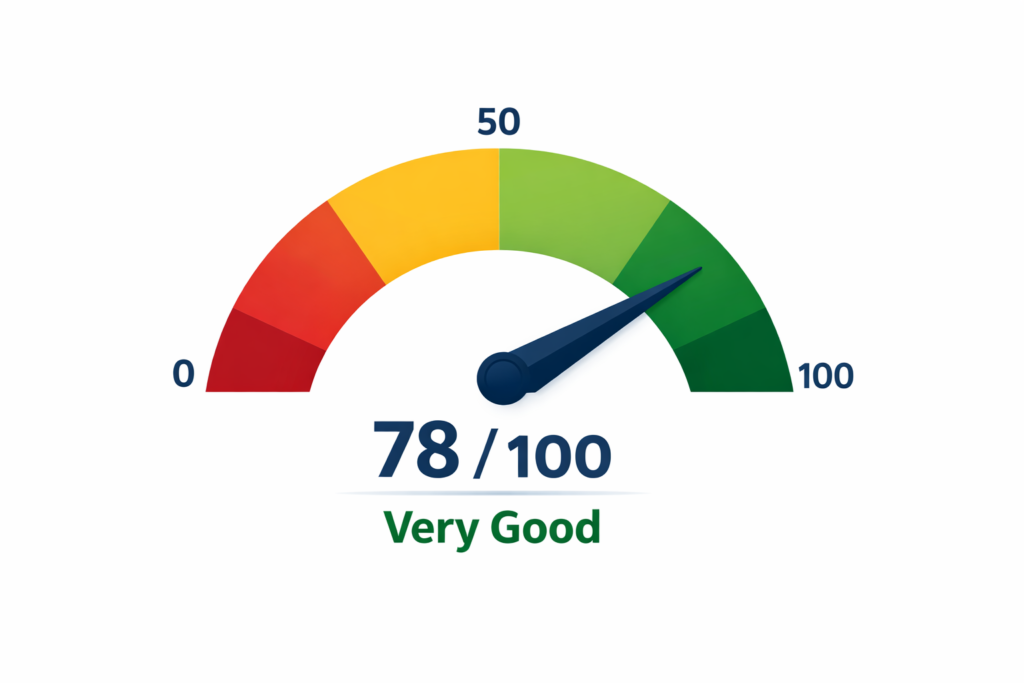
The Financial Health Score is a 0–100 score that measures your overall financial wellness across seven weighted pillars. Unlike CIBIL, it is not about lenders — it is entirely for you. It assesses not just debt but savings, investments, insurance, emergency preparedness, and net worth growth.
The seven pillars and their weights
The Wealthpedia Financial Health Score uses a weighted multi-factor model: Pillar Weight What It Asks Savings Rate 25% What percentage of income becomes wealth? Debt-to-Income Ratio 20% Are EMIs sustainable relative to income? Emergency Fund 15% Can you survive 3–6 months without income? Investments 15% Are you building long-term wealth consistently? Cash Flow 10% Is monthly income exceeding monthly outflow? Net Worth 10% Are assets growing faster than liabilities? Insurance 5% Are you protected against catastrophic financial shocks?
What the FHS score ranges mean
Score Range Category What It Means 0–39 Critical Immediate financial vulnerability — action required 40–59 At Risk Foundation exists but significant gaps present 60–74 Stable Basics in place; optimisation needed 75–89 Strong Healthy across most pillars; compounding phase 90–100 Exceptional Elite financial discipline; FIRE-ready
Who should use it and when
Unlike CIBIL — which updates monthly based on lender data — the FHS is self-reported and self-assessed. You input your own financial data: income, expenses, savings, EMIs, investments, insurance cover. The tool processes these inputs and delivers your score plus a pillar-by-pillar breakdown showing exactly where you are strong and where you are vulnerable.
Recalculate it every six months, or after any significant financial event: salary increment, new loan, job change, medical expense, or major investment. The comparison between your score today and six months ago is your most actionable personal finance review.
Calculate your Financial Health Score here — free, instant, no registration required.
The Critical Differences: What Each Score Measures and Misses
CIBIL measures your past behaviour with borrowed money. FHS measures your present financial structure and future wealth trajectory. They are complementary, not competing. Missing either one leaves you with an incomplete financial picture.
Side-by-side comparison
| Dimension | CIBIL Score | Financial Health Score |
|---|---|---|
| Purpose | For lenders to assess credit risk | For you to assess financial wellness |
| Scale | 300–900 | 0–100 |
| Data source | Bank and lender reports | Your self-reported inputs |
| Update frequency | Monthly (automatic) | Self-assessed (recommended every 6 months) |
| Measures debt | Yes — repayment history, utilisation | Yes — as DTI ratio (20% weight) |
| Measures savings | No | Yes — 25% weight |
| Measures investments | No | Yes — 15% weight |
| Measures emergency fund | No | Yes — 15% weight |
| Measures insurance | No | Yes — 5% weight |
| Measures net worth | No | Yes — 10% weight |
| Measures cash flow | No | Yes — 10% weight |
| Backward or forward looking | Backward (repayment history) | Present state + future trajectory |
| Can be gamed | Yes — through strategic credit behaviour | Harder — based on actual financial structure |
| Who benefits from your high score | Lenders (confidence to lend more) | You (better understanding of your finances) |
What CIBIL cannot tell you
It cannot tell you if you are over-leveraged. A household with ₹1.2 lakh in monthly EMIs on ₹2 lakh income, paying every EMI perfectly on time, has a 790 CIBIL score. It also has a debt-to-income ratio of 60% — nearly three times the safe threshold. CIBIL sees responsible repayment. FHS sees a household one layoff away from default.
It cannot tell you if you have any savings. Two people with identical CIBIL scores of 760 — one saving 25% of income for 8 years, the other saving nothing — look identical to a lender. They are financially worlds apart. Only the FHS distinguishes them.
It cannot tell you if you are prepared for emergencies. Medical bills, job loss, and urgent repairs are the most common reasons Indian households take personal loans at 18–24% interest. A strong CIBIL score makes it easy to get that expensive loan — but the FHS emergency fund pillar measures whether you should ever need it in the first place.
It cannot tell you if you are on track for retirement. India has no mandatory retirement savings requirement beyond EPF for salaried employees. The EPFO corpus of a typical Indian employee at 60 — often ₹20–40 lakh — covers 2–4 years of post-retirement expenses at current urban lifestyle costs. Whether you have built adequate additional retirement savings is entirely invisible to CIBIL. The FHS investments and net worth pillars directly address this.
What FHS cannot tell you
It cannot predict your loan approval chances. If you need a home loan, your FHS score is irrelevant to the bank. Your CIBIL score, income documentation, and property value are what matter. FHS is not a credit assessment tool.
It does not update automatically. CIBIL updates monthly without any action from you. FHS requires you to revisit and re-enter data — it reflects a snapshot, not a continuous feed.
It depends on honest inputs. Because FHS is self-reported, it is only as accurate as the data you enter. CIBIL, by contrast, is generated from third-party lender data and cannot be manipulated by underreporting your expenses.
The 780 CIBIL / 38 FHS Paradox: More Common Than You Think
A high CIBIL score combined with a critically low FHS is the defining financial profile of a large segment of India’s urban professional class. Understanding why this combination exists — and why it is dangerous — is the most important insight in this article.
How it happens
Meet a composite profile that represents hundreds of thousands of Indian households:
The household: Dual-income couple in Bengaluru, combined income ₹3.2 lakh per month. Software engineer and marketing manager, ages 36 and 34. Two children.
Their CIBIL picture:
- Home loan EMI: ₹78,000/month — never missed a payment in 7 years
- Car loan EMI: ₹18,000/month — 2 years remaining, perfect repayment
- Credit cards: ₹2.5 lakh limit, using ₹45,000 (18% utilisation) — full payment every month
- Credit age: 9 years
- CIBIL Score: 796 — excellent, qualifies for best rates
Their FHS picture:
- Monthly savings: ₹14,000 (savings rate: 4.4%)
- Emergency fund: ₹22,000 in savings account (covers 11 days of expenses)
- Investments: SIP of ₹5,000/month started 8 months ago, total corpus ₹44,000
- Health insurance: Corporate cover ₹5 lakh per family, no personal policy
- Term insurance: None
- Net worth: Home (₹1.2 crore estimated) − home loan outstanding (₹78 lakh) − car loan (₹4.2 lakh) = ₹37.8 lakh — mostly illiquid property
- Financial Health Score: 34 — Critical zone
This household is servicing ₹96,000 in monthly EMIs on ₹3.2 lakh income — a DTI of 30%. After rent on a second vehicle, children’s school fees (₹28,000/month for two), household expenses, utilities, and lifestyle spending, they have ₹14,000 left. Their CIBIL score is outstanding. Their financial health is precarious.
If one income stops — redundancy, health event, career break for childcare — the household cannot sustain its obligations for more than 11 days on liquid reserves. The home loan restructuring process alone takes 30–60 days.
Why CIBIL optimisation can create FHS problems
This is the uncomfortable truth: the behaviours that protect and improve your CIBIL score can directly undermine your FHS.
Keeping old credit cards open improves credit age (good for CIBIL) but may tempt spending that reduces savings rate (bad for FHS).
Taking a home loan improves credit mix (marginally good for CIBIL) but increases DTI and reduces savings rate dramatically (significantly bad for FHS for 15–20 years).
Paying EMIs before investing protects CIBIL but delays wealth compounding and emergency fund building — both critical FHS pillars.
Using credit cards for all spending maintains credit utilisation visibility (good for CIBIL management) but can mask cash flow problems that the FHS cash flow pillar would surface.
None of this means you should ignore CIBIL. It means you should not optimise only for CIBIL at the expense of genuine financial health.
How to Use Both Scores Together: The Integrated Framework
Use CIBIL to manage your borrowing cost and access. Use FHS to manage your actual financial life. Check CIBIL quarterly and before any loan application. Check FHS every six months and after any major financial event. Act on both, but understand they serve different masters.
The four financial profiles: What your combination reveals
High CIBIL (750+) + High FHS (75+): The Financially Sorted Household
This combination — genuinely rare — means you have strong credit discipline and strong financial health simultaneously. You borrow when it makes sense (home loan at favourable rates), you service debt without letting it crowd out savings, your emergency fund is intact, and your investment corpus is growing. You are in the compounding phase. The Multi-Goal FIRE Planner is your next tool — model your FIRE date and see if it can be pulled forward.
High CIBIL (750+) + Low FHS (below 60): The Danger Zone
The 780/38 profile described above. You look financially responsible to lenders. You are not financially healthy. Priority action: stop taking new loans, aggressively build emergency fund, cut DTI by closing high-interest debt, and redirect freed EMI money into SIPs. Use the EMI Pro Calculator to model prepayment scenarios on your highest-rate loan.
Low CIBIL (below 700) + High FHS (above 65): The Cash-Rich Non-Borrower
This profile appears in households that have deliberately avoided debt — business owners, professionals who use only debit cards, and people who paid off all loans years ago. Their CIBIL score is low simply due to lack of credit activity, not because of defaults. Financially, they are often in excellent shape. If they need a loan in future, a secured credit card or small credit builder loan for 12 months can restore their CIBIL score without materially affecting FHS.
Low CIBIL (below 650) + Low FHS (below 50): The Priority Case
Both scores need work, but the sequence matters. Fix FHS first — stabilise cash flow, build emergency fund, eliminate consumer debt. As debt reduces and repayment history improves, CIBIL follows automatically. Do not apply for new credit while in this quadrant — every hard inquiry further damages CIBIL and every new EMI further damages FHS.
Practical calendar for managing both
Frequency Action Monthly Check credit card statement — pay in full, monitor utilisation below 30% Quarterly Pull free CIBIL report (one free per year from each bureau; use all four staggered) 6-monthly Recalculate your Financial Health Score — compare to previous score Annually Full financial review — insurance adequacy, investment rebalancing, net worth update Before any loan Check CIBIL score first; calculate post-EMI FHS impact before signing
Improving Both Scores Simultaneously: Where They Align
The good news — several actions improve both CIBIL and FHS at the same time. Focus on these first. They deliver double the return on financial effort.
Action 1: Pay off personal loans and credit card debt aggressively
CIBIL effect: Reduces total outstanding, lowers credit utilisation, demonstrates debt management capability.
FHS effect: Reduces DTI ratio (20% weight), frees cash flow for savings rate improvement (25% weight). On ₹1.5 lakh income, eliminating a ₹12,000/month personal loan EMI raises the DTI from 28% to 20% and the savings rate from 6% to potentially 14% in one move.
Use the EMI Pro Calculator to identify which loan to attack first and how much you save in interest with different prepayment strategies.
Action 2: Never miss an EMI — but also redirect post-EMI cash to investments
CIBIL effect: Perfect repayment history is the single largest driver of CIBIL score (35% weight). One missed EMI costs 50–80 points.
FHS effect: Once an EMI ends, immediately redirect that amount to a SIP rather than absorbing it into lifestyle spending. This is the most reliable mechanism for improving the savings rate pillar.
Action 3: Set up a liquid emergency fund separate from your EMI account
CIBIL effect: Indirect but significant. Households with emergency funds are dramatically less likely to miss EMIs during income shocks — the leading cause of CIBIL score destruction.
FHS effect: Direct — emergency fund pillar (15% weight) improves directly. Even 1 month of liquid reserves is a meaningful improvement from zero.
Action 4: Buy pure term life insurance
CIBIL effect: None directly. But uninsured household breadwinner death creates a debt crisis that destroys family CIBIL for years.
FHS effect: Direct — insurance pillar (5% weight) improves. More importantly, it protects all other FHS pillars from being destroyed by a single catastrophic event.
For context on why insurance gaps compound into much larger financial problems, read Wealthpedia’s detailed guide on healthcare inflation in India — the data on how quickly medical costs erode financial reserves is sobering.
The Questions Each Score Cannot Answer — And What Fills the Gap
Neither score alone is sufficient for financial decision-making. CIBIL cannot tell you whether you are building wealth. FHS cannot tell you whether you can access capital when needed. Together they give you the two dimensions every Indian household needs: creditworthiness and financial health.
Here are the five financial questions most Indians ask — and which score actually answers them:
“Should I take a home loan?”
CIBIL tells you: Will the bank approve it and at what rate?
FHS tells you: Can your financial structure absorb this EMI without destroying your savings rate and emergency fund?
Answer requires both. A CIBIL of 780 qualifies you for the loan. An FHS analysis of post-EMI savings rate and DTI tells you whether you should take it.
“Am I saving enough for retirement?”
CIBIL tells you: Nothing.
FHS tells you: Your investments pillar score and net worth trajectory directly address this.
Answer requires FHS only. Use the Retirement Withdrawal (SWP) Calculator alongside your FHS to understand exactly how much corpus you need to generate your target monthly retirement income.
“Can I afford a new car loan?”
CIBIL tells you: Whether you qualify and at what interest rate.
FHS tells you: Whether adding this EMI pushes your DTI above the safe threshold and by how much it reduces your savings rate.
Answer requires both. The EMI Pro Calculator can model the exact monthly impact before you commit.
“Is my financial life in good shape?”
CIBIL tells you: Your debt repayment discipline specifically.
FHS tells you: Your overall financial wellness across seven dimensions.
Answer requires FHS primarily. A 790 CIBIL score does not mean your financial life is in good shape. A 78 FHS score is a much stronger indicator of genuine financial health.
“How do I compare to my peer group financially?”
CIBIL tells you: Nothing meaningful about relative financial health.
FHS tells you: Your score against the 0–100 scale, with band descriptions that contextualise where you stand.
Answer requires FHS only.
Why This Comparison Matters More in 2026 Than Ever Before
Three structural shifts in India’s economy in 2025–26 have made the gap between CIBIL score and financial health score wider and more consequential than at any previous point. Understanding these shifts changes how you should weight the two scores.
Shift 1: Easy credit has reached deep into the middle class
India’s fintech lending boom has made personal loans, buy-now-pay-later products, and consumer credit more accessible than at any time in history. A salaried professional in a Tier-2 city can receive a pre-approved personal loan offer on their phone within minutes of receiving their salary credit. The friction of borrowing has nearly vanished.
This is positive for financial access but dangerous for financial health. The same household that would have had to visit a bank branch and wait three weeks for a loan decision in 2015 can now take that loan in 90 seconds. Their CIBIL score enables it. Their FHS score, if they tracked it, would often counsel against it.
The result: consumer debt levels among Indian urban households have risen sharply, while savings rates and emergency fund adequacy have not kept pace. The CIBIL score is being used to access credit that the FHS score would flag as excessive.
Shift 2: Corporate health insurance is increasingly inadequate
India’s medical inflation running at 12–14% annually means that a ₹5 lakh family floater policy — standard in most corporate group health insurance schemes — covers approximately 60% of what it covered in real terms five years ago. A single critical illness hospitalisation or surgery in a private hospital in any major Indian city now routinely crosses ₹8–15 lakh.
CIBIL is blind to this risk entirely. The FHS insurance pillar specifically flags households where corporate health cover is the only coverage, awarding lower scores and pushing households toward the action they need: a personal top-up or super top-up health policy.
For a detailed quantification of how healthcare inflation specifically threatens FIRE plans and long-term financial health, Wealthpedia’s research article on healthcare inflation in India provides the numbers with sourced data.
Shift 3: The EPF rate environment has changed retirement planning requirements
EPF interest rate at 8.25% for FY 2025–26 remains competitive as a debt instrument. But the FIRE community has increasingly recognised that EPF alone — even with consistent contributions over a 30-year career — is insufficient for a comfortable retirement at current urban lifestyle costs. The corpus gap between what EPF delivers and what an urban retirement requires has widened.
This gap is invisible to CIBIL. It is partially visible in the FHS investments and net worth pillars — households that rely exclusively on EPF without building a parallel equity mutual fund corpus will score lower on the investments pillar’s diversification component, prompting them to address the gap before it becomes a retirement crisis.
Use the Multi-Goal FIRE Planner to model exactly how much additional monthly investment — beyond EPF — you need to reach your retirement corpus target.
A Note on Data Privacy: What Each Score Shares and With Whom
Your CIBIL data is shared with lenders every time you apply for credit. Your FHS data stays entirely in your browser — Wealthpedia does not store or transmit your financial inputs. This distinction matters for how freely you engage with each tool.
Your CIBIL report is a regulated financial document. It is generated from data submitted by banks and lenders under RBI guidelines. When you apply for a loan, lenders access this report. Your repayment history, outstanding amounts, and credit enquiries are visible to every lender who pulls your report.
The Wealthpedia Financial Health Score tool operates entirely differently. All calculations are performed locally in your browser. The numbers you enter — income, savings, EMI amounts, investment corpus — are not transmitted to any server, not stored in any database, and not accessible to any third party. The score exists only in your browser session.
This means you should feel entirely comfortable entering accurate, real numbers rather than approximations. The tool is only useful if it reflects your actual financial situation — and the privacy architecture ensures there is no reason to under-report or sanitise your inputs.
Common Myths About Both Scores — Debunked
Both scores are surrounded by misinformation. Knowing the truth prevents costly mistakes in how you manage each one.
Myth 1: “A high CIBIL score means I am financially healthy.”
False. CIBIL measures only one dimension of financial life — debt repayment. Financial health requires savings, investments, insurance, emergency reserves, and positive cash flow — none of which are captured by CIBIL.
Myth 2: “Checking my own CIBIL score reduces it.”
False. Checking your own score is a “soft inquiry” and has zero impact on your CIBIL score. Only hard inquiries — lenders pulling your report when you apply for credit — temporarily reduce your score by 5–10 points.
Myth 3: “Closing old credit cards improves my score.”
Usually false. Closing an old card reduces your available credit limit (increasing utilisation ratio) and shortens your credit age. Both typically reduce CIBIL score. Keep old cards open if there is no annual fee.
Myth 4: “I don’t need to track FHS — my CA handles my finances.”
A CA handles tax compliance, not financial wellness assessment. Very few CAs proactively assess their clients’ emergency fund adequacy, insurance coverage, or savings rate against FIRE benchmarks. The FHS tool fills a gap that professional financial management typically does not address for middle-income households.
Myth 5: “Once I pay off all my loans, my CIBIL will be perfect.”
Partially true, partially false. Paying off loans removes negative debt burden but also reduces credit activity. With zero active credit relationships, your CIBIL score can paradoxically decline due to lack of recent credit data. A single credit card used minimally and paid in full monthly maintains your CIBIL score without creating financial stress.
Myth 6: “The FHS tool is just another budgeting app.”
The FHS is a diagnostic and scoring tool, not a budgeting tracker. It does not track daily spending — it assesses structural financial health across seven pillars and produces a scored output with actionable recommendations. It is closer to an annual health check-up than a fitness tracker.
How to Start: A Step-by-Step Action Plan
Do these four things in this order. They take under 30 minutes total and will give you the most complete picture of your financial life you have ever had.
Step 1 — Know your CIBIL score (5 minutes)
Pull your free annual CIBIL report from cibil.com. Note your score and check for any errors in the report — incorrect loan entries or closed accounts showing as open are surprisingly common and can be disputed for free.
Step 2 — Calculate your Financial Health Score (10 minutes)
Go to wealthpedia.in/financial-health-score. Have your income, monthly expenses, EMI amounts, savings balance, investment corpus, and insurance cover details ready. The tool takes approximately 10 minutes for a thorough first assessment.
Step 3 — Identify your combination profile (5 minutes)
Map your two scores to the four quadrants described earlier in this article. High/High, High/Low, Low/High, or Low/Low. Your quadrant determines your priority action sequence.
Step 4 — Act on the weakest pillar first (ongoing)
For most Indian households in the High CIBIL/Low FHS category, the priority sequence is: emergency fund (1 month minimum) → high-interest debt elimination → savings rate increase → investment consistency → insurance adequacy. For a detailed pillar-by-pillar action plan, read Wealthpedia’s companion guide on how to improve your Financial Health Score.
Frequently Asked Questions
Does taking a home loan affect my Financial Health Score?
Yes, significantly. A new home loan typically reduces FHS across three pillars simultaneously: DTI ratio increases (20% weight), cash flow decreases (10% weight), and savings rate may decrease (25% weight) as EMI consumes more income. It may marginally improve the net worth pillar if the property value genuinely exceeds the loan. Before taking any large loan, model the post-EMI FHS impact using the EMI Pro Calculator to understand the trade-off.
My CIBIL score is 720. Should I focus on improving CIBIL or FHS first?
At 720, your CIBIL is functional — you will get loan approvals, possibly at slightly higher rates than 750+ borrowers. Unless you have a major loan application imminent, focus on FHS first. The actions that improve FHS (reducing debt, increasing savings) will naturally improve your CIBIL score as a byproduct, particularly the DTI-related pillars. Do not sacrifice savings rate improvements for marginal CIBIL gains.
Can I have a perfect CIBIL score of 900?
Theoretically yes, but extremely rare. Most genuinely excellent borrowers score 800–850. A score above 850 provides no additional lending benefit in practice — banks do not offer materially better terms at 880 versus 820. The marginal effort to push CIBIL beyond 800 delivers almost no real-world benefit and is better redirected toward improving your FHS.
How does EPF contribution affect my FHS?
EPF (Employee Provident Fund) contributions count toward both your savings rate (Pillar 1) and your investment corpus (Pillar 4) in the FHS model. The employer contribution is essentially a guaranteed 8.25% return on a forced savings mechanism — one of the most underappreciated wealth-building tools for salaried Indians. If you are voluntarily reducing VPF contributions to increase take-home pay, reconsider — every rupee removed from EPF reduces two FHS pillars simultaneously.
I am self-employed with irregular income. How should I use these tools?
For CIBIL: Self-employed individuals typically have thinner credit files. Maintain at least one credit card with consistent usage and full monthly payment. Keep a business current account with regular transactions — some lenders use banking behaviour as a proxy for creditworthiness.
For FHS: Use average monthly income over the previous 12 months as your input figure. Self-employed households should target a larger emergency fund (6–9 months rather than 3–6) precisely because income irregularity creates larger vulnerability windows.
Conclusion: The Financially Complete Indian Household Uses Both
India’s financial infrastructure has given us excellent tools for managing how we borrow — credit bureaus, credit scores, and a competitive lending market that rewards responsible borrowers with good rates. What it has not given us is an equally robust framework for managing how we save, invest, protect, and build wealth. That gap is what the Financial Health Score addresses.
The ideal financial position is simple to describe even if it takes years to build: a CIBIL score above 750 (earned through disciplined debt management) and a Financial Health Score above 75 (earned through disciplined savings, investment, and protection habits). Neither score alone is sufficient. Together they represent the complete financial profile of a household that is credit-worthy and genuinely wealth-building.
Check your CIBIL score today. Then check your Financial Health Score. The combination of both numbers will tell you more about your actual financial situation than any single metric ever could.
Related Tools on Wealthpedia:
- Financial Health Score Calculator — Get your 0–100 score across 7 pillars. Free, instant, no sign-up.
- EMI Pro Calculator — Model loan prepayment impact before committing to any EMI.
- Multi-Goal FIRE Planner — Build your retirement and FIRE corpus plan across multiple goals.
- SIP Comparison Calculator — Compare how different SIP amounts grow over time.
- Retirement Withdrawal (SWP) Calculator — Understand how much corpus generates your target retirement income.
- Personal Finance OS — All tools in one unified dashboard.
Disclaimer: Wealthpedia™ is a registered trademark (TM #4910385). This article is for educational purposes only and does not constitute investment advice. Please consult a SEBI-registered investment advisor before making financial decisions. Past performance is not indicative of future results.

Vishal Jhaveri is the founder of Wealthpedia and an MBA Finance professional with over 10 years of experience in financial planning, investing, and wealth creation. He specializes in FIRE (Financial Independence, Retire Early), retirement planning, investing, and personal finance education. Through Wealthpedia, he develops financial calculators and publishes evidence-based content to help Indian investors make informed financial decisions. He regularly reviews and updates Wealthpedia articles to reflect changes in tax, laws, investment regulations, and personal finance best practices.
Quick Wrap up