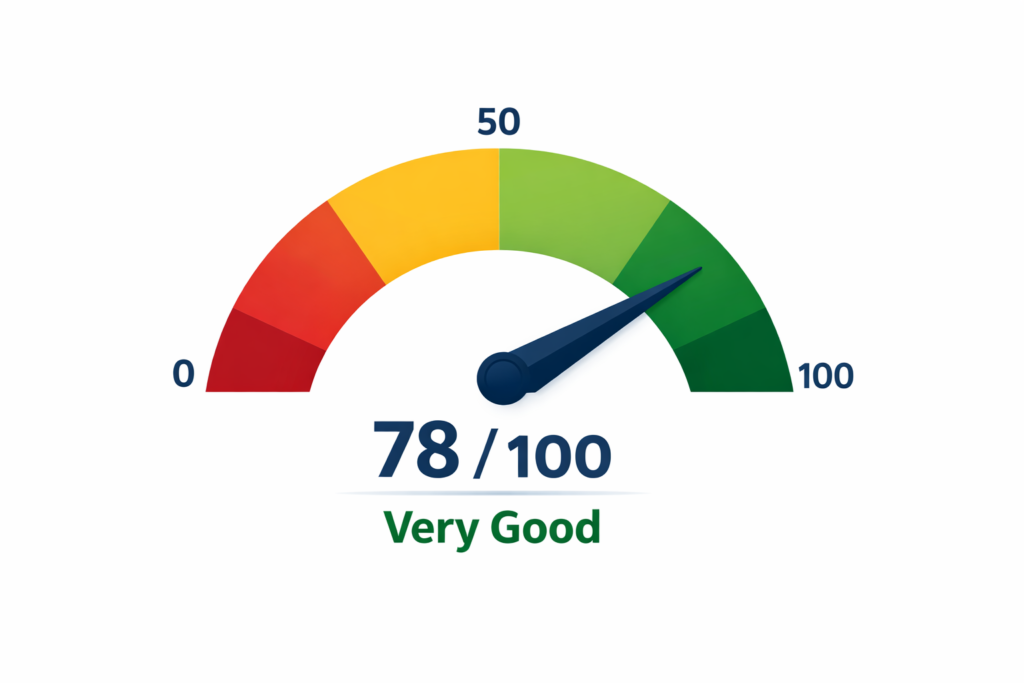

Net worth measures wealth accumulated. Cash flow measures money momentum. Financial health score measures structural soundness. You need all three — but most Indians focus only on net worth while ignoring cash flow (the driver) and financial health (the architecture). Check your Financial Health Score first at wealthpedia.in/financial-health-score — it is the most complete single-number diagnosis of your financial life available in India.
Quick Summary
Most Indians are tracking the wrong financial number. Net worth tells you what you own minus what you owe — a snapshot. Cash flow tells you whether money is working for you or against you — a direction. Financial health score tells you whether your entire financial life is structured correctly across savings rate, debt, insurance, emergency fund, and investment allocation — a diagnosis. All three matter, but they answer different questions. This article explains what each metric measures, when each matters most, and — most importantly — how to use the Wealthpedia Financial Health Score to get your complete financial diagnosis in 10 minutes.
Here is a question most financial advisors never ask their clients.
“You have ₹50 lakh in mutual funds. Is your financial life healthy?”
Most people would say yes. The answer might be no.
Because ₹50 lakh in mutual funds tells you exactly one thing: the current market value of your equity holdings. It tells you nothing about whether you have adequate insurance to protect that ₹50 lakh from being wiped out by a single medical event. It tells you nothing about whether your monthly cash flow is positive or negative — whether the ₹50 lakh is growing or being quietly eroded by debt. It tells you nothing about whether your emergency fund is adequate, your debt-to-income ratio is sustainable, or your investment allocation is appropriate for your age and goals.
Net worth is a snapshot. Cash flow is a direction. Financial health is the complete picture.
India’s financial planning conversation is obsessed with the snapshot. This article is about the complete picture.
Net Worth — What It Is and What It Misses
What Is Net Worth?
Net worth = Total assets minus total liabilities. It is the single most cited measure of financial success — and the most incomplete one when used alone.
Net worth is simple arithmetic:
Net Worth = Total Assets − Total Liabilities
Assets include:
- Mutual funds (current market value)
- EPF balance (check at epfindia.gov.in)
- PPF balance
- NPS corpus (Tier 1 and Tier 2)
- Direct equity portfolio
- Sovereign Gold Bonds
- Fixed deposits
- Primary home market value (optional — see caveat below)
- Investment property (market value)
- Cash and savings accounts
Liabilities include:
- Home loan outstanding balance
- Vehicle loan outstanding
- Personal loan outstanding
- Credit card outstanding balance
- Education loan outstanding
- Any informal borrowing
The primary home caveat: Many financial planners include primary home value in net worth. This inflates the number meaningfully but can mislead — your home is a consumption asset. You cannot withdraw from it without selling and either renting (new expense) or downsizing. For FIRE planning purposes, exclude the primary home from the investable corpus calculation. See can you retire with 3 crore for how this distinction affects retirement corpus calculations.
When Net Worth Is Useful
Net worth is most useful as a progress marker — tracking whether your financial position is improving over time. Comparing your net worth at 30 versus 35 versus 40 tells you whether the overall trajectory is upward.
It is also useful for understanding your 10 levels of financial freedom position — each level corresponds to a different relationship between your assets, your liabilities, and your income.
What Net Worth Misses
It says nothing about sustainability. A person with ₹80 lakh in mutual funds and ₹75 lakh in home loan outstanding has a net worth of ₹5 lakh. But if the home loan EMI is ₹65,000/month on a ₹1 lakh take-home, cash flow is deeply negative — the ₹80 lakh is being slowly depleted to fund lifestyle while the loan grows with interest.
It says nothing about structure. A person with ₹50 lakh net worth but zero health insurance, no term life cover, and no emergency fund is one medical emergency away from net worth collapse. The ₹50 lakh number is a mirage — it exists only if nothing goes wrong.
It says nothing about trajectory. Two people with identical ₹50 lakh net worth but different savings rates and debt levels are on completely different trajectories. One will have ₹2 crore in 10 years. The other will have ₹30 lakh.
This is why net worth, used alone, is a misleading metric. It tells you where you are — not where you are going, and not whether the structure supporting that position is sound.
Cash Flow — The Metric That Determines Everything
What Is Cash Flow?
Cash flow = Monthly income minus monthly outflows (expenses + EMIs + insurance + investments). Positive cash flow means money is accumulating. Negative cash flow means wealth is being destroyed, regardless of what the net worth statement says.
Cash flow is the most important financial metric most Indians do not formally track. It is the answer to a deceptively simple question: at the end of each month, is more money coming in than going out?
Monthly Cash Flow = Take-Home Income − (Essential Expenses + EMIs + Insurance Premiums + Discretionary Spending + Investments)
If this number is positive: you are accumulating wealth. The surplus is available for investment or debt prepayment.
If this number is zero: you are surviving — no accumulation, no depletion. Common among professionals who “invest what’s left” and find nothing is left.
If this number is negative: you are destroying wealth — funding current consumption through credit card rollovers, personal loans, or silent EPF depletion.
The Cash Flow Components
Positive cash flows (money in):
- Monthly take-home salary
- Rental income
- Business income
- Interest/dividend income
- Any other regular income
Negative cash flows (money out — essential):
- Rent or home loan EMI
- Groceries and household essentials
- Utilities (electricity, gas, internet, mobile)
- Vehicle fuel and maintenance
- Insurance premiums (health, life, vehicle)
- Children’s school fees
- Domestic help
Negative cash flows (money out — financial):
- SIP investments (this is positive for net worth but negative for current cash)
- PPF contributions
- NPS contributions
- Vehicle loan EMI
- Personal loan EMI
- Credit card minimum payment (or ideally full payment)
Negative cash flows (money out — discretionary):
- Dining out and entertainment
- Clothing and personal care
- Travel and holidays
- Subscriptions (OTT, gym, etc.)
The Three Cash Flow Zones
Zone 1 — Positive (₹X surplus/month): Healthy. Surplus goes to investments (Goal 1 in waterfall SIP allocation) or debt prepayment.
Zone 2 — Break-even (₹0 surplus): Warning. No wealth accumulation. Common cause: lifestyle has grown to exactly match income. The savings rate India guide explains why a 0% surplus means you are working until 65 regardless of income level.
Zone 3 — Negative (deficit/month): Crisis. Debt is growing. Each month the net worth statement looks worse, even if the individual assets appear stable. The how much debt is too much guide and debt-to-income ratio article explain the specific thresholds.
The Cash Flow Trap: Why High Earners Go Broke
The most counterintuitive finding in Indian personal finance data: high income does not guarantee positive cash flow. In fact, lifestyle inflation among high earners frequently produces negative cash flow at ₹30–50 lakh annual income levels.
The mechanism is predictable:
- Salary grows → lifestyle upgrades → EMIs grow → cash flow tightens
- Bonus arrives → lifestyle upgrade (new car, renovation) → EMI grows → cash flow tightens further
- Salary grows again → lifestyle upgrade → more EMIs → cash flow collapses
The result: a professional earning ₹40 lakh annually with a ₹70,000/month EMI burden, ₹35,000/month in lifestyle expenses, and ₹15,000/month in SIPs has a monthly cash flow of approximately ₹0 — no surplus, no wealth accumulation beyond the SIP. Despite the high income.
This is the central insight of the 12 financial mistakes Indians make — and the core reason why personal finance mistakes in India persist across income levels.
Cash Flow and the Investment Connection
Positive cash flow is the precondition for wealth accumulation. You cannot invest what you do not have. And what you do not invest does not compound.
This is the mathematical relationship between cash flow and every FIRE metric:
- More positive cash flow → higher savings rate → faster corpus accumulation
- Higher corpus accumulation → earlier Coast FIRE → fewer years of mandatory investing
- Fewer mandatory investing years → more flexibility in cash flow allocation
- More cash flow flexibility → better multi-goal FIRE planning outcomes
Every rupee of improved monthly cash flow is worth approximately ₹3–5 lakh in final retirement corpus (at 12% CAGR over 15–20 years). This is the quantified value of fixing a cash flow problem. See the real cost of waiting to invest for the exact compounding math.
Financial Health Score — The Complete Diagnostic
What Is a Financial Health Score?
Financial health score is a comprehensive, multi-dimensional assessment of your entire financial life — not just one metric. It evaluates savings rate, debt burden, insurance coverage, emergency fund adequacy, investment allocation, and more — and gives you a single score that indicates whether your financial architecture is sound.
If net worth is the destination and cash flow is the direction, financial health score is the roadworthiness check — the complete diagnostic that tells you whether the vehicle is fit for the journey.
The Wealthpedia Financial Health Score assesses 15 dimensions of your financial life using India-specific benchmarks — not imported American frameworks. Each dimension is scored against what is appropriate for your age, income, and life stage.
The 15 Dimensions of Financial Health
The Financial Health Score evaluates:
1. Savings Rate
Are you saving enough? The benchmark varies by age and FIRE target. The ideal savings rate in India 2026 is 30–45% for FIRE before 55. The score assesses where you are against this benchmark.
2. Emergency Fund Adequacy
Do you have 6 months of expenses liquid and accessible? The 3-months emergency fund is outdated — the benchmark has shifted. This dimension checks adequacy against the updated standard. See also the detailed emergency fund guide.
3. Debt-to-Income Ratio
What percentage of monthly income goes to EMI payments? The debt-to-income ratio article establishes the safe threshold at 35–40% maximum. Above this: financial health is at risk. And do you know how much debt is too much? This dimension answers it.
4. Insurance Coverage — Life
Is your term life cover adequate (10–15× annual income)? Undercoverage is a silent financial health risk — one of the 7 financial mistakes Indians make.
5. Insurance Coverage — Health
Is your health insurance adequate (minimum ₹25–50 lakh family floater)? Healthcare inflation in India runs at 10–14% annually — inadequate health insurance is the most common destroyer of accumulated wealth.
6. Investment Allocation — Asset Mix
Is your portfolio appropriately allocated between equity, debt, and gold for your age? The asset allocation for FIRE India framework establishes what is appropriate at each life stage.
7. Investment Allocation — Instrument Quality
Are you investing in Direct Plan index funds or paying regular plan commissions? Are you in growth option or IDCW? The dividend vs growth mutual funds distinction costs lakhs over a career.
8. Retirement Corpus Progress
Are you on track for your target FIRE date? This is the most important dimension — assessed against India-calibrated safe withdrawal rates and the FIRE number calculator.
9. Goal-Based Investment Structure
Do you have separate, appropriately structured investments for each financial goal? The waterfall SIP allocation principle is the gold standard — assessed here.
10. Tax Efficiency
Are you maximising 80C (₹1.5 lakh) and 80CCD(1B) (₹50,000 NPS)? The PPF vs ELSS vs NPS guide shows what optimal looks like. Suboptimal tax planning costs ₹15,000–₹60,000 annually in unnecessary tax.
11. Liquidity Ratio
What percentage of your net worth is in liquid or near-liquid instruments? Too illiquid = financial fragility. Too liquid = insufficient long-term growth. The balance matters.
12. Financial Goal Clarity
Do you have specific, quantified financial goals with timelines? The balance life financially with multi-goal FIRE planning article explains why clarity of goals is itself a financial health indicator.
13. Passive Income Development
Are you building income streams that are independent of your employment? As the barista FIRE India and invest monthly in India guides explain, passive income development is a leading indicator of long-term financial resilience.
14. Behaviour and Consistency
Are your investments automatic and consistent, or manual and sporadic? The habits of financially healthy people article identifies consistency as the most significant behavioural differentiator between successful and unsuccessful investors.
15. FIRE Readiness
Composite: are you on the path to financial independence? The score synthesises all dimensions into an overall FIRE readiness assessment.
How to Interpret Your Financial Health Score?
A score below 50 means structural problems need fixing before optimisation. 50–70 means you are functional but leaving significant value on the table. 70–85 means you are doing well with specific gaps. Above 85 means your financial architecture is sound — focus on corpus accumulation.
Score Range Assessment Priority Action 0–30 Critical — multiple structural failures Fix foundations first: emergency fund, insurance, eliminate high-cost debt 31–50 Poor — significant gaps Address the lowest-scoring dimensions systematically 51–65 Fair — functional but suboptimal Close the most impactful gaps (usually savings rate + instrument quality) 66–80 Good — sound structure with specific gaps Optimise — step-up SIP, tax efficiency, passive income 81–90 Very Good — strong architecture Focus on corpus growth and goal tracking 91–100 Excellent — comprehensive financial health Maintain and monitor annually
The critical insight: Most Indians in the 51–65 “fair” range believe they are financially healthy because their net worth is growing. But they are paying regular plan commissions, underinsured, without proper emergency funds, and not maximising tax efficiency. The improve financial health score India guide shows exactly how to move from each band to the next.
The Financial Health Score by Age Benchmark
As detailed in the financial health score by age in India article, what constitutes a “good” score varies by life stage: Age Group Minimum Healthy Score Key Dimension at This Stage 22–28 55+ Emergency fund + first SIP running + term insurance 28–35 62+ Savings rate 25%+, health insurance, no high-cost debt 35–45 70+ Corpus on FIRE trajectory, tax efficiency, goal structure 45–55 76+ Coast FIRE approaching, healthcare reserve, bucket structure 55+ 80+ Retirement-ready corpus, withdrawal strategy, sequence risk managed
Compare your score to your age benchmark at wealthpedia.in/financial-health-score.
The Relationship Between All Three
The three metrics are interdependent. Cash flow drives net worth growth. Financial health score tells you whether the cash flow → net worth mechanism is working efficiently or leaking value through structural problems.
Here is the complete picture:
| Component | Role | Impact on Next Stage |
|---|---|---|
| Cash Flow (Monthly Surplus) | The amount left after income minus expenses. | Determines the Investment Rate by defining how much can be invested each month. |
| Investment Rate | The portion of monthly surplus directed toward investments and wealth-building assets. | Determines the Net Worth Trajectory by influencing the speed of wealth accumulation. |
| Net Worth Trajectory | The trend of an individual’s assets minus liabilities over time. | Indicates whether wealth is growing, stagnating, or declining. |
| Financial Health Score | A holistic assessment of financial well-being, considering cash flow, investments, debt, protection, and goal alignment. | Evaluates whether the entire financial system is functioning efficiently and sustainably. |
The Four Financial Profiles
Understanding where you sit across these three metrics identifies your specific financial situation and priority action:
Profile 1: High Net Worth, Low Cash Flow, Low Health Score
“The Asset Rich, Cash Poor Indian”
Typical: 45-year-old professional with ₹1.5 crore in property + ₹30 lakh in mutual funds, but ₹80,000/month in EMIs on ₹1.5 lakh income. Net worth looks good. Cash flow is negative. Financial health score is poor (high debt-to-income ratio, inadequate liquid assets).
Priority: Reduce debt aggressively. Free up cash flow. Increase liquid investments.
Articles most relevant: how much debt is too much, debt-to-income ratio, personal finance mistakes India.
Profile 2: Low Net Worth, High Cash Flow, Medium Health Score
“The High Earner Who Just Started”
Typical: 32-year-old with ₹80,000/month surplus but only ₹8 lakh in investments (just started seriously). Cash flow is excellent. Net worth is low (young, late start). Financial health score is medium — good structure but corpus behind schedule.
Priority: Maximise the cash flow advantage immediately. Every month of delay costs significantly — see real cost of waiting to invest. Implement step-up SIP immediately.
Articles most relevant: why most FIRE plans fail, invest every month, 5000 vs 10000 vs 15000 SIP retirement.
Profile 3: Medium Net Worth, Medium Cash Flow, Low Health Score
“The Structurally Fragile Indian”
Typical: 38-year-old with ₹45 lakh corpus, ₹25,000/month surplus, but zero health insurance, regular plan mutual funds, and no goal structure. Looks fine on the surface. Financial health score reveals structural fragility — one medical event or market dislocation away from significant setback.
Priority: Fix the structural gaps immediately — insurance, switch to direct plans, goal structuring. The net worth and cash flow are adequate; the architecture is broken.
Articles most relevant: improve financial health score India, what is a good financial health score in India, dividend vs growth mutual funds.
Profile 4: High Net Worth, High Cash Flow, High Health Score
“The FIRE-Ready Indian”
Typical: 48-year-old with ₹2.8 crore corpus, ₹60,000/month surplus (even after aggressive SIPs), direct plan index funds, comprehensive insurance, clear goals, and a financial health score above 82.
Priority: Maintain. Track progress to FIRE. Check Coast FIRE status. Model retirement scenarios in the Multi Goal FIRE Planner. Review financial independence calculator India.
The Common Mistakes — What Low Scores Reveal
Mistake 1: Confusing High Income with Financial Health
Income is a raw material. Financial health is what you build with it. High income with poor structure produces low financial health scores — and historically has produced 7 financial mistakes Indians make.
The 12 financial mistakes Indians make report identifies this as the most common error in India’s high-earning professional class. Income is a precondition, not a guarantee.
Mistake 2: Optimising Returns Before Fixing Structure
Many investors spend hours researching which fund outperformed which by 1–2%. Meanwhile, they are paying 1.5% regular plan commissions, have no emergency fund, are underinsured, and have no goal structure.
The financial health score addresses this directly: structural problems have a higher impact on outcomes than return optimisation. Fix the structure first. Optimise returns after.
Relevant: sip really build compare, how inflation eats SIP corpus.
Mistake 3: Treating Net Worth as the Only Progress Metric
A property worth ₹1.5 crore with a ₹1.2 crore loan outstanding is a ₹30 lakh net worth position that generates zero monthly income, consumes ₹80,000/month in EMI, and cannot be liquidated without a 3–6 month sales process.
A mutual fund portfolio of ₹40 lakh is a smaller net worth position that generates accessible returns, can be liquidated within 1–3 days, and can be drawn down via SWP for retirement income.
Same “value,” radically different financial health implications. The personal finance OS explains how these different asset types interact in a complete financial life.
Mistake 4: Ignoring the FIRE Number Until It Is Too Late
The most common low financial health score among 40-somethings: no retirement corpus tracking. They have been saving without knowing their FIRE number — without knowing whether ₹40 lakh in mutual funds is 10% of the way or 50% of the way to retirement.
The retirement corpus calculator India, early retirement calculator India, and money you need to retire in India articles all address this gap. The Multi Goal FIRE Planner calculates it comprehensively in 10 minutes.
Using the Financial Health Score Tool — Step by Step
The Wealthpedia Financial Health Score takes 10 minutes to complete and gives you a diagnostic score across 15 financial dimensions — the most comprehensive free financial health assessment available in India.
Step 1: Open the Tool
Go to wealthpedia.in/financial-health-score. No registration required. Free.
Step 2: Complete the 15-Question Assessment
The assessment covers all 15 dimensions described in Part 3. Have the following information ready:
- Monthly take-home income
- Monthly expenses (approximate)
- Total EMI payments per month
- Emergency fund balance
- Total investment corpus (including EPF — check at epfindia.gov.in)
- Monthly SIP amounts
- Insurance coverage amounts (health + life)
- Whether you invest in Direct or Regular plans
Step 3: Read Your Score and the Dimension Breakdown
Your score is shown overall and by dimension. The lowest-scoring dimensions are your highest-priority gaps. The tool shows what score is appropriate for your age.
Step 4: Link to Specific Fix Articles
For each low-scoring dimension, the tool recommends specific actions. Use this article cluster to go deeper: Low-Scoring Dimension Go-To Article Emergency fund Emergency fund guide + 3-months is outdated Debt-to-income Debt-to-income ratio + how much debt is too much Savings rate Savings rate India + ideal savings rate 2026 Insurance coverage Healthcare inflation India Investment allocation Asset allocation FIRE India + index funds FIRE India Instrument quality Dividend vs growth MF + PPF vs ELSS vs NPS Retirement progress Multi Goal FIRE Planner + safe withdrawal rate India Tax efficiency PPF vs ELSS vs NPS Goal structure Waterfall SIP allocation FIRE readiness FIRE number calculator India + plan retirement India
Step 5: Recheck Annually
Financial health is not a one-time diagnosis — it is an ongoing assessment. Recheck every April, after each salary increment, and after any major financial event (new loan, new goal, new investment). The score should improve 3–8 points per year for an investor who is actively working their financial plan.
The Priority Framework — What to Fix First
Fix in this order — (1) Cash flow must be positive, (2) Emergency fund must be adequate, (3) Insurance must be sufficient, (4) High-cost debt must be eliminated, (5) Investment structure must be optimised, (6) Corpus must be on FIRE trajectory.
Many people try to optimise returns (Step 6) while Step 1 (positive cash flow) is not achieved. This is mathematically futile — you cannot compound what you do not invest.
The priority sequence:
Priority 1: Achieve Positive Monthly Cash Flow
If your cash flow is negative or zero, nothing else matters. Fix this first.
How:
- Identify the largest discretionary expense categories
- Reduce or eliminate high-cost debt (credit card, personal loan)
- Do not increase EMI burden further
- Redirect any income increment to SIP before lifestyle
See: best SIP strategy retirement 2026, achieve FIRE on 50k salary.
Priority 2: Build Emergency Fund to 6 Months
Once cash flow is positive, the first ₹4–10 lakh of surplus goes entirely to emergency fund in a liquid mutual fund. This is not an investment — it is insurance for all your other investments.
See: emergency fund guide.
Priority 3: Get Insurance Right
Term life (15× annual income) and health insurance (₹50 lakh family floater minimum) must be in place before aggressive corpus building. One uncovered medical event can destroy decades of corpus accumulation.
See: healthcare inflation India, habits of financially healthy people.
Priority 4: Eliminate High-Cost Debt
Credit cards (36%+ interest) and personal loans (18–24%) are guaranteed wealth destroyers. Eliminate before investing beyond the emergency fund.
See: debt-to-income ratio, how much debt is too much.
Priority 5: Optimise Investment Structure
Switch to Direct Plans. Move to Growth option. Implement the waterfall SIP allocation. Enable step-up SIP. These structural changes cost nothing to implement and typically improve final corpus by ₹30–80 lakh over a career.
See: dividend vs growth MF, step-up SIP India, index funds FIRE India.
Priority 6: Build the FIRE Corpus
With the structure in place, now focus on maximising the corpus. Use the Multi Goal FIRE Planner to set your specific FIRE number and required monthly SIP. Track progress annually. Check Coast FIRE status.
See: FIRE vs traditional retirement India, financial independence retire early FIRE India.
FAQs: Net Worth vs Cash Flow vs Financial Health
What is more important — net worth or cash flow?
Cash flow, for most people most of the time. Cash flow is the input that creates net worth. Without positive cash flow, net worth cannot grow. However, once a substantial corpus is built, net worth and its growth rate become more important than monthly cash flow.
What is a good financial health score in India?
65+ is the minimum healthy score for most age groups. 75+ indicates sound financial architecture. 85+ means your financial life is comprehensively structured. Check the benchmark for your age at the Financial Health Score tool. The what is a good financial health score in India article has the full breakdown.
How do I calculate my net worth?
Total assets (mutual funds + EPF + PPF + NPS + FDs + gold + property) minus total liabilities (home loan + vehicle loan + personal loan + credit card outstanding). Use current market values for assets. See the personal finance OS for a complete net worth tracking framework.
How do I calculate my monthly cash flow?
Take-home income minus all outflows (essential expenses + EMIs + insurance + investments + discretionary spending). If positive: you are accumulating. If zero or negative: address before optimising investments. See savings rate India.
What is the Financial Health Score tool?
The Wealthpedia Financial Health Score is a free, 15-question assessment that evaluates your savings rate, debt burden, insurance coverage, emergency fund, investment structure, tax efficiency, and FIRE readiness — giving you a single score out of 100 with dimension-by-dimension breakdown. Takes 10 minutes. No registration required.
Can I have a high net worth but poor financial health?
Yes — this is extremely common in India. A ₹1.5 crore property with ₹1.2 crore loan outstanding, no liquid assets, no health insurance, and negative monthly cash flow is a high net worth, poor financial health position. The improve financial health score India guide shows how to fix it.
What is a healthy debt-to-income ratio in India?
Total monthly EMI payments should not exceed 35–40% of monthly take-home income. Above 40%: financial health is at risk. Above 50%: crisis territory. See debt-to-income ratio.
How does cash flow relate to FIRE planning?
Every ₹10,000/month of additional positive cash flow directed to investment builds approximately ₹50 lakh additional corpus over 15 years at 12% CAGR. Cash flow is the fuel for financial independence. See real cost of waiting.
What does an emergency fund have to do with net worth?
An emergency fund protects net worth from being destroyed by unexpected events. Without it, a medical emergency or job loss forces liquidation of investments (often at the worst time). The emergency fund guide explains why 6 months is the new minimum.
How often should I check my financial health score?
Annually at minimum — every April after your salary revision. Also after any major financial event: new loan, marriage, child, job change, inheritance. The score should improve 3–8 points per year. See financial health score by age India.
Does property count in net worth for FIRE planning?
Primary home: generally excluded from the investable FIRE corpus — it is a consumption asset that cannot be drawn down without selling and relocating. Investment property: included if rental income supplements corpus withdrawal. See can I retire with 3 crore India for how property interacts with FIRE calculations.
What is the difference between financial health and financial independence?
Financial health is the structural soundness of your current financial life. Financial independence (FIRE) is a future state where investments fund all expenses. You need good financial health throughout the journey to reach financial independence. A high financial health score is a prerequisite for FIRE — not the same thing as FIRE. See financial independence retire early India.
Why do high earners often have poor cash flow?
Lifestyle inflation: expenses grow proportionally or faster than income, eliminating the surplus. EMI accumulation: each salary increment funds a new loan rather than a new investment. The 12 financial mistakes Indians make identifies the specific mechanisms.
How does the Financial Health Score relate to the Multi Goal FIRE Planner?
The Financial Health Score tells you whether your financial architecture is sound. The Multi Goal FIRE Planner tells you whether your corpus trajectory will reach your FIRE number. Use the Financial Health Score first — fix structural problems — then use the FIRE Planner to model the trajectory. They are complementary diagnostic tools.
What is the fastest way to improve financial health score?
Typically: (1) Switch mutual funds from Regular to Direct Plans — immediate improvement to investment quality dimension. (2) Set up or increase emergency fund. (3) Increase SIP by the step-up amount. These three actions together can move a score from 55 to 68 within one month. Full guide: improve financial health score India.
Should I focus on increasing net worth or improving cash flow first?
If cash flow is negative or zero: fix cash flow first — net worth cannot grow without it. If cash flow is positive but net worth is low (young investor): maximise the savings rate to grow net worth as fast as possible. If both are adequate: focus on financial health score — ensure structure is sound. See invest every month.
How does EPF fit into net worth vs cash flow?
EPF is a positive net worth item (asset). It is a neutral cash flow item (the deduction reduces take-home, but it is your own money being saved). Never withdraw EPF — it is locked, guaranteed, EEE, 8.25% compounding wealth. See Indian FIRE statistics 2026.
What is the ideal savings rate for good financial health?
25–30% minimum for FIRE before 60. 35–45% for FIRE before 55. See both savings rate India and ideal savings rate India 2026 for the full analysis. The financial health score assesses your current rate against these benchmarks.
How do I know if my debt level is healthy?
Total EMIs below 35% of monthly take-home = healthy. EMIs 35–45% = elevated, manageable. EMIs above 45% = dangerous — financial health at risk. Credit card outstanding > 0 at any month end = immediate fix required. See debt-to-income ratio.
Can I achieve FIRE with a low financial health score?
Theoretically possible but practically very difficult. A low financial health score typically indicates structural problems (high debt, inadequate insurance, poor investment structure) that drain cash flow and reduce effective corpus growth. Most FIRE achievers have financial health scores above 75. Fix the score first, then the FIRE trajectory typically self-corrects. See FIRE vs traditional retirement India.
What does negative cash flow do to long-term net worth?
Destroys it systematically. Each month of negative cash flow either: (a) increases debt (new liabilities), (b) reduces liquid assets (draws down savings), or (c) both. Over 2–3 years of negative cash flow, even a substantial net worth position can be significantly impaired. The personal finance mistakes India case studies shows real examples.
How does the SIP calculator relate to cash flow planning?
A monthly SIP calculator shows what your SIP amount grows to — the output of your savings. Cash flow planning determines what SIP amount is sustainable — the input. You cannot set the right SIP without first knowing your positive monthly cash flow. See SIP really build compare.
Is there a difference between financial health score and credit score?
Yes — completely different. Credit score (CIBIL) measures creditworthiness — your ability to repay loans as judged by lenders. Financial health score measures the comprehensive soundness of your financial life including savings, insurance, investments, and FIRE readiness. Credit score is one input to financial health, not a substitute for it.
How does the financial health score change with age?
Benchmarks rise with age — a 28-year-old with a score of 58 is doing reasonably well; a 45-year-old with a score of 58 is significantly behind. The financial health score by age India article has age-specific benchmarks and the specific dimensions that matter most at each life stage.
What is the single most important action I can take today?
Open the Wealthpedia Financial Health Score and complete the 15-question assessment. The score and dimension breakdown you receive will be the most specific, actionable financial diagnostic you have ever seen. It tells you not just where you are, but which specific dimensions to fix — and in what order. Then use the Multi Goal FIRE Planner to model your corpus trajectory once the structural problems are addressed.
Conclusion: The Complete Financial Picture
Net worth answers: What do I have?
Cash flow answers: Is money moving toward me or away from me?
Financial health score answers: Is my entire financial life structured correctly?
You need all three answers to make good financial decisions. Most Indians have an approximate sense of their net worth and a vague sense of their cash flow — but very few have ever assessed their financial health comprehensively.
The Wealthpedia Financial Health Score is the tool that closes this gap. It is free, takes 10 minutes, requires no registration, and gives you the most specific financial diagnosis available in India.
Take the assessment. Know your score. Fix the lowest-scoring dimensions first — using the linked articles above as your implementation guides. Then model your FIRE trajectory in the Multi Goal FIRE Planner.
A complete financial picture. Ten minutes. Free.
Disclaimer: This article is for educational purposes only. Please consult a SEBI-registered investment advisor for personalised financial advice. Wealthpedia® is a registered trademark (TM No. 4910385).

Vishal Jhaveri is the founder of Wealthpedia and an MBA Finance professional with over 10 years of experience in financial planning, investing, and wealth creation. He specializes in FIRE (Financial Independence, Retire Early), retirement planning, investing, and personal finance education. Through Wealthpedia, he develops financial calculators and publishes evidence-based content to help Indian investors make informed financial decisions. He regularly reviews and updates Wealthpedia articles to reflect changes in tax, laws, investment regulations, and personal finance best practices.
Quick Wrap up