
Leaving a job before 10 years of EPS-covered service forces a decision that most employees make without fully understanding the long-term consequences. When you file Form 10C on the EPFO portal, you are asked to choose between two options: Withdrawal Benefit or Scheme Certificate. The labels are dry and bureaucratic. The financial difference between the two choices — over a 20–30 year horizon — can run into several lakhs of rupees.
This guide breaks down exactly what each option gives you, who should choose which, and what the numbers look like across different career scenarios. Every claim on this page is backed by the EPFO formula — verify any figure using the EPS Pension Calculator India.
Quick Summary
When you leave a job with fewer than 10 years of EPS service, EPFO gives you two options via Form 10C: take a lump-sum withdrawal benefit calculated using Table D, or apply for a Scheme Certificate that preserves your EPS service for a future employer. The withdrawal gives you cash today but permanently closes your EPS account. The Scheme Certificate gives you nothing immediately but keeps the door open to qualifying for a lifetime monthly pension later. This article compares both options across financial value, eligibility impact, and life circumstances — with worked examples — so you can make the right choice for your career and retirement. Use the EPS Pension Calculator India to model your specific scenario.
What Is the EPS Withdrawal Benefit?
The EPS withdrawal benefit is a lump-sum payment EPFO makes to members who leave employment before completing 10 years of EPS service and choose to permanently close their EPS account.
It is calculated using Table D factors:
Withdrawal Benefit = Table D Factor × Monthly Pensionable Salary
The Table D factor ranges from 1.02 (1 year of service) to 9.72 (9 years of service). The pensionable salary is capped at ₹15,000 per month for most employees.
| Years of Service | Table D Factor | Benefit at ₹15,000 |
|---|---|---|
| 1 | 1.02 | ₹15,300 |
| 3 | 3.10 | ₹46,500 |
| 5 | 5.28 | ₹79,200 |
| 7 | 7.46 | ₹1,11,900 |
| 9 | 9.72 | ₹1,45,800 |
Once you take the withdrawal benefit, your EPS account is permanently closed. The service years are gone — they cannot be recovered or added to future EPS service. For the full breakdown of Table D and step-by-step examples, see the EPS Withdrawal Benefit Calculator article.
What Is the EPS Scheme Certificate?
A Scheme Certificate is an official EPFO document that records your EPS service period, pensionable salary, and membership details — preserving your past service for use with a future employer.
When you join a new EPF-covered employer, you submit your Scheme Certificate to your new employer, who forwards it to EPFO. Your previous service is then added to your new EPS account — effectively making your total EPS service the sum of the old and new spells.
What a Scheme Certificate Contains
- Your name and UAN
- Name and code of your previous employer
- Total EPS-covered service period (in years and months)
- Monthly pensionable salary at the time of exit
- Date of membership commencement and cessation
What a Scheme Certificate Does Not Give You
- No immediate cash or lump sum
- No guaranteed pension — you still need to accumulate enough total service later
- No interest on the preserved service (it is a record, not a savings account)
Key Differences — Scheme Certificate vs Withdrawal Benefit
| Feature | Withdrawal Benefit | Scheme Certificate |
|---|---|---|
| Immediate Cash | Yes — Table D lump sum | No |
| EPS Service Preserved | No — permanently lost | Yes — carried to next employer |
| Future Pension Eligibility | Lost for this period | Maintained |
| Reversible? | No | Yes — can be encashed via withdrawal later if needed |
| Suitable For | Leaving organised sector permanently | Continuing EPF-covered employment |
| Form Required | Form 10C (select Withdrawal) | Form 10C (select Scheme Certificate) |
| Processing Time | 7–20 working days (bank credit) | 7–20 working days (certificate issued) |
| Minimum Service Needed | 1 year | Any service duration |
| Maximum Service Applicable | 9 years (below 10 years) | 9 years (below 10 years) |
| Tax on Receipt | Taxable if under 5 years total service | Not applicable (no cash received) |
The Core Financial Question — What Are You Giving Up?
The Scheme Certificate preserves your EPS service. The withdrawal benefit monetises it today. To compare them rationally, you need to answer: what is the future pension value of the preserved service?
Scenario A — 5 Years of Past Service, Planning to Work 15 More Years
Past service: 5 years
Future planned service: 15 years in EPF-covered employment
Total combined service if Scheme Certificate used: 20 years
With Scheme Certificate:
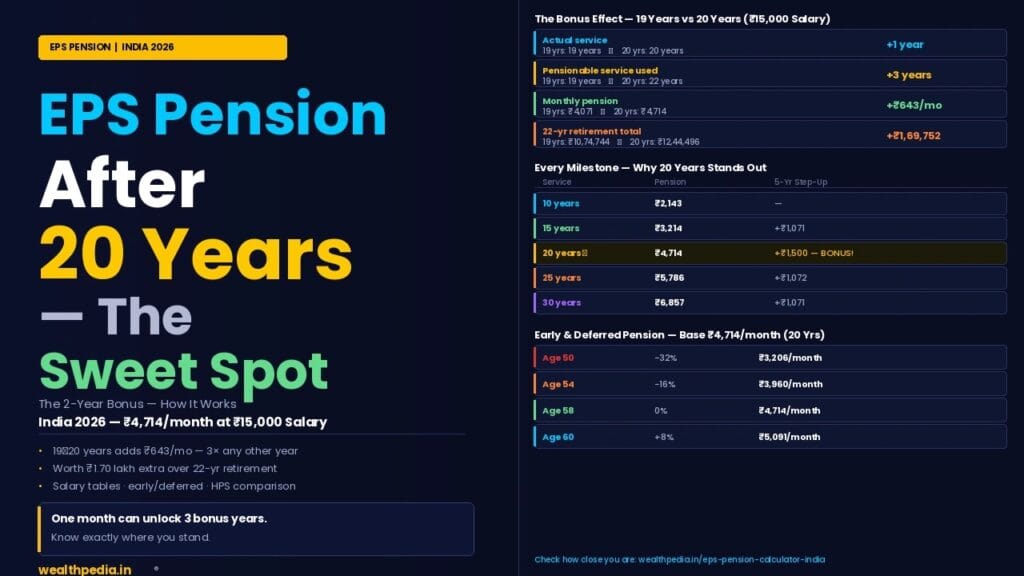
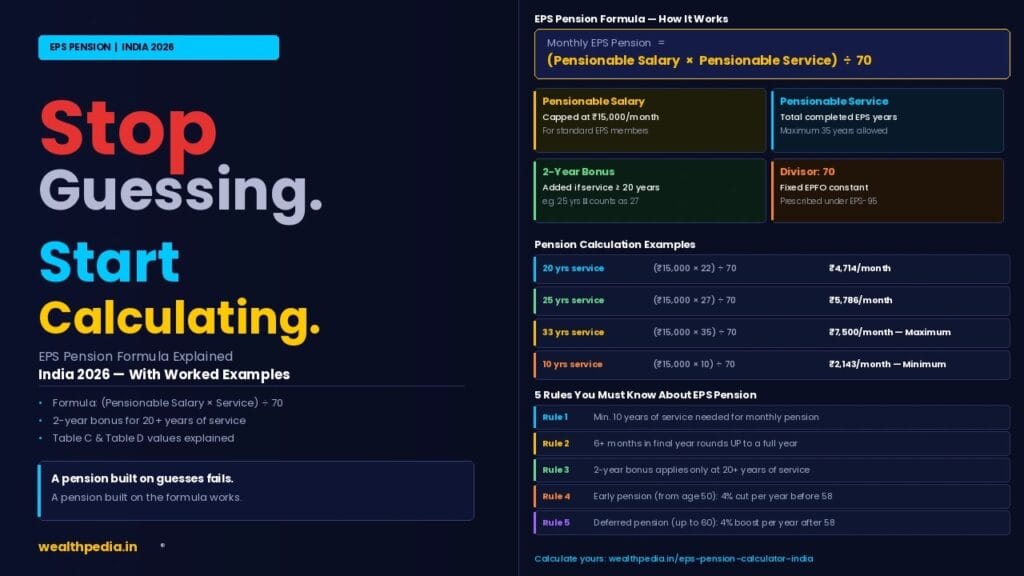
- Combined service = 20 years → 2-year bonus applies → Pensionable Service = 22 years
- Monthly Pension = (15,000 × 22) ÷ 70 = ₹4,714/month
- Over 22 years of retirement (age 58–80): Total pension = ₹12.44 lakh
Without Scheme Certificate (withdrawal taken):
- Future service alone = 15 years → Pensionable Service = 15 years (no bonus — below 20)
- Monthly Pension = (15,000 × 15) ÷ 70 = ₹3,214/month
- Over 22 years of retirement: Total pension = ₹8.49 lakh
Table D withdrawal taken today: ₹79,200
Pension lost by withdrawing: ₹12.44L − ₹8.49L = ₹3.95 lakh in lifetime pension
Lump sum received: ₹79,200
The Scheme Certificate delivers ₹3.95 lakh more in lifetime pension value — in exchange for giving up ₹79,200 today. The ratio is approximately 5:1 in favour of the Scheme Certificate.
Scenario B — 7 Years of Past Service, Planning to Work 13+ More Years
Past service: 7 years
Future planned service: 13 years in EPF-covered employment
Total combined service with Scheme Certificate: 20 years
With Scheme Certificate:
- Combined service = 20 years → bonus = 22 years pensionable
- Monthly Pension = (15,000 × 22) ÷ 70 = ₹4,714/month
Without Scheme Certificate:
- Future service alone = 13 years → no 2-year bonus
- Monthly Pension = (15,000 × 13) ÷ 70 = ₹2,786/month
Table D withdrawal: ₹1,11,900
Additional lifetime pension value (Scheme Certificate): (₹4,714 − ₹2,786) × 12 × 22 = ₹5.09 lakh
Again, the Scheme Certificate wins decisively on lifetime value — by nearly 4.5x the lump sum.
Scenario C — 8 Years Past Service, Not Planning to Rejoin EPF Employment
Past service: 8 years
Future plans: Self-employment, freelancing, or abroad
With Scheme Certificate:
- Future EPF service = 0
- Combined service = 8 years → below 10 years → no monthly pension
- The Scheme Certificate is eventually worthless if never submitted to an EPF employer
Without Scheme Certificate (withdrawal taken):
- Table D at 8 years × ₹15,000 = 8.63 × ₹15,000 = ₹1,29,450 received today
Verdict: In this case, the withdrawal benefit is clearly better. The Scheme Certificate only has value if it is submitted to a future EPF employer. If that never happens, the preserved service generates nothing.
When to Choose Withdrawal Benefit
Choose the withdrawal benefit when one or more of the following apply:
- You are permanently moving to self-employment, entrepreneurship, or freelancing
- You are moving abroad and do not plan to return to Indian EPF-covered employment
- Your total past service is very short (1–3 years) and the pension impact is negligible
- You have an immediate financial need that the lump sum can address
- You have strong alternative retirement savings (NPS, mutual funds, real estate) and the marginal pension increase does not materially change your retirement picture
- Your health or family history suggests a shorter-than-average life expectancy
When to Choose Scheme Certificate
Choose the Scheme Certificate when one or more of the following apply:
- You plan to continue working in any EPF-covered organisation in India
- You are below 40 years of age with significant earning years remaining
- Your past service, combined with expected future service, can cross 10 years (the minimum for monthly pension)
- Your past service, combined with expected future service, can cross 20 years (to unlock the 2-year bonus)
- You are in career transition and are unsure whether you will rejoin EPF employment — the Scheme Certificate keeps the option open at zero cost
- Your past service is 7–9 years — close enough to 10 years that even a short future stint can qualify you for lifetime pension
The 2-Year Bonus Trap — Why the Scheme Certificate Is Often Undervalued
The single most powerful reason to choose the Scheme Certificate over the withdrawal benefit for most working-age employees is the 2-year bonus at 20 years of service. Most employees do not model this when making the Form 10C decision.
If your combined service (past + future) reaches exactly 20 years, EPFO adds 2 bonus years — making your effective pensionable service 22 years instead of 20. That is an additional:
(15,000 × 2) ÷ 70 = ₹429/month for life
Over 20 years of retirement: ₹1,02,960 extra — generated entirely by the 2-year bonus.
If your past service is 5 years and you need 15 more to reach 20, taking the Scheme Certificate today preserves not just the 5 years — it preserves the future possibility of the 2-year bonus, which alone is worth over ₹1 lakh in lifetime pension.
The EPS Pension Formula Explained article covers the 2-year bonus rule in full detail.
Can You Change Your Mind After Taking a Scheme Certificate?
Yes — within limits. A Scheme Certificate can later be surrendered for the withdrawal benefit if your circumstances change and you decide you will never rejoin EPF employment. You would receive the Table D withdrawal amount based on your original service and pensionable salary at the time of exit.
However, you cannot reverse a withdrawal benefit. Once you take the lump sum and close your EPS account, the service is gone permanently. There is no mechanism to restore it.
This asymmetry is critical: the Scheme Certificate preserves optionality; the withdrawal forfeits it. Given the irreversibility of the withdrawal, the default choice for any employee with meaningful future working years ahead should be the Scheme Certificate.
How to Apply for Scheme Certificate — Form 10C Online
Both options — withdrawal benefit and Scheme Certificate — are applied for via Form 10C on the EPFO UAN portal. The process is identical until the step where you select your preference.
Step-by-Step Process
Step 1: Log in to the EPFO Member Portal at unifiedportal-mem.epfindia.gov.in using your UAN and password.
Step 2: Go to Online Services → Claim (Form 31, 19, 10C & 10D).
Step 3: Verify your bank account details on screen. Enter the last 4 digits to confirm.
Step 4: Click “Proceed for Online Claim.” From the dropdown, select “Only Pension Withdrawal (Form 10C)”.
Step 5: When prompted for the type of benefit, select:
- “Scheme Certificate” — to preserve your EPS service
- “Withdrawal Benefit” — to take the Table D lump sum
Step 6: Complete the Aadhaar OTP verification on your registered mobile number.
Step 7: Submit. For Aadhaar-verified accounts, employer approval is not required. For others, the employer must approve via the EPFO Employer Portal.
Step 8:
- If you selected Withdrawal Benefit → amount credited to bank within 7–20 working days
- If you selected Scheme Certificate → certificate issued by EPFO within 7–20 working days; download from the Member Portal
For a detailed guide with common filing errors and resolutions, see Form 10C Explained: EPS Withdrawal and Scheme Certificate.
How to Submit a Scheme Certificate to Your New Employer
When you join a new EPF-covered employer, follow these steps to have your preserved service added:
Step 1: Download your Scheme Certificate from the EPFO Member Portal (under Certificates section).
Step 2: Submit it to your new employer’s HR or accounts team.
Step 3: Your new employer submits the Scheme Certificate to their regional EPFO office along with your new employee registration details.
Step 4: EPFO links the past service to your active UAN and EPS account. Your pension calculation will include both the old and new service periods.
Note: Ensure your UAN is the same across both employment stints. If you have multiple UANs, get them merged via the EPFO Member Portal before submitting the Scheme Certificate.
What Happens If You Hold a Scheme Certificate and Never Submit It?
If you take the Scheme Certificate but never join another EPF-covered employer — and never surrender it for the withdrawal benefit — the service it records is simply never used. There is no penalty for holding an unused Scheme Certificate. However, the EPS contributions for that period remain in EPFO’s pooled pension fund and are not refunded in any form.
If you reach age 58 with unused Scheme Certificate service and insufficient total service (below 10 years), you will not qualify for monthly pension. In this case, you can still file for the withdrawal benefit based on the original service — consult your regional EPFO office for the process.
Scheme Certificate vs Withdrawal Benefit — Decision Framework
Use this framework to decide:
Are you below 40 years old?
→ Yes → Take Scheme Certificate (you likely have significant EPF employment ahead)
→ No → Continue below
Do you plan to work in any EPF-covered role in the next 5 years?
→ Yes → Take Scheme Certificate
→ No → Continue below
Will your past + future service ever reach 10 years?
→ Yes → Take Scheme Certificate (qualifies you for lifetime pension)
→ No → Consider withdrawal, but evaluate Scheme Certificate optionality
Is your past service 7 years or more?
→ Yes → Even a short future stint can cross 10 years — strongly consider Scheme Certificate
→ No (1–4 years) → Withdrawal benefit is more defensible, especially if pension amount is small
Do you have an urgent, unavoidable financial need?
→ Yes → Withdrawal benefit may be justified
→ No → Default to Scheme Certificate
Long-Term Financial Comparison — Summary Table
| Scenario | Past Service | Future Service | Action | Lifetime Pension Value | Table D Lump Sum | Better Option |
|---|---|---|---|---|---|---|
| Young professional, 5 yrs past | 5 yrs | 15 yrs more | Scheme Cert | ₹12.44L | ₹79,200 | Scheme Certificate |
| Mid-career, 7 yrs past | 7 yrs | 13 yrs more | Scheme Cert | ₹12.44L | ₹1,11,900 | Scheme Certificate |
| Entrepreneur exit, 8 yrs past | 8 yrs | 0 yrs | Withdrawal | ₹0 (no pension) | ₹1,29,450 | Withdrawal Benefit |
| Near threshold, 9 yrs past | 9 yrs | 1 yr more | Scheme Cert | ₹5.65L | ₹1,45,800 | Scheme Certificate |
| Short tenure, 2 yrs past | 2 yrs | Uncertain | Scheme Cert | Preserves option | ₹30,900 | Scheme Certificate (default) |
Frequently Asked Questions — Scheme Certificate vs EPS Withdrawal
What is a Scheme Certificate under EPS?
A Scheme Certificate is an official EPFO document issued under Form 10C that records your EPS service period and pensionable salary when you leave employment before 10 years. Submitting it to a future EPF employer allows your past service to be added to your new EPS account, preserving eligibility for monthly pension.
Which is better — Scheme Certificate or EPS withdrawal benefit?
For most working-age employees who plan to continue in EPF-covered employment, the Scheme Certificate is financially superior. It preserves service that can contribute to the 10-year pension minimum and the 20-year 2-year bonus, delivering lifetime pension value that typically far exceeds the Table D lump sum. The withdrawal benefit is better only when you are permanently exiting organised sector employment. See the EPS Pension Calculator India to model your specific numbers.
Can I convert a Scheme Certificate into a withdrawal benefit later?
Yes. If your circumstances change and you decide you will never rejoin EPF employment, you can surrender your Scheme Certificate and claim the Table D withdrawal benefit. However, you cannot reverse a withdrawal — once taken, the service is permanently lost.
How do I apply for a Scheme Certificate?
File Form 10C online at the EPFO UAN Member Portal (unifiedportal-mem.epfindia.gov.in). At the benefit type selection step, choose “Scheme Certificate” instead of “Withdrawal Benefit.” Full process in Form 10C Explained.
Does a Scheme Certificate earn interest?
No. A Scheme Certificate is a service record, not a savings account. It records your service duration and pensionable salary — it does not accumulate interest or grow over time. Its value lies entirely in the pension it enables later.
What happens to the Scheme Certificate if my future employer is not EPF-covered?
If your future employer is not EPF-covered (below 20 employees or in an exempt category), you cannot submit the Scheme Certificate and your past service cannot be added. However, you can continue holding the certificate and submit it when you eventually join an EPF-covered employer, or surrender it for the withdrawal benefit at any point before age 58.
I have 9 years of EPS service. Should I take the Scheme Certificate or withdrawal?
With 9 years of past service, even 6+ additional months in a new EPF-covered role will complete 10 years total — qualifying you for a lifetime monthly pension of ₹2,143/month (at ₹15,000 salary). Over 22 years of retirement, that is ₹5.65 lakh vs the Table D lump sum of ₹1,45,800. The Scheme Certificate is overwhelmingly better unless you are certain you will never rejoin EPF employment.
Does the Scheme Certificate preserve the 2-year bonus eligibility?
Yes. The 2-year bonus applies to your total combined service (past + future). If your past service (preserved via Scheme Certificate) plus future service reaches 20 years, the 2-year bonus applies. This can add ₹429/month for life — over ₹1 lakh in additional lifetime pension — simply by preserving the past service.
How long is a Scheme Certificate valid?
A Scheme Certificate does not have an official expiry date under EPS-95 rules. It remains valid until you submit it to a new employer or surrender it for withdrawal. However, very old certificates may require manual verification by EPFO — always check with your regional office for certificates issued more than 10 years ago.
Can I have more than one Scheme Certificate?
Yes. If you left multiple employers before 10 years of service at each (without ever crossing 10 cumulative years), you can hold multiple Scheme Certificates — one from each employer. When submitting to a new employer, provide all certificates. EPFO will aggregate all service periods.
What is the tax treatment of the Scheme Certificate?
The Scheme Certificate involves no cash payment, so there is no tax event when it is issued. Tax implications arise only if you later surrender it for the withdrawal benefit (taxable if combined service is under 5 years) or ultimately receive monthly pension (taxable as income from other sources).
Is there any difference in the Form 10C filing process for Scheme Certificate vs withdrawal?
The Form 10C filing process is identical for both options. The only difference is the benefit type selection step, where you choose “Scheme Certificate” or “Withdrawal Benefit.” All other steps — Aadhaar OTP, bank details, employer exit date — are the same.
Can I get a Scheme Certificate if my previous employer has shut down?
Yes, but the process may require manual intervention. If your previous employer is no longer operating and cannot mark your exit date on the EPFO portal, raise a grievance via EPFiGMS (epfigms.gov.in) with supporting documents (resignation letter, last salary slip, bank statements showing salary credits). EPFO can update the exit date administratively.
How does the Scheme Certificate interact with EPF (provident fund) withdrawal?
The Scheme Certificate applies only to the EPS (pension) portion of your EPFO account. The EPF corpus (provident fund — employee + employer EPF contributions + interest) is completely separate. You can withdraw your EPF corpus via Form 19 regardless of whether you take a Scheme Certificate or withdrawal benefit for EPS. They are independent decisions.
What if my combined service never reaches 10 years even with the Scheme Certificate?
If your total service (past + future) never reaches 10 years — despite holding a Scheme Certificate — you will not qualify for monthly pension. In this case, you will receive the Table D withdrawal benefit based on your total combined service when you eventually file for it. The Scheme Certificate simply gives you more time to accumulate the necessary years.
How quickly is a Scheme Certificate issued after filing Form 10C?
EPFO typically issues the Scheme Certificate within 7–20 working days of Form 10C approval, for Aadhaar-verified online claims. The certificate is available for download from the EPFO Member Portal under the Certificates section.
If I moved from one company to another and transferred my EPF, do I still need a Scheme Certificate?
No. If you transferred your EPF account via UAN when switching jobs, your EPS service was automatically carried forward — no Scheme Certificate is needed. A Scheme Certificate is only required when you exit EPF-covered employment entirely (not just switching employers) and want to preserve service for a future employer.
Is a Scheme Certificate required if I am returning to EPF employment after a break of less than 2 years?
If your EPS account was not closed (you did not file Form 10C) and your UAN remained active, your service may still be intact. Check your EPFO passbook. If the account shows continuous membership, you may not need a Scheme Certificate at all — the service is already preserved in your account.
Can the withdrawal benefit and Scheme Certificate be applied for simultaneously?
No. They are mutually exclusive options under Form 10C. You select one or the other. You cannot take partial withdrawal and partial Scheme Certificate for the same service period.
What is the EPS withdrawal benefit for 6 years of service?
Table D Factor at 6 years = 6.40. Withdrawal Benefit = 6.40 × ₹15,000 = ₹96,000. For a full Table D breakdown, see the EPS Withdrawal Benefit Calculator article.
My employer deducted EPS but I only have 8 months of service. Can I claim withdrawal?
With less than 1 completed year of service (after applying the 6-month rounding rule — 8 months rounds up to 1 year), you are entitled to the 1-year Table D factor: 1.02 × ₹15,000 = ₹15,300. However, since this is under 1 year of service, EPFO rules may not provide for a withdrawal benefit — consult your regional EPFO office for the exact treatment.
Does the Scheme Certificate affect my EPF interest or EPF withdrawal amount?
No. The Scheme Certificate relates only to EPS (pension). Your EPF corpus — accumulated with compound interest — is entirely separate and unaffected by your EPS Scheme Certificate decision. The EPF amount is available for full withdrawal via Form 19 regardless of what you choose for EPS.
I took a Scheme Certificate 5 years ago and never submitted it. What should I do?
You have three options: (1) Submit it to your current EPF employer if you are in EPF-covered employment — this adds the past service to your current EPS account. (2) Continue holding it if you might rejoin EPF employment. (3) Surrender it for the Table D withdrawal benefit if you have permanently exited organised employment. Contact your regional EPFO office for option 3.
Can both EPF and EPS be preserved when leaving a job?
EPF (provident fund) does not need a Scheme Certificate to be preserved — your EPF balance remains in your UAN-linked account earning interest even if you leave employment. EPS (pension) requires a Scheme Certificate to explicitly preserve service; otherwise it is withdrawn or remains dormant. So yes — leave the EPF balance untouched and apply for a Scheme Certificate for EPS if you plan to continue in EPF employment.
Where can I compare Scheme Certificate vs withdrawal benefit with my own numbers?
Use the free EPS Pension Calculator India on Wealthpedia. Enter your past service, expected future service, and pensionable salary — the calculator shows you both the Table D withdrawal amount and the projected lifetime monthly pension, so you can make an informed comparison for your specific situation.
Disclaimer: The information on this page is for educational purposes only and does not constitute investment or financial advice. EPS rules are governed by EPFO regulations under EPS-95 and may be updated by the Government of India. For personalised guidance, consult a SEBI-registered financial planner or visit your nearest EPFO office. Wealthpedia™ (Trademark Reg. No. 4910385) is not a SEBI-registered investment advisor. All mutual fund references on this site are for Direct Plan, Growth option only.

Vishal Jhaveri is the founder of Wealthpedia and an MBA Finance professional with over 10 years of experience in financial planning, investing, and wealth creation. He specializes in FIRE (Financial Independence, Retire Early), retirement planning, investing, and personal finance education. Through Wealthpedia, he develops financial calculators and publishes evidence-based content to help Indian investors make informed financial decisions. He regularly reviews and updates Wealthpedia articles to reflect changes in tax, laws, investment regulations, and personal finance best practices.
Quick Wrap up