
Ten years. That is the number every EPF-covered employee needs to know. Cross it and you qualify for a monthly EPS pension for life. Fall short and you receive only a lump-sum withdrawal benefit calculated using Table D. The difference in lifetime financial value — between a lump sum of ₹1,45,800 at 9 years and a monthly pension of ₹2,143 for the rest of your life at 10 years — is enormous.
This article is for employees who have completed, or are approaching, exactly 10 years of EPS service and want to know precisely what pension they will receive, when they can claim it, and how to maximise its value.
Use the EPS Pension Calculator India to compute your personalised pension estimate — it applies all EPFO rules automatically including Table C values, the 2-year bonus, and early/deferred pension adjustments.
Quick Summary
After completing exactly 10 years of EPS-covered service, you qualify for a lifetime monthly pension under EPFO’s EPS-95 rules — the minimum threshold for pension eligibility. At the ₹15,000 wage ceiling, the monthly pension is ₹2,143/month, calculated as (15,000 × 10) ÷ 70. Since 10 years is below the 20-year threshold, the 2-year bonus does not apply. This article explains the full calculation, provides a salary-wise pension table, compares pension amounts at different claim ages (50–60), shows what 10 years means for lifetime retirement income, and explains why crossing 10 years is the most important EPS milestone. Use the EPS Pension Calculator India to verify your figure.
Why 10 Years Is the Most Important EPS Milestone
10 years of EPS-covered service is the minimum threshold for qualifying for a monthly pension under EPS-95. Below 10 years, there is no monthly pension — only a lump-sum withdrawal benefit.
This threshold creates the single most important financial boundary in EPS:
| Service Duration | Outcome |
|---|---|
| Less than 10 years | Table D withdrawal benefit only (lump sum) |
| Exactly 10 years | Minimum monthly pension — ₹2,143/month (at ₹15,000 salary) |
| 20+ years | 2-year bonus applies — pension increases significantly |
| 33+ years | Maximum pension — ₹7,500/month |
The jump from 9 years (₹1,45,800 lump sum) to 10 years (₹2,143/month for life) is not just a ₹0 vs ₹2,143 decision — it is a decision about whether you receive a one-time amount or a guaranteed income stream for 20–25 years of retirement.
Over a 22-year retirement (age 58 to 80), the pension delivers approximately ₹5.65 lakh in total nominal income — nearly 4× the Table D lump sum of ₹1,45,800 at 9 years. See the EPS Withdrawal Benefit Calculator for the full break-even analysis.
EPS Pension Calculation After 10 Years — The Formula
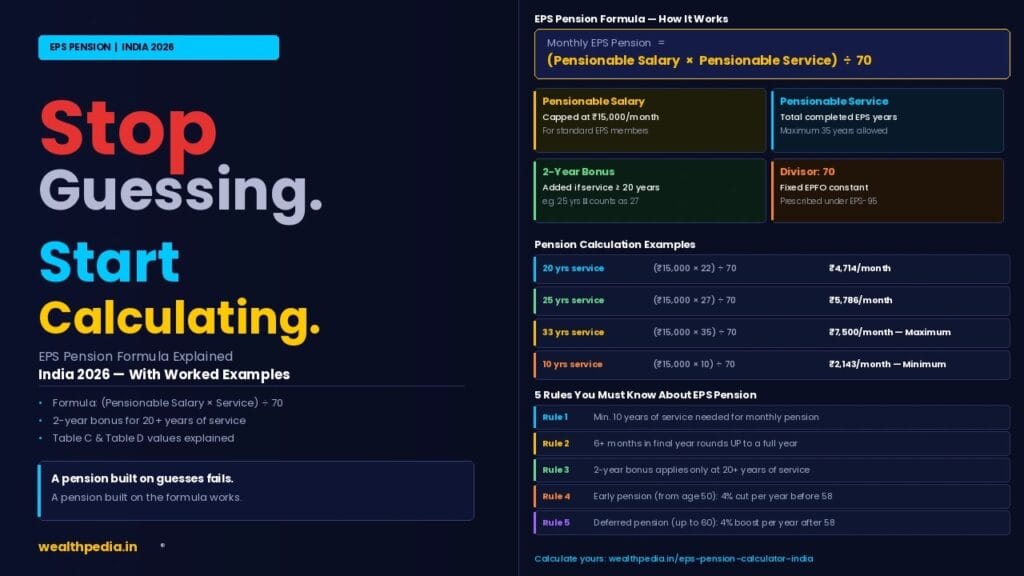
The standard EPS pension formula applies:
Monthly EPS Pension = (Pensionable Salary × Pensionable Service) ÷ 70
For 10 years of service:
- Pensionable Salary: ₹15,000 (wage ceiling for most employees)
- Pensionable Service: 10 years
- 2-Year Bonus: Does NOT apply (service must be ≥ 20 years for the bonus)
- Divisor: 70 (fixed)
Monthly Pension = (15,000 × 10) ÷ 70 = ₹2,142.86 ≈ ₹2,143/month
This ₹2,143 per month is the minimum EPS pension for a full ₹15,000-salary employee. It is also the government’s minimum pension floor — no EPS member receives less than ₹1,000/month regardless of their calculated amount, but at ₹15,000 salary the formula already exceeds this floor.
For the complete explanation of every variable in the formula, see EPS Pension Formula Explained.
EPS Pension After 10 Years — Salary-Wise Calculation Table
Not all employees have pensionable salary of ₹15,000. Here is the monthly pension after exactly 10 years of service at every common salary level:
| Monthly Pensionable Salary (₹) | Pensionable Service (Years) | Monthly EPS Pension (₹) |
|---|---|---|
| 5,000 | 10 | 714 (floor: 1,000) |
| 6,500 | 10 | 929 (floor: 1,000) |
| 8,000 | 10 | 1,143 (floor: 1,000) |
| 10,000 | 10 | 1,429 (floor applies: 1,429) |
| 12,000 | 10 | 1,714 |
| 14,000 | 10 | 2,000 |
| 15,000 | 10 | 2,143 |
Note: EPFO guarantees a minimum pension of ₹1,000/month to all qualifying members. Employees with pensionable salary below approximately ₹7,000 will receive the ₹1,000 floor rather than the formula-based amount. See What Is the Minimum EPS Pension in India? for details.
The 2-Year Bonus Does Not Apply at 10 Years — Here Is Why It Matters
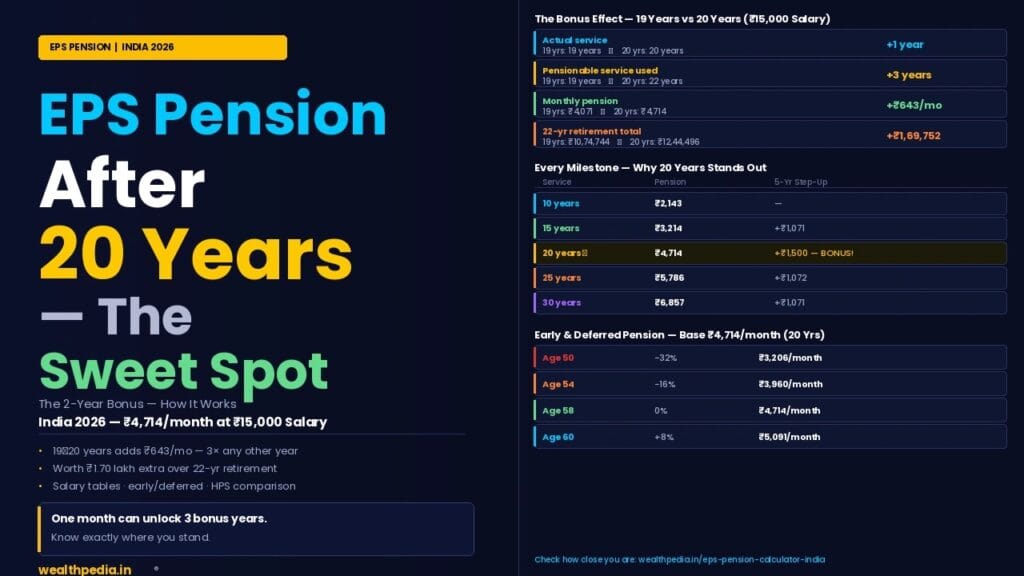
The 2-year bonus is one of the most valuable features of EPS — EPFO adds 2 extra years to your pensionable service if your total service reaches 20 years or more. At exactly 10 years, this bonus does not apply.
This creates a significant pension gap between employees who stop at 10 years versus those who continue to 20: Actual Service Pensionable Service (after bonus) Monthly Pension Difference from 10-year baseline 10 years 10 years ₹2,143/month — 15 years 15 years ₹3,214/month +₹1,071/month 20 years 22 years (+2 bonus) ₹4,714/month +₹2,571/month
The jump from 10 to 20 years of service more than doubles the monthly pension — from ₹2,143 to ₹4,714. Over a 22-year retirement, that difference is approximately ₹6.78 lakh in additional lifetime pension income.
For a complete analysis of how pension grows with service, see How EPS Pension Increases With Service Years.
EPS Pension After 10 Years — Early Pension Options (Age 50–57)
You do not have to wait until 58 to claim your EPS pension. EPFO allows pension claims from age 50, but applies a 4% reduction per year for every year before 58.
Early Pension Calculation Formula
Early Pension = Base Pension × (1 − 0.04 × years before 58)
Early Pension Table — Base Pension ₹2,143/month (10 Years Service, ₹15,000 Salary)
| Claim Age | Years Before 58 | Reduction (%) | Monthly Pension (₹) |
|---|---|---|---|
| 58 | 0 | 0% | 2,143 |
| 57 | 1 | 4% | 2,057 |
| 56 | 2 | 8% | 1,972 |
| 55 | 3 | 12% | 1,886 |
| 54 | 4 | 16% | 1,800 |
| 53 | 5 | 20% | 1,714 |
| 52 | 6 | 24% | 1,629 |
| 51 | 7 | 28% | 1,543 |
| 50 | 8 | 32% | 1,457 |
Claiming at 50 instead of 58 permanently reduces your pension by 32% — from ₹2,143 to ₹1,457/month. Over a 30-year retirement (age 50–80), the early claim gives ₹5.25 lakh total vs ₹4.71 lakh from age 58 over 22 years — the early claim wins on total amount, but only if you live long enough and the reduced amount still meets your needs.
For a detailed break-even analysis of early pension timing, see EPS Early Pension Before 58: Reduction Rules Explained.
EPS Pension After 10 Years — Deferred Pension Options (Age 59–60)
If you delay your pension claim beyond age 58, EPFO rewards you with a 4% increase per year, up to a maximum deferment of 2 years (age 60).
Deferred Pension Formula
Deferred Pension = Base Pension × (1 + 0.04 × years after 58)
Claim Age Years After 58 Enhancement Monthly Pension 58 0 0% ₹2,143 59 1 4% ₹2,229 60 2 8% ₹2,314
Waiting until 60 instead of claiming at 58 adds ₹171/month for life — ₹45,144 extra over a 22-year retirement in exchange for giving up 2 years of pension income (₹51,432). The break-even on deferment is approximately 25 years of pension — it only makes financial sense if you live beyond 85.
For the full deferred pension analysis, see Deferred EPS Pension After 58: Benefits Explained.
Lifetime Value of ₹2,143/month — Is It Worth It?
At first glance, ₹2,143/month seems modest. But viewed as a lifetime income stream, it has significant financial value:
Nominal Lifetime Value
| Retirement Duration | Total Pension Received (₹) |
|---|---|
| 15 years (age 58–73) | 3,85,740 |
| 20 years (age 58–78) | 5,14,320 |
| 22 years (age 58–80) | 5,65,752 |
| 25 years (age 58–83) | 6,42,900 |
Why EPS Pension Has Value Beyond the Numbers
- Guaranteed for life — no market risk, no reinvestment risk
- Cannot be outlived — continues even if you live to 95
- Survivor pension — 50% continues to your spouse as widow pension after death
- No management required — EPFO credits directly to your bank account each month
- Floor protection — minimum ₹1,000/month regardless of calculation
For most retirees, the EPS pension functions as the guaranteed floor of their retirement income — providing baseline coverage even when market-linked portfolios underperform. The Multi-Goal FIRE Planner on Wealthpedia helps you build a retirement corpus plan that accounts for this guaranteed EPS floor.
10 Years vs 9 Years — The Decision That Changes Everything
Financial Comparison at ₹15,000 Salary
| Parameter | 9 Years Service (Table D) | 10 Years Service (Pension) |
|---|---|---|
| Immediate Payout | ₹1,45,800 (lump sum) | ₹0 (monthly from age 58) |
| Monthly Pension | ₹0 | ₹2,143/month |
| Annual Income | ₹0 | ₹25,716/year |
| Total over 20-year retirement | ₹1,45,800 | ₹5,14,320 |
| Break-even Years | — | ~5.7 years |
The Rounding Rule Advantage
EPFO’s rounding rule means that 9 years and 6+ months of service is counted as 10 years — qualifying you for monthly pension. This means if you have served 9 years and 6 months, leaving your job today already crosses the 10-year threshold.
Conversely, if you have served 9 years and 5 months, you need just 1 more month to cross the 6-month boundary and qualify for monthly pension. Staying 1 additional month of employment could unlock ₹2,143/month for 20+ years of retirement.
How to Claim EPS Pension After 10 Years
Once you retire at 58 (or claim early from 50), EPS pension is claimed using Form 10D. The process is entirely online through the EPFO UAN Member Portal.
What You Need
- Active UAN with Aadhaar-linked mobile number
- Bank account seeded with UAN (for direct pension credit)
- Age proof confirming you have reached the eligible claim age
- Employer’s confirmation of retirement date in EPFO records
Where to File
Log in to: unifiedportal-mem.epfindia.gov.in → Online Services → Claim (Form 31, 19, 10C & 10D) → Select Form 10D.
For a complete step-by-step guide, see Form 10D Explained: How to Claim EPS Pension.
Does Your EPS Pension Increase After 10 Years If You Continue Working?
Yes — significantly. Every additional year of service after 10 years increases your monthly pension. And once you cross 20 years, the 2-year bonus kicks in and accelerates the growth:
| Total Service | Monthly Pension (₹) | Increase from 10-Year Base (₹) |
|---|---|---|
| 10 years | 2,143 | — |
| 12 years | 2,571 | +428 |
| 15 years | 3,214 | +1,071 |
| 18 years | 3,857 | +1,714 |
| 20 years (+2 bonus = 22 years) | 4,714 | +2,571 |
| 25 years (+2 bonus = 27 years) | 5,786 | +3,643 |
| 30 years (+2 bonus = 32 years) | 6,857 | +4,714 |
| 33 years (+2 bonus = 35 years) | 7,500 | +5,357 |
Each year between 10 and 20 adds approximately ₹214/month. Crossing 20 years adds ₹857/month in a single step (from 19 to 22 pensionable years). For a visual breakdown of the entire pension growth curve, see How EPS Pension Increases With Service Years.
EPS Pension After 10 Years — What Your EPF Corpus Looks Like Alongside It
EPS pension and EPF corpus are separate — you receive both at retirement. Here is an illustration of the combined retirement picture after exactly 10 years at ₹15,000 salary:
EPF Corpus (approximate):
- Employee contribution: 12% × ₹15,000 × 120 months = ₹2,16,000
- Employer EPF contribution: 3.67% × ₹15,000 × 120 months = ₹66,060
- Plus EPF interest at 8.25% p.a. compounded = approximately ₹3,20,000–₹3,50,000 total
EPS Pension:
- ₹2,143/month for life from age 58
Combined retirement package after 10 years:
- EPF lump sum: ~₹3.35 lakh (for immediate use or reinvestment)
- EPS pension: ₹2,143/month for life (guaranteed floor income)
For a deeper understanding of how EPF and EPS differ and complement each other, see EPF vs EPS: Key Differences Explained.
Frequently Asked Questions — EPS Pension After 10 Years
How much EPS pension will I get after 10 years of service?
With 10 years of EPS service at the ₹15,000 wage ceiling, your monthly pension is ₹2,143/month — calculated as (15,000 × 10) ÷ 70. The 2-year bonus does not apply since service is below 20 years. Use the EPS Pension Calculator India to get a personalised figure based on your actual salary and service dates.
Is 10 years the minimum service for EPS pension?
Yes. 10 years of EPS-covered service is the minimum threshold for qualifying for a monthly pension under EPS-95. With less than 10 years, you receive only the Table D withdrawal benefit or a Scheme Certificate. See EPS Pension Eligibility Rules for the complete eligibility criteria.
Does the 2-year bonus apply at 10 years of service?
No. The 2-year bonus is only added to your pensionable service if your total EPS service reaches 20 years or more. At exactly 10 years, no bonus applies — the formula uses 10 years directly: (15,000 × 10) ÷ 70 = ₹2,143/month.
Can I claim EPS pension before 58 after 10 years of service?
Yes. You can claim EPS pension from age 50 after completing 10 years of service. However, the pension is reduced by 4% for each year before 58. At age 50 (8 years early), the reduction is 32%, bringing the ₹2,143 base pension down to ₹1,457/month. Full details in EPS Early Pension Before 58.
What is the EPS pension for 10 years at ₹10,000 salary?
At ₹10,000 pensionable salary with 10 years of service: Monthly Pension = (10,000 × 10) ÷ 70 = ₹1,429/month. This is above the ₹1,000 minimum floor, so the formula amount applies.
Does 10 years of service include service with multiple employers?
Yes. If you transferred your EPF account via UAN between employers, your EPS service is cumulative. 4 years at Company A + 6 years at Company B = 10 years total pensionable service — qualifying for monthly pension.
What happens if I have 9 years and 8 months of service?
EPFO’s rounding rule: 8 months > 6 months → rounds up to 1 full year. So 9 years and 8 months is counted as 10 years of service — qualifying you for monthly pension at ₹2,143/month. This is the rounding threshold most employees are unaware of.
Is ₹2,143/month EPS pension worth staying for 10 years?
Over a 22-year retirement, ₹2,143/month delivers approximately ₹5.65 lakh in total nominal income. Compared to the Table D withdrawal of ₹1,45,800 at 9 years, the monthly pension delivers nearly 4× more over a normal retirement lifespan. For most employees, the answer is clearly yes — the monthly pension is significantly more valuable. The EPS Pension Calculator India can model your specific break-even.
What is the EPS pension for 10 years at ₹15,000 salary if claimed at 60?
Base pension = ₹2,143/month. Deferred by 2 years (claimed at 60) → enhancement = 4% × 2 = 8%. Deferred Pension = ₹2,143 × 1.08 = ₹2,314/month. See Deferred EPS Pension After 58.
Will I also get my EPF corpus after 10 years of service?
Yes. EPF (provident fund) and EPS (pension) are separate accounts. At retirement, you receive your full EPF corpus — employee + employer EPF contributions + compound interest — as a lump sum, and separately receive the monthly EPS pension for life. The two are independent of each other.
Can I withdraw EPS after 10 years of service?
No. Once you have completed 10 years of EPS-covered service, the withdrawal benefit option is no longer available. You must take the monthly pension. If you do not want the pension immediately, you can defer claiming until you reach the eligible age (minimum 50, standard 58).
How much pension will I get if I have 10 years of service but my salary was ₹8,000?
Monthly Pension = (8,000 × 10) ÷ 70 = ₹1,143/month. Since this is above the ₹1,000 minimum floor, the formula amount applies. Note: you receive ₹1,143/month for life — compared to Table D at 9 years at ₹8,000 salary (9.72 × ₹8,000 = ₹77,760). The lifetime pension of ₹1,143 × 12 × 20 years = ₹2.74 lakh — more than 3.5× the lump sum.
What is the Form I need to file to claim EPS pension after 10 years?
File Form 10D online at the EPFO UAN Member Portal to start receiving monthly EPS pension. This is filed after you reach age 50 (early pension) or 58 (standard pension). Full guidance in Form 10D Explained.
What is the survivor pension if I die after completing 10 years of EPS service?
After your death, your spouse receives widow pension at 50% of your EPS pension (₹1,072/month at the 10-year standard rate). Each child receives 25% (₹536/month) up to 2 children under 25. Full details in EPS Family Pension Rules.
Does the EPS pension after 10 years increase with inflation?
No. The EPS monthly pension is fixed at the amount calculated at the time of retirement using the formula. It is not automatically indexed to inflation. The government periodically revises the minimum pension floor, but regular EPS pensions do not receive automatic cost-of-living adjustments. This is why building an inflation-hedged retirement corpus alongside EPS pension is important — the Multi-Goal FIRE Planner can help you model this.
My total EPS service is 10 years and 4 months. What pension do I get?
EPFO rounding: 4 months < 6 months → dropped. Service counts as 10 years. Monthly Pension = (15,000 × 10) ÷ 70 = ₹2,143/month — same as exactly 10 years.
My total EPS service is 10 years and 7 months. What pension do I get?
EPFO rounding: 7 months > 6 months → rounds up to 1 year. Service counts as 11 years. Monthly Pension = (15,000 × 11) ÷ 70 = ₹2,357/month — ₹214 more per month than the 10-year pension.
Is EPS pension taxable after 10 years of service?
Yes. Monthly EPS pension is taxable as “Income from Other Sources” and added to your total annual income for slab-rate taxation. However, at ₹2,143/month (₹25,716/year), the pension income is well below the basic exemption limit under the new tax regime — meaning most retirees with only EPS income will pay no tax on it.
What if I did not transfer my EPS account when switching jobs — does my old service count?
If you left a previous employer and did not transfer your EPS account (or take a Scheme Certificate), the old service may be lost for pension purposes. If you took a Scheme Certificate from the previous employer and submit it to your current employer, it can be added. Check your EPFO passbook via the UAN portal to verify your total credited EPS service.
Can I check how many years of EPS service I have?
Yes. Log into the EPFO Member Portal at passbook.epfindia.gov.in with your UAN. The EPS contribution column shows monthly credits — count the months to determine your total EPS service. Alternatively, the EPS Pension Calculator India computes your service automatically from your joining and retirement dates.
What is the EPS pension for 10 years at ₹12,000 salary?
Monthly Pension = (12,000 × 10) ÷ 70 = ₹1,714/month. Over a 22-year retirement, total nominal pension = ₹4.52 lakh.
If I have 10 years of EPS service and take VRS at 50, when does my pension start?
You can start pension from the day you take VRS at 50 — but with the 8-year early pension reduction (32%). Alternatively, you can defer claiming until 58 and receive the full ₹2,143/month — or until 60 for ₹2,314/month. If you claim at 50 after VRS: ₹2,143 × 0.68 = ₹1,457/month. The choice depends on your immediate income needs and expected longevity.
How does EPS pension interact with NPS or PPF at retirement?
EPS pension is completely separate from NPS or PPF. All three can be received simultaneously at retirement — EPS pension monthly from EPFO, NPS annuity from your NPS service, and PPF lump sum at maturity. EPS pension is a guaranteed floor income; NPS and PPF supplement it. Use the Financial Health Score tool to assess how your overall retirement readiness looks.
If my employer did not contribute to EPS for some months, does it affect my 10-year qualification?
Yes. Only months in which EPS contributions were actually made count towards pensionable service. If your employer missed contributions for certain months, those months do not count. Check your EPFO passbook for gaps in the EPS column. If contributions are missing, raise a complaint via EPFiGMS at epfigms.gov.in.
Is there any benefit to completing exactly 10 years vs stopping at 9 years and 11 months?
With 9 years and 11 months, EPFO counts 5+ months in the final partial year (11 months > 6 months) → rounds up to 10 years. So 9 years and 11 months already qualifies as 10 years of service — you do not need to work an additional month. The critical boundary is 9 years and 6 months, beyond which the service rounds up to 10 years and qualifies you for monthly pension.
Disclaimer: The information on this page is for educational purposes only and does not constitute investment or financial advice. EPS rules are governed by EPFO regulations under EPS-95 and may be updated by the Government of India. For personalised guidance, consult a SEBI-registered financial planner or visit your nearest EPFO office. Wealthpedia™ (Trademark Reg. No. 4910385) is not a SEBI-registered investment advisor. All mutual fund references on this site are for Direct Plan, Growth option only.

Vishal Jhaveri is the founder of Wealthpedia and an MBA Finance professional with over 10 years of experience in financial planning, investing, and wealth creation. He specializes in FIRE (Financial Independence, Retire Early), retirement planning, investing, and personal finance education. Through Wealthpedia, he develops financial calculators and publishes evidence-based content to help Indian investors make informed financial decisions. He regularly reviews and updates Wealthpedia articles to reflect changes in tax, laws, investment regulations, and personal finance best practices.
Quick Wrap up