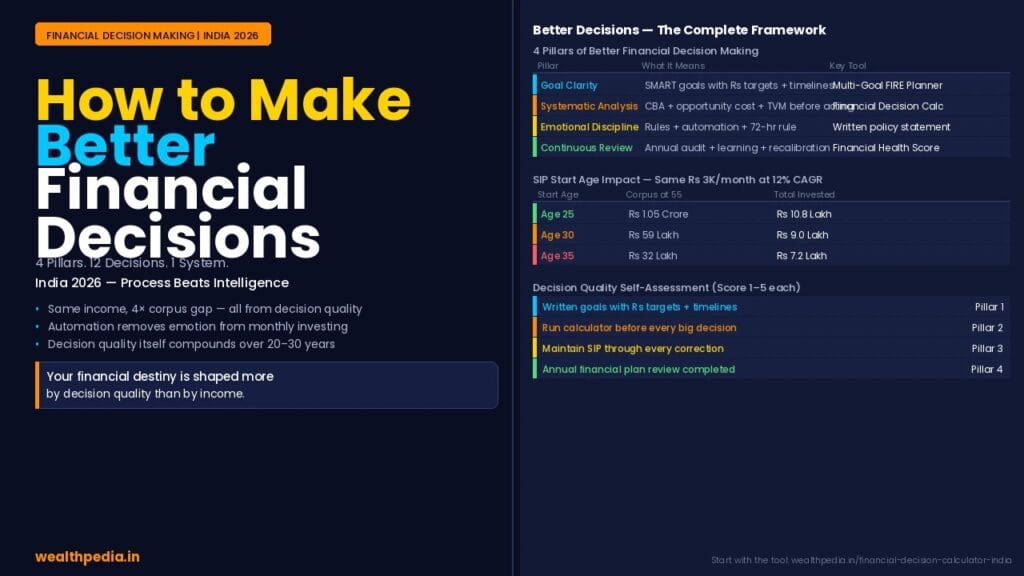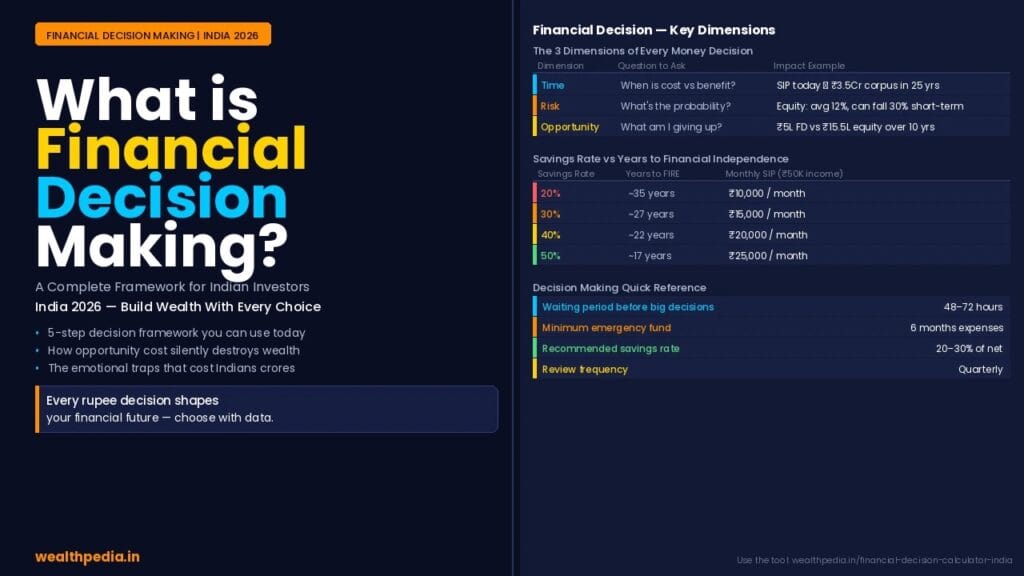

Cost benefit analysis is a structured decision-making process in which you identify and quantify all the costs and all the benefits of a financial choice, convert them into comparable rupee terms, and determine whether the benefits outweigh the costs — and by how much. If benefits exceed costs, the decision creates value. If costs exceed benefits, it destroys value. And if two options are both net positive, CBA tells you which one creates more value, and by what margin.
In corporate finance, CBA is a formal discipline with standardised methodologies. In personal finance, it does not need to be that rigorous — but it does need to be systematic. The biggest difference between a good financial decision maker and a poor one is not the complexity of their analysis. It is whether they even do analysis at all, versus defaulting to habit, emotion, or social comparison.
Most significant financial mistakes in India are made without any CBA. Someone buys a flat because “property never goes down” — without comparing the locked-up down payment’s investment opportunity cost, the EMI’s drag on monthly cashflow, and the total interest cost over 20 years. Someone takes an MBA loan of ₹25 lakh because “an MBA opens doors” — without calculating the break-even salary required to justify that debt, or the years it will take to repay it. Someone renews an endowment policy because “they have already paid 10 years of premiums” — without recognising that past premiums are a sunk cost and the forward-looking CBA clearly favours surrendering and reinvesting.
A proper cost benefit analysis, applied consistently to major financial decisions, protects against all of these mistakes. Combined with the Financial Decision Calculator, which automates the quantitative comparison of two financial scenarios, CBA becomes a practical daily tool rather than a theoretical framework.
This article is part of the financial decision making series on Wealthpedia — building the analytical toolkit that helps Indian investors make better money choices at every life stage.
Quick Summary
Cost benefit analysis (CBA) is the process of systematically comparing all the costs and all the benefits of a financial decision before committing to it — in rupees, over time. It is the most rigorous framework available for evaluating major life decisions: buying a home versus renting, taking an education loan for an MBA, switching careers, starting a business, or choosing between investment products. Most Indians make these decisions based on emotion, social pressure, or incomplete information. This guide teaches you how to apply CBA to the decisions that matter most, using real Indian examples, and shows how the Financial Decision Calculator automates the most complex calculations.
Join Now →
The Six-Step Cost Benefit Analysis Framework
A practical CBA for personal finance decisions follows six steps. These steps apply whether you are evaluating a ₹5 lakh car purchase or a ₹1 crore property investment.
Step 1 — Define the Decision Clearly
As with any financial decision framework, CBA begins with a precise definition of the choice being made. Not “should I buy a house?” but “should I buy a ₹80 lakh 2BHK in Ahmedabad in the next 12 months using a 20-year home loan at 8.75%, or continue renting my current flat at ₹18,000 per month?” The more precisely the decision is defined, the more useful the CBA will be.
A common mistake is to define the decision too broadly. “Should I do an MBA?” is not a well-defined decision for CBA purposes — it does not specify which MBA program, at what cost, with what financing, at what current salary, with what post-MBA career expectation. Each of those variables materially changes the CBA outcome.
Step 2 — List All Costs — Direct and Hidden
Costs fall into several categories, and missing any of them will distort the CBA. The main categories are:
Direct monetary costs — the cash outflows associated with the decision. For a home purchase: down payment, registration and stamp duty charges, home loan EMIs over the entire tenure, annual maintenance charges, property tax, and home insurance.
Opportunity costs — the return foregone on money used for this decision. The down payment of ₹16 lakh invested in equity at 12% CAGR would become approximately ₹99 lakh in 20 years. That foregone ₹83 lakh of corpus is the opportunity cost of the down payment — it must be counted as a cost of buying the home.
Hidden and intangible costs — illiquidity risk (you cannot easily access the equity in your home in an emergency), concentration risk (a large fraction of net worth in a single illiquid asset), relocation flexibility cost (owning a home reduces your ability to move for better job opportunities), and the psychological burden of large long-term debt.
Sunk costs — costs already paid that should NOT influence the decision. If you have already paid 5 years of premiums on an endowment policy and are evaluating whether to continue, the premiums already paid are irrelevant to the forward-looking CBA. Only future costs and future benefits matter. This is perhaps the most common CBA error Indians make — continuing poor financial products because they “have already invested so much.”
Step 3 — List All Benefits — Direct and Intangible
Benefits also span multiple dimensions:
Direct monetary benefits — rental savings (you no longer pay rent), potential rental income (if the property is rented), property price appreciation, and tax benefits (home loan interest deduction under Section 24(b), principal repayment under Section 80C).
Intangible benefits — stability (not subject to landlord decisions), freedom to customise the home, the emotional value of owning your home, and social factors that matter to the household.
Optionality benefits — a paid-off home provides housing security in retirement without ongoing rental costs, which reduces the retirement corpus needed.
Intangible benefits are real and should not be ignored — but they should also not be used to override a decisive quantitative CBA. If the numbers clearly show that buying a property destroys ₹40 lakh of net wealth versus renting and investing over 15 years, the intangible benefit of “owning your home” needs to be explicitly valued at ₹40 lakh or more for the purchase to make sense. Forcing yourself to put a rupee number on intangible benefits is one of the most useful disciplines in CBA.
Step 4 — Convert Everything to a Common Time Basis
Costs and benefits occur at different points in time, and a rupee spent or received 20 years from now is not worth the same as a rupee today. This is the time value of money applied to CBA. The standard technique is to convert all future cash flows to their present value using a discount rate — typically the expected return on the best alternative investment (for personal finance, often 10–12% for equity-oriented decisions).
This step is where most informal CBA breaks down, because the mental arithmetic of discounting future cash flows is difficult without a calculator. The Financial Decision Calculator on Wealthpedia handles this automatically — it shows the present and future value of both scenarios, discounted to a common basis, so you can compare them on equal terms.
Step 5 — Calculate Net Benefit and Make the Decision
Net Benefit = Total Benefits (present value) − Total Costs (present value).
If Net Benefit > 0: the decision is financially justified.
If Net Benefit < 0: the decision destroys financial value.
If comparing two options: choose the one with the higher Net Benefit.
This step also requires a threshold judgement. A Net Benefit of ₹1 lakh over 20 years on a ₹50 lakh commitment is not meaningfully positive — the margin is too small to justify the risk and complexity. A Net Benefit of ₹40 lakh is clearly decisive.
Step 6 — Check Assumptions and Run Sensitivity Analysis
CBA outputs are only as good as the assumptions feeding them. The most important assumptions to stress-test are the return rate on investments, the property appreciation rate, the loan interest rate trajectory, and the income growth rate. Running the CBA with optimistic, base, and pessimistic assumptions reveals how sensitive the outcome is to these variables.
If the decision is a Net Buy under optimistic assumptions but a Net Rent under pessimistic ones, the right choice is less clear — and the decision should weight personal risk tolerance and life circumstances more heavily than the midpoint projection.
CBA Applied to India’s Most Important Financial Decisions
Buying a Home vs Renting
This is the most emotionally charged financial decision in Indian life — and one of the most important to analyse with rigorous CBA.
Costs of Buying (₹80L flat, ₹16L down payment, 20-year loan at 8.75%):
- Down payment: ₹16 lakh
- Stamp duty and registration: approximately ₹4.8 lakh (6% in most states)
- Total interest on 20-year loan: approximately ₹82 lakh
- Annual maintenance and property tax: ₹30,000–₹60,000 per year
- Opportunity cost of down payment at 12% CAGR for 20 years: approximately ₹83 lakh (the corpus foregone)
- Total cost (nominal): approximately ₹1.87 crore over 20 years, plus opportunity cost
Benefits of Buying:
- Rental savings: ₹18,000 per month × 12 × 20 years = ₹43.2 lakh (nominal)
- Property appreciation: at 5–6% annual appreciation, ₹80 lakh becomes approximately ₹2.15–₹2.56 crore in 20 years
- Tax benefit on home loan: approximately ₹1.5 lakh per year interest deduction under Section 24(b) for self-occupied property (at 30% slab, ₹45,000 annual tax saving for approximately 10 years = ₹4.5 lakh)
- Intangible: housing security in retirement, freedom to customise
The CBA here is genuinely close in many Indian cities — closer than most people expect. In cities with high property prices and low rental yields (Mumbai, Bengaluru, Delhi NCR), renting and investing the down payment in equity often wins financially over 15–20 years. In cities with more reasonable price-to-rent ratios (Ahmedabad, Pune, Hyderabad at moderate locations), buying can be competitive. The Financial Decision Calculator can model your specific city, property price, and rental amount to give you a personalised CBA. Also see our detailed home loan vs rent comparison for city-specific analysis.
Taking an Education Loan for an MBA
One of the most consequential financial decisions for young Indian professionals — and one of the most poorly analysed.
Costs of an MBA at a premium Indian B-school (₹25 lakh total cost, ₹20 lakh loan at 11%):
- Total loan repayment over 7 years: approximately ₹34 lakh (including interest)
- Opportunity cost of 2 lost salary years: if your pre-MBA salary is ₹8 lakh, you forgo ₹16 lakh in salary
- Opportunity cost of the ₹25 lakh if self-funded: at 12% CAGR, ₹25 lakh invested instead would grow to approximately ₹44 lakh in 7 years
- Lifestyle cost of debt: EMI burden reduces savings capacity and investment in the early career years
Benefits of an MBA:
- Salary increment: if pre-MBA CTC is ₹8 lakh and post-MBA CTC is ₹18 lakh, the annual increment is ₹10 lakh
- Career acceleration: access to roles, networks, and industries not accessible without the degree
- Break-even timeline: at ₹10 lakh annual salary premium, the ₹34 lakh loan cost is recovered in approximately 3.4 years post-graduation — a strong CBA case
The MBA CBA strongly favours the degree when the salary increment is large and reliable (top-tier IIMs, ISB, XLRI, FMS). It is much weaker for mid-tier programs where the post-MBA salary premium is marginal — the debt burden can exceed the salary gain for years. The key metric is the payback period: if the annual salary increment divided into the total loan cost produces a payback of under 4 years, the CBA typically favours taking the loan.
Investing in Equity vs Prepaying a Home Loan
A perennial Indian personal finance debate, and an ideal CBA case study.
Scenario: ₹5 lakh annual surplus. Home loan outstanding: ₹40 lakh at 8.75% with 12 years remaining.
Option A — Prepay the home loan:
- Interest saved: approximately ₹8.2 lakh over the remaining tenure (prepayment in year 8 of 20)
- After-tax benefit: home loan interest up to ₹2 lakh per year is deductible under Section 24(b); prepaying eliminates this deduction, so the after-tax savings are lower than the nominal interest saved
- Effective benefit: approximately ₹6.5–₹7 lakh after accounting for lost tax deduction
Option B — Invest ₹5 lakh in equity mutual funds:
- Expected growth at 12% CAGR over 12 years: ₹5 lakh becomes approximately ₹19.4 lakh
- After-tax return (LTCG at 10% on gains above ₹1.25 lakh): approximately ₹17.8 lakh net
Net benefit of investing over prepaying: approximately ₹10.8–₹11.3 lakh — a decisive CBA outcome in favour of investing, assuming equity delivers 12% CAGR. The break-even return on equity that makes investing equal to prepaying is approximately 9.5% — a bar that diversified equity funds have historically cleared over 10+ year periods in India.
This CBA favours investing over prepaying when the loan rate is below the expected equity return. It shifts in favour of prepaying when the loan rate is high (above 10–11%), the investment horizon is short (under 7 years), or the investor is risk-averse and values guaranteed debt elimination over uncertain equity returns. Model your specific situation at the Financial Decision Calculator and read our full guide on should you close your loan early.
Switching Careers or Taking a Pay Cut for Growth
Career decisions are among the hardest to subject to CBA because they are laden with emotion, identity, and uncertainty. But they are also among the most financially significant decisions a person can make — a well-timed career switch can add ₹20–₹50 lakh in lifetime earnings.
Scenario: Software engineer earning ₹18 lakh CTC considering a product management role at a startup for ₹14 lakh CTC plus ESOP options.
Costs:
- Immediate salary cut: ₹4 lakh per year
- Opportunity cost of ESOPs not vesting (high risk): the ESOPs may be worth nothing if the startup fails
- Uncertainty and career risk premium
Benefits:
- Skill diversification and career optionality in a high-demand role
- ESOP upside: if the startup succeeds, ESOPs could be worth ₹50 lakh+ in 4–6 years
- Long-term salary trajectory: experienced PMs at growth companies often earn ₹30–₹50 lakh within 5 years
The CBA here requires scenario analysis: what is the probability that the startup succeeds to a liquidity event? At 20% probability of ₹50 lakh ESOP value, the expected value is ₹10 lakh — versus a certain ₹4 lakh annual shortfall for 4 years (₹16 lakh cumulative). This is a negative expected-value CBA in financial terms alone. But the long-term career trajectory benefit — higher earning potential at a senior PM role in a growth market — changes the picture over a 10-year horizon. CBA for career decisions must always include the long-term trajectory, not just the immediate cash flow comparison.
Buying a Car on EMI vs Paying Cash
A decision most Indian households face, and one where CBA produces a clear answer more often than people expect.
Scenario: ₹8 lakh car. Options: pay cash (₹8 lakh upfront) or take a 4-year loan (₹2 lakh down payment, ₹8.3% auto loan on ₹6 lakh).
Cost of EMI route:
- Monthly EMI: approximately ₹14,800
- Total repayment over 4 years: approximately ₹7.1 lakh
- Total paid for the car: ₹2 lakh down + ₹7.1 lakh = ₹9.1 lakh
- Extra cost of financing: ₹1.1 lakh in interest
Cost of Cash route:
- ₹8 lakh deployed today, unavailable for investment
- Opportunity cost at 10% over 4 years: ₹8 lakh would have become approximately ₹11.7 lakh
CBA verdict: If you have the ₹8 lakh as investment corpus (already invested, growing at 10%+), the cost of liquidating it to buy the car is ₹3.7 lakh in foregone corpus — far more than the ₹1.1 lakh in EMI interest. In this case, taking the auto loan and keeping the investment intact is the better financial decision.
If the ₹8 lakh is sitting in a savings account at 3.5%, the opportunity cost is only ₹1.2 lakh over 4 years — less than the EMI interest cost. In this case, paying cash is financially better.
The right answer depends entirely on where your ₹8 lakh is and what it is earning — which is exactly the kind of context-dependent analysis that CBA is designed to surface.
Common CBA Mistakes Indian Investors Make
Counting sunk costs as relevant. The single most common CBA error. Money already spent — whether on premiums, down payments, or previous investments — is irrelevant to a forward-looking decision. Only future costs and future benefits matter.
Ignoring opportunity costs. Most people count explicit costs (EMIs, interest) but ignore implicit ones (the investment corpus foregone by deploying capital in a low-return asset). A complete CBA must include opportunity costs or it systematically underestimates the cost of every capital deployment decision.
Using nominal rather than real values. A projected benefit of ₹1 crore in 20 years sounds impressive until you apply 6% inflation — its real value is only ₹31 lakh in today’s purchasing power. Always express CBA outcomes in real terms for long-horizon decisions.
Overvaluing certainty. Indian investors consistently overvalue guaranteed returns (FDs, endowment plans) relative to their risk-adjusted benefit, and undervalue probable-but-uncertain returns (equity). A CBA that assigns full weight to a 7% guaranteed return but heavily discounts a 12% probable return is not an objective analysis — it is a reflection of loss aversion.
Ignoring base rates. CBA for education loans should use realistic post-MBA salary increment data, not the best-case placements from the institute brochure. CBA for property investment should use realistic property appreciation rates for that specific market over a realistic period, not the best decade in recent history.
Using the Financial Decision Calculator for CBA
The Financial Decision Calculator on Wealthpedia is the most practical tool available for automating the quantitative portion of a personal finance CBA. It handles the present value and future value calculations, the compounding arithmetic, and the side-by-side comparison — the parts most people either skip or get wrong when doing CBA informally.
To use it for a CBA: enter the costs and benefits of Option A as Scenario A inputs (for example, the monthly EMI and down payment for a home purchase, offset by rental savings), and the costs and benefits of Option B as Scenario B inputs (continued rent payments, plus monthly investment of the down payment equivalent). Set the time horizon to your planning period. The calculator produces the net financial position of both options at the end of the period, making the CBA output concrete and comparable.
For qualitative dimensions that the calculator does not capture — intangible benefits, career optionality, family priorities — layer these on top of the quantitative output and decide whether they are worth the financial gap the numbers show. A decision to buy a home that costs ₹20 lakh more than renting over 15 years is still valid if homeownership provides ₹20 lakh worth of lifestyle value, security, and peace of mind to your household. CBA does not make decisions for you — it ensures you make them with full information.
Connect your CBA findings to your SMART financial goals and check that your chosen option keeps your key financial goals on track. A financially suboptimal home purchase decision becomes more problematic if it also derails your retirement SIP or your children’s education fund — a holistic view the Multi-Goal FIRE Planner helps you maintain.
Frequently Asked Questions
What is cost benefit analysis in personal finance?
Cost benefit analysis (CBA) in personal finance is the process of systematically listing and quantifying all the costs and all the benefits of a financial decision — including opportunity costs and intangible factors — and comparing them to determine whether a decision creates or destroys financial value. It is the most rigorous framework available for evaluating major money decisions.
How is CBA different from a simple pros and cons list?
A pros and cons list is qualitative — it names factors but does not measure them. CBA is quantitative — it converts every factor to a rupee value (or explicitly estimates one for intangibles) and compares the totals. CBA also accounts for the time value of money, converting future cash flows to present value so that costs and benefits occurring at different times can be compared on equal terms.
What is a sunk cost and why does it matter in CBA?
A sunk cost is any cost already incurred that cannot be recovered, regardless of the decision you make going forward. In CBA, sunk costs are irrelevant — only future costs and future benefits matter. The most common sunk cost error in India is continuing with a poor financial product (endowment plan, ULIP) because “I have already paid premiums for 10 years.” Past premiums are sunk; the forward-looking CBA should compare surrendering and reinvesting versus continuing.
Should I buy a home or rent in India — what does CBA say?
The CBA outcome depends heavily on the specific city, property price, rental cost, loan interest rate, and investment return assumption. In high price-to-rent ratio cities (Mumbai, Bengaluru), renting and investing the down payment in equity frequently wins the CBA over 15–20 years. In more affordable cities, buying is more competitive. Use the Financial Decision Calculator with your specific numbers for a personalised answer.
How do I apply CBA to an education loan decision?
Calculate the total loan cost (principal + interest), the opportunity cost of the years spent studying (foregone salary), and compare these to the present value of the expected salary premium over your career. The key metric is payback period — if the total loan cost divided by the annual salary premium is under 4 years, the CBA typically favours the loan. For top-tier programs with large, reliable salary increments, education loans almost always pass the CBA test.
What is opportunity cost and how does it fit into CBA?
Opportunity cost is the return foregone on the best alternative use of the money being committed to a decision. For a home purchase, the opportunity cost of the down payment is the investment corpus it would have generated if invested in equity instead. CBA that ignores opportunity costs systematically underestimates the true cost of every major financial commitment.
How does inflation affect CBA?
Inflation reduces the real value of future cash flows. A projected benefit of ₹50 lakh in 20 years has a real value of approximately ₹15.5 lakh at 6% inflation. CBA for long-horizon decisions must express all values in real, inflation-adjusted terms — or use a real discount rate — to avoid overstating the value of future benefits. See our article on how inflation affects financial decisions for more on this.
Can CBA be used for career decisions?
Yes, though career CBA requires scenario analysis because the benefits (salary increments, career trajectory, ESOP outcomes) are probabilistic rather than certain. Assign probabilities to different outcome scenarios, calculate the expected value of each, and compare to the certain costs of the career change. Always include the long-term trajectory — a short-term salary cut that produces a ₹15 lakh salary premium 5 years later may have a strong positive CBA over a 10-year horizon.
What is the role of the Financial Decision Calculator in CBA?
The Financial Decision Calculator automates the quantitative portion of CBA — present value and future value calculations, compounding arithmetic, and side-by-side scenario comparison. Enter your two options as Scenario A and Scenario B, set the time horizon, and the calculator shows the net financial position of each option at the end of the period. Layer intangible benefits on top of this quantitative output to make your final decision.
How does CBA relate to the concept of opportunity cost?
Opportunity cost is one of the most important cost inputs in any CBA. A CBA without opportunity cost is incomplete — it understates the true cost of every capital deployment decision. Our article on opportunity cost in personal finance covers this concept in depth and shows how to calculate it for common Indian financial decisions.
What is sensitivity analysis and why does it matter in CBA?
Sensitivity analysis re-runs the CBA with different values for key assumptions — return rate, property appreciation, salary growth, loan interest rate — to see how sensitive the outcome is to these inputs. If the CBA outcome flips from positive to negative under only slightly pessimistic assumptions, the decision is risky. If it remains positive across a wide range of assumptions, the decision is robust. Always run at least a base case and a pessimistic case before committing to any major financial decision.
Where can I learn more about financial decision making frameworks?
Explore the complete Financial Decision Making series on Wealthpedia, which covers opportunity cost, time value of money, SMART goals, emotional vs rational decisions, and more. Use the Financial Decision Calculator to apply each framework to your own financial situation with real numbers.
Disclaimer: The information on this page is for educational purposes only and does not constitute investment or financial advice. Please consult a SEBI-registered financial planner for personalised guidance. Wealthpedia™ (Trademark Reg. No. 4910385) is not a SEBI-registered investment advisor. All mutual fund references on this site are for Direct Plan, Growth option only.

Vishal Jhaveri is the founder of Wealthpedia and an MBA Finance professional with over 10 years of experience in financial planning, investing, and wealth creation. He specializes in FIRE (Financial Independence, Retire Early), retirement planning, investing, and personal finance education. Through Wealthpedia, he develops financial calculators and publishes evidence-based content to help Indian investors make informed financial decisions. He regularly reviews and updates Wealthpedia articles to reflect changes in tax, laws, investment regulations, and personal finance best practices.
Quick Wrap up