
The classical model of economics assumed that human beings make decisions rationally — weighing all available information, calculating expected outcomes, and choosing the option that maximises their utility. Decades of research in behavioural economics, pioneered by psychologists Daniel Kahneman and Amos Tversky and built upon by Richard Thaler, have comprehensively dismantled this assumption. Human beings do not make financial decisions rationally by default. They make them emotionally, and then construct rational-sounding justifications after the fact.
This is not a personal failing — it is neuroscience. The human brain processes emotional stimuli faster and more powerfully than analytical ones. When you see your investment portfolio down 25% in a market crash, the brain’s amygdala — the emotional processing centre — triggers a threat response before the prefrontal cortex (the rational decision-making centre) has had time to frame the situation analytically. The urge to act — to sell, to exit, to do something — is physiological. It feels urgent and logical. And it is almost always financially damaging.
In the Indian context, the emotional dimension of financial decisions is amplified by several additional cultural and social factors. Family pressure to buy property operates as a powerful social script that overrides individual financial analysis. Fear of social shame associated with visible financial failure makes Indian investors reluctant to sell losing investments or exit poor financial products. The deeply rooted preference for gold — historically associated with safety, prosperity, and social standing — leads to significant over-allocation to an asset that delivers poor real returns over most long periods. And the culture of trusting financial advice from relatives and community members creates a channel for emotionally driven, poorly analysed investment decisions.
Understanding why financial decisions are emotionally driven — and what specific emotions and cognitive biases drive them — is the first step toward building the habits and systems that produce better outcomes. This connects directly to the broader financial decision making framework explored in this series.
Quick Summary
Every significant financial mistake in India — panic-selling during a market crash, buying a ULIP from a relative, pouring money into a hot IPO, or refusing to switch from a poor FD to a better investment — has emotion at its root. Emotion is not the enemy of good financial decisions, but it is the most common saboteur of them. This guide explains the neuroscience behind emotional financial decisions, identifies the ten most common emotional triggers Indian investors face, and provides a practical, repeatable framework for shifting from reactive emotional responses to deliberate, rational financial choices. Use the Financial Decision Calculator to anchor every major decision in data rather than feeling.
Join Now →
The Neuroscience of Financial Emotion — System 1 vs System 2
Daniel Kahneman’s framework of System 1 and System 2 thinking provides the most useful lens for understanding emotional versus rational financial decisions.
System 1 thinking is fast, automatic, intuitive, and emotional. It operates continuously in the background, making quick pattern-matching judgements based on prior experience and emotional associations. System 1 is excellent at handling routine decisions — it processes thousands of micro-decisions per day without conscious effort. But it is poorly calibrated for complex financial decisions, which require probability estimation, long-horizon thinking, and resistance to immediate emotional rewards.
System 2 thinking is slow, deliberate, analytical, and effortful. It is the part of the brain that calculates, plans, compares, and reasons. System 2 is where good financial decisions live — but it requires activation. It does not engage automatically. And crucially, it can be overridden by System 1 when emotional arousal is high.
In financial terms, System 1 drives the panic sell during a market crash, the impulsive purchase of a hot sector fund, the refusal to cut a losing stock because selling would make the loss feel real, and the decision to invest based on a friend’s tip rather than analysis. System 2 is what runs the cost benefit analysis, calculates the opportunity cost, builds the SMART financial goal, and uses the Financial Decision Calculator before committing.
The practical implication is straightforward: build systems and habits that force System 2 engagement before any significant financial decision, and reduce the conditions under which System 1 acts unchecked. This is the core design principle behind every financial decision-making framework covered in this series.
Ten Emotional Triggers That Derail Indian Investors
These are the ten most common emotional patterns that produce poor financial decisions for Indian investors. Recognising them in real time is the first and most important step toward neutralising their impact.
Fear of Loss — The Most Powerful Financial Emotion
Loss aversion — the psychological tendency to feel losses approximately twice as powerfully as equivalent gains — is the single most studied and most consequential bias in personal finance. Losing Rs 1 lakh feels roughly twice as bad as gaining Rs 1 lakh feels good. This asymmetry explains a wide range of destructive financial behaviours.
Loss aversion explains why investors refuse to sell losing positions — because selling converts a paper loss into a realised one, making it psychologically real. It explains why people exit equity funds during market crashes at precisely the moment they should be staying invested or buying more. And it explains why Indian investors persistently over-allocate to capital-protected instruments (FDs, PPF, gold) despite the long-run opportunity cost.
The rational response to loss aversion is to reframe: instead of evaluating your portfolio in terms of today’s profit or loss versus yesterday’s value, evaluate it in terms of trajectory toward your long-term goal. A portfolio down 20% in a bear market is not a loss if your 20-year SIP is still on track to deliver the retirement corpus you need. The Financial Health Score helps with this reframing — it evaluates your financial position against your goals, not against yesterday’s market price.
FOMO — Fear of Missing Out
FOMO is the emotional driver behind every market bubble participation, every hot IPO subscription, and every frenzied investment in a thematic fund after it has already run up 80%. When your colleague says he made 40% on a small-cap fund last year, the emotional response is not analytical — it is competitive: “Why am I not making that? I should invest before I miss more.”
FOMO-driven investing is consistently expensive. Investors who buy into a theme or sector after significant outperformance are typically buying near the top — they get in just as the early-adopter gains have already been captured and the risk has risen. Our article on FOMO investing in India covers this pattern in detail.
The antidote to FOMO is a written investment policy — a personal financial constitution that specifies your asset allocation, investment instruments, and rebalancing rules in advance. When you have already decided that you will invest 60% in diversified equity funds, 20% in debt, and 20% in gold and REITs, and you will not deviate from this without a formal review, FOMO-driven deviations become structurally harder to execute.
Overconfidence — The Bull Market Disease
Overconfidence is the tendency to overestimate your own financial knowledge, skill, and the reliability of your predictions. It peaks during bull markets, when rising asset prices produce strong returns for almost every investor regardless of the quality of their decisions — creating a dangerous illusion that skill explains the performance.
Overconfident investors trade too frequently, incurring higher transaction costs and tax. They take concentrated bets that amplify downside risk. They dismiss risk management as unnecessary. And they underestimate the tail risks in their portfolios. The empirical evidence is clear: most retail investors who trade actively underperform a simple index fund strategy after costs and taxes.
Herding — Following the Crowd
Herding is the tendency to make financial decisions based on what the majority of people around you are doing. In financial markets, it is reliably harmful, because asset prices rise and fall in cycles, and the crowd is typically most enthusiastic near market peaks and most fearful near market troughs.
The Indian mutual fund industry provides a clear illustration. NFO subscriptions consistently peak during bull markets, when investor optimism is highest and valuations are most stretched. Conversely, SIP cancellations spike during bear markets, when investor sentiment is most negative and valuations are most attractive. Herding drives exactly the wrong behaviour at every turning point.
Anchoring — Stuck on a Number
Anchoring is the tendency to over-weight a specific reference number when making financial decisions. The most common financial anchors are the purchase price of an investment (“I’ll sell when it gets back to what I paid”) or a round-number target (“it’ll definitely reach Rs 1,000”). Anchoring causes investors to hold losing positions too long, sell winning positions too early, and make predictions based on arbitrary historical reference points.
Recency Bias — The Short Memory Trap
Recency bias is the tendency to give excessive weight to recent events when predicting the future. After three years of strong equity returns, investors extrapolate that trend and invest aggressively near the peak. After a sharp correction, they extrapolate the decline and reduce equity investment near the trough. Recency bias is the emotional driver behind the classic buy-high-sell-low pattern that destroys retail investor returns.
Endowment Effect — Overvaluing What You Own
The endowment effect is the tendency to overvalue an asset simply because you own it. Indian investors often exhibit this with inherited property (“it’s a family asset — we can’t sell it”), with employer stock held in ESOPs well beyond a rational allocation, and with longstanding insurance policies. The endowment effect causes failure to rebalance portfolios and inability to exit underperforming assets.
Status and Social Proof in Indian Financial Decisions
India’s deeply social financial culture creates unique emotional pressures. Property ownership is a social signal, not just a financial decision. Gold jewellery represents family wealth and status. Insurance products are sold through personal relationships where social obligation makes saying no feel rude. Investment tips from respected community members carry social authority that independent analysis does not.
These social dynamics do not make the underlying financial decisions wrong — but they do mean that the decision-making process is often contaminated by factors irrelevant to the financial outcome. Recognising social pressure as a distinct input — and deliberately separating it from financial analysis — is essential for Indian investors.
Regret Aversion — Paralysis Through Fear of Being Wrong
Regret aversion is the fear of making a decision that you will later regret, which leads to decision paralysis — avoiding choices entirely rather than risking the regret of making the wrong one. It is particularly common with investment decisions: “What if I invest and the market crashes?” or “What if I switch funds and this one outperforms?”
Regret aversion is why so many Indian investors keep large amounts in savings accounts indefinitely — not because they have actively decided a savings account is the best home for this money, but because doing nothing avoids the regret risk of making an active decision that turns out poorly. The problem is that inaction has its own compounding cost — the opportunity cost of money sitting in low-return instruments grows every year.
Optimism Bias in High-Risk Decisions
Optimism bias is the tendency to underestimate the probability of negative outcomes for decisions we are invested in. It drives over-leveraged property purchases, investments in relatives’ businesses, and speculative trading. The emotional excitement of a potential large gain overrides the probabilistic assessment of risk. The antidote is forcing yourself to explicitly calculate the downside scenario — what happens if this investment goes to zero, and can you sustain that loss?
A Practical Framework for Shifting from Emotional to Rational Decisions
Recognising emotional triggers is necessary but not sufficient — you also need a concrete system for neutralising them before they produce bad financial decisions. Here is a six-part framework.
The 72-Hour Rule
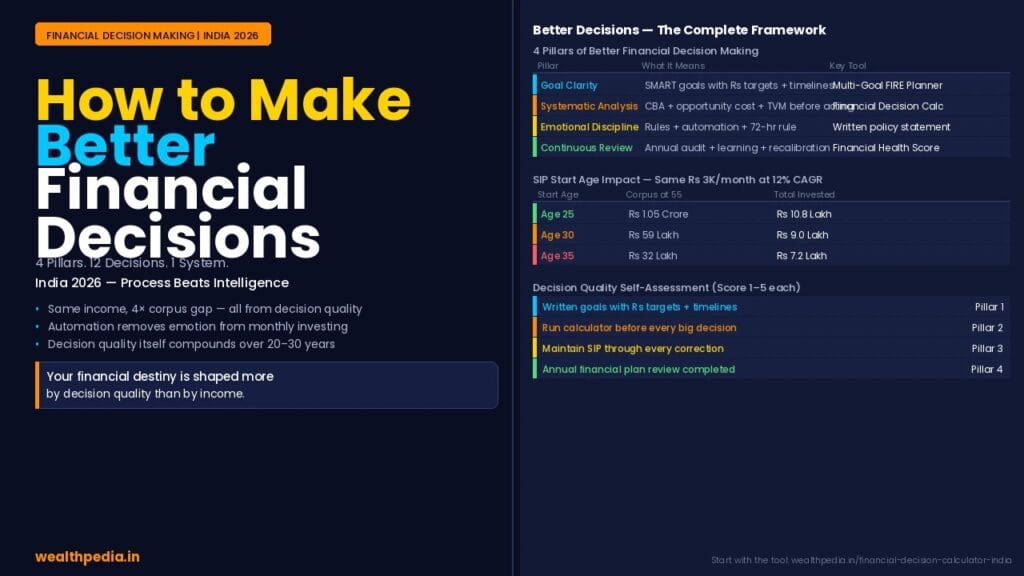
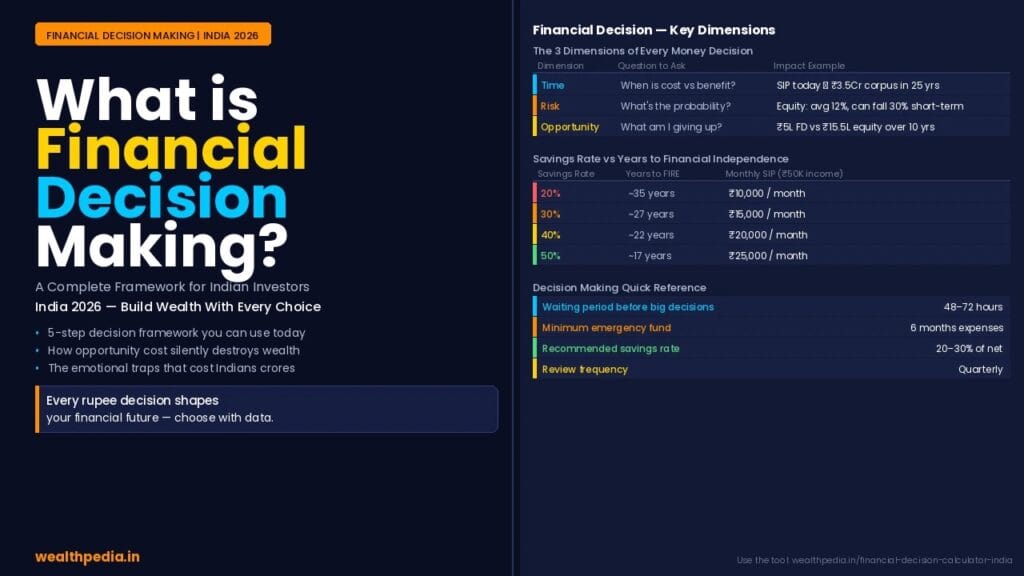
For any financial decision above Rs 50,000, impose a mandatory 72-hour waiting period between the initial impulse and the commitment. Most emotional financial decisions are made in a state of elevated emotion — excitement during a bull market, panic during a crash, social pressure in a conversation. The 72-hour rule allows the emotional arousal to subside and System 2 thinking to engage. If the decision still seems right after 72 hours of deliberate consideration, it is far more likely to be a rational one.
The Pre-Mortem
Before making any significant financial decision, run a pre-mortem: imagine it is 3 years from now and the decision turned out badly. What went wrong? What were the warning signs you ignored? This mental exercise forces you to confront the downside scenario explicitly — activating the analytical System 2 before commitment. It is particularly effective against optimism bias and overconfidence.
Write It Down — The Decision Journal
Keep a brief financial decision journal. Before every significant financial decision, write: what you are deciding, why you are deciding it now, what the alternatives are, and what conditions would tell you that the decision was wrong in retrospect. This documentation creates accountability — you are less likely to rationalise a System 1 impulse when you have to write it down — and provides a learning resource when you review past decisions.
Separate the Financial Analysis from the Social Decision
For any decision that has a social component — buying a property that your family expects, investing in a product recommended by a relative, buying insurance from a friend — separate the financial analysis from the social response. Analyse the financial decision on its own merits using the Financial Decision Calculator first. Then decide separately how to handle the social dimension. Never let the social response contaminate the financial analysis.
Use Rules, Not Discretion, for High-Emotion Scenarios
Pre-commit to rules for the scenarios most likely to produce emotional decisions. Write these rules in your financial policy statement when emotions are calm. For example: “If the market falls more than 20%, I will increase my SIP by 25% rather than reducing it.” “I will not invest in any product I cannot explain in two minutes.” “I will not make any investment based solely on a tip from a social contact without independent research.” When the high-emotion scenario arrives, you follow the rule — you do not make a new decision under pressure.
Use Calculators and Data as an Anchor
Numbers are the most effective antidote to emotional reasoning. Before any major financial decision, run the quantitative analysis using the Financial Decision Calculator. The act of engaging with real numbers — entering your specific amounts, return rates, and time horizons — activates System 2 and provides a data anchor that competes with the emotional response. When your portfolio is down 20% and the instinct to sell is strong, looking at a projection that shows your SIP still on track to deliver your retirement corpus in 18 years is often enough to override the panic response.
The Rational Financial Decision Checklist
Before committing to any significant financial decision, run through this checklist. Any “no” answer is a flag that an emotional driver may be at work.
Have I waited at least 72 hours after the initial impulse before deciding? Have I calculated the costs and benefits of this decision with real numbers? Have I identified the best realistic alternative and compared it to this option? Have I considered what a trusted, financially knowledgeable friend would think of this decision? Have I explicitly considered the downside scenario? Is this decision consistent with my written financial goals and investment policy? Have I separated any social pressure or emotional associations from the financial analysis? Am I making this decision because the numbers support it, or because I fear missing out, fear looking wrong, or feel social obligation?
If you can answer yes to all eight questions, the decision is likely rational. If several answers are no, the 72-hour rule should be applied before proceeding.
When Emotion Is the Right Guide
A sophisticated understanding of emotional versus rational financial decisions recognises that not all emotional inputs are biases to be overcome. Some emotional responses carry genuine information that rational analysis alone cannot fully capture.
The discomfort you feel at having too much of your net worth in a single stock is not just loss aversion — it is a legitimate signal about concentration risk. The sense of peace you feel when your home loan is fully paid off, even if the rational calculation showed investing the prepayment was financially superior, reflects a real preference for simplicity and security that is genuinely part of your utility function.
The goal of financial decision making is not to eliminate emotion from the process — it is to ensure that emotional responses are informative inputs rather than unchecked drivers. What must be filtered out are the reflex responses: the panic, the FOMO, the anchoring, the social pressure. Those are noise. The deeper signals — genuine risk discomfort, carefully considered conviction — are worth listening to.
Frequently Asked Questions
Why do Indians make emotional financial decisions?
A combination of factors amplifies emotional decision making for Indian investors: cultural preference for capital protection and guaranteed returns, social pressure around property and gold, financial advice delivered through personal relationships, limited formal financial education, and a media environment that emphasises short-term market narratives. These factors do not cause emotional decision making — they amplify the universal human tendency toward it.
What is the most costly emotional financial mistake Indian investors make?
Panic-selling during equity market corrections is arguably the single most expensive emotional mistake — it locks in losses at the bottom, exits the investor from the subsequent recovery, and often leads to reinvestment at higher prices. The second most costly is the consistent failure to invest in equity for long-term goals due to loss aversion, resulting in decades of underperformance in low-return instruments.
What is loss aversion and how does it affect investing?
Loss aversion is the psychological tendency to feel losses approximately twice as powerfully as equivalent gains. In investing, it drives refusal to sell losing positions, exit from equity during corrections, and persistent over-allocation to capital-protected instruments at the cost of long-term returns.
How can I tell if I am making an emotional financial decision?
Warning signs include: the decision feels urgent and you feel you must act now; the decision follows a market event, social conversation, or news story; you are finding it difficult to articulate the quantitative case for the decision; you have not compared the decision to its best alternative; and the decision deviates from your existing financial plan without a clear logical reason.
What is System 1 vs System 2 thinking in finance?
System 1 is fast, automatic, and emotional — it responds to financial situations with immediate intuitive judgements. System 2 is slow, deliberate, and analytical — it calculates, compares, and plans. Good financial decisions require System 2 engagement. The 72-hour rule, decision journaling, and calculator-based analysis are practical tools for forcing System 2 activation before major financial decisions.
How does FOMO affect financial decisions in India?
FOMO drives investment in hot sectors, thematic funds, and IPOs near market peaks — after most of the gains have already been captured. It is triggered by social comparison and media coverage of recent winners. The antidote is a pre-committed asset allocation that does not deviate based on recent performance of any individual asset class.
What is the 72-hour rule for financial decisions?
The 72-hour rule is a mandatory waiting period of at least 72 hours between the initial impulse to make a financial decision and the actual commitment. It allows emotional arousal to subside and System 2 analytical thinking to engage. It is particularly effective for high-emotion scenarios: market crashes, bull market FOMO, social pressure to invest in a relative’s product.
Is it ever rational to follow your emotions in financial decisions?
Yes. Not all emotional responses are biases to be overridden. Genuine discomfort with concentration risk, persistent conviction in an investment thesis developed through rigorous research, and the psychological value of financial simplicity are legitimate inputs that deserve weight even if they diverge slightly from the pure quantitative optimum.
How does social pressure influence Indian financial decisions?
Social pressure operates through multiple channels in India: family expectations around property purchase, community norms around gold and jewellery allocation, personal relationships with insurance agents and bank relationship managers, and social comparison with peers’ visible financial choices. Separating social pressure from financial analysis — doing the numbers independently before considering the social dimension — is essential for Indian investors.
What tools can help me make more rational financial decisions?
The Financial Decision Calculator provides quantitative analysis for major financial choices. The Financial Health Score anchors your self-assessment to objective metrics rather than emotional self-perception. A written financial policy statement — specifying your goals, asset allocation, and pre-committed rules for high-emotion scenarios — is the most powerful structural tool for reducing emotional decision making.
What is anchoring bias and how does it hurt investors?
Anchoring bias is the tendency to over-weight a specific reference number — typically the purchase price of an investment or a recent market high — when making financial decisions. It causes investors to hold losing positions waiting to break even, set arbitrary price targets, and anchor return expectations to recent performance. The antidote is always to evaluate an investment on its current fundamental merit and future expected return, not relative to its historical price.
How do I build a more rational financial decision-making process?
Apply the six-part framework from this article: impose the 72-hour rule, run a pre-mortem before major decisions, keep a decision journal, separate social pressure from financial analysis, pre-commit rules for high-emotion scenarios, and use calculators and data as an emotional anchor. Start every major decision with the Financial Decision Calculator.
Disclaimer: The information on this page is for educational purposes only and does not constitute investment or financial advice. Please consult a SEBI-registered financial planner for personalised guidance. Wealthpedia (Trademark Reg. No. 4910385) is not a SEBI-registered investment advisor. All mutual fund references on this site are for Direct Plan, Growth option only.

Vishal Jhaveri is the founder of Wealthpedia and an MBA Finance professional with over 10 years of experience in financial planning, investing, and wealth creation. He specializes in FIRE (Financial Independence, Retire Early), retirement planning, investing, and personal finance education. Through Wealthpedia, he develops financial calculators and publishes evidence-based content to help Indian investors make informed financial decisions. He regularly reviews and updates Wealthpedia articles to reflect changes in tax, laws, investment regulations, and personal finance best practices.
Quick Wrap up