
Most EPF-covered employees assume their EPS pension starts at 58 — and for many, it does. But EPFO’s EPS-95 rules give you flexibility: if you have 10 or more years of pensionable service, you can start drawing pension from as early as age 50. The trade-off is a permanent reduction in your monthly pension — 4% for every year you claim before 58.
For some employees — those who took VRS, those whose employers shut down, those with health constraints, or those who simply want earlier retirement — this trade-off may be acceptable. For others, the lifetime cost of the reduction is too high to justify.
This guide gives you everything you need to make an informed decision: the exact reduction at every early claim age, the break-even analysis, and the specific life circumstances under which early pension is financially rational. Use the EPS Pension Calculator India to compute both your base pension and early pension amounts instantly.
Quick Summary
EPS members with 10 or more years of service can claim their monthly pension before the standard age of 58 — as early as age 50. However, EPFO permanently reduces the pension by 4% for each year the claim is made before 58. Claiming at 50 (8 years early) reduces your pension by 32% for life. This article explains the reduction formula, calculates the exact pension at every age from 50 to 57, presents a full break-even analysis, and outlines the specific scenarios where early pension makes financial sense versus waiting until 58. Use the EPS Pension Calculator India to model your specific scenario.
What Is EPS Early Pension?
EPS early pension is a provision under EPS-95 that allows EPS members who have completed 10 or more years of pensionable service to commence drawing monthly pension from age 50, instead of waiting until the standard age of 58.
Key characteristics:
- Minimum claim age: 50 years
- Maximum early claim period: 8 years before standard age 58
- Reduction: 4% per year for each year claimed before 58
- Permanence: The reduction is permanent — it applies for the entire lifetime of the pension
- No catch-up: The pension does not increase back to the base amount when you turn 58
- Service requirement: Minimum 10 years of EPS-covered pensionable service still required
Early pension is available to members who have ceased all EPF-covered employment. If you are still working in any EPF-covered organisation, you cannot draw EPS pension — early or standard.
The Early Pension Reduction Formula
Early Pension = Base Pension × (1 − 0.04 × Years Before 58)
Where:
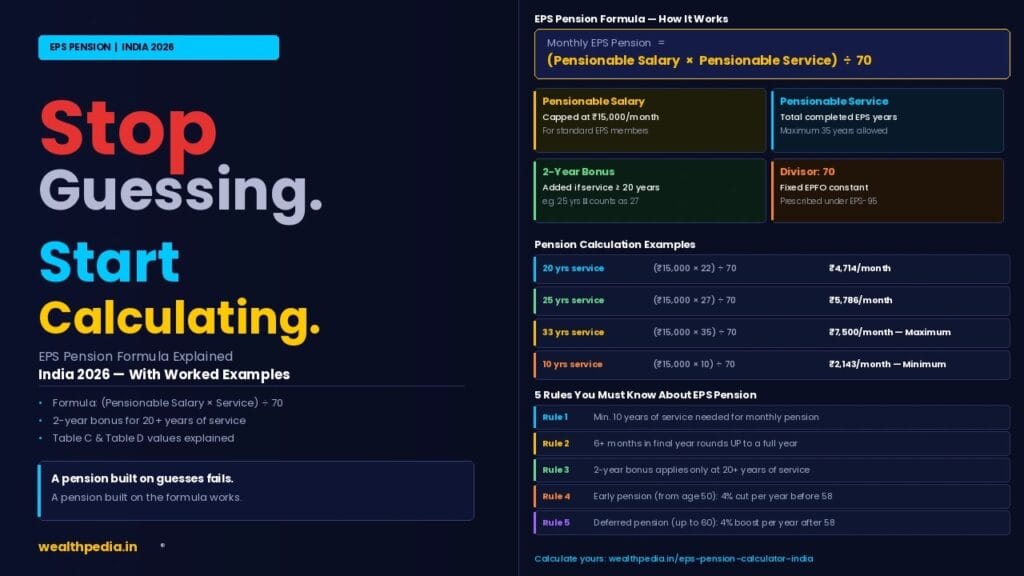
- Base Pension = (Pensionable Salary × Pensionable Service) ÷ 70 — the standard pension at age 58
- Years Before 58 = 58 minus your age at the time of claiming pension
- 0.04 = 4% reduction per year
Example
Base Pension = ₹5,786/month (25 years service at ₹15,000 salary)
Claimed at age 54 (4 years before 58):
Early Pension = ₹5,786 × (1 − 0.04 × 4) = ₹5,786 × 0.84 = ₹4,860/month
The ₹926/month reduction is permanent — it continues for the full duration of the pension.
For the complete base pension formula and examples, see EPS Pension Formula Explained.
Early Pension at Every Age — Complete Reduction Table
For Base Pension of ₹5,786/month (25 Years Service, ₹15,000 Salary)
| Claim Age | Years Before 58 | Reduction % | Monthly Pension | Annual Pension |
|---|---|---|---|---|
| 58 | 0 | 0% | ₹5,786 | ₹69,432 |
| 57 | 1 | 4% | ₹5,554 | ₹66,648 |
| 56 | 2 | 8% | ₹5,323 | ₹63,876 |
| 55 | 3 | 12% | ₹5,091 | ₹61,092 |
| 54 | 4 | 16% | ₹4,860 | ₹58,320 |
| 53 | 5 | 20% | ₹4,629 | ₹55,548 |
| 52 | 6 | 24% | ₹4,397 | ₹52,764 |
| 51 | 7 | 28% | ₹4,166 | ₹49,992 |
| 50 | 8 | 32% | ₹3,934 | ₹47,208 |
For Base Pension of ₹7,500/month (Maximum — 33 Years Service, ₹15,000 Salary)
| Claim Age | Years Before 58 | Reduction % | Monthly Pension |
|---|---|---|---|
| 58 (standard) | 0 | 0% | ₹7,500 |
| 56 | 2 | 8% | ₹6,900 |
| 54 | 4 | 16% | ₹6,300 |
| 52 | 6 | 24% | ₹5,700 |
| 50 | 8 | 32% | ₹5,100 |
For Base Pension of ₹2,143/month (Minimum — 10 Years Service, ₹15,000 Salary)
| Claim Age | Years Before 58 | Reduction % | Monthly Pension |
|---|---|---|---|
| 58 (standard) | 0 | 0% | ₹2,143 |
| 56 | 2 | 8% | ₹1,972 |
| 54 | 4 | 16% | ₹1,800 |
| 52 | 6 | 24% | ₹1,629 |
| 50 | 8 | 32% | ₹1,457 |
Note: All reduced amounts remain above the EPFO minimum pension floor of ₹1,000/month — the floor does not compensate for early pension reductions. See What Is the Minimum EPS Pension in India? for floor rules.
Break-Even Analysis — Is Early Pension Worth It?
The break-even analysis answers: at what total lifetime pension income does the early claim catch up with waiting until 58?
Case Study: 25 Years Service, ₹15,000 Salary
Option A — Claim at 50 (8 years early)
- Monthly pension: ₹3,934
- Pension received from age 50 to 80 (30 years): ₹3,934 × 360 = ₹14,16,240
Option B — Claim at 58 (standard)
- Monthly pension: ₹5,786
- Pension received from age 58 to 80 (22 years): ₹5,786 × 264 = ₹15,27,504
Verdict: Option B delivers ₹1,11,264 more in total nominal pension despite starting 8 years later. Even with 8 extra years of payments, Option A cannot overcome the 32% permanent reduction.
Year-by-Year Break-Even Between Age 50 and Age 58 Claim
Comparison Claim at 50 Claim at 58 Break-Even Age Monthly pension ₹3,934 ₹5,786 — Monthly gap — −₹1,852 — Cumulative advantage at 58 ₹3,934 × 96 mo = ₹3,77,664 ₹0 — Months to erode the lead ₹3,77,664 ÷ ₹1,852 = 204 months — Age 75
Break-even: age 75. If you live beyond 75, waiting until 58 delivers more total pension. If you die before 75, claiming at 50 delivers more. Average Indian life expectancy at 60 is approximately 78–80 years — meaning for most people, waiting until 58 is the better financial decision.
Break-Even Age for Different Claim Ages
Claim Age Monthly Pension Break-Even Age (vs waiting till 58) 57 ₹5,554 Age 90+ (waiting almost always wins) 55 ₹5,091 Age 83 53 ₹4,629 Age 78 51 ₹4,166 Age 75 50 ₹3,934 Age 75
The later you claim early pension (closer to 58), the longer it takes to break even — because the reduction is smaller but the head-start period is also shorter.
Eligibility Conditions for EPS Early Pension
To claim EPS early pension, all of the following must be true:
1. Minimum 10 years of EPS-covered pensionable service
Same threshold as standard pension — early pension does not lower this requirement.
2. Age between 50 and 57
You must have attained age 50 but not yet reached age 58. You cannot claim early pension after turning 58 — at that point you simply file for standard pension.
3. Not in active EPF-covered employment
You must have ceased employment at all EPF-covered establishments before filing Form 10D for early pension. You cannot draw pension while still contributing to EPF.
4. File Form 10D with early pension age indicated
The claim form requires you to indicate the pension start age. The EPFO system calculates the reduction automatically based on your date of birth and chosen start date. See Form 10D Explained for the complete filing process.
When Does Early Pension Make Financial Sense?
Early pension is financially rational in specific life circumstances. Here is a structured analysis:
Scenario 1 — VRS at Age 52 After 25 Years of Service
An employee takes Voluntary Retirement at 52 after 25 years of service. Their options:
- Claim early pension at 52: ₹4,397/month permanently (24% reduction)
- Wait until 58: ₹5,786/month (no reduction)
Analysis: They have 6 years with no pension income. If their EPF corpus and savings can sustain them from 52 to 58, waiting is better by ₹1,11,000+ in lifetime pension. If income replacement is urgently needed, early pension at ₹4,397/month fills the gap.
Recommendation: Wait until 58 if financially possible. Consider early pension only if the EPF corpus + other savings cannot sustain 6 years of living expenses.
Scenario 2 — Health Issues at Age 54 with Reduced Life Expectancy
An employee has a serious health condition at 54 and realistically expects to live until 70 (not 80). Base pension = ₹5,786/month.
- Claim at 54 (4 years early): ₹4,860/month × 192 months (to age 70) = ₹9,33,120
- Wait until 58: ₹5,786/month × 144 months (to age 70) = ₹8,33,184
Analysis: With a shorter expected lifespan, claiming at 54 generates ₹99,936 more total pension. Early pension is the correct financial choice here.
Recommendation: If life expectancy is significantly below average due to health conditions, early pension is strongly indicated.
Scenario 3 — Employer Shutdown at Age 51
An employee’s employer shuts down at age 51, leaving them unemployed with 22 years of service and limited re-employment prospects.
Options:
- Claim early pension at 51 (7 years early): ₹4,166/month (28% reduction)
- Find new EPF-covered job: Add service, wait until 58 for full pension
- Wait in unemployment until 58: Live on savings; claim ₹5,786/month later
Analysis: If re-employment is feasible, taking a new EPF-covered job is best — adds service, avoids reduction. If not, early pension at ₹4,166/month provides guaranteed income during a difficult transition.
Scenario 4 — FIRE Retirement at Age 50 After 20 Years of Service
A FIRE-focused employee retires at 50 after 20 years of EPS service. They have a large investment portfolio.
Analysis: EPS pension at 50 = (₹15,000 × 22) ÷ 70 × 0.68 = ₹3,239/month. This is a small but guaranteed floor income. For a FIRE portfolio, the guaranteed pension — even at 32% reduction — provides valuable sequence-of-returns protection as a floor. However, deferring to 58 adds ₹1,475/month permanently — a 46% increase.
Recommendation: For FIRE retirees with adequate corpus, deferring EPS pension to 58 (or even 60) provides the highest long-term floor. Use the Multi-Goal FIRE Planner to model this alongside your overall retirement corpus.
What Is the Difference Between Early Pension and Deferred Pension?
Feature Early Pension Deferred Pension Claim age 50–57 59–60 Adjustment −4% per year before 58 +4% per year after 58 Maximum adjustment −32% (claim at 50) +8% (claim at 60) Best for Immediate income need, health issues Those who can afford to wait Pension lifetime Longer (more years) but smaller amount Shorter but larger amount
For the deferred pension analysis, see Deferred EPS Pension After 58: Benefits Explained.
How to Claim EPS Early Pension — Form 10D
Early pension is claimed using the same Form 10D as standard pension. The process is identical — the only difference is that you file when you are between 50 and 57 rather than at 58. EPFO automatically calculates the early pension reduction based on your date of birth and the date of your Form 10D submission.
Key steps:
- Ensure your date of birth on EPFO records matches Aadhaar exactly — errors cause wrong reduction calculation
- Ensure your employer has updated your exit date in EPFO records
- File Form 10D online at unifiedportal-mem.epfindia.gov.in
- Select pension type: Member Pension (early) — the system prompts for your claim date
- Complete Aadhaar OTP verification and submit
For a complete step-by-step filing guide, see Form 10D Explained: How to Claim EPS Pension.
Can Early Pension Be Reversed or Upgraded to Standard Pension?
No. Once you start drawing early pension, the reduction is permanent. You cannot:
- Stop early pension and restart at the standard rate at age 58
- Claim a “top-up” to bridge the gap to standard pension amount
- Appeal for the reduction to be removed
This irreversibility is the most important financial fact about early pension. Once you file Form 10D and the PPO is issued with the reduced amount, that amount is fixed for life.
The only change that can increase your pension after it has started is a government-mandated revision to the minimum pension floor (currently ₹1,000/month) — which affects all pensioners equally, not individual early pension cases.
Early Pension and the Minimum Pension Floor
The EPFO minimum pension guarantee of ₹1,000/month applies to all EPS pensioners, including early pensioners. However, the ₹1,000 floor does not compensate for early pension reductions — if your formula-based early pension is ₹1,457/month (base ₹2,143 × 0.68 at age 50), you receive ₹1,457/month, not ₹2,143/month. The floor only applies if the reduced pension falls below ₹1,000.
For base pensions of ₹2,143/month (10 years service, ₹15,000 salary), even the maximum 32% reduction at age 50 gives ₹1,457/month — safely above the ₹1,000 floor.
Early Pension — Summary Decision Guide
Choose early pension if:
- You have ceased all EPF employment and genuinely cannot sustain living expenses until 58
- Your health or life expectancy is significantly below average
- You are the primary income earner and your family needs immediate pension income
- You took VRS and your EPF corpus alone cannot cover 8 years of expenses
- Your investment portfolio is small and pension provides the primary retirement floor
Defer to 58 (or beyond) if:
- Your EPF corpus and savings can sustain you until 58
- Your health is good and you expect to live well beyond 75
- You are following a FIRE strategy with a large investment portfolio
- You can find alternate income — consulting, freelance, or non-EPF employment
- You want to maximise the guaranteed floor income for your lifetime
Frequently Asked Questions — EPS Early Pension Before 58
Can I claim EPS pension before age 58?
Yes. EPS members with 10 or more years of pensionable service can claim pension from age 50. The pension is permanently reduced by 4% for each year before 58. At age 50 (8 years early), the reduction is 32%. Use the EPS Pension Calculator India to compute your early pension amount.
What is the reduction for EPS early pension?
The reduction is 4% for each year the pension is claimed before age 58. Formula: Early Pension = Base Pension × (1 − 0.04 × years before 58). At age 54 (4 years early): Base Pension × 0.84. At age 50 (8 years early): Base Pension × 0.68.
Is the early pension reduction permanent?
Yes. The 4% per year reduction is permanent for the life of the pension. It cannot be reversed when you turn 58, and the pension does not automatically increase to the base amount at any point.
What is the minimum age to claim EPS pension?
The minimum age to claim EPS pension is 50 years — for early pension with the 4% per year reduction. Standard pension is available from age 58 with no reduction. Deferred pension (with enhancement) is available at ages 59 and 60.
What is the EPS early pension at age 55 for 25 years of service?
Base Pension = (15,000 × 27) ÷ 70 = ₹5,786/month. Claimed at 55 (3 years early): Reduction = 3 × 4% = 12%. Early Pension = ₹5,786 × 0.88 = ₹5,091/month.
Is early pension a good idea for VRS employees?
It depends on your financial position. If your EPF corpus and savings can sustain you from VRS date to age 58, waiting for standard pension is better — you receive ₹5,786/month instead of a reduced amount permanently. If you need immediate income replacement, early pension is a valid choice. See the VRS scenario analysis above for a worked example.
How do I apply for EPS early pension?
File Form 10D online at the EPFO UAN Member Portal when you are between ages 50 and 57, have 10+ years of service, and have ceased EPF-covered employment. The system automatically calculates the early pension reduction based on your date of birth. Full guide in Form 10D Explained.
Does the 2-year service bonus apply to early pension?
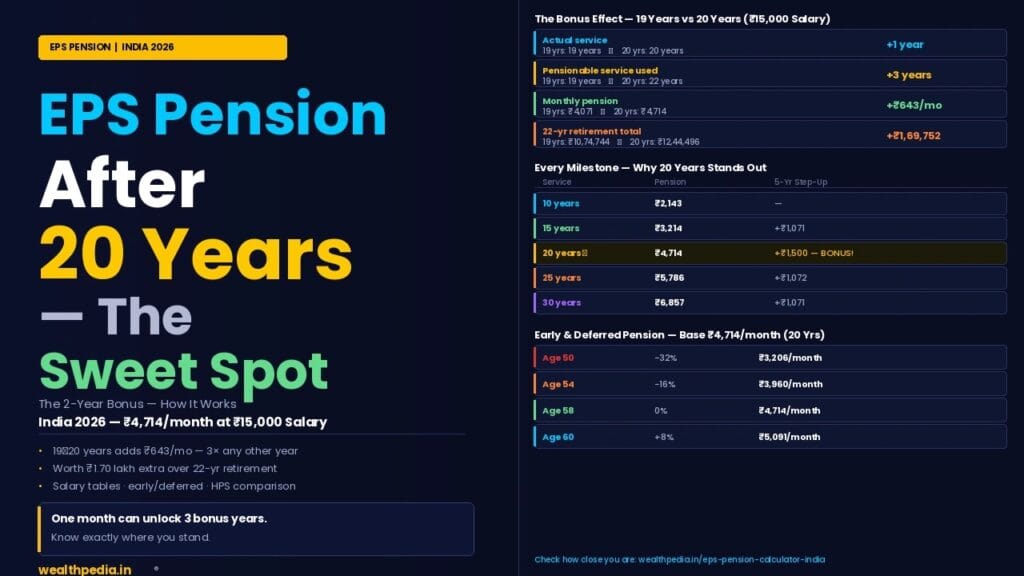
Yes. The 2-year bonus (for 20+ years of service) is applied to the base pension calculation first. The early pension reduction is then applied to that bonus-inclusive base pension amount. So if your base pension with bonus is ₹4,714/month and you claim at 54, your early pension is ₹4,714 × 0.84 = ₹3,960/month.
Can I claim early pension and still work as a freelancer?
Yes. The restriction is on employment in EPF-covered establishments. Freelance, self-employment, consulting, or work in non-EPF-covered organisations does not prevent you from drawing EPS pension — early or standard.
What is the break-even age for claiming at 50 vs waiting till 58?
For a base pension of ₹5,786/month, claiming at 50 vs waiting till 58 breaks even at approximately age 75. If you live beyond 75, waiting till 58 delivers more total pension. Average Indian life expectancy at 60 is 78–80 — so for most people, waiting until 58 is financially superior.
What is the EPS early pension at age 50 for 20 years of service?
Base Pension = (15,000 × 22) ÷ 70 = ₹4,714/month. Claimed at 50 (8 years early): Reduction = 32%. Early Pension = ₹4,714 × 0.68 = ₹3,205/month.
Is there a penalty for claiming EPS pension early?
It is not technically a “penalty” — it is an actuarial adjustment that accounts for the longer expected payment period. The reduction ensures the total expected lifetime pension paid is roughly equivalent whether you claim at 50 or 58. However, for individuals with normal life expectancy, it works out as a financial disadvantage to claim early.
Can I defer my early pension claim once I have started receiving it?
No. Once Form 10D is processed and the Pension Payment Order (PPO) is issued, the pension amount is fixed. You cannot pause, defer, or re-calculate the pension after it has started.
My employer shut down when I was 51. Can I claim early pension?
Yes. If your employer has shut down, you are no longer in EPF-covered employment. Once you attain age 50 (or if already above 50), you can file Form 10D for early pension. If your employer’s exit date has not been updated in EPFO records, raise a grievance via EPFiGMS. See Form 10D Explained for the employer shutdown scenario.
Does early pension affect family pension after death?
Yes — indirectly. Family pension (widow pension) is 50% of the member’s pension. If you drew early pension at a reduced amount, the widow pension is 50% of that reduced amount — not 50% of the original base pension. This is another significant financial implication of the permanent reduction that many employees overlook.
What is the EPS pension at age 52 for 30 years of service?
Base Pension = (15,000 × 32) ÷ 70 = ₹6,857/month. Claimed at 52 (6 years early): Reduction = 24%. Early Pension = ₹6,857 × 0.76 = ₹5,211/month.
Is early pension available if I retired from a private sector job and joined a government job?
If you join a government establishment that is not EPF-covered (most central/state government jobs), you have ceased EPF-covered employment and can claim EPS early pension from age 50. If the new government job is also EPF-covered (e.g., some PSUs), you are still in EPF employment and cannot draw EPS pension during that period.
Can I claim EPS early pension if I have a Scheme Certificate from an old employer?
If your combined EPS service (old employer + new employer) reaches 10 years after submitting the Scheme Certificate to the new employer, yes — you qualify for early pension on the full combined service. If you left the new employer before 10 years total and have a Scheme Certificate from the old employer unsubmitted, the eligibility depends on whether the total combined service can cross 10 years. See Scheme Certificate vs EPS Withdrawal.
How does early pension interact with NPS?
They are completely independent. EPS pension (early or standard) and NPS annuity are from different schemes. If you have both EPS and NPS service, you receive both separately — early pension from EPS does not affect your NPS annuity timing or amount.
What is the minimum EPS early pension amount?
The minimum pension EPFO guarantees is ₹1,000/month — but this floor applies to the formula-based pension, not as a compensation for early pension reductions. If your reduced early pension formula amount is below ₹1,000, you receive ₹1,000. In practice, even the maximum 32% reduction at age 50 for the minimum-qualifying 10-year pension (base ₹2,143) gives ₹1,457/month — above the floor.
Does EPFO notify me when I become eligible for early pension?
No. EPFO does not proactively notify members of pension eligibility. It is your responsibility to file Form 10D when you choose to start drawing pension. Check your service years and age eligibility using the EPS Pension Calculator India and file when ready.
Is early pension indexed to inflation after I start receiving it?
No. EPS pension — early or standard — is fixed at the sanctioned amount and does not automatically adjust for inflation. The government may revise the minimum pension floor, but there is no cost-of-living adjustment for individual pension amounts. This makes early pension particularly vulnerable to inflation erosion over a 30-year retirement.
If I claim early pension and then re-join EPF employment, what happens?
Your pension payments are suspended during the re-employment period. On final retirement from the new EPF-covered job, your additional service is added and your pension is recomputed — potentially at a higher amount that eliminates or reduces the early pension reduction, depending on the new calculation. File a revised Form 10D on final retirement.
What is the EPS pension at age 56 for 15 years of service?
Base Pension = (15,000 × 15) ÷ 70 = ₹3,214/month. Claimed at 56 (2 years early): Reduction = 8%. Early Pension = ₹3,214 × 0.92 = ₹2,957/month.
Is there any way to avoid the 4% reduction for early pension?
No. The 4% per year reduction is mandatory under EPS-95 for all pension claims before age 58. There are no exceptions — not for VRS, employer shutdown, health reasons, or any other circumstance. The only way to receive pension without reduction is to wait until age 58 (standard pension) or defer to 59–60 (for the enhancement). The EPS Pension Calculator India models all three options side by side.
Disclaimer: The information on this page is for educational purposes only and does not constitute investment or financial advice. EPS rules are governed by EPFO regulations under EPS-95 and may be updated by the Government of India. For personalised guidance, consult a SEBI-registered financial planner or visit your nearest EPFO office. Wealthpedia™ (Trademark Reg. No. 4910385) is not a SEBI-registered investment advisor. All mutual fund references on this site are for Direct Plan, Growth option only.

Vishal Jhaveri is the founder of Wealthpedia and an MBA Finance professional with over 10 years of experience in financial planning, investing, and wealth creation. He specializes in FIRE (Financial Independence, Retire Early), retirement planning, investing, and personal finance education. Through Wealthpedia, he develops financial calculators and publishes evidence-based content to help Indian investors make informed financial decisions. He regularly reviews and updates Wealthpedia articles to reflect changes in tax, laws, investment regulations, and personal finance best practices.
Quick Wrap up