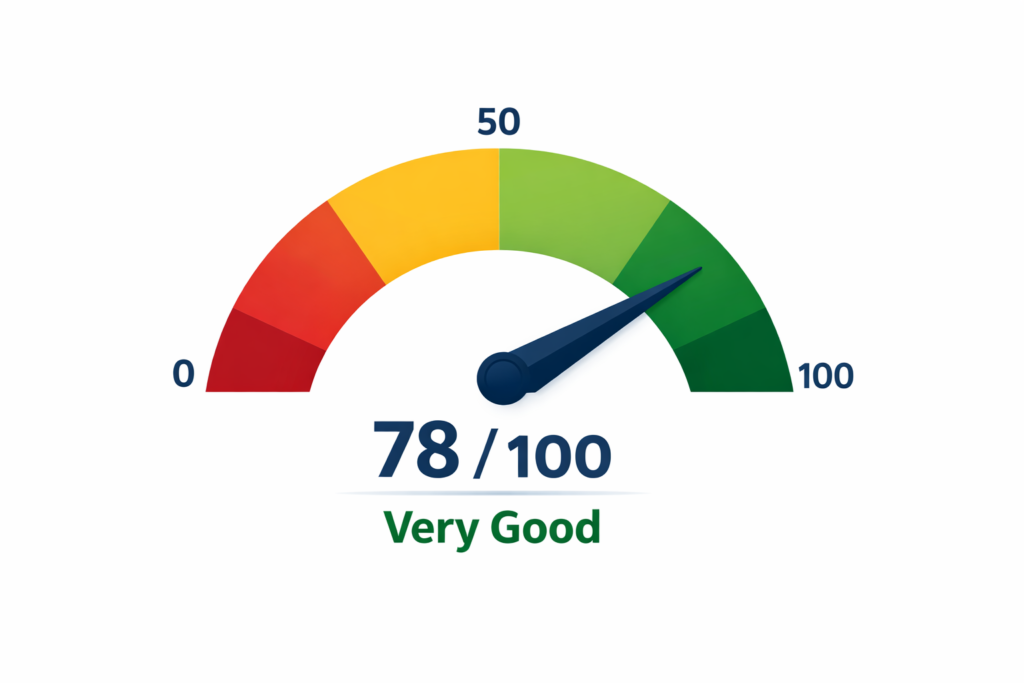

Introduction: Your Score Is a Starting Point, Not a Verdict
A low Financial Health Score does not mean you have failed. It means you now have a precise map of what to fix and in which order — something most Indians never get.
Most personal finance advice in India is fragmented. You read one article about SIP returns, another about emergency funds, a third about term insurance, and a fourth about debt repayment. None of them talk to each other. None of them tell you where you specifically should focus first.
That is the problem the Financial Health Score tool on Wealthpedia solves. It scores your entire financial life on a single 0–100 scale across seven weighted pillars, and — critically — it tells you your score on each pillar separately. That pillar breakdown is where this guide begins.
This is not a generic list of “save more, invest early” tips. This is a structured, sequenced action plan. You will learn:
- What each pillar measures and how it is scored
- The exact benchmarks that determine whether you score 0, 50, or 100 on each pillar
- The highest-leverage actions to move each score up, with real Indian rupee examples
- Which pillars to fix first (the sequence matters enormously)
- How improving one pillar often lifts two or three others automatically
Before you read further, take two minutes to calculate your Financial Health Score so you know your starting point. This guide will make significantly more sense when you have actual numbers in front of you.
Quick Summary
Your Financial Health Score (FHS) gives you a single number from 0 to 100 that measures the true strength of your financial life — not just your debt repayments like CIBIL, but all seven pillars: savings rate, debt health, emergency fund, investments, net worth, cash flow, and insurance. Knowing your score is only the first step. This guide tells you exactly how to improve it, pillar by pillar, with specific numbers and actions tailored for Indian households in 2026. Whether you scored 34 or 74, the same framework applies — find your weakest pillar, fix it first, and watch your score climb.
Understanding the Seven-Pillar Framework
The FHS model weights savings rate most heavily at 25%, followed by debt health at 20%. Getting these two right accounts for nearly half your total score. Start there.
The Financial Health Score does not treat all financial habits as equal. It uses a weighted model because research — and common sense — shows that some financial behaviours matter more than others for long-term wealth. Here is how the weightings break down.
| Pillar | Weight | What It Measures |
|---|---|---|
| Savings Rate | 25% | Percentage of income saved or invested monthly |
| Debt-to-Income Ratio | 20% | Monthly EMI obligations as a percentage of gross income |
| Emergency Fund | 15% | Liquid savings covering a certain number of months of expenses |
| Investments | 15% | Consistency, amount, and diversification of long-term investments |
| Cash Flow | 10% | Monthly income surplus after all expenses |
| Net Worth | 10% | Total assets minus all liabilities |
| Insurance | 5% | Adequacy of health insurance and term life cover |
Why this sequence? Because in personal finance, you build from the bottom up. Cash flow is the foundation — if you spend more than you earn, every other pillar is compromised. Savings rate converts that surplus into future wealth. Debt management ensures liabilities do not eat your surplus. And so on.
The sections below address each pillar in the order you should typically fix them, starting with the highest-weight pillars where improvement delivers the most score movement.
Pillar 1: Savings Rate — The 25% Weight That Moves Your Score Most
If your savings rate is below 10%, fixing it alone can add 10–18 points to your FHS. The Indian FIRE benchmark is 20%+. The tool gives full marks at 30%+. Getting from 5% to 20% is usually a lifestyle decision, not an income problem.
What the FHS tool measures
Your savings rate is calculated as:
Savings Rate = (Monthly Savings + Investments) ÷ Gross Monthly Income × 100
This includes all forms of systematic saving: SIP contributions to mutual funds, PPF deposits, EPF contributions (employee share), RD instalments, and any other money that leaves your current account and goes into an asset. It does not include loan repayments, insurance premiums, or spending — only genuine wealth-building outflows.
Benchmark scoring
| Savings Rate | Approximate FHS Points from This Pillar |
|---|---|
| Below 5% | 0–2 points |
| 5–9% | 3–6 points |
| 10–14% | 8–13 points |
| 15–19% | 14–19 points |
| 20–29% | 20–23 points |
| 30%+ | 24–25 points |
The Indian context
India’s personal savings rate (household level, including physical assets) averages around 18–20% of GDP, but financial savings — the kind that actually compounds — are far lower for most urban middle-class households. A family in Ahmedabad or Bangalore earning ₹1.5 lakh per month often genuinely saves just ₹8,000–₹12,000, a rate of 5–8%. The rest goes to rent or home loan EMI, children’s school fees, car loan, lifestyle spending, and discretionary expenses.
Getting to 20% on ₹1.5L income means saving ₹30,000 per month. That sounds large, but consider the levers:
Lever 1 — Automate before you can spend. Set up SIP debits on the 1st of every month, the day after salary credit. What leaves the account before you see it is never “spent.”
Lever 2 — The 1% monthly step-up. Do not attempt to jump from 7% to 20% overnight. Increase your SIP by 1% of income every three months. On ₹1.5L income, that is ₹1,500 more per quarter. Within 18 months you are at 13–14%. Within 3 years you are past 20%.
Lever 3 — Redirect windfalls. Bonus, increment, tax refund, rental arrears — direct 80% of every windfall to investments before it touches your spending account.
Lever 4 — Review the two largest expenses. For most Indian households, rent/EMI and school fees together account for 45–55% of income. A one-time renegotiation or school fee review can permanently lift your savings rate by 3–5%.
Use the SIP Comparison Calculator on Wealthpedia to model exactly how increasing your monthly SIP by ₹2,000 or ₹5,000 changes your corpus at different time horizons. The compounding numbers are often the motivation you need to act.
Pillar 2: Debt-to-Income Ratio — The 20% Weight That Can Trap You
If your total monthly EMIs exceed 40% of your gross income, your debt health score is near zero. The sweet spot the FHS tool rewards is below 20%. Every percentage point of DTI reduction directly improves your savings rate.
What the FHS tool measures
Debt-to-Income Ratio = Total Monthly EMI Obligations ÷ Gross Monthly Income × 100
This includes home loan EMI, car loan EMI, personal loan EMI, credit card minimum payments (if recurring), and any other debt repayment obligations. It does not include rent (which is an expense, not debt) unless you are treating it as a liability in your net worth calculation.
Benchmark scoring
| DTI Ratio | Approximate FHS Points from This Pillar |
|---|---|
| Above 50% | 0–2 points |
| 40–50% | 3–6 points |
| 30–40% | 7–11 points |
| 20–30% | 12–15 points |
| 10–20% | 16–18 points |
| Below 10% | 19–20 points |
The trap that Indian households fall into
India’s easy lending environment has created a generation of EMI-dependent households. A ₹1.5L/month earner often carries:
- Home loan EMI: ₹42,000 (28%)
- Car loan EMI: ₹12,000 (8%)
- Personal loan: ₹8,000 (5.3%)
- Total DTI: 41.3% → FHS debt score: ~5 out of 20
This single pillar is often the biggest drag on the overall FHS for Indian middle-class households between 35 and 50.
Practical debt reduction strategies
Strategy 1 — Avalanche method. List all debts by interest rate, highest first. Direct every extra rupee to the highest-rate debt while paying minimums on others. Personal loans at 15–18% and credit card debt at 36–42% should be eliminated first, before you increase SIP contributions.
Strategy 2 — Partial prepayment of home loan. Most Indian home loans are floating rate. The RBI allows partial prepayment without penalty. Even ₹50,000 annually — redirected from a bonus or tax refund — can shorten a 20-year loan by 2–3 years and save ₹8–12 lakh in interest. Use the EMI Pro Calculator to run these numbers before deciding.
Strategy 3 — Do not take a new EMI until an existing one ends. This sounds obvious, but most households replace one ending EMI with a new one immediately. Breaking this cycle for even 12 months dramatically improves DTI.
Strategy 4 — Balance transfer for personal loans. Personal loan interest rates vary from 10.5% to 24% across lenders. A balance transfer to a lower-rate NBFC or bank can reduce your EMI by ₹800–₹1,500 per lakh borrowed.
Note the critical relationship between Pillar 1 and Pillar 2: every rupee you free from EMI becomes a rupee you can save. Reducing your DTI from 40% to 25% on a ₹1.5L income frees ₹22,500 per month. That alone takes your savings rate from 7% to 22% — a transformation in a single action.
Pillar 3: Emergency Fund — The 15% Weight That Protects Everything Else
An emergency fund is not about returns — it is about preventing a financial shock from destroying years of wealth building. The FHS tool gives full marks at 6 months of expenses. Most Indians have less than 1 month of liquid reserves.
What the FHS tool measures
Emergency Fund Adequacy = Liquid Savings ÷ Monthly Essential Expenses
“Liquid” means money accessible within 24–48 hours without penalty. This includes savings bank balance, liquid mutual funds (overnight or liquid category), and short-duration FDs with no lock-in. It does not include PPF (lock-in), ELSS (3-year lock-in), real estate (highly illiquid), or gold jewellery (realisation delay and cost).
Benchmark scoring
| Emergency Fund Coverage | Approximate FHS Points from This Pillar |
|---|---|
| Below 1 month | 0–2 points |
| 1–2 months | 3–6 points |
| 2–3 months | 7–10 points |
| 3–4 months | 11–12 points |
| 4–6 months | 13–14 points |
| 6+ months | 15 points |
Why Indian households typically fail this pillar
Three reasons dominate:
Reason 1 — FD lock-in confusion. Many households count a 1-year FD as an emergency fund. It is not — breaking it incurs a penalty (typically 0.5–1% interest loss) and takes 3–5 working days to process. Only genuinely penalty-free, next-day-accessible funds count.
Reason 2 — Overinvestment at the expense of liquidity. Households that invest aggressively in SIPs but maintain near-zero bank balances score poorly here. Having ₹20 lakh in equity mutual funds but ₹8,000 in your savings account is a dangerous position — markets can fall 30% exactly when you need money urgently.
Reason 3 — Underestimating “essential expenses.” The FHS tool defines essential expenses as rent/EMI + food + utilities + school fees + insurance premiums + minimum debt payments. Not your total spending — your minimum survivable spending. For a family spending ₹1.2L/month, essential expenses are often ₹65,000–₹75,000. Six months of that is ₹3.9–4.5 lakh in liquid reserves.
Building it without destroying your SIP momentum
The most common mistake is stopping SIPs to build an emergency fund. Do not do this. Instead:
- Open a dedicated savings account labelled “Emergency Fund” — separate from your salary account
- Redirect just one month’s worth of any discretionary spending into this account for 6 months
- For immediate liquidity with better returns than savings accounts, move funds into a liquid mutual fund (Overnight or Liquid category) — returns of 6.5–7% with T+1 redemption
- Do not touch it for non-emergencies. Medical crises, job loss, and major home repairs qualify. A vacation does not.
Once you have 3 months’ cover, do not stop SIPs to build to 6 months. Instead, continue SIPs and direct 50% of any surplus to the emergency fund until it reaches 6 months’ cover.
Pillar 4: Investments — The 15% Weight That Determines Long-Term Wealth
The investments pillar rewards consistency and diversification, not just total corpus. A household SIPping ₹5,000/month consistently for 5 years scores higher than one that invested ₹3 lakh once three years ago and stopped.
What the FHS tool measures
This pillar assesses three things simultaneously:
- Investment as a percentage of income — Are you investing enough relative to what you earn?
- Consistency — Are contributions regular and systematic, or sporadic?
- Diversification — Are investments spread across asset classes (equity, debt, gold, real estate) or concentrated in one?
Benchmark scoring
| Investment Rate (% of income, consistently) | Approximate FHS Points from This Pillar |
|---|---|
| 0–3% | 0–3 points |
| 3–7% | 4–7 points |
| 7–12% | 8–10 points |
| 12–18% | 11–13 points |
| 18%+ across diversified assets | 14–15 points |
Note: This pillar overlaps with savings rate but scores specifically on the investment component. Pure savings (savings account, FD) score lower than equivalent amounts in equity/debt mutual funds, PPF, or direct equity — because inflation erodes pure savings over time.
What good investing looks like for Indian households in 2026
A well-structured investment allocation for a 35-year-old Indian household with moderate risk tolerance might look like:
- Large/Flexicap equity mutual funds via SIP — 50% of investment amount (long-term wealth engine)
- PPF or EPF — 20% (tax-efficient, debt component, forced discipline)
- Short-duration debt funds — 15% (stability, 3–5 year goals)
- Sovereign Gold Bonds or Gold ETF — 10% (inflation hedge)
- International equity fund — 5% (currency diversification)
This is not a recommendation — it is an illustration of what diversification actually looks like. Single-asset concentration (e.g., 90% in one equity SIP, or 80% in real estate) scores lower on the FHS regardless of total corpus size.
To model different SIP scenarios against your goals, use the Multi-Goal FIRE Planner on Wealthpedia — it lets you build separate goal buckets (retirement, children’s education, home purchase) and shows exactly how much SIP is required for each.
Pillar 5: Cash Flow Health — The 10% Weight That Is Your Foundation
Cash flow is the most basic pillar — do you earn more than you spend? If your monthly outflows exceed inflows, every other pillar is structurally impossible to maintain. Fix this before anything else.
What the FHS tool measures
Monthly Cash Flow = Gross Income − (All Fixed Expenses + Variable Expenses + EMIs + Savings)
A positive surplus is the baseline. The FHS rewards larger surpluses as a percentage of income. Negative cash flow — spending more than you earn via credit card rollovers or informal borrowing — results in a near-zero score on this pillar regardless of everything else.
Common cash flow leaks in Indian households
Lifestyle creep is the dominant issue. As incomes rise from ₹80,000 to ₹1.5 lakh, spending typically rises from ₹65,000 to ₹1.35 lakh — the percentage surplus barely improves even as the absolute income doubles. The solution is the income increment rule: when you get a raise or bonus, commit 70% of the increment to investments before adjusting lifestyle spending.
Subscription and convenience spending has exploded post-2020 in urban India. OTT subscriptions, food delivery, cloud storage, gym memberships, app subscriptions — the average urban Indian household spends ₹3,000–₹6,000 per month on subscriptions alone, often without tracking them. A quarterly subscription audit typically finds ₹1,500–₹2,500 in unused or duplicate subscriptions.
Credit card utilisation without full payment is a dangerous cash flow distortion. Using credit cards is fine — not paying the full balance monthly is a cash flow crisis in disguise, because the 36–42% annual interest compounds rapidly.
Pillar 6: Net Worth — The 10% Weight That Shows Your True Progress
Net worth is the scoreboard of everything else you are doing. It measures not income, not savings rate, not investments — but actual accumulated wealth. Growing net worth year-on-year, even slowly, is what financial independence is built on.
What the FHS tool measures
Net Worth = Total Assets − Total Liabilities
Assets include: savings/current account balance, mutual fund corpus, stocks, PPF/EPF balance, FD value, gold value (jewellery + SGBs), real estate market value, and any other owned assets.
Liabilities include: outstanding home loan principal, car loan balance, personal loan balance, credit card outstanding (full balance, not minimum due), and any informal loans.
A realistic net worth snapshot for Indian households by age
These are illustrative, not benchmarks. They represent rough medians for urban salaried households:
| Age | Rough Net Worth Range (Urban Salaried) |
|---|---|
| 25–30 | ₹2–10 lakh |
| 30–35 | ₹10–40 lakh |
| 35–40 | ₹30–90 lakh |
| 40–45 | ₹75–200 lakh |
| 45–50 | ₹1.5–4 crore |
The FHS does not penalise you for being below these ranges — it scores improvement trajectory and the ratio of liquid/invested assets to liabilities. A household with ₹40 lakh in equity mutual funds and zero debt scores better than one with ₹1 crore in real estate and ₹80 lakh in home loan outstanding.
The dangerous illusion of real estate-heavy net worth
Many Indian households show strong headline net worth on paper because they own property — but property is illiquid, generates maintenance costs, and may have significant price uncertainty in smaller cities. For FHS purposes, real estate contributes to net worth but does not fully compensate for poor scores on other pillars. A household with ₹1.5 crore in property and no liquid financial assets still has near-zero emergency fund, near-zero investable corpus, and likely very high DTI from the home loan.
The goal is to build liquid, productive net worth alongside any property you own. For retirement planning specifically, use the Retirement Withdrawal (SWP) Calculator to understand how much liquid corpus you actually need to generate your target monthly income in retirement.
Pillar 7: Insurance — The 5% Weight You Cannot Afford to Ignore
Insurance has the lowest weight in the FHS model, but an inadequate cover can result in a single event — a hospitalisation or a premature death — destroying all six other pillars simultaneously. Treat it as the foundation of your financial structure, not an afterthought.
What the FHS tool measures
Two types of insurance are assessed:
Health insurance adequacy: For a family of four in a Tier-1 city in 2026, a minimum sum insured of ₹10–15 lakh is considered adequate. Corporate health cover (employer-provided) is discounted because it disappears upon job change or layoff — exactly when you are most vulnerable.
Term life insurance adequacy: The FHS benchmarks term cover at 10–15× annual income for the primary earning member. A household with ₹15 lakh annual income should ideally have ₹1.5–2.25 crore in pure term cover.
The most common insurance mistakes Indian households make
Relying entirely on corporate health cover. India’s group health insurance typically covers ₹3–5 lakh per family per year. A single major hospitalisation in a private hospital in Mumbai or Ahmedabad — cardiac bypass, cancer treatment, major surgery — can cost ₹8–25 lakh. The FHS tool correctly penalises households with no personal health policy outside their employer’s cover.
Treating endowment or ULIP as “insurance + investment.” These products typically provide life cover of 5–10× annual premium — far below the 10–15× income benchmark. They also deliver suboptimal investment returns (4–6% post charges versus 10–12% from equity mutual funds). The FHS framework scores pure term + mutual fund combinations significantly higher than bundled ULIP/endowment products of equivalent premium.
No coverage for the non-earning spouse. Medical inflation in India is running at 12–14% annually — significantly higher than general inflation. A hospitalisation of the non-earning spouse has zero life insurance implication but a major financial impact. Both earning and non-earning adult household members should have individual health covers.
For context on healthcare inflation specifically and its impact on FIRE planning, Wealthpedia’s detailed article on Healthcare Inflation in India shows why ₹5 lakh of health cover today will be worth the equivalent of ₹1.5 lakh in real terms by 2040.
How to Sequence Your Improvement: The FHS Priority Ladder
Fix pillars in this order: (1) Cash flow positive, (2) Minimum emergency fund of 1 month, (3) High-interest debt elimination, (4) Savings rate to 10%+, (5) Emergency fund to 3 months, (6) Savings rate to 20%+, (7) Insurance adequacy, (8) Investment diversification, (9) Net worth optimisation.
Most people try to improve all pillars simultaneously and improve none meaningfully. The sequence above is not arbitrary — it reflects the dependency structure of personal finance.
You cannot build savings if cash flow is negative. You cannot invest effectively if you carry 24% personal loan debt. You cannot hold long-term equity investments without an emergency fund (because you will redeem during every market fall to meet expenses).
For those scoring 0–39 (Critical): Your priority is survival — stop the cash bleed, eliminate consumer debt, build one month of emergency funds. The Financial Health Score tool will show you exactly which pillar is most depleted.
For those scoring 40–59 (At Risk): Your foundation exists but has gaps. The single highest-leverage action is typically DTI reduction — freeing EMI-trapped income for savings and investments.
For those scoring 60–74 (Stable): You have the basics right. The improvement lever here is usually savings rate — pushing from 12–14% to 20%+ and beginning systematic multi-goal investing via the Multi-Goal FIRE Planner.
For those scoring 75–89 (Strong): Your job now is optimisation — tax efficiency, step-up SIPs, rebalancing, and accelerating your FIRE timeline.
For those scoring 90+ (Exceptional): You are in wealth preservation and passive income mode. Focus shifts to withdrawal strategy, estate planning, and ensuring your retirement corpus generates inflation-adjusted income for 30+ years.
The Maths Behind Your Score: What a 10-Point Improvement Actually Means
A 10-point improvement in your FHS — say from 54 to 64 — typically represents ₹8,000–₹18,000 per month in redirected money and translates to ₹40–80 lakh more in retirement corpus over 20 years. Small score improvements are not small financial improvements.
People often dismiss score improvements as abstract. “What does going from 61 to 72 actually mean for my life?” It means a great deal in concrete rupees.
Here is a worked example. Consider a 38-year-old couple in Ahmedabad with combined income of ₹2 lakh per month, currently scoring 59 on the FHS. Their specific weakness is debt health and savings rate — they carry ₹55,000 in monthly EMIs (DTI 27.5%) and save ₹18,000 per month (9%).
Scenario A: They do nothing. At 9% savings rate, they invest ₹18,000/month. Over 22 years to retirement at 60, at 11% annualised return, this grows to approximately ₹1.87 crore.
Scenario B: They close a ₹12,000/month personal loan in 14 months (possible with focused prepayment), then redirect that ₹12,000 entirely to SIP. Their savings rate jumps from 9% to 15%. Their DTI falls from 27.5% to 21.5%. Their FHS score improves by roughly 9–12 points. They now invest ₹30,000/month. Over the remaining 20.8 years at 11% annualised return, this grows to approximately ₹2.94 crore.
The difference: ₹1.07 crore. Generated by a 9-point FHS score improvement. That is not abstract. That is a crore of rupees that exists or does not exist depending on whether a household takes action on a single debt.
This is why the FHS tool is worth using seriously and repeatedly. Each pillar improvement has a direct rupee consequence in your long-term wealth.
Five Mental Models That Make FHS Improvement Sustainable
Tactical actions — increasing SIP, closing a loan — are necessary but not sufficient. Without the right mental models, households improve temporarily then revert. These five frameworks make improvement permanent.
Mental Model 1: Pay Yourself First, Not Last
Most Indian households follow the sequence: Income → Expenses → EMIs → Whatever Remains = Savings. The FHS model reveals the problem with this: “whatever remains” is systematically less than intended because expenses and lifestyle spending expand to fill available income.
The correct sequence is: Income → Savings (automated debit on salary day) → EMIs → Whatever Remains = Expenses. This is the single highest-leverage behavioural change in personal finance. It does not require discipline in the moment — it requires one automation setup that removes the decision entirely.
Mental Model 2: Your Lifestyle Is a Fixed Cost Until You Decide Otherwise
Lifestyle expenses feel variable because they are not fixed monthly debits like EMIs. But in practice, households spend very similar amounts month over month on food, entertainment, clothing, and discretionary items. Treating lifestyle spending as a fixed budget — with genuine consequences for exceeding it — converts it from a passive drain to a managed allocation.
A practical implementation: maintain a separate “lifestyle” account with a fixed monthly transfer. When it is empty, discretionary spending stops until the next month’s transfer. This is uncomfortable for the first two months and invisible after that.
Mental Model 3: Each Pillar Has a Ceiling; Focus Below the Ceiling
If your emergency fund already covers 4 months of expenses, putting more money there delivers zero additional FHS improvement. The tool’s pillar-by-pillar breakdown tells you exactly which pillars have room to grow. Allocate effort to the pillars that still have meaningful score upside, not to the ones already near maximum.
This is a particularly important insight for high savers who consistently direct all surplus to investments while ignoring insurance gaps or emergency fund adequacy. Diversifying your effort across pillars — not just your money across asset classes — is what moves the overall score.
Mental Model 4: Compare Your FHS to Your Past Self, Not to Others
The FHS is a personal benchmark, not a competition. A 68-year-old retiree and a 28-year-old junior professional should have very different Financial Health Scores, and comparing them is meaningless. What matters is whether your score is higher than it was six months ago, and by how much. Progress, not perfection, is the metric that keeps people engaged with the process long enough to reach financial independence.
Mental Model 5: The Emergency Fund Is What Allows You to Stay Invested
This connection is underappreciated. The primary reason Indian investors redeem equity mutual fund units during market downturns is not because they have lost faith in equity — it is because they need the money for an emergency and have no liquid alternative. Every market-bottom redemption crystallises a loss and destroys compounding.
A properly funded emergency fund (3–6 months of expenses in liquid funds) means that a job loss, medical crisis, or major repair can be absorbed without touching your equity portfolio. This one structural change — often worth 15 FHS points on its own — can add ₹30–60 lakh to your final retirement corpus simply by allowing you to remain invested through the downturns that will inevitably occur over a 20–25 year investing horizon.
What Indian FIRE Seekers Need to Know About the FHS
Financial Independence, Retire Early (FIRE) requires a Financial Health Score of at least 75 as a baseline. Below 75, you are still plugging holes. Above 75, you are building the surplus and the corpus that makes FIRE achievable.
FIRE is not a destination — it is a financial state where your passive income from invested assets equals or exceeds your living expenses. In India, this typically requires a corpus of 25–33 times your annual expenses (the 3–4% withdrawal rate framework), adjusted for Indian tax treatment of withdrawals and Indian inflation rates.
For a household spending ₹80,000 per month (₹9.6 lakh annually), the FIRE corpus target is ₹2.4–3.2 crore in liquid, productive assets.
The FHS tracks your progress toward this target through three pillars that directly map to FIRE readiness:
Savings Rate (Pillar 1) — A FIRE-oriented household needs a savings rate of 30–50%. At 30% savings rate on ₹2 lakh monthly income, ₹60,000/month is invested. At 11% annualised return, the ₹2.4 crore corpus target is reached in approximately 17 years from zero. At 40% savings rate (₹80,000/month), the same target is reached in approximately 13 years.
Net Worth (Pillar 6) — The FHS’s net worth pillar directly tracks your FIRE corpus accumulation. As your net worth grows relative to your annual expenses, this pillar score improves — a direct proxy for FIRE progress.
Investments (Pillar 4) — FIRE requires not just invested money but productively invested money: equity mutual funds, index funds, REITs, SGBs, and other assets that generate real returns above inflation. The investments pillar rewards diversification and consistency, both of which are essential for a 25–30 year retirement horizon.
The Multi-Goal FIRE Planner was built precisely for this calculation — it lets you model multiple goals simultaneously (retirement, children’s education, property, sabbatical) and shows you the exact monthly SIP required for each, across multiple market return scenarios.
If FIRE is your goal, your FHS is your scoreboard. A score below 65 means your foundations are not yet solid enough to build the required surplus. A score above 80 means you are in the compounding phase where FIRE becomes a timeline question, not a possibility question.
Tracking Your Score: Why You Should Re-Check Every 6 Months
Your FHS is a dynamic number. Life events — job change, salary hike, new EMI, a child’s birth, a medical expense — can shift it by 10–15 points in either direction. A 6-month re-check keeps you calibrated and accountable.
The most powerful use of the FHS tool is not the first score — it is the second one, six months later, after you have acted on the first.
Consider this trajectory for a household that starts at 52 (At Risk) and takes three specific actions:
| Action Taken | Pillar Affected | Score Impact |
|---|---|---|
| Eliminated ₹6,000/month personal loan EMI | Debt (20%) | +4 points |
| Increased SIP by ₹4,000/month | Savings (25%) | +3 points |
| Bought ₹10L health insurance policy | Insurance (5%) | +2 points |
| Built 2-month emergency fund | Emergency (15%) | +3 points |
| Total Improvement | — | +12 points |
A score of 64 after six months. From At Risk to Stable — a meaningful change that required no extraordinary income event, just intentional redirection of existing money.
Calculate your score now, bookmark this article, and set a calendar reminder for six months. The comparison will be your most useful personal finance review of the year.
Related Tools to Accelerate Your FHS Improvement
Every pillar in the FHS has a corresponding tool on Wealthpedia that helps you take action, not just understand the problem:
- Financial Health Score Calculator — Know your score across all 7 pillars. The starting point for everything in this article.
- Multi-Goal FIRE Planner — Build separate investment goals for retirement, children’s education, home purchase, and early retirement. Links directly to improving Pillars 4 and 6.
- SIP Comparison Calculator — Model how different SIP amounts grow at different rates over time. Essential for improving Pillar 1 (savings rate) and Pillar 4 (investments).
- EMI Pro Calculator — Run prepayment scenarios on your home loan. Shows exactly how much interest you save and how many years you save by prepaying. Links directly to improving Pillar 2 (debt health).
- Retirement Withdrawal (SWP) Calculator — Understand how much corpus you need to sustain your lifestyle in retirement. The tool that motivates action on Pillar 6 (net worth) more powerfully than any article.
- Personal Finance OS — All four flagship tools in one unified interface with a shared profile. The most complete financial dashboard Wealthpedia offers.
Frequently Asked Questions
Is the Financial Health Score the same as a credit score?
No. A credit score (CIBIL, Experian, etc.) measures only one dimension — your debt repayment history and current debt burden — and is designed for lenders, not for you. The Financial Health Score is a self-assessment tool designed for you, measuring seven dimensions of financial wellness. Your credit score affects your ability to borrow. Your Financial Health Score tells you whether you should be borrowing at all, and how much.
My income is irregular (business/freelance). Can I still use the FHS tool?
Yes. For irregular income, use your average monthly income over the past 6–12 months as your input. The tool is designed to handle income variability — in fact, irregular income households typically score lower on cash flow stability, which is useful feedback because it highlights the need for a larger emergency fund (4–8 months rather than 3–6).
I have a high income but low FHS score. How is that possible?
Extremely common. High income masks financial vulnerability when it is accompanied by high lifestyle spending, large EMIs, no emergency fund, and inadequate insurance. Income is not measured in the FHS at all — only what you do with it. A household earning ₹3 lakh per month with ₹1.4 lakh in EMIs, ₹1.2 lakh in expenses, ₹40,000 in savings, no health insurance, and no emergency fund scores significantly lower than a household earning ₹80,000 per month with ₹10,000 in EMIs, ₹40,000 in expenses, ₹30,000 in savings, and full insurance coverage.
How often should I use the FHS tool?
Minimum once every 6 months. Additionally, recalculate whenever a significant financial event occurs: salary increment, new loan, job change, new child, major medical expense, or large investment.
My score is 87. What should I focus on?
At 87, your foundational pillars are in excellent shape. Focus on: (1) Tax optimisation — ELSS for 80C, NPS for additional ₹50,000 deduction under 80CCD(1B), HRA if applicable; (2) Step-up SIPs to accelerate corpus; (3) Reviewing your insurance coverage for inflation — a ₹1 crore term cover bought in 2015 is worth ₹60–65 lakh in 2026 real value; (4) Estate planning — will, nominee updates, POA if you have dependents. Use the Multi-Goal FIRE Planner to see if your FIRE date can be pulled forward.
Conclusion: The Score Is the Map — You Provide the Movement
A Financial Health Score of 100 is not the goal. The goal is financial independence — the freedom to make life choices without being constrained by money. The score is simply the most honest, structured map of where you stand on that journey.
Most people never get this map. They spend their financial lives reacting to events — an unexpected expense, a market fall, an EMI they can no longer afford — rather than building proactively toward a clear destination.
The Wealthpedia Financial Health Score tool gives you the map. This article gives you the action plan. The six months ahead are yours to use.
Calculate. Act. Re-check. Improve.
That is the entire system.
Disclaimer:Wealthpedia™ is a registered trademark (TM #4910385). This article is for educational purposes only and does not constitute investment advice. Please consult a SEBI-registered investment advisor before making financial decisions. Past performance is not indicative of future results.

Vishal Jhaveri is the founder of Wealthpedia and an MBA Finance professional with over 10 years of experience in financial planning, investing, and wealth creation. He specializes in FIRE (Financial Independence, Retire Early), retirement planning, investing, and personal finance education. Through Wealthpedia, he develops financial calculators and publishes evidence-based content to help Indian investors make informed financial decisions. He regularly reviews and updates Wealthpedia articles to reflect changes in tax, laws, investment regulations, and personal finance best practices.
Quick Wrap up