
“Can I withdraw my EPS before retirement?” is one of the most commonly asked questions on EPFO-related forums, and the answer depends entirely on one number: how many years of EPS service you have accumulated.
The rules are clear but frequently misunderstood — particularly by employees who assume EPS works like EPF (where withdrawal is permitted under several circumstances) or who believe there is a universal right to cash out pension contributions at any time.
This guide explains the complete EPS withdrawal rules, the situations where withdrawal is possible, where it is permanently blocked, and what is at stake financially when you choose cash over preserved service.
Use the EPS Pension Calculator India to see exactly what monthly pension you would be giving up by choosing to withdraw now instead of preserving your service.
Quick Summary
EPS withdrawal before retirement is only possible in one specific scenario: less than 10 years of pensionable service at the time you leave EPF-covered employment. If your service is below 10 years, you can claim the Table D withdrawal benefit (a one-time lump sum) via Form 10C, or opt for a Scheme Certificate instead. Once you cross 10 years, EPS cannot be withdrawn as a lump sum under any circumstances — you must wait until the eligible pension age (50 for early pension, 58 for standard). This article explains every rule, common misconceptions, and what you permanently lose by withdrawing instead of preserving service. Use the EPS Pension Calculator India to model the long-term value of your pension versus the withdrawal benefit.
Join Now →
The Short Answer — EPS Withdrawal Rules at a Glance
| Your EPS Service | Can You Withdraw? | What Are Your Options? |
|---|---|---|
| Less than 10 years | Yes — limited window | Table D withdrawal (Form 10C) or Scheme Certificate |
| Exactly 10 years or more | No | Must claim monthly pension at age 50 (early) or 58 (standard) |
| 10+ years, still employed | No | Service continues accumulating until you leave or retire |
| Retired (age 58+) with 10+ years | No | Must claim monthly pension via Form 10D |
There is no general right to withdraw EPS as a lump sum once you have crossed 10 years of pensionable service. This is fundamentally different from EPF, where various withdrawal triggers exist (home purchase, medical emergency, unemployment, retirement, etc.). EPS has no equivalent flexibility above the 10-year threshold.
When EPS Withdrawal IS Permitted — Below 10 Years of Service
If you have less than 10 years of EPS-covered pensionable service and you leave EPF-covered employment (voluntarily or involuntarily), you have two options via Form 10C:
Option A — Table D Withdrawal Benefit
A one-time lump sum calculated as:
Withdrawal Benefit = Table D Factor × Pensionable Salary
| Years of Service | Table D Factor | Amount at ₹15,000 Salary |
|---|---|---|
| 1 year | 1.02 | ₹15,300 |
| 2 years | 2.06 | ₹30,900 |
| 3 years | 3.10 | ₹46,500 |
| 4 years | 4.14 | ₹62,100 |
| 5 years | 5.28 | ₹79,200 |
| 6 years | 6.36 | ₹95,400 |
| 7 years | 7.46 | ₹1,11,900 |
| 8 years | 8.54 | ₹1,28,100 |
| 9 years | 9.72 | ₹1,45,800 |
The withdrawal benefit is not interest-bearing — it does not grow the longer you wait to claim it. By contrast, preserving the service via Scheme Certificate costs you nothing to maintain.
Option B — Scheme Certificate
Instead of cash, you request a Scheme Certificate that preserves your service record. This allows you to combine this service period with future EPF-covered employment, potentially reaching the 10-year pension eligibility threshold or the 20-year bonus threshold.
For the complete Form 10C process, see Form 10C Explained. For the decision framework between these two options, see Scheme Certificate vs EPS Withdrawal Benefit.
When EPS Withdrawal Is NOT Permitted
Scenario 1 — You Have 10 or More Years of EPS Service
Once your pensionable service crosses 10 years (or 9 years 6 months, which rounds up to 10 years under the 6-month rounding rule), withdrawal is permanently blocked. You cannot:
- Withdraw EPS as a lump sum
- “Convert” your EPS to a one-time payment
- Opt out of EPS and receive the contributions back
Your only option is to wait until you reach the eligible age and claim monthly pension via Form 10D — at age 50 for early pension (with permanent reduction), or age 58 for standard pension.
Scenario 2 — You Are Unemployed But Have 10+ Years of Service
Unemployment does not unlock EPS withdrawal. Even if you leave EPF-covered employment permanently, with no intention of returning, your EPS service remains on record and the only path to accessing the benefit is through monthly pension at the eligible age.
Scenario 3 — Financial Emergency
Unlike EPF (which has an advance provision for emergencies, illness, and other life events), EPS has no emergency withdrawal provision. No matter how urgent the financial need, EPS contributions cannot be accessed as a lump sum once the 10-year threshold is crossed.
Scenario 4 — Death of Member With 10+ Years Service
Even in the event of the member’s death, the EPS benefit is not paid as a lump sum to the family — instead, the family receives the monthly survivor pension (widow pension and child pension). There is no EPS lump sum payable on death for members with 10+ years of service.
EPF vs EPS — A Critical Distinction
One of the most common sources of confusion is treating EPF and EPS as a single fund. They are separate, with very different withdrawal rules: Feature EPF (Employee Provident Fund) EPS (Employee Pension Scheme) Withdrawal flexibility High — multiple triggers permitted Very low — only below 10 years Emergency advance Available under various conditions Not available Lump sum on retirement Yes — full corpus No — only monthly pension Withdrawal above 10 years Yes — on retirement or unemployment (58+ or 2 months jobless) No Nominee receives lump sum on death Yes (EPF corpus) No — survivor gets monthly pension
Understanding this distinction prevents employees from assuming that EPFO approval for an EPF withdrawal also covers EPS — they are processed separately, and EPS rules are considerably stricter for lump-sum access.
For the complete comparison, see EPF vs EPS: Key Differences Explained.
The Financial Cost of Withdrawing EPS Instead of Preserving Service
For employees below the 10-year threshold who are genuinely choosing between withdrawal and Scheme Certificate, the financial stakes can be significant.
Case Study — 7 Years of Service
Option A — Withdraw Now (Table D)
- Withdrawal Benefit: ₹1,11,900 (7 years × factor 7.46 × ₹15,000)
- You receive cash immediately
- Service is permanently forfeited
Option B — Scheme Certificate + 3 More Years at New Employer
- Combined service: 7 + 3 = 10 years (crosses pension eligibility)
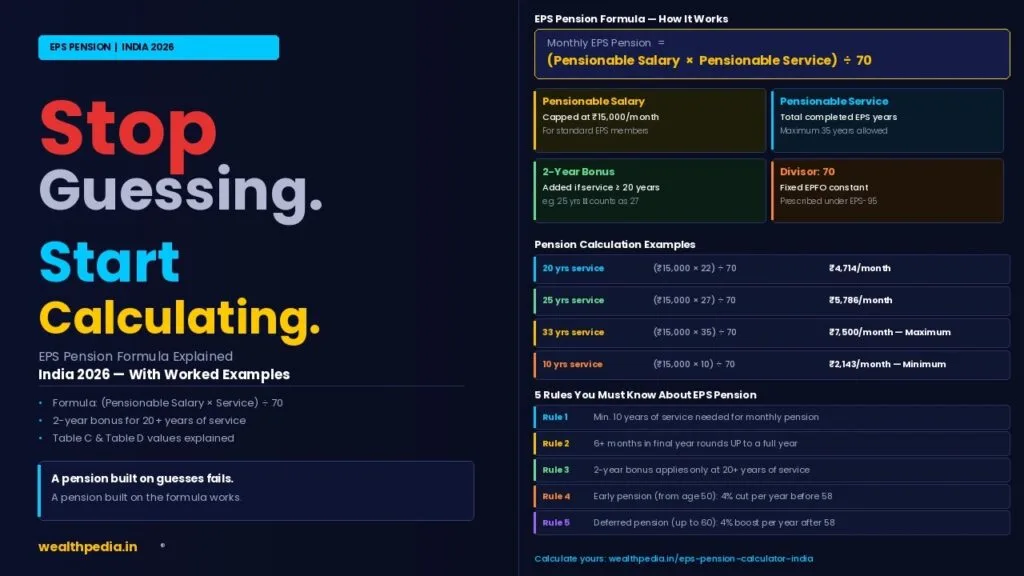
- Monthly Pension for life: (15,000 × 10) ÷ 70 = ₹2,143/month
- Over 22-year retirement (age 58–80): ₹2,143 × 264 = ₹5,65,752 total
The Scheme Certificate path delivers over 5 times the value of the immediate cash withdrawal, assuming the member continues in EPF-covered employment for just 3 more years.
Even accounting for the time value of money (the ₹1,11,900 withdrawal could be invested), the guaranteed, risk-free monthly pension from just 10 years of service (₹2,143/month starting at 58) represents a considerably stronger long-term outcome for most employees.
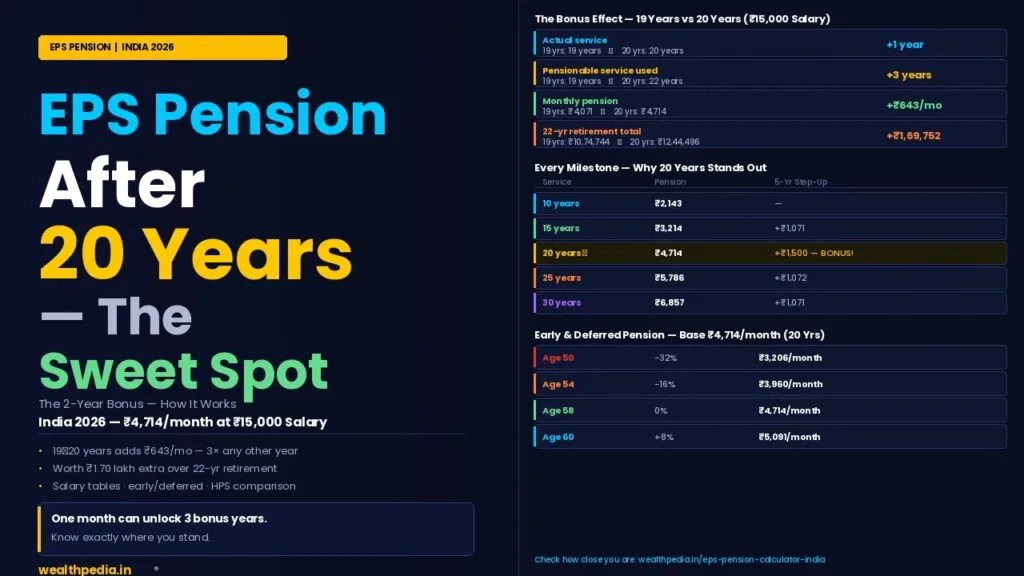
And if the combined service eventually reaches 20 years, the pension jumps to ₹4,714/month with the 2-year bonus — making the preservation decision even more valuable. See EPS Pension After 20 Years.
Common Misconceptions About EPS Withdrawal
Misconception 1 — “I Can Withdraw EPS Since I Withdrew EPF”
Withdrawing your EPF corpus does not entitle you to withdraw EPS. These are two separate funds with independent rules. EPF withdrawal approval does not include or imply EPS withdrawal approval.
Misconception 2 — “My Employer Said I Can Withdraw EPS Anytime”
Some employers (and even some payroll personnel) incorrectly advise employees that EPS can be withdrawn freely. This is incorrect — EPFO’s rules are firm. Below 10 years, withdrawal is available via Form 10C. Above 10 years, it is not available at all as a lump sum.
Misconception 3 — “I Will Get Arrears for All the Years I Waited”
If you delay claiming your pension after becoming eligible (age 58), EPFO does not pay you retroactive pension for the delay period — you only receive pension from the date you file Form 10D. See EPS Pension Arrears: Meaning and Calculation for the complete explanation of this critical rule.
Misconception 4 — “EPS Withdrawal Is the Same as PF Withdrawal”
“PF withdrawal” in common usage refers to both EPF and EPS, but the underlying rules are completely different. When EPFO processes a “PF withdrawal,” it processes the EPF component via Form 19 and the EPS component (if eligible) via Form 10C — two separate forms, two separate eligibility criteria.
What Happens to EPS If You Never Withdraw and Never Claim Pension?
If a member leaves EPF-covered employment below the 10-year threshold and neither withdraws (Form 10C) nor claims pension (not applicable below 10 years), the service record stays in EPFO’s system indefinitely under the member’s UAN. There is no automatic forfeiture after a fixed period — unclaimed benefits do not disappear.
However, the withdrawal benefit does not earn interest while waiting — the Table D factor remains fixed at the time-of-exit calculation. There is no financial advantage to delaying a withdrawal claim once you have definitively decided not to return to EPF-covered employment.
The better option for someone uncertain about their future employment is to obtain a Scheme Certificate, which preserves service with no obligation or cost until they are ready to decide. See Scheme Certificate vs EPS Withdrawal Benefit for the full comparison.
Steps to Claim EPS Withdrawal (Below 10 Years Only)
- Wait 2 months after your last working day
- Log in to the EPFO UAN Member Portal at unifiedportal-mem.epfindia.gov.in
- Navigate to Online Services → Claim (Form 31, 19, 10C & 10D)
- Select Form 10C and choose between withdrawal benefit and Scheme Certificate
- Verify bank details, submit with Aadhaar OTP
- Track claim status — processing typically takes 7–20 working days
For the complete step-by-step process, see Form 10C Explained.
Quick Reference — EPS Withdrawal Rules
Situation EPS Withdrawal Allowed? Less than 10 years service, left employer Yes — via Form 10C Exactly 9 years 6 months service (rounds to 10 years) No — pension eligibility applies 10+ years service, any circumstance No — monthly pension only Unemployed with 10+ years EPS service No Financial emergency, 10+ years service No Death of member with 10+ years service No — family gets survivor pension
Frequently Asked Questions — Withdrawing EPS Before Retirement
Can I withdraw my EPS before retirement?
Only if you have less than 10 years of EPS service at the time of leaving employment. You can then claim the Table D withdrawal benefit via Form 10C, or opt for a Scheme Certificate instead. With 10 or more years of service, EPS cannot be withdrawn as a lump sum under any circumstances.
What is the EPS withdrawal benefit for 5 years of service?
At ₹15,000 pensionable salary: Table D Factor (5.28) × ₹15,000 = ₹79,200 as a one-time lump sum. Use the EPS Withdrawal Benefit Calculator for your exact amount.
Can I withdraw EPS if I am unemployed?
Below 10 years of service: yes, after a 2-month waiting period. Above 10 years of service: no — unemployment does not unlock EPS lump-sum withdrawal. You must wait until the pension-eligible age.
Is EPS withdrawal taxable?
Tax-exempt if combined EPF+EPS service was 5 years or more. Taxable as salary income if service was less than 5 years.
Why can’t I withdraw EPS the same way I withdrew EPF?
EPF and EPS are separate funds with different rules. EPF has multiple withdrawal triggers; EPS withdrawal is only available below 10 years of service via Form 10C. Above 10 years, EPS is payable only as monthly pension. See EPF vs EPS: Key Differences Explained.
Should I take the EPS withdrawal or a Scheme Certificate?
If you plan to continue in EPF-covered employment, a Scheme Certificate preserves your service and is almost always more valuable long-term. If you are certain you will never return to EPF-covered employment, the withdrawal provides immediate cash. See Scheme Certificate vs EPS Withdrawal Benefit for the complete decision framework.
What happens to my EPS if I have 9 years and 6 months of service?
EPFO’s 6-month rounding rule rounds 9 years 6 months UP to 10 years — making you eligible for monthly pension, not EPS withdrawal. The Table D benefit is no longer available once rounded service reaches 10 years.
Can I get a lump sum from EPS at retirement after 25 years of service?
No. EPS does not pay a lump sum at retirement regardless of service length (above 10 years). You receive monthly pension only, claimed via Form 10D, from age 50 (early) or 58 (standard).
If I withdraw EPS now, can I rebuild the service later?
No. Once the Table D withdrawal benefit is paid, that period of service is permanently forfeited. Future EPF employment starts a fresh EPS service count from zero for that period.
How do I know if my EPS service is below or above 10 years?
Log in to passbook.epfindia.gov.in with your UAN. Count the months with EPS contributions in the passbook, convert to years and months, and apply the 6-month rounding rule. Alternatively, use the EPS Pension Calculator India by entering your joining date to get your exact pensionable service instantly.
Disclaimer: The information on this page is for educational purposes only and does not constitute investment or financial advice. EPS withdrawal rules are governed by EPFO regulations under EPS-95 and may be updated by the Government of India. For personalised guidance, consult a SEBI-registered financial planner or visit your nearest EPFO office. Wealthpedia™ (Trademark Reg. No. 4910385) is not a SEBI-registered investment advisor. All mutual fund references on this site are for Direct Plan, Growth option only.

Vishal Jhaveri is the founder of Wealthpedia and an MBA Finance professional with over 10 years of experience in financial planning, investing, and wealth creation. He specializes in FIRE (Financial Independence, Retire Early), retirement planning, investing, and personal finance education. Through Wealthpedia, he develops financial calculators and publishes evidence-based content to help Indian investors make informed financial decisions. He regularly reviews and updates Wealthpedia articles to reflect changes in tax, laws, investment regulations, and personal finance best practices.
Quick Wrap up