
“Arrears” is one of the most misunderstood terms in EPS pension administration. Many members assume that if they delay filing for pension — even by several years — EPFO will eventually pay them everything they “missed” once they do file. This is not how EPS arrears work, and the misunderstanding can lead to significant financial loss for members who delay claiming.
This guide explains precisely what EPS pension arrears are, when they apply, how they are calculated, and the critical distinction between legitimate processing-delay arrears (which are paid) and missed-eligibility-period arrears (which are not).
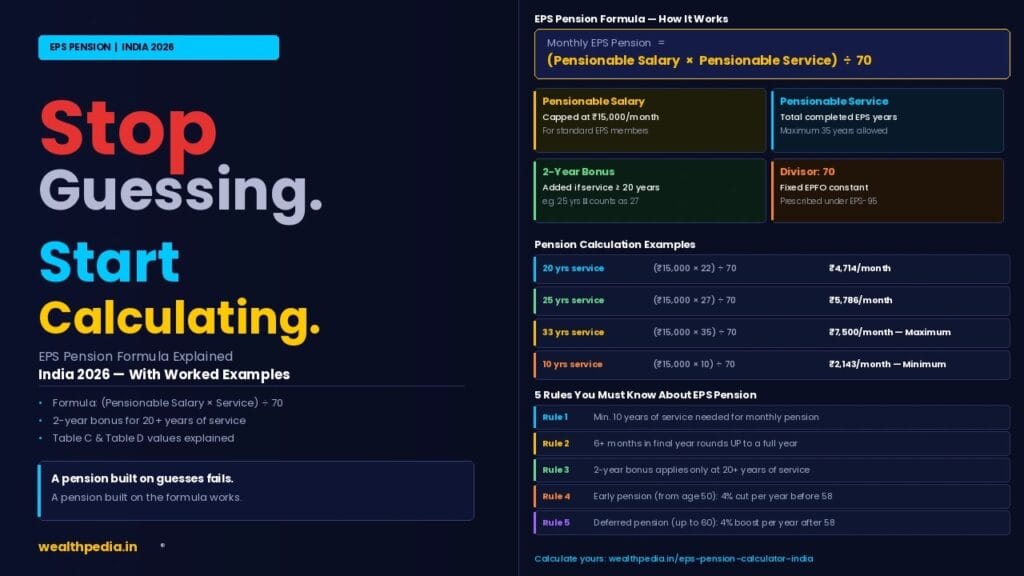
Use the EPS Pension Calculator India to compute your expected monthly pension and avoid costly delays in filing.
Quick Summary
EPS pension arrears refer to backdated pension amounts owed to a member or their family for a period during which pension was due but not yet credited — typically because of EPFO processing time between the date Form 10D was submitted and the date the Pension Payment Order (PPO) was issued. Arrears are paid as a one-time lump sum once the claim is approved. Crucially, EPS pension does not pay arrears for periods before a claim is filed — there is no retroactive payment for years a member was eligible but never claimed. This article explains exactly how arrears are calculated, common scenarios, and how to resolve delayed arrears. Use the EPS Pension Calculator India to verify your expected monthly pension.
Join Now →
What Are EPS Pension Arrears?
EPS pension arrears are backdated pension payments owed for the period between the effective date of pension entitlement (typically the date of Form 10D submission) and the date the first regular monthly pension payment actually begins.
Arrears exist because of the practical reality of pension processing: EPFO requires time — typically 10 to 45 working days depending on claim type — to verify service records, salary history, and documentation before issuing the Pension Payment Order (PPO). During this processing window, the member is technically entitled to pension from their claim date, but no monthly credit has yet occurred. The arrears payment bridges this gap as a one-time lump sum.
The Critical Rule — Arrears Start From the Claim Date, NOT From Eligibility Date
This is the single most important fact about EPS pension arrears, and the source of the most costly misunderstanding among members:
EPS pension arrears cover the gap between your Form 10D submission date and your first pension credit. They do NOT cover any period before you submitted Form 10D — even if you were eligible for pension during that time.
Example of the Misunderstanding
An employee becomes eligible for standard pension at age 58 but does not file Form 10D until age 62 (a 4-year delay, perhaps due to unawareness or procrastination).
What many members incorrectly assume: EPFO will pay 4 years of backdated pension once the claim is processed.
What actually happens: Pension is paid only from the date of Form 10D submission at age 62. The 4 years between age 58 and 62 — during which the member was eligible but did not claim — results in permanently lost pension income with no arrears compensation.
For an employee with a pension of ₹5,786/month, a 4-year delay in filing results in a loss of:
₹5,786 × 48 months = ₹2,77,728 in permanently forfeited pension income
This is one of the costliest mistakes an EPS member can make. For the complete filing process and timing guidance, see Form 10D Explained: How to Claim EPS Pension.
When Do Legitimate EPS Pension Arrears Apply?
Legitimate arrears apply in the following scenarios:
Scenario 1 — Standard Processing Delay
Member files Form 10D on their 58th birthday. EPFO takes 25 working days to verify records and issue the PPO. The first regular pension payment begins on the next monthly cycle after PPO issuance.
Arrears calculation: Pension is calculated as due from the Form 10D submission date. The number of days/months between submission and the first regular payment is paid as a lump-sum arrear, alongside (or just before) the first regular monthly credit.
Scenario 2 — Family Pension Claim Processing Delay
A widow files Form 10D for family pension following her husband’s death. Processing (including verification of death certificate, marriage certificate, and relationship documents) takes 35 working days.
Arrears calculation: Family pension is due from the date of the member’s death (for death-in-service cases) or from the date of the widow’s Form 10D submission (for cases where the member was already retired and drawing pension, then died). The exact start date depends on the specific circumstances — verify with your regional EPFO office.
Scenario 3 — Disputed or Re-processed Claims
A member’s initial Form 10D claim is rejected due to a documentation error (e.g., DOB mismatch). The member corrects the issue and re-files. Processing of the corrected claim takes additional time.
Arrears calculation: If the original submission date is preserved in EPFO’s system (common when the issue is a correction rather than a fresh claim), arrears are calculated from the original submission date, not the re-submission date. If treated as an entirely new claim, the arrears would only cover the gap from the re-submission date.
Scenario 4 — Pension Revision Due to Calculation Error
EPFO later discovers a calculation error (e.g., incorrect service years used) and revises a member’s pension upward.
Arrears calculation: The difference between the originally paid (lower) pension and the corrected (higher) pension, for all months since the original PPO was issued, is paid as a lump-sum arrear.
How EPS Pension Arrears Are Calculated
Arrears Amount = Monthly Pension × Number of Months Between Claim Date and First Regular Payment
Worked Example
- Member’s monthly pension (as sanctioned): ₹5,786/month
- Form 10D submitted: June 1
- PPO issued: July 10 (after 39 days of processing)
- First regular monthly credit scheduled for: July 31
Arrears calculation:
- Period covered: June 1 to July 30 (approximately 2 months)
- Arrears = ₹5,786 × 2 = ₹11,572 (paid as a one-time lump sum, typically alongside or shortly before the first regular monthly credit)
The exact arrears period can vary slightly depending on EPFO’s internal processing calendar and how partial months are handled, but the core principle — pension due from claim date, paid in arrears for the processing period — remains consistent.
Arrears for Different Claim Types
| Claim Type | Typical Processing Time | Arrears Period Covered |
|---|---|---|
| Standard member pension (Aadhaar verified) | 10–20 working days | Form 10D date to first credit |
| Standard member pension (employer approval needed) | 20–35 working days | Form 10D date to first credit |
| Family pension (widow/child) | 15–30 working days | Death date or Form 10D date (case-dependent) to first credit |
| Invalidity pension | 20–45 working days | Form 10D date to first credit |
| Revised/corrected pension | Varies | Original PPO date to revision date |
For the complete processing timeline guide, see Form 10D Explained: How to Claim EPS Pension.
Arrears in Early and Deferred Pension Scenarios
Arrears calculations apply the same logic regardless of whether the member is claiming early pension (age 50–57), standard pension (58), or deferred pension (59–60):
Early Pension Arrears Example
Member files Form 10D for early pension at age 54 (16% reduction applied). Base pension = ₹5,786/month → Early pension = ₹4,860/month. If processing takes 30 days, arrears = ₹4,860 × 1 month = ₹4,860, paid as a lump sum alongside the first regular monthly credit.
Deferred Pension Arrears Example
Member files Form 10D for deferred pension at age 60 (8% enhancement applied). Base pension = ₹5,786/month → Deferred pension = ₹6,249/month. Arrears are calculated on the enhanced amount, not the standard amount, for the processing delay period.
See EPS Early Pension Before 58 and Deferred EPS Pension After 58 for the complete reduction/enhancement rules.
Family Pension Arrears — A Special Case
Family pension arrears can involve longer and more complex periods, particularly when:
- The member died years before the family became aware of EPS family pension eligibility
- Documentation (death certificate, marriage certificate) takes time to gather
- There is ambiguity about which date triggers entitlement (date of death vs date of Form 10D submission)
Important Clarification
If a member dies while drawing pension (post-retirement), and the widow does not file Form 10D for widow pension until 2 years later, arrears typically apply only from the date of the widow’s Form 10D submission — not from the date of the member’s death. This mirrors the same “claim date, not eligibility date” principle that applies to member pension.
Practical implication: Families should file Form 10D for survivor pension as soon as possible after a member’s death, to avoid permanently forfeiting pension income for the delay period. See EPS Family Pension Rules Explained for the complete family pension framework.
How Arrears Are Paid
Once the PPO is issued and arrears are calculated, they are typically paid in one of the following ways:
- As a separate lump-sum credit to the member’s seeded bank account, shortly before or alongside the first regular monthly pension credit
- Combined with the first regular payment in some cases, making the first credit larger than subsequent monthly amounts
- Reflected in the Pension Payment Order (PPO) documentation, which should clearly show the arrears amount and period covered
Always check your bank statement and the PPO details to confirm the arrears amount matches your expected calculation.
What to Do If Your Arrears Payment Is Delayed or Incorrect
Step 1 — Verify Your PPO Details
Log in to the EPFO Member Portal and download your PPO. It should specify the pension start date and any arrears calculation.
Step 2 — Cross-Check the Calculation
Use the formula: Arrears = Monthly Pension × Number of Months Between Claim Date and First Regular Credit. Compare this with what was actually credited.
Step 3 — Raise a Grievance via EPFiGMS
If arrears are missing, delayed beyond a reasonable period (60+ days after PPO issuance), or incorrectly calculated, file a grievance at epfigms.gov.in with your UAN, PPO number, and a clear explanation of the discrepancy.
Step 4 — Visit Your Regional EPFO Office
For unresolved or complex cases (particularly family pension arrears spanning long periods), an in-person visit to the regional EPFO office with all original documents can expedite resolution.
Step 5 — Escalate If Necessary
If grievances remain unresolved beyond a reasonable timeframe, escalate via the EPFO’s grievance escalation matrix, or consult a SEBI-registered financial planner or labour law professional for guidance on further recourse.
Why Filing Promptly Matters More Than Arrears
The existence of arrears for processing delays sometimes creates a false sense of security — members assume “I’ll get my arrears anyway, so there’s no rush to file.” This is a dangerous misconception. As established earlier in this article:
Arrears only cover the processing delay AFTER you file. They never cover the period BEFORE you file, no matter how long you were eligible and did not claim.
The practical lesson: file Form 10D the moment you become eligible — at age 50 for early pension (if circumstances warrant), at age 58 for standard pension, or immediately after a member’s death for family pension claims. Any delay in filing is a delay that results in permanently lost pension income, not deferred-but-eventually-recovered income.
EPS Pension Arrears — Quick Reference Summary
| Scenario | Arrears Apply? | Period Covered |
|---|---|---|
| Processing delay after filing Form 10D | Yes | Claim date to first regular credit |
| Member delayed filing for years after becoming eligible | No | Lost permanently — no arrears for pre-claim period |
| Family pension filed promptly after death | Yes | Death date (or claim date, case-dependent) to first credit |
| Family pension filed years after death | Partial | Typically only from the family’s claim date, not the death date |
| Pension revised upward due to EPFO error | Yes | From original PPO date to revision/correction |
| Claim rejected and re-filed after correction | Case-dependent | May preserve original date if treated as correction, not new claim |
Frequently Asked Questions — EPS Pension Arrears
What are EPS pension arrears?
EPS pension arrears are backdated lump-sum pension payments covering the gap between the date a pension claim (Form 10D) is submitted and the date the first regular monthly pension payment begins. They compensate for EPFO’s processing time, not for any period before the claim was filed.
If I delay filing for pension by 5 years, will I get 5 years of arrears?
No. EPS pension arrears only cover the processing delay AFTER you submit Form 10D — never the period before you file, regardless of how long you were eligible. Delaying your claim by 5 years results in 5 years of permanently lost pension income, not deferred arrears.
How are EPS pension arrears calculated?
Arrears = Monthly Pension × Number of Months Between Form 10D Submission Date and First Regular Monthly Credit. For example, if your pension is ₹5,786/month and processing takes 2 months, arrears = ₹11,572, paid as a one-time lump sum.
Do family pension arrears cover the period from the member’s death?
It depends on the circumstances. If the member died while still in service or shortly before drawing pension, arrears may run from the date of death. If the member died while already drawing pension and the widow delayed filing for survivor pension, arrears typically apply only from the widow’s Form 10D submission date — not the date of death.
How long does it take to receive EPS pension arrears?
Arrears are usually credited alongside or shortly before the first regular monthly pension payment — typically within 10–45 working days of Form 10D submission, depending on claim type (standard, family, or invalidity pension). See Form 10D Explained for processing timelines.
What should I do if my arrears payment seems incorrect?
First verify your PPO details on the EPFO Member Portal, then cross-check the calculation (monthly pension × months of delay). If there is a discrepancy, raise a grievance via EPFiGMS at epfigms.gov.in with your UAN and PPO number.
Are EPS pension arrears taxable?
Yes. Arrears are taxable as “Income from Other Sources,” the same as regular monthly pension. However, since arrears are typically a relatively small lump sum (covering only the processing delay period, not years of missed claims), the tax impact is usually modest.
Can I get arrears if my pension claim was initially rejected and I had to re-file?
This depends on whether EPFO treats your re-filing as a correction to the original claim or as an entirely new claim. If treated as a correction, arrears may run from the original submission date. If treated as a new claim, arrears only cover the period from the re-submission date. Clarify this with your regional EPFO office when re-filing.
What is the arrears calculation for early pension claimed at age 54?
Arrears use the already-reduced pension amount. If base pension is ₹5,786/month and early pension at 54 (16% reduction) is ₹4,860/month, arrears = ₹4,860 × number of months of processing delay — not the un-reduced base amount.
Is there a deadline to claim EPS pension arrears?
There is no separate deadline for arrears specifically — they are automatically calculated and paid as part of normal pension claim processing once Form 10D is approved. However, since arrears only cover the post-filing processing period, the real “deadline” that matters is filing Form 10D itself — any delay in filing results in permanently lost pension, not delayed arrears.
Where can I verify my expected pension amount to ensure my arrears are calculated correctly?
Use the EPS Pension Calculator India on Wealthpedia. Enter your service details and salary to compute your expected monthly pension, which you can then use to verify that your arrears payment (monthly pension × processing delay months) matches what EPFO has credited.
Disclaimer: The information on this page is for educational purposes only and does not constitute investment or financial advice. EPS rules governing pension arrears are set by EPFO under EPS-95 and may be updated by the Government of India. For personalised guidance on your specific arrears calculation, consult your regional EPFO office or a SEBI-registered financial planner. Wealthpedia™ (Trademark Reg. No. 4910385) is not a SEBI-registered investment advisor. All mutual fund references on this site are for Direct Plan, Growth option only.

Vishal Jhaveri is the founder of Wealthpedia and an MBA Finance professional with over 10 years of experience in financial planning, investing, and wealth creation. He specializes in FIRE (Financial Independence, Retire Early), retirement planning, investing, and personal finance education. Through Wealthpedia, he develops financial calculators and publishes evidence-based content to help Indian investors make informed financial decisions. He regularly reviews and updates Wealthpedia articles to reflect changes in tax, laws, investment regulations, and personal finance best practices.
Quick Wrap up