
One of the least understood — and most valuable — protections in EPS is the family pension provision. Unlike the member’s own pension which requires 10 years of service and age 58, family pension has no minimum service requirement. Even if an employee worked for just one day in an EPF-covered establishment and died while in service, their family qualifies for survivor pension.
This guide covers every family pension rule under EPS-95 in plain language — who qualifies, how much they receive, how the amounts are calculated, and exactly how to file the claim.
Use the EPS Pension Calculator India to compute the base pension from which all family pension amounts are derived.
Quick Summary
EPS family pension provides financial protection to the dependants of deceased EPS members — regardless of how many years of service the member completed. The widow or widower receives 50% of the member’s pension (minimum ₹1,000/month) for life. Each eligible child receives 25% of the member’s pension (up to 2 children simultaneously, up to age 25). Orphans receive 75%. Dependent parents may receive pension if no other beneficiary exists. This article explains every family pension rule — eligibility, amounts, calculation examples, how to claim via Form 10D, and what happens in edge cases. Use the EPS Pension Calculator India to compute the base pension from which family pension is derived.
What Is EPS Family Pension?
EPS family pension is a survivor benefit paid by EPFO to the dependants of a deceased EPS member — whether the member died while in service, after retirement while drawing pension, or after leaving service but before reaching pension age.
Family pension is a defined-benefit monthly payment — it continues for the lifetime of the eligible beneficiary (or until the qualifying age for children). It is not a one-time payment and not a return of EPS contributions.
Three Types of Family Pension Situations
Type 1 — Death while in service:
The member dies while actively employed in an EPF-covered establishment. No minimum service required. Family qualifies immediately.
Type 2 — Death after retirement (while drawing pension):
The member was already receiving monthly EPS pension when they died. The pension continues at reduced rates to the family.
Type 3 — Death after leaving service but before claiming pension:
The member left employment (with 10+ years service) but had not yet reached the pension age or had not yet filed Form 10D. On death, the family claims pension from the date of death.
Who Are the Eligible Beneficiaries?
EPFO recognises the following beneficiaries for family pension, in order of priority:
1. Widow or Widower
The legally married surviving spouse of the deceased EPS member.
- Pension rate: 50% of member’s pension
- Duration: For life, or until remarriage
- On remarriage: Widow/widower pension ceases immediately on remarriage. The widow/widower must notify EPFO.
- Minimum: ₹1,000/month (government guaranteed floor)
- Note: Common-law partners and live-in partners are not currently recognised under EPS-95
2. Children
The legitimate children of the deceased EPS member.
- Pension rate: 25% of member’s pension per child
- Maximum simultaneous: 2 children at any one time
- Age limit: Up to age 25
- On turning 25: Child pension stops automatically. The next eligible child (if any) begins receiving pension.
- Disabled children: Receive pension beyond age 25 — for life, provided disability is certified
3. Orphans
Children who have lost both parents (member and spouse both deceased).
- Pension rate: 75% of member’s pension per orphan (instead of the standard 25%)
- Maximum simultaneous: 2 orphans at a time
- Age limit: Up to age 25 (except disabled orphans)
4. Dependent Parents
If no widow/widower and no eligible children exist, the member’s dependent parents may qualify.
- Pension rate: 15% of member’s pension per parent
- Conditions: Parents must be financially dependent on the deceased member
- Duration: For life of the parent
How Is Family Pension Calculated?
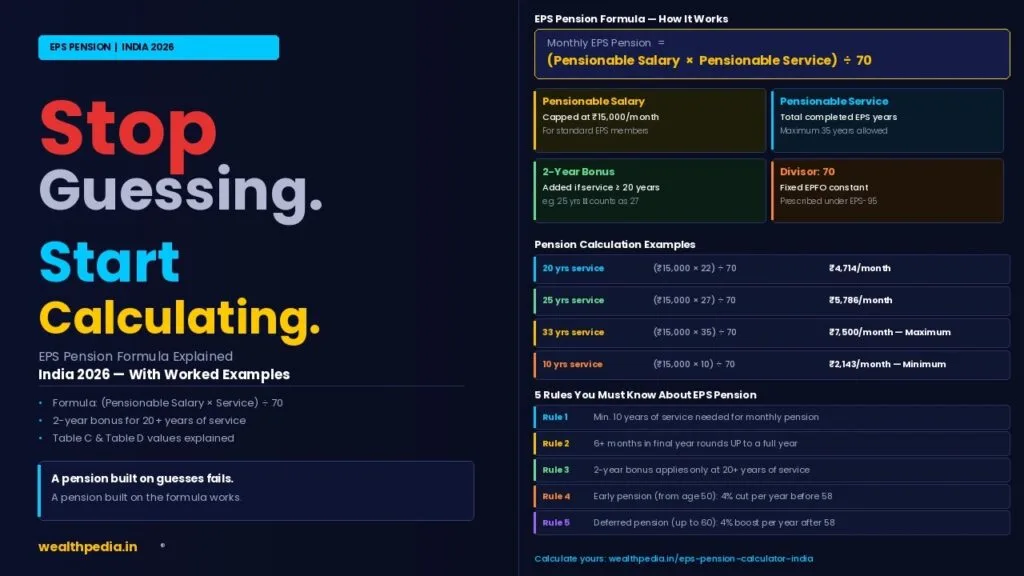
Family pension is calculated as a percentage of the member’s pension — which in turn is based on the EPS formula.
Step 1 — Calculate the Member’s Base Pension
Member’s Pension = (Pensionable Salary × Pensionable Service) ÷ 70
For members who died while in service with very short tenure, EPFO uses a notional pensionable service of at least 2 years for the calculation — ensuring the family receives a meaningful pension even for short-tenured employees.
Step 2 — Apply the Family Pension Percentage
Beneficiary Percentage of Member’s Pension Widow / Widower 50% Each child (up to 2) 25% Each orphan (up to 2) 75% Dependent parent 15%
Step 3 — Apply the Minimum Pension Floor
All family pension amounts are subject to the EPFO minimum pension guarantee of ₹1,000/month. If the calculated family pension is below ₹1,000, it is topped up to ₹1,000.
Family Pension Calculation Examples
Example 1 — Member with 25 Years Service Dies After Retirement
- Member’s pension: (15,000 × 27) ÷ 70 = ₹5,786/month
- Widow pension: 50% × ₹5,786 = ₹2,893/month for life
- Child pension (2 children under 25): 25% × ₹5,786 = ₹1,447/month each
- Total family pension: ₹2,893 + ₹1,447 + ₹1,447 = ₹5,787/month
Example 2 — Member with 10 Years Service Dies While in Service
- Member’s pension: (15,000 × 10) ÷ 70 = ₹2,143/month
- Widow pension: 50% × ₹2,143 = ₹1,072/month
- Child pension (1 child under 25): 25% × ₹2,143 = ₹536/month
- Total family pension: ₹1,072 + ₹536 = ₹1,608/month
Example 3 — Member Dies in Service on Day 1 (Notional Service Applied)
- Actual service: 1 day
- EPFO notional service applied: 2 years minimum
- Notional pension: (15,000 × 2) ÷ 70 = ₹429/month → floor applies → ₹1,000/month (minimum pension)
- Widow pension: 50% × ₹1,000 = ₹500/month → floor applies → ₹1,000/month
- The widow receives the minimum guaranteed pension of ₹1,000/month
Example 4 — Both Parents Deceased (Orphan Pension)
- Member’s pension: ₹4,714/month (20 years service)
- Both parents deceased — 2 children qualify as orphans
- Orphan pension per child: 75% × ₹4,714 = ₹3,536/month each
- Total orphan pension: ₹7,072/month across 2 children
Example 5 — Deferred Pension Member Dies After Filing
- Member deferred pension to age 60: ₹6,249/month (25 years service, 8% enhancement)
- Widow pension: 50% × ₹6,249 = ₹3,125/month
This demonstrates why deferring pension to age 60 also increases the widow pension — the 8% enhancement flows through to all family pension amounts. See Deferred EPS Pension After 58 for the full deferral analysis.
When Does Family Pension Start and Stop?
Widow / Widower Pension
Event Effect on Widow Pension Member’s death Pension starts from date of death Widow files Form 10D Pension credited from date of Form 10D submission Widow remarries Pension stops immediately — notify EPFO Widow dies Pension stops
Child Pension
Event Effect on Child Pension Member’s death Pension starts for eligible children Child turns 25 Pension stops for that child; next eligible child begins Child marriage No effect — child pension continues until age 25 Child death Pension stops for that child All children turn 25 Child pension ceases entirely
Orphan Pension
Event Effect Both parents die Orphan pension (75%) replaces child pension (25%) Guardian appointed Pension paid to guardian’s account for minor orphans Orphan turns 25 Pension stops (except permanently disabled orphans)
Widow Pension After Remarriage — What Happens to Children?
A common concern: if the widow remarries and loses her pension, do the children lose their pension too?
No. Child pension is completely independent of widow pension. If the widow remarries:
- Widow pension ceases
- Child pension continues at 25% per child until each child turns 25
- If the widow dies (regardless of remarriage), children may qualify for orphan pension
Special Rule — Death While in Service With No Pension Age Reached
If an EPS member dies while in service before reaching pension age (58), the normal service and salary conditions for pension are relaxed:
- No minimum service requirement — even 1 day of service qualifies
- Notional service of 2 years is used if actual service is less than 2 years
- Full pensionable salary at the time of death is used (capped at ₹15,000)
This special provision ensures that young employees with short tenures still provide meaningful pension protection to their families.
How to Claim EPS Family Pension — Form 10D
Family pension is claimed using Form 10D — the same form used by members for their own pension, filed in the name of the beneficiary (widow/child/orphan), not the deceased member.
Documents Required
For Widow / Widower Pension:
- Death certificate of the deceased member (original or attested copy)
- Marriage certificate (proof of relationship to the deceased)
- Bank account details of the widow/widower (must be in their own name)
- Aadhaar of the claiming spouse
- Copy of the deceased member’s UAN/EPF passbook (if available)
For Child Pension:
- Death certificate of the member
- Birth certificate of each child
- For minor children: guardian’s details and bank account
- For children above 18: enrollment proof (college) if still a student
- If orphan: death certificate of both parents
For Dependent Parent Pension:
- Death certificate of the member
- Proof of no surviving spouse or eligible children
- Dependency declaration from parents
- Parents’ Aadhaar and bank account details
Filing Process (Online)
Step 1: The claimant (widow/guardian) creates or activates a UAN-linked profile on the EPFO Member Portal using the deceased member’s UAN details. For family pension, the process typically requires visiting the regional EPFO office or working through the deceased employer’s HR.
Step 2: File Form 10D at the regional EPFO office (physical submission may be required for family pension cases with death certificates and relationship proof documents).
Step 3: EPFO verifies the death certificate, relationship documents, and service records.
Step 4: Pension Payment Order (PPO) is issued in the name of the widow/guardian/orphan.
Step 5: Monthly pension credited to the beneficiary’s seeded bank account.
Processing time: 15–30 working days for complete documentation. For delays or rejections, raise a grievance via EPFiGMS at epfigms.gov.in.
For a complete Form 10D filing guide see Form 10D Explained: How to Claim EPS Pension.
What If the Member Had No Nominee Registered?
EPFO uses the following priority order to determine the family pension beneficiary if no nominee was registered:
- Widow/widower
- Children (in order of age, youngest first for simultaneous benefit)
- Dependent parents
- If none of the above — the benefit lapses
It is strongly advisable for all EPS members to register nominees via the EPFO UAN portal (under E-Nomination) to avoid disputes and delays in family pension claim processing.
Family Pension and the Minimum Pension Floor
The ₹1,000/month EPFO minimum pension guarantee applies to all family pension beneficiaries individually:
- If widow pension calculated = ₹500/month → EPFO tops up to ₹1,000/month
- If child pension calculated = ₹300/month → EPFO tops up to ₹1,000/month
- Each beneficiary receives the minimum independently
This means even members with very short service or low pensionable salary provide meaningful minimum pension protection to their families. See What Is the Minimum EPS Pension in India? for the complete floor rules.
Is EPS Family Pension Taxable?
Yes. EPS family pension received by the widow/widower or children is taxable as “Income from Other Sources” under the Income Tax Act, added to the beneficiary’s total income at their applicable slab rate.
However, for most family pension beneficiaries:
- Widow pension at ₹2,893/month = ₹34,716/year — well within the basic exemption limit
- Child pension at ₹1,447/month = ₹17,364/year — below any taxable threshold
Most family pension recipients will pay little or no income tax on the pension income.
Key Differences — Member Pension vs Family Pension
Feature Member’s Own Pension Family Pension Minimum service required 10 years None (even 1 day qualifies) Minimum age required 50 (early) / 58 (standard) None — starts on member’s death Amount Full formula-based pension 50% / 25% / 75% of member’s pension Duration Lifetime of member Lifetime of widow / until child turns 25 Claimant Member Widow / guardian / children Form Form 10D (member files) Form 10D (family files) Minimum guarantee ₹1,000/month ₹1,000/month per beneficiary
EPS Family Pension — Quick Reference Summary
Beneficiary Rate Duration Minimum Notes Widow / Widower 50% of member’s pension Lifetime or until remarriage ₹1,000/month Stops on remarriage Each child 25% of member’s pension Until age 25 ₹1,000/month Max 2 simultaneous Each orphan 75% of member’s pension Until age 25 ₹1,000/month Both parents deceased Disabled child/orphan Same rates Lifetime ₹1,000/month Disability certified Dependent parent 15% of member’s pension Lifetime ₹1,000/month No other beneficiary
Frequently Asked Questions — EPS Family Pension
What is EPS family pension?
EPS family pension is a monthly survivor benefit paid by EPFO to the dependants of a deceased EPS member. The widow/widower receives 50% of the member’s pension, each eligible child receives 25% (up to 2 simultaneously, up to age 25), and orphans receive 75%. There is no minimum service requirement — even 1 day of EPS-covered service qualifies the family.
How much family pension does the wife get after husband’s death in EPS?
The widow receives 50% of the deceased member’s monthly pension. Example: If the member’s pension was ₹5,786/month, the widow receives ₹2,893/month for life (or until remarriage). The minimum is ₹1,000/month regardless of the calculated amount.
Is there a minimum service requirement for EPS family pension?
No. Family pension is payable regardless of how many years the member served. Even 1 day of EPS-covered employment qualifies the family for survivor pension. If service was very short (less than 2 years), EPFO uses a notional service of 2 years for the pension calculation.
How long does EPS family pension continue?
Widow pension continues for the widow’s lifetime, or until remarriage. Child pension continues until the child turns 25 (or for life for permanently disabled children). Orphan pension follows the same age rules as child pension.
Does EPS family pension stop if the widow remarries?
Yes. Widow pension ceases immediately upon remarriage. The widow must inform EPFO. Child pension for eligible children continues regardless of the widow’s remarriage.
What is the EPS family pension for a member who dies with 20 years of service?
Member’s pension = (15,000 × 22) ÷ 70 = ₹4,714/month. Widow pension = 50% × ₹4,714 = ₹2,357/month. Each child = 25% × ₹4,714 = ₹1,179/month (up to 2 children simultaneously).
What happens to EPS family pension if both parents die?
If both the EPS member and the spouse are deceased, the children qualify for orphan pension at 75% of the member’s pension per child (instead of 25%). The maximum simultaneous orphans is 2. Children over 25 are no longer eligible (except permanently disabled children).
How do I claim EPS family pension after my husband’s death?
File Form 10D at the regional EPFO office in your name (the widow), with the death certificate, marriage certificate, and your bank account details. The pension is credited to your bank account once the PPO is issued. Full process in Form 10D Explained.
Q9. Is there any age limit for EPS widow pension?
No age limit for the widow — the pension continues for her entire lifetime (or until remarriage), regardless of her age at the time of the member’s death. A widow who was 30 at the time of her husband’s death continues to receive pension until she dies or remarries.
What is the EPS family pension if the member had no service?
If the member was enrolled in EPS (even briefly) but died before completing any formal service period, EPFO uses a notional service of 2 years for the pension calculation. The resulting family pension amount, if below ₹1,000/month, is topped up to the ₹1,000 minimum floor.
Can two children receive EPS pension simultaneously?
Yes. Up to 2 eligible children can receive child pension simultaneously. The pension is paid to the 2 youngest eligible children at any given time. As each child turns 25 and exits, the next eligible sibling begins receiving pension.
What is the EPS pension for a child above 18?
Child pension continues until the child turns 25 — regardless of whether they are employed, married, or financially independent. The only condition is age (below 25) and being a legitimate child of the deceased member.
Does a divorced wife qualify for EPS family pension?
Under EPS-95, family pension is payable to the legally married widow/widower. A legally divorced spouse does not qualify as a widow/widower for EPS family pension purposes. Children from the divorced marriage, however, retain their eligibility for child pension.
What if the member’s nominee is different from the legal spouse?
In EPS, the family pension rules follow legal entitlement (widow/children), not the nominee designation. A nominee is relevant for EPF corpus withdrawal — not for EPS family pension. Even if the member nominated a different person, family pension goes to the legal widow/widower and children.
Does EPS family pension interact with any other government pension?
EPS family pension is independent of other government pensions. A widow who already receives a government pension (e.g., from her own employment) can still receive EPS family pension from her deceased husband’s EPS account. There is no means-test or income limit for EPS family pension.
What is the EPS pension for the family of a member who died at age 35 with 5 years of service?
Service = 5 years. Since 5 < 10 years, the member normally would not qualify for monthly pension — but death in service overrides this. EPFO uses the actual service (5 years) or the 2-year notional minimum, whichever is higher. Member’s notional pension = (15,000 × 5) ÷ 70 = ₹1,071/month. Widow pension = 50% × ₹1,071 = ₹536/month → floor applies → ₹1,000/month.
What is the EPS family pension for a member with maximum pension (₹7,500/month)?
Widow pension = 50% × ₹7,500 = ₹3,750/month. Each child = 25% × ₹7,500 = ₹1,875/month. Each orphan = 75% × ₹7,500 = ₹5,625/month.
What if the member had deferred pension to 60 — does the family get the enhanced amount?
Yes. If the member had received PPO for deferred pension (e.g., ₹6,249/month at age 60), the family pension is based on the enhanced amount. Widow pension = 50% × ₹6,249 = ₹3,125/month — higher than the ₹2,893 they would receive if the member had claimed at 58. See Deferred EPS Pension After 58.
Can a physically challenged child above 25 receive EPS family pension?
Yes. Permanently disabled children are exempt from the age-25 cutoff and receive family pension for their lifetime. The disability must be certified by a medical board and documented with EPFO. The pension rate is the same as standard child pension (25% of member’s pension).
Is EPS family pension affected by the EPF withdrawal by the family?
No. EPF (provident fund) and EPS (pension) are completely separate funds. The family can withdraw the full EPF corpus via Form 20 and simultaneously receive EPS family pension — one does not affect the other.
What happens to EPS family pension if the child gets adopted after the member’s death?
Adopted children may qualify for child pension under EPS if the adoption occurred before the member’s death and is legally recognised. Adoptions after the member’s death typically do not qualify. Consult your regional EPFO office for specific cases.
How does EPFO calculate the base pension for a member who died with 3 years of service?
Since 3 years is above the 2-year notional minimum, EPFO uses the actual 3-year service: Member’s pension = (15,000 × 3) ÷ 70 = ₹643/month → floor of ₹1,000/month applies. Widow pension = 50% × ₹1,000 = ₹500/month → each beneficiary’s ₹1,000 floor applies separately → widow receives ₹1,000/month.
What is the EPS family pension for a member who took early pension at 50?
If the member claimed early pension (with reduction) and then died, family pension is based on the reduced early pension amount — not the original base pension. Example: Member claimed at 50 with ₹3,934/month (32% reduction on ₹5,786 base). Widow pension = 50% × ₹3,934 = ₹1,967/month — not 50% of ₹5,786. This is a key reason to avoid early pension if the surviving spouse is significantly younger.
My husband died 5 years ago and I did not know about EPS family pension. Can I still claim?
Yes. There is no time limit for claiming EPS family pension. However, pension is paid only from the date of Form 10D submission — not retroactively to the date of death. File immediately. All arrears from the submission date to the first credit will be paid as a lump sum, but years of unclaimed pension before filing cannot be recovered.
Where can I compute the EPS family pension my family would receive?
Use the free EPS Pension Calculator India on Wealthpedia. It calculates the member’s base pension, which you can then apply the 50%/25%/75% family pension percentages to — giving you an accurate picture of the family pension your dependants would receive. For personalised guidance on filing, visit your nearest EPFO office.
Disclaimer: The information on this page is for educational purposes only and does not constitute investment or financial advice. EPS rules are governed by EPFO regulations under EPS-95 and may be updated by the Government of India. For personalised guidance, consult a SEBI-registered financial planner or visit your nearest EPFO office. Wealthpedia™ (Trademark Reg. No. 4910385) is not a SEBI-registered investment advisor. All mutual fund references on this site are for Direct Plan, Growth option only.

Vishal Jhaveri is the founder of Wealthpedia and an MBA Finance professional with over 10 years of experience in financial planning, investing, and wealth creation. He specializes in FIRE (Financial Independence, Retire Early), retirement planning, investing, and personal finance education. Through Wealthpedia, he develops financial calculators and publishes evidence-based content to help Indian investors make informed financial decisions. He regularly reviews and updates Wealthpedia articles to reflect changes in tax, laws, investment regulations, and personal finance best practices.
Quick Wrap up