
For most EPF-covered employees in India, the maximum monthly EPS pension is ₹7,500 — determined by the ₹15,000 wage ceiling and 35 years maximum pensionable service. But a subset of higher-income employees had access to a fundamentally different pension calculation — the EPS Higher Pension Scheme (HPS) — that removed the salary ceiling entirely and calculated pension on actual salary.
The HPS was the subject of a landmark Supreme Court ruling in 2022 and a series of EPFO circulars that followed. For employees who qualified and applied before the deadline, the HPS can result in pensions of ₹15,000–₹50,000+ per month. For those who did not apply in time, understanding the HPS is still important — both to understand why their pension is capped at ₹7,500 and to be aware of any future policy developments.
This guide explains the HPS eligibility conditions, the calculation methodology with worked examples, the contribution shortfall mechanics, and how to compare HPS against standard EPS pension.
Use the EPS Pension Calculator India to compute your standard EPS pension as a baseline — the HPS pension uses the same formula with a higher pensionable salary input.
Quick Summary
The EPS Higher Pension Scheme (HPS) allows eligible EPFO members to receive monthly pension based on their actual salary instead of the standard ₹15,000 wage ceiling — dramatically increasing the pension amount. Eligibility was limited to members who were EPFO contributors before November 1, 2022 and whose employers contributed on actual salary above ₹15,000. Approved members must deposit a lump-sum contribution shortfall with interest. This article explains HPS eligibility conditions, the calculation methodology, contribution shortfall computation, worked examples at different salary levels, and how HPS compares with standard EPS pension. Use the EPS Pension Calculator India to compute your standard pension as a baseline comparison.
What Is the EPS Higher Pension Scheme?
The EPS Higher Pension Scheme (HPS) is a provision under EPS-95 that allows eligible members to have their EPS pension calculated on their actual basic salary + DA, rather than the standard ₹15,000 wage ceiling.
Under standard EPS:
- Pensionable Salary is capped at ₹15,000/month
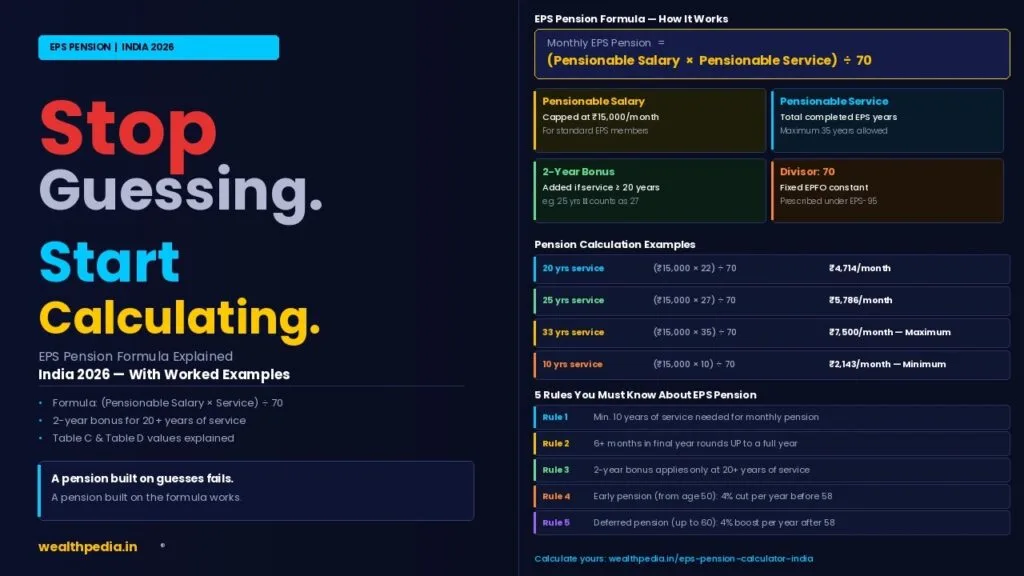
- Maximum pension = (15,000 × 35) ÷ 70 = ₹7,500/month
Under HPS:
- Pensionable Salary = average of actual basic + DA over the last 60 months before retirement
- No ceiling — pension proportional to actual salary
- Example at ₹60,000 average salary, 30 years service: (60,000 × 32) ÷ 70 = ₹27,429/month
The same pension formula applies — (Pensionable Salary × Pensionable Service) ÷ 70 — only the pensionable salary input changes.
Background — The Supreme Court Ruling and Eligibility Window
The HPS has a complex legal and regulatory history:
- Pre-2014: Before September 2014, EPFO allowed employers to contribute on actual salary (above the then-₹6,500 ceiling) if the employee and employer jointly opted in. Many large employers did this.
- September 2014: EPFO raised the ceiling to ₹15,000 and effectively ended new higher-pension contributions. Many employees who had been contributing on actual salary lost the ability to continue.
- November 2022 Supreme Court ruling: The Supreme Court of India upheld the right of employees who had been contributing on actual salary before September 2014 to opt for higher pension under EPS. EPFO was directed to give these members a fresh opportunity to apply.
- EPFO circular (February–May 2023): EPFO opened an online application window for eligible members to apply jointly with their employers for HPS membership.
- Application deadline: EPFO set a deadline for applications. The window has now closed. Members who applied and received approval are on the HPS track; those who did not apply remain on standard EPS (₹15,000 ceiling).
HPS Eligibility Conditions
To have been eligible for the Higher Pension Scheme, all of the following must have been true:
Condition 1 — EPFO Member Before November 1, 2022
The employee must have been an active EPS-95 member as of November 1, 2022. New members who joined EPF after this date are not eligible for HPS.
Condition 2 — Employer Contributed on Actual Salary
The employer must have been making EPF/EPS contributions on the employee’s actual basic + DA (above ₹15,000) rather than on the ₹15,000 ceiling. This typically applied to:
- Large private sector companies that opted in before 2014
- PSUs and certain government-owned companies
- Companies with collective bargaining agreements that included higher contributions
Employees whose employers always contributed on the ₹15,000 ceiling (which is the majority of EPF-covered employers) were not eligible for HPS even if their salary was above ₹15,000.
Condition 3 — Joint Application Before Deadline
Both the employee and the employer had to file a joint application via the EPFO online portal before the specified deadline. Individual applications without employer support were not accepted.
Condition 4 — Contribution Shortfall Deposit
Approved HPS members must deposit the contribution shortfall — the additional EPS contributions that should have been made on the higher salary (above ₹15,000) over all past years, with interest. This is a lump-sum payment to EPFO.
What Is the Contribution Shortfall?
Under standard EPS, the employer contributes 8.33% on ₹15,000 = ₹1,250/month. Under HPS, the contribution should have been 8.33% on the actual salary.
Contribution shortfall per month = 8.33% × (Actual Salary − ₹15,000)
For an employee earning ₹50,000/month:
- Standard contribution: 8.33% × ₹15,000 = ₹1,250/month
- HPS contribution: 8.33% × ₹50,000 = ₹4,165/month
- Monthly shortfall: ₹4,165 − ₹1,250 = ₹2,915/month
This shortfall must be deposited for all past years since the date when the employer started contributing on actual salary, with interest at EPFO’s prescribed rate (8.25% p.a. compounded annually).
For an employee who had higher contributions for 20 years, the total shortfall deposit can run into several lakhs to tens of lakhs of rupees — making the HPS cost-benefit analysis critical before applying.
HPS Pension Calculation — The Formula
The HPS pension uses the exact same formula as standard EPS:
Monthly HPS Pension = (Pensionable Salary × Pensionable Service) ÷ 70
The only difference is in Pensionable Salary:
- Standard EPS: Pensionable Salary = ₹15,000 (ceiling)
- HPS: Pensionable Salary = Average of actual basic + DA over the last 60 months before retirement
The pensionable service rules (2-year bonus, maximum 35 years, partial-year rounding) remain identical. For the full formula breakdown, see EPS Pension Formula Explained.
HPS Pension Worked Examples
Example 1 — ₹40,000 Average Salary, 25 Years Service
- Pensionable Salary: ₹40,000 (60-month average)
- Actual Service: 25 years → Pensionable Service: 27 years (with 2-year bonus)
- HPS Pension = (40,000 × 27) ÷ 70 = ₹15,429/month
- Standard EPS Pension: (15,000 × 27) ÷ 70 = ₹5,786/month
- HPS advantage: +₹9,643/month (+166%)
Example 2 — ₹60,000 Average Salary, 30 Years Service
- Pensionable Salary: ₹60,000
- Actual Service: 30 years → Pensionable Service: 32 years (with bonus)
- HPS Pension = (60,000 × 32) ÷ 70 = ₹27,429/month
- Standard EPS Pension: (15,000 × 32) ÷ 70 = ₹6,857/month
- HPS advantage: +₹20,572/month (+300%)
Example 3 — ₹80,000 Average Salary, 33 Years Service
- Pensionable Salary: ₹80,000
- Actual Service: 33 years → Pensionable Service: 35 years (maximum)
- HPS Pension = (80,000 × 35) ÷ 70 = ₹40,000/month
- Standard EPS Pension: ₹7,500/month (maximum standard)
- HPS advantage: +₹32,500/month (+433%)
Example 4 — ₹1,00,000 Average Salary, 28 Years Service
- Pensionable Salary: ₹1,00,000
- Actual Service: 28 years → Pensionable Service: 30 years (with bonus)
- HPS Pension = (1,00,000 × 30) ÷ 70 = ₹42,857/month
- Standard EPS Pension: (15,000 × 30) ÷ 70 = ₹6,429/month
- HPS advantage: +₹36,428/month
HPS Pension Comparison Table
| Average Salary (Last 60 Months) | Service | Pensionable Service | HPS Pension | Standard Pension | Monthly Advantage |
|---|---|---|---|---|---|
| ₹25,000 | 20 yrs | 22 yrs | ₹7,857 | ₹4,714 | +₹3,143 |
| ₹40,000 | 25 yrs | 27 yrs | ₹15,429 | ₹5,786 | +₹9,643 |
| ₹60,000 | 30 yrs | 32 yrs | ₹27,429 | ₹6,857 | +₹20,572 |
| ₹80,000 | 33 yrs | 35 yrs | ₹40,000 | ₹7,500 | +₹32,500 |
| ₹1,00,000 | 28 yrs | 30 yrs | ₹42,857 | ₹6,429 | +₹36,428 |
HPS Cost-Benefit Analysis — Is the Shortfall Worth It?
The HPS pension is significantly higher than standard EPS — but the lump-sum shortfall deposit can be substantial. Here is a structured analysis for a typical case:
Case: ₹60,000 Current Salary, 20 Years of Higher Contributions
Monthly shortfall per month:
8.33% × (₹60,000 − ₹15,000) = 8.33% × ₹45,000 = ₹3,749/month
Total shortfall over 20 years (240 months):
₹3,749 × 240 = ₹8,99,760 (principal only)
With compound interest at 8.25% p.a. for 20 years:
Approximately ₹21–25 lakh total shortfall deposit
HPS pension benefit:
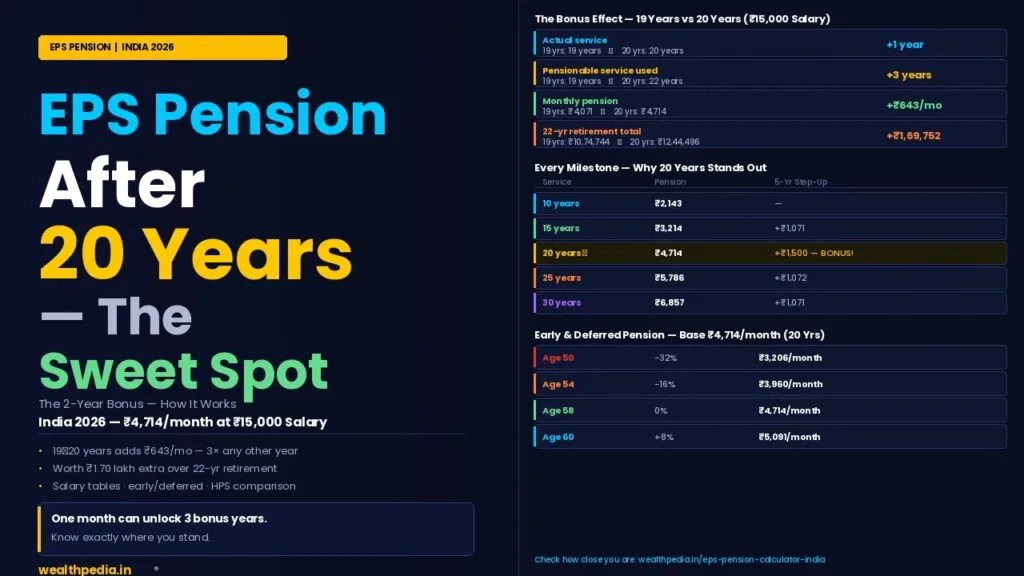
- Standard pension at 30 years: ₹6,857/month
- HPS pension: ₹27,429/month
- Monthly gain: ₹20,572/month
- Annual gain: ₹2,46,864/year
- Break-even on shortfall deposit: ₹25,00,000 ÷ ₹20,572/month = 121 months ≈ 10 years
At 68 years of age (10 years after standard retirement at 58), the HPS delivers more cumulative value than the deposit cost. For a member with average longevity (78–80), the HPS delivers ₹4–5 lakh more in net lifetime pension value over the shortfall cost.
Verdict: For most employees with 20+ years of higher contributions and moderate-to-good health, HPS is financially advantageous. The break-even is approximately 10 years of pension receipt.
HPS and the Pensionable Salary Definition
Under HPS, pensionable salary is defined as:
Average of actual basic + DA over the last 60 months of EPS-covered service before retirement
Key points:
- It is an average — not the last month’s salary
- Only basic + DA counts — allowances (HRA, conveyance, etc.) are excluded
- If salary fluctuated, the 60-month average smooths out spikes
- For members who retired before completing HPS verification, EPFO may use available salary records
HPS and Widow / Family Pension
Like standard EPS pension, HPS pension also generates family pension on the member’s death:
- Widow pension: 50% of HPS monthly pension
- Child pension: 25% per child (up to 2, up to age 25)
- Orphan pension: 75% per orphan
For a member with HPS pension of ₹27,429/month:
- Widow pension = 50% × ₹27,429 = ₹13,715/month for life
- Child pension = 25% × ₹27,429 = ₹6,857/month per child
This is substantially higher than standard EPS family pension (₹3,750 widow, ₹1,875 child at maximum standard pension). For employees with dependent spouses, the HPS family pension advantage compounds significantly over the surviving spouse’s lifetime.
For the complete family pension rules, see EPS Family Pension Rules Explained.
HPS vs Standard EPS — Side-by-Side Comparison
| Feature | Standard EPS | Higher Pension Scheme (HPS) |
|---|---|---|
| Pensionable Salary | ₹15,000 (ceiling) | Actual salary (60-month average) |
| Maximum Pension | ₹7,500/month | No ceiling — proportional to salary |
| Eligibility | All EPS members | Pre-Nov 2022 members with higher contributions |
| Application required | No — automatic | Yes — joint employee + employer application |
| Lump-sum deposit needed | No | Yes — contribution shortfall with interest |
| Widow pension | Up to ₹3,750/month | Proportional — can be ₹15,000+ per month |
| Formula | Same | Same |
| Service rules | Same | Same |
How to Check If Your HPS Application Was Approved
For members who applied for HPS before the deadline:
- EPFO Member Portal: Log in at unifiedportal-mem.epfindia.gov.in → Check your member profile for HPS status indicators
- EPFO Grievance Portal: If status is unclear, raise a query via EPFiGMS at epfigms.gov.in with your UAN and application reference number
- Regional EPFO Office: Visit your regional office with UAN, application acknowledgment, and employer’s confirmation letter
For members who did not apply before the deadline:
- You remain on standard EPS (₹15,000 ceiling)
- Monitor EPFO communications for any future reopening of the HPS application window
- Your standard EPS pension is still calculated using the standard formula — see EPS Pension Formula Explained and EPS Pension Rules 2026
Frequently Asked Questions — EPS Higher Pension Scheme
What is the EPS Higher Pension Scheme?
The EPS Higher Pension Scheme (HPS) allows eligible EPFO members to receive monthly pension based on their actual salary (60-month average) instead of the ₹15,000 wage ceiling. The same formula applies — (Pensionable Salary × Pensionable Service) ÷ 70 — but with actual salary instead of ₹15,000, resulting in dramatically higher pensions for high earners.
Who is eligible for the EPS Higher Pension Scheme?
Eligibility required: (1) EPFO membership before November 1, 2022; (2) employer contributing on actual salary above ₹15,000; (3) joint application by employee and employer before EPFO’s deadline; and (4) deposit of contribution shortfall with interest. The application window has closed.
What is the maximum pension under the Higher Pension Scheme?
There is no fixed maximum under HPS. Pension is proportional to actual salary and service. For a member with ₹1,00,000 average salary and 28 years of service: HPS pension = (1,00,000 × 30) ÷ 70 = ₹42,857/month. High earners with long service can receive even more.
How is HPS pension different from standard EPS pension?
Only the pensionable salary differs. Standard EPS uses ₹15,000 (ceiling); HPS uses the actual 60-month average salary. The formula, service rules, 2-year bonus, and early/deferred pension rules are identical. See EPS Pension Formula Explained.
What is the contribution shortfall in HPS?
The shortfall is the additional EPS contributions that should have been made on the actual salary above ₹15,000, for all past years, with compound interest. For an employee earning ₹60,000 with 20 years of higher contributions, the shortfall can be ₹20–25 lakh.
Is the HPS application window still open?
No. EPFO’s application window for the Higher Pension Scheme has closed. Members who did not apply in time remain on standard EPS. Monitor EPFO’s official website (epfindia.gov.in) for any announcements of reopening.
What is the EPS pension for ₹50,000 salary under HPS with 25 years of service?
Pensionable Salary = ₹50,000. Pensionable Service = 25 + 2 bonus = 27 years. HPS Pension = (50,000 × 27) ÷ 70 = ₹19,286/month vs standard EPS of ₹5,786/month.
Does HPS affect family pension?
Yes. Family pension is a percentage of the member’s pension. With HPS pension of ₹27,429/month, widow pension = ₹13,715/month — vs ₹3,429/month under standard EPS for the same service. See EPS Family Pension Rules.
Can I still benefit from HPS if I did not apply?
No — for the current scheme. The application window has closed. Members who did not apply remain on standard EPS pension calculated on the ₹15,000 ceiling. Future policy developments may create another opportunity — follow EPFO notifications.
How is the 60-month average salary calculated for HPS?
EPFO averages the member’s actual basic + DA over the last 60 months (5 years) of EPS-covered service before retirement. Allowances (HRA, conveyance, special pay) are excluded. If the salary changed significantly in the last 5 years, the average reflects the career-end trajectory rather than the entire career average.
What happens to the contribution shortfall if the member dies before retirement?
If an HPS-approved member dies before retirement, family pension is calculated on the HPS pensionable salary. The contribution shortfall already deposited is not refunded — it becomes the basis for the higher family pension. Consult EPFO for specific cases where the shortfall was not fully deposited.
Is HPS pension taxable?
Yes. HPS pension is taxable as “Income from Other Sources” — same as standard EPS pension. However, HPS pension amounts (₹15,000–₹40,000+/month) result in annual pension income of ₹1.8L–₹4.8L+, which is likely taxable at the applicable slab rate for most HPS recipients.
Can I compute my HPS pension using the EPS Pension Calculator?
The standard EPS Pension Calculator India calculates standard EPS pension. For HPS, use the same formula manually: (60-month average actual salary × Pensionable Service with bonus) ÷ 70. The calculator’s standard output provides the baseline comparison.
What is the HPS pension for ₹75,000 salary, 20 years of service?
Pensionable Salary = ₹75,000. Pensionable Service = 20 + 2 bonus = 22 years. HPS Pension = (75,000 × 22) ÷ 70 = ₹23,571/month vs standard ₹4,714/month.
Does the early and deferred pension rule apply to HPS?
Yes. The 4% per year reduction for early pension (below 58) and the 4% per year enhancement for deferred pension (above 58) apply to HPS pension exactly as for standard EPS. The enhanced or reduced amounts are calculated on the HPS base pension.
What if my employer contributed on actual salary but I was not aware of HPS?
If your employer was making higher EPS contributions (on actual salary) and you did not apply for HPS, you may have missed the application window. Your standard EPS pension uses the ₹15,000 ceiling. The excess contributions made on the higher salary were credited to EPFO’s pooled pension fund — they are not refundable as a lump sum.
How does the 2-year service bonus apply under HPS?
Exactly the same as standard EPS. If total pensionable service is 20+ years, 2 bonus years are added before applying the formula. The only difference is the pensionable salary input. Example: ₹60,000 salary, 25 years service → Pensionable Service = 27 years → HPS Pension = (60,000 × 27) ÷ 70 = ₹23,143/month.
Is there a HPS pension for employees in exempted establishments?
Yes. Employees in exempted EPF trusts where EPS contributions were made to EPFO’s central pool on actual salary were eligible for HPS, subject to the same eligibility conditions. The pension calculation methodology is the same.
What is the break-even period for the HPS contribution shortfall?
For a typical case (₹60,000 salary, 20 years contributions above ₹15,000), the shortfall is approximately ₹21–25 lakh and the monthly pension gain is ₹20,572/month. Break-even ≈ 10 years of pension receipt (at approximately age 68). For members with expected longevity to 78+, HPS is strongly positive on a net basis.
Can the HPS shortfall be paid in instalments?
EPFO’s standard position requires full payment of the contribution shortfall before HPS benefits are activated. Some special provisions for deduction from accumulated EPF corpus exist in certain cases — consult your regional EPFO office for your specific situation.
What is the HPS pension at age 60 (deferred) for ₹50,000 salary, 30 years service?
Pensionable Service = 30 + 2 bonus = 32 years. Base HPS Pension = (50,000 × 32) ÷ 70 = ₹22,857/month. Deferred to 60 (+8%): ₹22,857 × 1.08 = ₹24,686/month.
Does the minimum pension floor (₹1,000/month) apply to HPS pension?
Yes, technically — but in practice HPS pensions are always substantially above ₹1,000/month given the higher salary base. The floor is irrelevant for HPS recipients.
Is there a difference between HPS and the old “exempted employee” EPS provision?
HPS is specifically about pension calculation on actual salary for non-exempted EPS members. Separately, some employees in “exempted” provident fund trusts had their own higher-contribution structures. These are related but distinct provisions — if you were in an exempted trust, consult EPFO for how HPS applies to your case.
What happens to EPS if the HPS application is rejected by EPFO?
If EPFO rejects the HPS application, the member continues on standard EPS (₹15,000 ceiling). The rejection may be appealed — consult the regional EPFO office or file a grievance via EPFiGMS. Past higher contributions made on actual salary remain in the pooled pension fund and are not refunded.
Where can I read the official EPFO notifications on the Higher Pension Scheme?
Official EPFO circulars and notifications are available at epfindia.gov.in under the “What’s New” and “Circulars” sections. For updates on any future reopening of the HPS application window, monitor this page regularly or check with your HR department.
Disclaimer: The information on this page is for educational purposes only and does not constitute investment or financial advice. HPS rules and application windows are governed by EPFO regulations and Supreme Court directives and may be updated by the Government of India. For personalised guidance, consult a SEBI-registered financial planner or visit your nearest EPFO office. Wealthpedia™ (Trademark Reg. No. 4910385) is not a SEBI-registered investment advisor. All mutual fund references on this site are for Direct Plan, Growth option only.

Vishal Jhaveri is the founder of Wealthpedia and an MBA Finance professional with over 10 years of experience in financial planning, investing, and wealth creation. He specializes in FIRE (Financial Independence, Retire Early), retirement planning, investing, and personal finance education. Through Wealthpedia, he develops financial calculators and publishes evidence-based content to help Indian investors make informed financial decisions. He regularly reviews and updates Wealthpedia articles to reflect changes in tax, laws, investment regulations, and personal finance best practices.
Quick Wrap up