
The Employees’ Pension Scheme, commonly known as EPS or EPS-95, is one of the most consequential retirement benefit programmes for India’s organised sector workforce — yet it remains deeply misunderstood. Most EPF-covered employees know they contribute to “EPF and pension” but have little clarity on the specific rules that determine their pension amount, eligibility conditions, and claim process.
This is the definitive guide to EPS pension rules as they stand in 2026. Every rule is explained in plain language with examples, cross-referenced to the relevant EPFO circulars and EPS-95 provisions where applicable. Use the EPS Pension Calculator India to apply any of these rules to your personal situation and compute your exact pension estimate.
Quick Summary
The Employees’ Pension Scheme (EPS-95) is governed by a specific set of rules that determine who qualifies, how much they receive, when they can claim, and what happens to the pension after death. Key rules include: 10 years minimum service for monthly pension, ₹15,000 wage ceiling on pensionable salary, the (Pensionable Salary × Pensionable Service) ÷ 70 formula, a 2-year bonus for 20+ years of service, maximum pension of ₹7,500/month, and early pension from age 50 with a 4% annual reduction. This complete guide covers every EPS pension rule in force for 2026. Verify your pension using the EPS Pension Calculator India.
Rule 1 — Who EPS Applies To
EPS applies to all employees in establishments covered under the Employees’ Provident Funds and Miscellaneous Provisions Act, 1952, who earn a basic salary + DA of up to ₹15,000 per month.
More specifically, EPS membership is mandatory for:
- All employees in EPF-covered establishments (20 or more employees in most industries)
- Employees whose basic + DA is ₹15,000 or below at the time of joining
- Employees who join the organisation before completing 58 years of age
Employees earning above ₹15,000/month at the time of joining have the option to become “excluded employees” and opt out of EPS — though their employer must still contribute 8.33% to EPS on the ₹15,000 ceiling if they opt in. In practice, most salaried employees in India are automatically enrolled in EPS through their EPF registration.
Government employees, autonomous bodies under state/central governments, and certain exempted establishments have their own pension arrangements and are not covered under EPS-95.
Rule 2 — Contribution Rules
The employee contributes nothing directly to EPS. The employer contributes 8.33% of the employee’s basic + DA (capped at ₹15,000) to EPS every month.
The full 12% employee contribution goes into the EPF account. Of the employer’s 12%, it splits as: Employer Contribution Component Percentage Goes To EPF contribution 3.67% of Basic+DA Employee’s EPF account EPS contribution 8.33% of Basic+DA EPFO’s pooled pension fund
The EPS contribution is capped at 8.33% of ₹15,000 = ₹1,250/month for standard members. This amount goes into EPFO’s central pension pool — it does not accumulate in a personal account earning interest. This is why the EPS pension is formula-based rather than corpus-based.
For a detailed breakdown of how EPF and EPS contributions differ, see EPF vs EPS: Key Differences Explained.
Rule 3 — Minimum Service for Pension Eligibility
You must complete a minimum of 10 years of EPS-covered pensionable service to qualify for a monthly pension under EPS.
This is the single most important rule in EPS. Below 10 years:
- No monthly pension is payable
- You receive a Table D lump-sum withdrawal benefit (or a Scheme Certificate)
At exactly 10 years:
- Monthly pension = (Pensionable Salary × 10) ÷ 70 = ₹2,143/month at ₹15,000 salary
The 10-year minimum counts cumulative service across all EPF-covered employers, provided the EPS accounts were transferred correctly via UAN. See EPS Pension Eligibility Rules for the complete eligibility conditions.
Rule 4 — The Pensionable Salary Rule
Pensionable salary under EPS is capped at ₹15,000 per month for most members.
This ₹15,000 ceiling has been in effect since September 1, 2014. Before that date, the ceiling was ₹6,500/month. The cap applies regardless of the employee’s actual salary.
What Counts as Pensionable Salary
- Only basic salary + Dearness Allowance (DA) counts
- HRA, conveyance, special allowance, and other components are excluded
- If actual basic+DA is below ₹15,000 → the actual amount is used
- If actual basic+DA is ₹15,000 or above → ₹15,000 is used
Exception — Higher Pension Scheme
Members who applied for and received EPFO approval under the Higher Pension Scheme use the average actual salary over the last 60 months before retirement as their pensionable salary — removing the ₹15,000 ceiling entirely. See EPS Higher Pension Scheme: Eligibility & Calculation for details.
For a dedicated breakdown of this rule, see What Is Pensionable Salary Under EPS?
Rule 5 — The Pensionable Service Rule
Pensionable service is the total number of completed years of EPS contribution, with partial years rounded using the 6-month rule.
How EPFO Counts Service
- Count the total months of EPS contribution across your career
- Convert to years and months
- If months in the final partial year are 6 or more → round up to 1 full year
- If months in the final partial year are less than 6 → drop (ignored)
Maximum Service
EPFO recognises a maximum of 35 years of pensionable service. Service beyond 35 years does not increase the pension further.
For the complete rules on how service is counted, see What Is Pensionable Service Under EPS?
Rule 6 — The Pension Formula
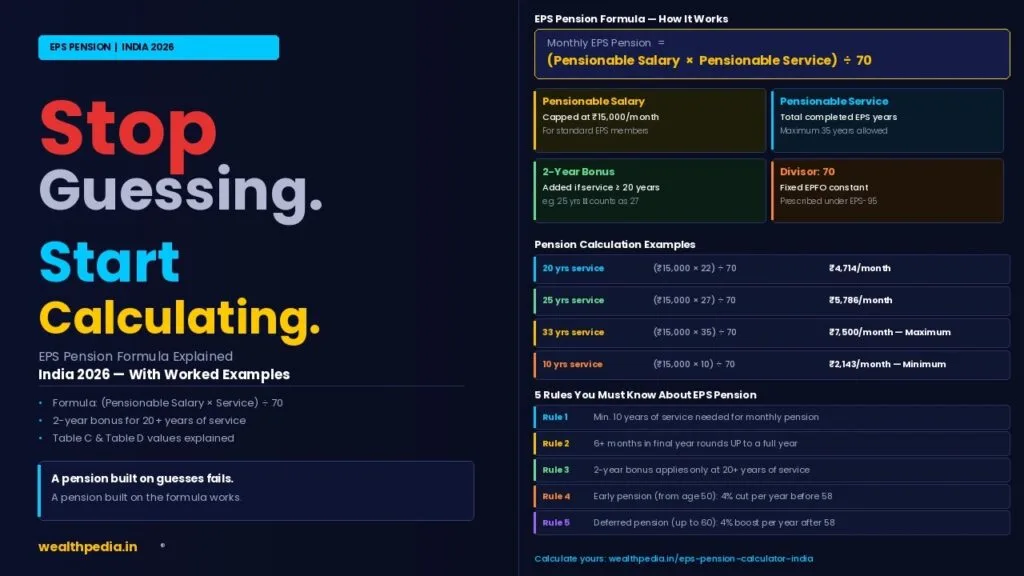
Monthly EPS Pension = (Pensionable Salary × Pensionable Service) ÷ 70
This formula is prescribed under EPS-95 and applies to all standard EPS members. The divisor of 70 is a fixed constant — it does not change based on age, industry, or any other variable.
| Service Years | Pensionable Service (after bonus) | Monthly Pension at ₹15,000 (₹) |
|---|---|---|
| 10 | 10 | 2,143 |
| 15 | 15 | 3,214 |
| 20 | 22 | 4,714 |
| 25 | 27 | 5,786 |
| 30 | 32 | 6,857 |
| 33 | 35 (max) | 7,500 |
For the complete formula explanation with all worked examples, see EPS Pension Formula Explained.
Rule 7 — The 2-Year Service Bonus Rule
If your total pensionable service is 20 years or more, EPFO adds 2 bonus years to your pensionable service before applying the formula.
- 19 years actual → 19 years in formula (no bonus)
- 20 years actual → 22 years in formula (20 + 2 bonus)
- 25 years actual → 27 years in formula (25 + 2 bonus)
- 33 years actual → 35 years in formula (capped at maximum)
This bonus adds a minimum of ₹429/month (2 years × ₹15,000 ÷ 70) to the pension for any member who crosses 20 years. Over a 22-year retirement, that is over ₹1.13 lakh in additional lifetime pension income — generated purely by the 2-year bonus rule.
Rule 8 — Standard Retirement Age (Age 58)
The standard retirement age under EPS is 58 years. Monthly pension is normally payable from this age.
Key conditions at standard retirement:
- Member must have completed minimum 10 years of pensionable service
- Member must have attained age 58
- Member must not be in employment at any EPF-covered establishment when drawing pension
- Pension is claimed by filing Form 10D with the regional EPFO office
Rule 9 — Early Pension Rule (Age 50–57)
EPS members can claim a reduced pension from age 50, with a 4% reduction applied for each year the claim is made before age 58.
Early Pension = Base Pension × (1 − 0.04 × years before 58)
| Claim Age | Reduction (%) | Pension at ₹15,000 Salary, 25 Years Service (₹/month) |
|---|---|---|
| 58 | 0% | 5,786 |
| 56 | 8% | 5,323 |
| 54 | 16% | 4,860 |
| 52 | 24% | 4,397 |
| 50 | 32% | 3,934 |
The early pension reduction is permanent — it applies for the entire duration of the pension and cannot be reversed. Members must also not be in EPF-covered employment while drawing early pension. Full details in EPS Early Pension Before 58: Reduction Rules Explained.
Rule 10 — Deferred Pension Rule (Age 59–60)
EPS members can defer their pension claim beyond age 58 to receive a higher pension, with a 4% enhancement per year of deferment, up to a maximum of age 60.
Deferred Pension = Base Pension × (1 + 0.04 × years after 58)
- Claimed at 59 → Base Pension × 1.04
- Claimed at 60 → Base Pension × 1.08 (maximum enhancement of 8%)
Full details and break-even analysis in Deferred EPS Pension After 58: Benefits Explained.
Rule 11 — Maximum Pension Rule
The maximum monthly EPS pension under the standard formula is ₹7,500 per month.
This maximum is reached when:
- Pensionable Salary = ₹15,000 (the ceiling)
- Actual service = 33 years (which becomes 35 with the 2-year bonus)
- Formula: (15,000 × 35) ÷ 70 = ₹7,500/month
Any service beyond 33 years delivers no additional pension since the 35-year cap is already reached. Under the Higher Pension Scheme, there is no maximum — pension is proportional to actual salary and service.
Rule 12 — Minimum Pension Rule
EPFO guarantees a minimum monthly pension of ₹1,000 to all qualifying EPS members, regardless of their formula-based calculation.
This means if your formula-based pension works out to less than ₹1,000 — due to very low pensionable salary or short service — EPFO tops it up to ₹1,000/month. The Central Government funds this top-up. Full details in What Is the Minimum EPS Pension in India?
Rule 13 — Withdrawal Before 10 Years Rule
If you leave employment before completing 10 years of EPS-covered service, you are eligible for a lump-sum withdrawal benefit calculated using Table D factors.
- Filed via Form 10C on the EPFO UAN portal
- Requires a minimum 2-month waiting period after leaving employment
- Alternative to withdrawal: Scheme Certificate — preserves service for future employer
Years of Service Table D Factor Benefit at ₹15,000 5 5.28 ₹79,200 7 7.46 ₹1,11,900 9 9.72 ₹1,45,800
For the complete Table D and comparison with Scheme Certificate, see EPS Withdrawal Benefit Calculator and Scheme Certificate vs EPS Withdrawal.
Rule 14 — Scheme Certificate Rule
An EPS member with fewer than 10 years of service who leaves employment can apply for a Scheme Certificate instead of the withdrawal benefit, preserving their EPS service for a future employer.
- Applied via Form 10C (select Scheme Certificate)
- Can be surrendered for withdrawal benefit later if circumstances change
- Past service is added to new employer’s EPS account on submission
- Critical for members who plan to continue in EPF-covered employment
Rule 15 — Family Pension Rules
On the death of an EPS member — whether during service or after retirement — EPFO pays pension to the family as follows:
| Beneficiary | Pension Amount | Conditions |
|---|---|---|
| Widow / Widower | 50% of member’s pension (min ₹1,000/month) | For life or until remarriage |
| Each Child | 25% of member’s pension | Up to 2 children; up to age 25 |
| Orphan (no parents) | 75% of member’s pension | Up to 2 orphans; up to age 25 |
Family pension is payable regardless of how many years of service the member had completed — even 1 day of EPS-covered service qualifies the family for survivor pension. Full details in EPS Family Pension Rules Explained.
Rule 16 — Invalidity Pension Rule
An EPS member who suffers permanent and total disablement during service is entitled to an invalidity pension, regardless of years of service completed.
- No minimum service requirement
- Same formula applies: (Pensionable Salary × Pensionable Service) ÷ 70
- Member is treated as having completed a minimum pensionable service for the purpose of calculation
- Filed via Form 10D with medical certificate of permanent disablement
Rule 17 — Higher Pension Scheme Rules
Certain EPS members who were contributing on their actual salary (above ₹15,000) before November 1, 2022 were eligible to apply for the Higher Pension Scheme.
Key rules:
- Pensionable salary = actual average salary over last 60 months (no ₹15,000 cap)
- Required a joint application by the employee and employer before the EPFO deadline
- Member must deposit the contribution shortfall (difference between actual 8.33% and 8.33% on ₹15,000) with interest for all past years
- The resulting pension can be 3–5× the standard maximum of ₹7,500/month for high earners
For complete eligibility and calculation rules, see EPS Higher Pension Scheme: Eligibility & Calculation.
Rule 18 — EPS Pension Cannot Be Attached
EPS monthly pension is exempt from attachment by any court or authority — it cannot be seized to settle debts or legal judgements.
This protection is provided under Section 10 of the Employees’ Provident Funds and Miscellaneous Provisions Act, 1952. It means creditors, banks, or courts cannot intercept your EPS pension payment to recover outstanding dues. The pension is paid directly to the member’s bank account and is legally protected.
Rule 19 — Tax Rules on EPS Pension
Monthly EPS pension is taxable as “Income from Other Sources” under the Income Tax Act, added to the member’s total income and taxed at the applicable slab rate.
However, for most retirees:
- Standard EPS pension at ₹7,500/month = ₹90,000/year
- This falls within or close to the basic exemption limit under the new tax regime (₹3 lakh for individuals below 60; ₹5 lakh for those above 60)
- Most pensioners with EPS as their primary income pay little or no income tax
EPS withdrawal benefit (Table D) is:
- Tax-exempt if combined EPF-EPS service was 5 years or more
- Taxable as salary income if service was less than 5 years
Rule 20 — UAN and Transfer Rules
When switching employers, EPS service is automatically carried forward via the Universal Account Number (UAN) — no separate transfer is required if you are joining another EPF-covered employer.
Key transfer rules:
- Same UAN must be used across all employers
- EPF transfer via Form 13 carries both EPF corpus and EPS service
- Multiple UANs should be merged via the EPFO portal before retirement
- If you have EPS service with a previous employer but did not transfer, apply for a Scheme Certificate from the previous employer and submit it to your current employer
Rule 21 — Pension Commencement Rule
EPS pension payments begin from the date of retirement (or the date of claim if filed after reaching the eligible age) and are credited directly to the member’s bank account on the last working day of each month.
- Pension is credited via Electronic Payment Order (EPO) from the regional EPFO office
- Bank account must be seeded with UAN for direct credit
- Pension Disbursing Authority (PDA) issues the first payment once Form 10D is processed
- Arrears (if any) for the period between retirement and claim filing are paid as a lump sum
For EPS pension arrears rules, see EPS Pension Arrears: Meaning and Calculation.
Rule 22 — Rules for Employees Who Join After Age 50
Employees who join an EPF-covered establishment after age 50 but before age 58 can still become EPS members, but their pension eligibility depends on whether they complete 10 years of service before reaching age 58.
- If they complete 10 years before 58 → eligible for standard pension at 58
- If they do not complete 10 years before 58 → eligible for Table D withdrawal benefit
- There is no EPS membership for those joining after age 58
Rule 23 — Re-employment After Pension Rule
A retired EPS member who is drawing monthly pension and re-joins an EPF-covered establishment must stop drawing the pension during the re-employment period.
- EPS contributions restart for the re-employment period
- On final retirement, the additional service is added and pension is recomputed
- The member cannot draw EPS pension and make EPS contributions simultaneously
Rule 24 — Pension Revision Rule
EPFO may revise EPS pension amounts through government notification, particularly the minimum pension floor.
The minimum pension has been ₹1,000/month since 2014. Various trade unions and pension activist groups have petitioned for an increase — as of 2026, the floor remains ₹1,000/month pending government review. Any revision applies to all existing pensioners from the effective date of the notification.
Rule 25 — Death in Service Rule
If an EPS member dies while in service, the family immediately qualifies for survivor pension — there is no minimum service requirement for this benefit.
Even if the employee died on their first day of work, the family receives pension. The amount is the higher of:
- The formula-based pension (Pensionable Salary × Pensionable Service) ÷ 70, or
- A notional pension calculated as if the member had 2 years of service
This ensures even very short-tenured employees’ families are protected.
EPS Pension Rules — Comprehensive Quick Reference
| Rule / Parameter | Summary |
|---|---|
| Applicability | EPF-covered employees, Basic+DA ≤ ₹15,000, joining before age 58 |
| Employer Contribution to EPS | 8.33% of Basic+DA (max ₹1,250/month) |
| Employee Contribution to EPS | 0% |
| Pensionable Salary | Lower of actual salary or ₹15,000 |
| Minimum Service for Pension | 10 years |
| Maximum Pensionable Service | 35 years |
| 2-Year Bonus | Added if service ≥ 20 years |
| Pension Formula | (Pensionable Salary × Pensionable Service) ÷ 70 |
| Standard Pension Age | 58 years |
| Early Pension | From age 50 (4% reduction per year before 58) |
| Deferred Pension | Up to age 60 (4% increase per year after 58) |
| Maximum Pension | ₹7,500/month (standard); unlimited under Higher Pension Scheme |
| Minimum Pension | ₹1,000/month (government guaranteed) |
| Withdrawal Before 10 Years | Table D lump sum via Form 10C |
| Preserve Service Option | Scheme Certificate via Form 10C |
| Family Pension (Widow/Widower) | 50% of member’s pension (min ₹1,000) |
| Family Pension (Each Child) | 25% of member’s pension (max 2 children, up to age 25) |
| Invalidity Pension | Available regardless of service years |
| Tax on Pension | Taxable as income from other sources |
| Tax on Table D Withdrawal | Exempt if 5+ years service; taxable if less |
| Claim Form for Pension | Form 10D |
| Claim Form for Withdrawal | Form 10C |
| Pension Attachment by Courts | No — legally exempt |
Frequently Asked Questions — EPS Pension Rules
What are the EPS pension rules in India 2026?
The key EPS pension rules for 2026 are: minimum 10 years of EPS-covered service to qualify for monthly pension; pensionable salary capped at ₹15,000/month; pension formula is (Pensionable Salary × Pensionable Service) ÷ 70; 2-year bonus for 20+ years of service; standard pension age 58; early pension from 50 with 4% annual reduction; maximum pension ₹7,500/month; minimum pension ₹1,000/month. The EPS Pension Calculator India applies all current rules to compute your personalised estimate.
What is the minimum service to get EPS pension?
10 years of EPS-covered pensionable service is the minimum. Below 10 years, you receive a Table D lump-sum withdrawal benefit or a Scheme Certificate. See EPS Pension Eligibility Rules for complete conditions.
What is the EPS pension formula?
Monthly EPS Pension = (Pensionable Salary × Pensionable Service) ÷ 70. Pensionable salary is capped at ₹15,000; pensionable service counts completed years with a 2-year bonus for 20+ years. Full explanation in EPS Pension Formula Explained.
What is the maximum EPS pension in India 2026?
The maximum monthly pension under the standard EPS formula is ₹7,500/month — achieved with 33+ years of service at the ₹15,000 wage ceiling. Under the Higher Pension Scheme, there is no ceiling and pensions can exceed ₹30,000–40,000/month for long-tenured high earners.
Can I get EPS pension before 58?
Yes, from age 50 — but with a 4% permanent reduction per year before 58. At age 50 (maximum 8 years early), the reduction is 32%. See EPS Early Pension Before 58 for the full reduction table and break-even analysis.
What happens to EPS if I leave before 10 years?
You receive a Table D lump-sum withdrawal benefit (claimed via Form 10C) or a Scheme Certificate to preserve service for a future employer. Once you have 10+ years of service, the withdrawal option is no longer available. See EPS Withdrawal Benefit Calculator and Scheme Certificate vs EPS Withdrawal.
What is the 2-year bonus rule in EPS?
EPFO adds 2 bonus years to your pensionable service if your total service reaches 20 years or more. This bonus adds at least ₹429/month to the pension for life — worth over ₹1 lakh in lifetime pension income.
Is EPS pension taxable?
Yes. Monthly EPS pension is taxable as “Income from Other Sources” at your applicable slab rate. The Table D withdrawal benefit is tax-exempt if combined service is 5+ years; taxable otherwise.
What is the minimum EPS pension guaranteed by EPFO?
EPFO guarantees a minimum of ₹1,000/month to all qualifying EPS pensioners, regardless of their formula-based calculation. The government funds the shortfall for members whose formula amount is below ₹1,000. See What Is the Minimum EPS Pension in India?
What forms are required to claim EPS pension?
Use Form 10D to claim monthly EPS pension — filed online at the EPFO UAN portal. Use Form 10C to claim the Table D withdrawal benefit or apply for a Scheme Certificate when leaving before 10 years. Guides: Form 10D Explained and Form 10C Explained.
What is the EPS wage ceiling in 2026?
The EPS wage ceiling — the cap on pensionable salary — is ₹15,000 per month as of 2026. This has been in effect since September 2014. The government periodically reviews this ceiling, but no revision was announced as of the knowledge cutoff for this guide.
Who qualifies for EPS Higher Pension Scheme?
Employees who were EPFO members before November 1, 2022 and whose employer was contributing on their actual salary above ₹15,000 were eligible to apply. The window for applying has closed. Approved members use their actual 60-month average salary as pensionable salary. See EPS Higher Pension Scheme for details.
Can EPS pension be attached or seized for debt recovery?
No. EPS pension is legally exempt from attachment under the EPF & MP Act, 1952. Creditors, banks, or courts cannot intercept or seize the monthly pension payment.
What is the EPS pension after 20 years of service?
With ₹15,000 pensionable salary and 20 years of actual service: 2-year bonus applies → 22 years pensionable. Monthly Pension = (15,000 × 22) ÷ 70 = ₹4,714/month. See EPS Pension After 20 Years.
Does EPS apply to contract or gig workers?
EPS applies only to employees on formal payroll in EPF-covered establishments. Contract workers engaged through registered contractors may be covered — it depends on whether the principal employer’s EPF registration covers them. Pure gig or freelance workers are not covered under EPS.
What happens to EPS pension when the pensioner dies?
The surviving spouse receives widow pension at 50% of the member’s pension (minimum ₹1,000/month) for life or until remarriage. Children receive 25% each (up to 2 children; up to age 25). Orphans receive 75%. Full rules in EPS Family Pension Rules.
Can I withdraw my EPS balance after retirement?
No lump-sum withdrawal of EPS is available after completing 10+ years of service. You receive only the monthly pension. The EPS contribution goes into a pooled pension fund, not a personal account — there is no “balance” to withdraw once you are eligible for monthly pension.
What is the difference between EPF and EPS rules?
EPF is a savings/investment account — employee and employer contributions accumulate with compound interest and are paid as a lump sum at retirement. EPS is a defined-benefit pension scheme — formula-based monthly pension for life with no lump-sum option after 10 years of service. They operate under different rules within the same EPFO framework. See EPF vs EPS Explained.
Does EPS cover domestic workers or household employees?
No. Domestic workers employed in private households are not covered under the EPF & MP Act, 1952, and therefore do not have EPS coverage. EPS covers only employees in establishments that fall under the Act (generally commercial/industrial organisations with 20+ employees).
How do I check my EPS service years and pension estimate?
Log into the EPFO Member Portal at passbook.epfindia.gov.in with your UAN to see EPS contributions by month. Count the months to determine service. For an instant pension estimate applying all 2026 EPS rules, use the EPS Pension Calculator India.
What is the EPS pension for a ₹15,000 salary employee with 25 years of service?
Pensionable Service = 25 + 2 bonus = 27 years. Monthly Pension = (15,000 × 27) ÷ 70 = ₹5,786/month. Over a 22-year retirement: approximately ₹15.27 lakh in total nominal pension income.
Are EPS pension rules different for women employees?
No. The EPS pension formula, eligibility conditions, service requirements, and benefit amounts are identical for male and female employees. The only gender-specific provision is widow/widower pension on the survivor side — the member’s pension calculation itself has no gender differentiation.
Can an EPS member have both EPF withdrawal and EPS pension at retirement?
Yes. At retirement, you receive your full EPF corpus as a lump sum (via Form 19) and your monthly EPS pension separately (via Form 10D). They are independent funds and independent claims — receiving one does not affect the other.
What is the rule for EPS pension if service has a break?
A break in EPS contribution reduces your pensionable service by the gap period. If the break is under 2 years, it may be condoned. If you obtained a Scheme Certificate at the time of the earlier exit and submit it to your current employer, the old and new service are combined. See Scheme Certificate vs EPS Withdrawal.
Where can I find the official EPS-95 rules document?
The official EPS-95 scheme document is available on the EPFO website at epfindia.gov.in under the Schemes section. For a plain-language explanation of all rules with examples, this guide covers every major provision. Use the EPS Pension Calculator India to apply any rule to your personal situation.
Disclaimer: The information on this page is for educational purposes only and does not constitute investment or financial advice. EPS rules are governed by EPFO regulations under EPS-95 and may be updated by the Government of India. This guide reflects rules as understood in 2026. For personalised guidance, consult a SEBI-registered financial planner or visit your nearest EPFO office. Wealthpedia™ (Trademark Reg. No. 4910385) is not a SEBI-registered investment advisor. All mutual fund references on this site are for Direct Plan, Growth option only.

Vishal Jhaveri is the founder of Wealthpedia and an MBA Finance professional with over 10 years of experience in financial planning, investing, and wealth creation. He specializes in FIRE (Financial Independence, Retire Early), retirement planning, investing, and personal finance education. Through Wealthpedia, he develops financial calculators and publishes evidence-based content to help Indian investors make informed financial decisions. He regularly reviews and updates Wealthpedia articles to reflect changes in tax, laws, investment regulations, and personal finance best practices.
Quick Wrap up