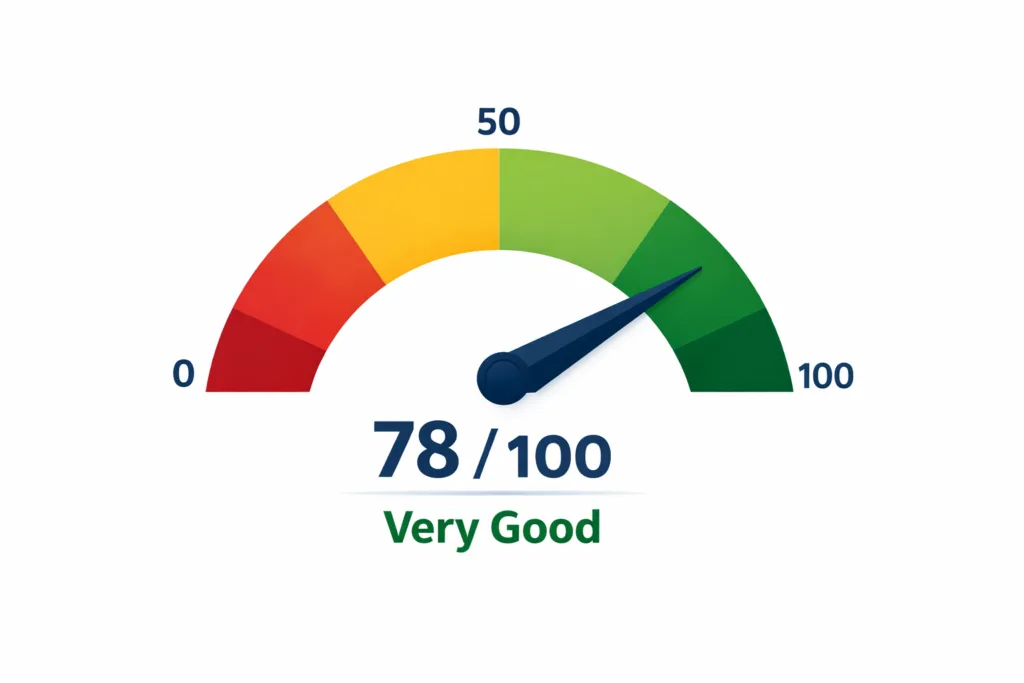

Most financial benchmarks in India are either too vague (“save more”) or too narrow (“beat the index”). The Financial Health Score by age gives you something far more useful: a specific, honest number that tells you whether your financial life is on track for your stage of life — not someone else’s.
The Comparison That Actually Matters
Everyone knows you should “save more” and “invest early.” What nobody tells you is how much is enough for your age, income, and life stage.
A 28-year-old with a ₹35,000 savings balance and ₹3 lakh in mutual funds — is that good or bad? A 42-year-old with ₹45 lakh invested but 55% of income going to EMIs — is that on track? A 52-year-old with ₹1.8 crore in corpus and zero term insurance — safe or dangerously exposed?
The answer to each of these depends entirely on context. On age. On income. On goals. On the specific combination of pillars that together constitute financial health.
The Wealthpedia Financial Health Score converts this contextual, multi-variable assessment into a single 0–100 number — calibrated specifically for Indian financial realities. But the score only becomes truly meaningful when compared against age-appropriate benchmarks.
This article gives you those benchmarks. Decade by decade. Pillar by pillar. With specific score targets, real rupee thresholds, and the honest assessment of what “on track” actually looks like at each stage of your financial life.
Quick Summary
Your Financial Health Score means different things at different ages. A score of 65 at 28 is good; the same score at 45 is a warning. This guide gives age-calibrated benchmarks for each decade — from 25 to 55 — across all 7 pillars: savings rate, DTI, emergency fund, investments, cash flow, net worth, and insurance. At 30, target 60–75 with 5× annual income in liquid net worth. At 40, target 68–80 with 15× income. At 50, target 72–84 with 20× income and zero debt. Calculate your score at wealthpedia.in/financial-health-score and compare it against your age benchmark to find your specific gap.
Join Now →
Why Age-Based Financial Benchmarks Matter
Short answer: Financial health is not static. What constitutes a healthy savings rate at 25 is dangerously low at 45. What constitutes excessive debt at 50 is manageable at 35. Age-calibrated benchmarks prevent you from measuring yourself against the wrong standard.
The 7 pillars of the Financial Health Score interact differently at each life stage:
- At 25: Savings rate and emergency fund are the critical pillars. Investments are starting to build. Debt is low. Net worth is small but growing.
- At 35: All 7 pillars are active. Home loan EMI has entered the picture. Investment corpus is building. Child-related costs are emerging. Insurance is critical.
- At 45: Debt reduction takes priority as retirement approaches. Investment portfolio must be substantial. Insurance must be maximised before premiums spike.
- At 55: Corpus sustainability is the focus. Debt should be eliminated. Withdrawal planning begins to matter alongside accumulation.
Understanding where you are in this arc — and whether you are ahead or behind for your age — is the starting point for every meaningful financial decision.
The Age-by-Age Financial Health Score Benchmarks
At Age 25–30: The Foundation Decade
Target overall score: 55–70
This is the foundation decade. Income is typically at its lowest. Habits are being formed. The financial decisions made between 25 and 30 — whether to start SIPs, build an emergency fund, avoid high-interest consumer debt — have disproportionate compounding impact over the following 30 years.
The expectation at this age is not perfection. It is foundation-building.
Pillar Benchmarks at 25–30:
Savings Rate (target: 15–20%+)
Starting salaries in Indian metros range from ₹25,000 to ₹80,000/month depending on sector and city. A 20% savings rate on ₹40,000 take-home is ₹8,000/month — achievable but requires discipline.
The ideal savings rate India guide establishes this as the minimum. At 25, even ₹3,000–₹5,000/month in SIP with a 10% annual step-up builds meaningful long-term wealth. As shown in the step-up SIP India FIRE guide, ₹5,000/month started at 25 with 10% step-up builds approximately ₹1.89 crore by age 55 — a dramatically better outcome than waiting until 30.
Debt-to-Income Ratio (target: below 20%)
At 25–30, most Indians have no home loan yet. The DTI danger at this age is consumer debt: credit card revolving balances, personal loans for gadgets or travel, and vehicle EMIs. Any single consumer loan above 15% of income is a warning sign.
As detailed in the how much debt is too much guide, consumer debt at 18–36% interest is the single worst financial decision available to a 25-year-old. Paying it off delivers a guaranteed 18–36% return — better than any equity market.
Emergency Fund (target: 3–4 months)
Building 3 months initially is realistic by age 27–28 for most salaried earners. The full 6-month target can come by 30. The emergency fund guide and the why 3 months is outdated article both establish that 6 months is the correct long-term target.
Investments (target: SIP started, any amount)
The critical milestone at this age is not the amount — it is starting. A ₹500/month SIP is dramatically better than ₹0. The real cost of waiting to invest quantifies this precisely: every year of delay at 25 costs significantly more than a year of delay at 40, because early years have the longest compounding runway.
Liquid Net Worth Target at 30:
- Minimum: 3× annual income
- Good: 5× annual income
- Excellent: 8×+ annual income
For someone earning ₹6 lakh/year at 28: minimum liquid net worth target = ₹18 lakh. This includes investments + savings − any consumer debt.
Insurance (target: term life active, health insurance personal)
Term life insurance at 25–26 is at its cheapest — typically ₹8,000–₹12,000/year for ₹1 crore cover for a non-smoker. Waiting until 35 increases the premium by 40–60%. Get it early. The healthcare inflation reality — 12–15% annually as detailed in the healthcare inflation India FIRE guide — means personal health insurance cannot wait.
What a score of 55–70 looks like at age 28:
- ₹8,000–₹12,000/month in SIP
- ₹1.5–₹2 lakh in emergency fund (3 months)
- No consumer debt
- ₹5–₹8 lakh in investments
- Term life ₹75 lakh–₹1 crore
- Personal health insurance ₹10–₹15 lakh
At Age 30–35: The Building Decade
Target overall score: 60–75
The 30s are the decade when everything accelerates simultaneously. Income grows. Goals multiply (home purchase, children, career transitions). Complexity increases. And the financial mistakes made in this decade — overleveraging on a home loan, neglecting SIP step-ups, delaying insurance upgrades — have compounding consequences that show up at 45 or 50.
A 30–35-year-old who scores 65+ is on a solid trajectory. Below 55 at this stage warrants structural attention.
Pillar Benchmarks at 30–35:
Savings Rate (target: 20–25%)
By 32–33, income has typically grown 40–60% from the starting salary. The savings rate should have grown proportionally — not lifestyle-inflated away. The most common failure: ₹30,000/month income at 25 with ₹6,000 savings (20%) grows to ₹60,000 at 32 with ₹9,000 savings (15%) — absolute amount grew but percentage fell.
As explored in the savings rate India FIRE guide, the ideal response to every salary increase is to direct 70% of the increment to savings before allowing lifestyle expansion. This keeps the savings rate growing with income.
Debt-to-Income Ratio (target: below 35%)
Many 30–35-year-olds take their first home loan in this decade. A home loan EMI of ₹35,000 on a ₹1.2 lakh income = 29% DTI — within the healthy zone. The trap is adding a car loan on top: ₹35,000 (home) + ₹12,000 (car) = ₹47,000 = 39% DTI — entering caution territory.
The debt-to-income ratio guide establishes the threshold clearly. Beyond 40% DTI, investment capacity shrinks to the point where retirement goals are at serious risk.
Emergency Fund (target: 6 months minimum)
With dependants, EMIs, and reduced income resilience (career disruption risk increases with specialisation), 6 months is non-negotiable by 33–34. The emergency fund should cover all expenses including EMI — not just living costs.
Investments (target: SIP with 10% step-up running, goal-based allocation)
By 35, the investment portfolio should reflect the multi-goal SIP architecture: separate SIPs for retirement, child’s education, and any medium-term goals. The monthly SIP for child education guide and the waterfall SIP allocation guide together give the complete framework for this decade.
Liquid Net Worth Target at 35:
- Minimum: 5× annual income
- Good: 8–10× annual income
- Excellent: 15×+ annual income
For someone earning ₹10 lakh/year at 35: minimum liquid net worth = ₹50 lakh. Good = ₹80–₹1 crore. This includes all investments minus all liabilities (excluding home value).
Insurance (target: term life 15–20× income, health ₹20 lakh+ personal)
By 35, with children and a home loan, term insurance must be sized to cover: outstanding home loan + 10+ years of family expenses. The sum assured should be 15–20× annual income minimum. Upgrading from a ₹50 lakh starter policy to ₹1.5–₹2 crore is essential in this decade.
What a score of 60–75 looks like at age 33:
- ₹20,000–₹30,000/month across multiple SIPs (retirement + child education)
- ₹4–₹5 lakh emergency fund
- Home loan EMI under 35% of income
- ₹40–₹70 lakh total investment value
- Term life ₹1.5 crore + personal health ₹20 lakh
At Age 35–40: The Acceleration Decade
Target overall score: 65–78
The late 30s are when the financial compounding machine should be visibly running. Income is at or near peak. Investments started in the 20s have had 10+ years to compound. The groundwork laid at 25–35 is now paying off — or the absence of that groundwork is becoming painfully apparent.
A score of 70+ at 38 means you are on the right trajectory. Below 60 at 38 signals that the retirement corpus is likely to be significantly underfunded and structural changes are urgent.
Pillar Benchmarks at 35–40:
Savings Rate (target: 25–30%)
Peak earning years begin here. This is the decade to accelerate — not plateau. For professionals earning ₹15–₹25 lakh/year, a 25–30% savings rate means ₹31,250–₹62,500/month in total investments. This is achievable and necessary.
The how much to invest monthly in India guide covers the specific allocation approach for this income and age range.
Debt-to-Income Ratio (target: below 30% and declining)
The home loan taken in the early 30s should now be declining as a percentage of income (because income has grown even if the EMI is fixed). Any additional consumer debt taken in this decade is a serious warning sign. Use the debt-free before FIRE framework to plan the prepayment schedule so the home loan closes before retirement.
Emergency Fund (target: 6–9 months)
With higher income comes higher lifestyle exposure. Monthly expenses are larger, children’s school fees are ongoing, EMI is present. The emergency fund must grow proportionally. 6 months minimum; 9 months for dual-income families where one income loss would be significant.
Investments (target: ₹50 lakh–₹1 crore+ accumulated)
By age 38–40, the investment corpus for a household that started SIPs at 25–26 and implemented step-ups should be approaching ₹60–₹80 lakh (assuming ₹10,000/month starting SIP at 25, 10% step-up, 12% CAGR). This corpus is the foundation of the retirement plan.
The mutual fund portfolio allocator should be used at this stage to audit whether the portfolio is properly structured — core index funds at low cost, appropriate mid-cap exposure, international diversification, and debt allocation.
Liquid Net Worth Target at 40:
- Minimum: 10× annual income
- Good: 15–20× annual income
- Excellent: 25×+ annual income
For someone earning ₹15 lakh/year at 40: minimum liquid net worth = ₹1.5 crore. Good = ₹2.25–₹3 crore.
Insurance (target: maximum cover, reassess coverage gaps)
This is the last decade to add affordable term cover before premiums become steep. Reassess: is the sum assured still 15–20× income? (Income may have grown significantly since the original policy.) Is the health cover keeping pace with medical inflation? A ₹15 lakh cover bought 8 years ago has the real value of approximately ₹6 lakh today at 12% medical inflation.
What a score of 65–78 looks like at age 38:
- ₹40,000–₹60,000/month across goal-based SIPs
- ₹6–₹8 lakh emergency fund
- Home loan EMI under 28% of income, 5+ years of prepayment done
- ₹60–₹1.2 crore investment corpus
- Term life ₹2–₹3 crore, health ₹25 lakh family
At Age 40–45: The Critical Window
Target overall score: 68–80
The early 40s are the most consequential 5-year window in Indian personal finance. This is where the retirement trajectory is set — with 15–20 years remaining, there is still time to course-correct, but the window is narrowing.
A score of 72+ at 43 means retirement is achievable as planned. A score of 58 at 43 requires immediate structural changes — not incremental improvements.
Pillar Benchmarks at 40–45:
Savings Rate (target: 28–35%)
Household expenses typically peak in the early 40s — children’s school/college costs, ageing parents’ healthcare, home renovation. The savings rate must be protected aggressively. Lifestyle inflation is the enemy. Use the financial health score tool to check quarterly whether the savings rate is being maintained or eroded.
Debt-to-Income Ratio (target: below 25% and on a clear payoff trajectory)
The home loan must be on a trajectory to close before retirement. If the current loan extends past the planned retirement date by more than 3 years, targeted prepayment is the priority — as explored in the debt-free before FIRE guide, the additional corpus needed to fund an EMI overlap in retirement can add ₹80 lakh to ₹3.6 crore to the required retirement fund.
Emergency Fund (target: 9–12 months)
Career risk increases in the 40s — particularly for senior professionals who face restructuring, redundancy, or entrepreneurial transitions. A robust 9–12 month emergency fund is essential. This is also the decade when medical emergencies become more likely.
Investments (target: ₹1.5 crore–₹3 crore+ accumulated)
By 44, a household that has invested consistently since 25–26 should have ₹1.5–₹2.5 crore in liquid investments. Run the corpus through the SIP Allocation Optimizer to check whether the current trajectory reaches the required retirement corpus (use the FIRE Number Calculator to establish this target).
If the Monte Carlo survival rate is below 70%, increase SIP immediately — the how much SIP per month for retirement India article gives the specific required SIP amounts by age.
Liquid Net Worth Target at 45:
- Minimum: 15× annual income
- Good: 20–25× annual income
- Excellent: 30×+ annual income
For someone earning ₹18 lakh/year at 44: minimum liquid net worth = ₹2.7 crore. Good = ₹3.6–₹4.5 crore.
Insurance (target: reassess and lock in cover before 45 premium jump)
Most term insurance providers apply material rate increases at the 45-year anniversary. Adding cover or extending before 45 is significantly cheaper. Reassess whether the existing sum assured covers: outstanding home loan principal + 10× current annual income.
What a score of 68–80 looks like at age 43:
- ₹60,000–₹1 lakh/month across SIPs (retirement + near-term goals wrapping up)
- ₹8–₹12 lakh emergency fund
- Home loan EMI under 22% of income, prepayment plan active
- ₹1.8–₹2.5 crore investment corpus
- Term life ₹2.5–₹4 crore (covers loan + income replacement)
At Age 45–50: The Pre-Retirement Runway
Target overall score: 72–84
The late 40s are the final major accumulation phase. With 10–15 years to retirement, every structural decision — allocation, debt elimination, corpus adequacy — should be made with a retirement-day deadline in mind.
A score of 75+ at 48 means retirement is on track. Below 65 at 48 requires the hard conversation about timeline adjustments or lifestyle recalibration.
Pillar Benchmarks at 45–50:
Savings Rate (target: 30–40%)
Children are completing college. Some EMIs may have closed. Income is typically at its highest. This is the “golden compounding window” — directing the maximum possible savings into retirement corpus at the highest income level, with 10–15 years remaining.
The FIRE planning India guide calls this the “final acceleration phase” — investors who hit 30%+ savings rate in their late 40s typically achieve their FIRE targets on schedule even if they started slowly.
Debt-to-Income Ratio (target: below 15% and declining rapidly to zero)
The home loan should either be closed or within 5 years of closure. All other debt — car loan, personal loan — should be fully eliminated. Carrying consumer debt into the pre-retirement years is a serious financial health failure at this stage.
Emergency Fund (target: 12 months)
With potential early retirement on the horizon, the emergency fund transitions toward becoming Bucket 1 of the retirement withdrawal strategy. 12 months of full expenses is appropriate and forms the foundation of the decumulation phase.
Investments (target: ₹3–₹6 crore+ accumulated)
By 49, a household that has invested well since 25 and implemented step-ups should have ₹3–₹5 crore in liquid investments. This is the range that, at 3.5% SWR, generates ₹87,500–₹1,45,833/month in today’s purchasing power — covering most urban Indian household retirement needs.
Use the retirement corpus calculator India guide to validate whether the corpus is on track for the specific retirement income target.
Liquid Net Worth Target at 50:
- Minimum: 20× annual income
- Good: 28–35× annual income
- Excellent: 40×+ annual income
For someone earning ₹20 lakh/year at 49: minimum liquid net worth = ₹4 crore. Good = ₹5.6–₹7 crore.
Insurance (target: health cover upgraded to maximum, term life review)
Term life may start reducing in relevance as the corpus builds and children become financially independent. However, health insurance must be maximised — the 50s are when healthcare costs begin escalating significantly. Upgrading to a super top-up (₹50 lakh+ effective cover at lower premium than a new base policy) is cost-efficient.
What a score of 72–84 looks like at age 48:
- ₹80,000–₹1.5 lakh/month in SIPs (maximum accumulation phase)
- ₹10–₹15 lakh emergency fund (transitioning to Bucket 1)
- Home loan closed or within 3 years of closure
- ₹3.5–₹5 crore investment corpus
- Health ₹30 lakh+ (base + super top-up), term life being reviewed
At Age 50–55: The Transition Zone
Target overall score: 75–88
The early 50s are the transition decade: from accumulation to pre-decumulation. The corpus is (or should be) largely built. The focus shifts from growing wealth to protecting it, structuring it for income generation, and eliminating the remaining vulnerabilities.
A score of 78+ at 53 means the retirement transition is manageable. A score of 65 at 53 requires immediate remediation — there is still time, but not much.
Pillar Benchmarks at 50–55:
Savings Rate (target: 30–40% but transitioning to corpus protection)
The savings rate remains critical in the early 50s — but the allocation shifts from aggressive equity accumulation to balanced accumulation with increasing debt component. The asset allocation for FIRE India guide establishes the appropriate glide path: reducing equity from 75–80% at 45 to 50–60% by 55.
Debt-to-Income Ratio (target: zero — no debt at retirement)
All debt should be eliminated before retirement. If any loan extends past the planned retirement date, this is a structural failure that the retirement withdrawal strategy guide explicitly addresses. The additional corpus required to fund a loan overlap in retirement is ₹1–₹4 crore depending on EMI and duration.
Emergency Fund (target: 12–18 months, transitioning to Bucket 1)
The emergency fund at 53–54 begins transitioning into the retirement income bucket. As detailed in the how to withdraw money after retirement guide, Bucket 1 (24 months of expenses in liquid instruments) is the foundation of the withdrawal phase. Building it before retirement prevents the structural weakness of entering decumulation without immediate income security.
Investments (target: ₹4–₹8 crore+ accumulated, allocation shifting)
By 53, the portfolio should be approaching or at the retirement target corpus. Validate using the safe withdrawal rate India calculator — does the current corpus, at 3.5% SWR, generate the required monthly income? If not, what additional SIP is needed?
Liquid Net Worth Target at 55:
- Minimum: 25× annual income
- Good: 35–45× annual income
- Excellent: 50×+ annual income
Insurance (target: focus shifts entirely to health)
Term life importance decreases as corpus builds and family becomes financially independent. Health insurance becomes the critical pillar — ₹30–₹50 lakh effective cover through base + super top-up combination, with a plan to maintain this cover through retirement.
What a score of 75–88 looks like at age 52:
- All consumer and home debt eliminated
- ₹15–₹20 lakh liquid (transitioning to Bucket 1)
- ₹4.5–₹7 crore investment corpus
- Health ₹40 lakh+ effective cover
- Term life being wound down as corpus grows
- Withdrawal plan designed and validated
The Summary: Financial Health Score Benchmarks by Age
Age Target Score Min Liquid NW Savings Rate DTI Emergency Fund 25–30 55–70 3× income 15–20% <20% 3–4 months 30–35 60–75 5× income 20–25% <35% 6 months 35–40 65–78 10× income 25–30% <30% 6–9 months 40–45 68–80 15× income 28–35% <25% 9–12 months 45–50 72–84 20× income 30–40% <15% 12 months 50–55 75–88 25× income 30–40% 0% 12–18 months
What to Do If Your Score Is Below the Age Benchmark
Short answer: Identify the lowest-scoring pillar, fix it with urgency appropriate to your age (a 42-year-old needs more urgency than a 28-year-old), use the tool to track progress quarterly, and do not attempt to fix all pillars simultaneously.
You Are Under-Scoring by 5–10 Points
Mild gap. Usually one or two pillars dragging the score down. Common at this level: emergency fund slightly below target, or investments slightly below age-appropriate threshold.
Action: Fix the weakest pillar specifically. Use the improve financial health score India guide for the targeted approach. Re-test in 3–4 months.
You Are Under-Scoring by 10–20 Points
Moderate gap. Multiple pillars are underperforming. The combination of a mild DTI problem AND a savings rate gap AND an emergency fund shortfall creates a score 15 points below target. Each problem is manageable alone; the combination is significant.
Action: Address in priority sequence (emergency fund → high-interest debt → insurance → savings rate). Do not try to fix all simultaneously. The financial health score tool breakdown shows which pillars have the most room for improvement and therefore the highest impact per unit of effort.
You Are Under-Scoring by 20+ Points
Significant gap. This requires structural changes — not incremental improvements. Common at this level: DTI above 50%, savings rate below 10%, no emergency fund, no personal insurance.
The urgency depends on age:
- At 28: significant gap but 30+ years of compounding ahead. Structural change now produces large future benefit.
- At 42: significant gap with only 15–18 years remaining. Urgent structural change is the priority. The FIRE at 45 guide and FIRE at 50 guide give realistic pathways for different starting points.
- At 52: limited time. The Barista FIRE India guide and the savings rate India FIRE guide explore the most viable options for late starters.
Conclusion: The Score Is a Compass, Not a Verdict
The Financial Health Score by age is not a grade. It is a compass. It tells you the direction you need to move — and how urgently — based on where you are in your financial life.
A 28-year-old with a score of 54 has 30+ years to build on a solid foundation. A 47-year-old with a score of 54 has a genuinely urgent problem that requires immediate structural action.
The same score means very different things at different ages. That is why the age-calibrated benchmark matters — it converts a number into a contextualised assessment.
Calculate your Financial Health Score now. Compare it against the age-appropriate benchmark in this guide. Identify the gap. Start with the highest-impact pillar.
Then do it again in 6 months. And in 6 more months after that. Financial health, like physical health, does not improve from a single check-up. It improves from consistent monitoring and deliberate, targeted action.
Frequently Asked Questions
What Financial Health Score should I have at 30 in India?
A target score of 60–75 is appropriate at 30. Key milestones: savings rate 20–25%, DTI below 35%, emergency fund at 6 months, investments started with step-up SIP running, term life ₹1–₹1.5 crore, personal health ₹15–₹20 lakh. Liquid net worth should be approaching 5× annual income. Use the Financial Health Score tool to measure your specific score and see which pillar is pulling it down.
Is a Financial Health Score of 70 good at age 35?
Yes — 70 is in the “good” range for a 35-year-old. The target range is 65–78. A score of 70 at 35 means your foundation is solid but there are 1–2 pillars with improvement room. Check the pillar breakdown: the most common gap at 35 is either a savings rate below 20% or an emergency fund below 6 months.
What is a poor Financial Health Score for a 40-year-old?
Below 60 at 40 is a poor score that warrants urgent attention. The target range is 68–80. A score below 60 at 40 typically reflects high DTI (home + car + personal loan combined above 45%), insufficient investments (below ₹1 crore), and often inadequate insurance. The 40s are the last comfortable window for structural repair before retirement proximity creates time pressure.
How does Financial Health Score change with age?
The score benchmark rises with age because financial capability and accumulated wealth should increase over time. A 55 at age 28 is good; a 55 at age 45 is concerning. Each decade raises the expected score by approximately 5–8 points — reflecting the compounding of good financial habits and the growing corpus that comes with consistent investment.
What is the most important pillar at age 25?
At 25, savings rate (25% weight) and emergency fund (15% weight) are the most impactful pillars to focus on. Starting SIPs — even at ₹2,000–₹5,000/month — and building a 3-month emergency fund delivers outsized compounding benefit. The real cost of waiting guide shows that every year of delay at 25 costs disproportionately more than a year of delay at 35.
What is the most important pillar at age 45?
At 45, the DTI (20% weight) becomes the most critical pillar. The home loan must be on a trajectory to close before retirement. If the loan extends past the FIRE date, it adds ₹1–₹4 crore to the required retirement corpus. Additionally, the investment pillar (15%) must reflect an adequate corpus trajectory — run the Monte Carlo in the SIP Allocation Optimizer to validate.
My score is below my age benchmark. Is it too late?
It depends on the age gap. A 30-year-old below benchmark has 30 years to recover — significant gap, plenty of time. A 48-year-old below benchmark has 12–15 years — still time, but structural action is urgent, not incremental. A 54-year-old below benchmark may need to consider Barista FIRE or extended timeline. The tool’s breakdown shows precisely what to fix for the fastest score improvement.
What liquid net worth should I have at 40?
Minimum 10× annual income in liquid net worth at 40. For ₹12 lakh/year income: minimum ₹1.2 crore. Good = ₹1.8–₹2.4 crore. This excludes home equity (illiquid) — only investments, savings, EPF, PPF, and liquid assets minus all liabilities. The what should your net worth be at 30 guide covers the full age-by-age benchmark framework.
How does DTI change the score differently at 30 vs 45?
At 30, a 35% DTI (home loan in early stages) is expected and scores moderately. At 45, the same 35% DTI is a warning sign — the home loan should be declining as income has grown, and consumer debt should be eliminated. The age-calibrated benchmark penalises stagnant DTI more heavily in the 40s than the 30s because the retirement proximity creates urgency that didn’t exist earlier.
What insurance should I have at each age decade?
25–30: Term ₹75L–₹1 Cr, health ₹10–₹15L personal. 30–35: Term ₹1–₹2 Cr, health ₹20L+ family. 35–40: Term ₹2–₹3 Cr, health ₹25L family. 40–45: Term ₹2.5–₹4 Cr (last affordable upgrade window), health ₹25–₹30L. 45–50: Term ₹3–₹4 Cr, health ₹30–₹40L. 50–55: Focus on health ₹40–₹50L+ effective cover; term relevance declining.
How much should I have saved by age 35 in India?
By 35, total liquid investments (mutual funds + stocks + EPF + PPF + FD, excluding property) should ideally be 8–10× annual income. For ₹10 lakh/year gross income: ₹80 lakh–₹1 crore. If this number seems high, it is achievable for those who started investing at 25 with consistent step-up SIPs. The step-up SIP guide shows the compounding path from ₹5,000/month at 25 to substantial corpus at 35.
Why does my score matter more at 42 than at 27?
Urgency and time compression. At 27, a low score with 33 years to retirement means structural improvements made today have 33 years of compounding to work with. At 42, the same structural improvement has only 18 years — less than half the compounding runway. This is why the urgency multiplier on corrective action is significantly higher at 42 than at 27.
What is the emergency fund target by age?
25–30: 3–4 months. 30–35: 6 months. 35–40: 6–9 months. 40–45: 9–12 months. 45–50: 12 months. 50–55: 12–18 months (transitioning to Bucket 1). The emergency fund grows with age because exposure (EMIs, children, ageing parents, career risk) grows and because it eventually transitions into the retirement income buffer.
Can high income compensate for a low Financial Health Score?
No. The tool rewards financial discipline, not income level. A ₹5 lakh/month earner with 55% DTI, 5% savings rate, and no insurance will score below 50. A ₹75,000/month earner with 25% savings rate, 6-month emergency fund, and adequate insurance will score 70+. High income provides the capacity to improve — but only if that capacity is used.
How does the score relate to FIRE planning?
A Financial Health Score above 70 is the prerequisite for meaningful FIRE planning. It confirms the foundational structure is sound before complex long-term modelling begins. Once the score crosses 70, use the Multi-Goal FIRE Planner to model the retirement trajectory and the FIRE Number Calculator to validate the corpus target.
I am 50 and my score is 62. What should I do?
Focus immediately on: (1) eliminating all non-mortgage debt, (2) maximising SIP contributions for the remaining 10–12 working years using aggressive step-up, (3) upgrading health insurance to ₹30–₹40 lakh+ effective cover before premiums spike further. The Barista FIRE India guide and FIRE at 50 guide both provide realistic pathways from a 62 score at 50.
Does the score account for EPF in the investments pillar?
The EPF balance should be included in total investments when using the Financial Health Score tool. EPF at 8.25% EEE is a significant retirement asset. For a salaried professional with 20 years of service, EPF alone may constitute ₹40–₹80 lakh — a meaningful component of the investment and net worth pillars.
My investments are good but I keep scoring below 70. Why?
A common pattern: strong investments but a weakness in another high-weight pillar dragging the score down. Check: (1) Is the savings rate above 20%? (2) Is the DTI below 35%? (3) Is the emergency fund above 6 months? These three pillars together carry 60% of the total weight. Strong investments (15% weight) cannot compensate for failures in savings rate (25%) and DTI (20%) combined.
How should couples track Financial Health Score?
Calculate both individually and jointly. Individual scores reveal each person’s financial habits. A joint score (combined income, expenses, assets, liabilities) gives the household picture. For FIRE planning purposes, the joint score and the Multi-Goal FIRE Planner work together to model dual-income household trajectories.
What’s the difference between the Financial Health Score and CIBIL for different ages?
CIBIL is equally relevant at all ages — it reflects recent borrowing behaviour. The Financial Health Score has different emphasis by age: at 28, the savings and emergency pillars matter most; at 45, DTI trajectory and investment corpus matter most; at 55, debt elimination and withdrawal readiness matter most. CIBIL never captures these life-stage dimensions.
How does lifestyle inflation affect the score over time?
Lifestyle inflation — expenses growing proportionally with income — is the primary reason scores stagnate or decline in the 30s and 40s despite income growth. The tool specifically tracks savings rate as a percentage of income (not absolute amount), so lifestyle inflation shows up immediately as a savings rate decline even if the absolute savings amount grew.
At what age is the Financial Health Score most predictive of retirement readiness?
Most predictive at 40–45. This is late enough that the compounding trajectory is established, early enough that structural corrections are still highly impactful. A score of 75+ at 42 correlates strongly with retirement readiness at 58–60. A score of 60 at 42 is a meaningful warning signal that requires active intervention.
What does an excellent score (80+) look like at age 45?
At 45 with a score of 82+: savings rate 32%+, DTI below 20% (home loan in final years), emergency fund 12 months, investment corpus ₹2.5 crore+ (liquid), liquid net worth 22×+ annual income, term life ₹3 crore+, health ₹30 lakh+ personal. This profile is on track for FIRE at 55–57 for most Indian household expense levels.
How often should I check the score relative to my age?
25–35: Annually. 35–45: Every 6 months during active goal-setting and debt management. 45–55: Quarterly as retirement approaches and every structural decision has time-sensitive implications. After retirement: annually as part of the withdrawal plan review covered in the retirement withdrawal strategy guide.
What is the single most important insight from age-calibrated financial health benchmarks?
Time compression. The same score gap is significantly more urgent at 42 than at 28 — because the time available to compound corrective actions is dramatically shorter. A 28-year-old with a 55 score has 32 years to reach 75. A 45-year-old with a 55 score has 13 years to reach 75 — and that same journey requires 2.5× more monthly effort. This is why starting early matters, why checking your score matters, and why acting on the gap matters. Not eventually. Now.
Disclaimer: All financial benchmarks in this article are illustrative and based on general financial planning principles calibrated for Indian markets. Individual circumstances vary significantly. This article is for educational purposes only. Wealthpedia is not a SEBI-registered investment advisor. Consult a qualified financial planner for decisions specific to your situation. Wealthpedia® is a registered trademark (TM No. 4910385).

Vishal Jhaveri is the founder of Wealthpedia and an MBA Finance professional with over 10 years of experience in financial planning, investing, and wealth creation. He specializes in FIRE (Financial Independence, Retire Early), retirement planning, investing, and personal finance education. Through Wealthpedia, he develops financial calculators and publishes evidence-based content to help Indian investors make informed financial decisions. He regularly reviews and updates Wealthpedia articles to reflect changes in tax, laws, investment regulations, and personal finance best practices.
Quick Wrap up