
Pensionable service is the second variable in the EPS pension formula — and for most employees, it is the variable they have the most control over. Unlike pensionable salary (largely fixed by the ₹15,000 ceiling for most members), pensionable service grows every year you continue in EPF-covered employment, and crosses important thresholds that significantly change your pension.
This guide explains exactly how EPFO counts pensionable service — the rounding rules, the 2-year bonus, the maximum cap, and how service from multiple employers is combined.
Use the EPS Pension Calculator India to compute your exact pensionable service from your joining and exit dates.
Quick Summary
Pensionable service under EPS is the total number of years of EPS-covered employment used in the pension formula — (Pensionable Salary × Pensionable Service) ÷ 70. EPFO counts service in completed years, with a critical rounding rule: 6 or more months in the final partial year rounds up to a full year; less than 6 months is dropped. If total service reaches 20 years or more, EPFO adds a 2-year bonus. The maximum pensionable service recognised is 35 years. Service from multiple employers is cumulative if transferred via UAN. This article explains every rule governing pensionable service with examples. Use the EPS Pension Calculator India to compute your pensionable service automatically.
Join Now →
What Is Pensionable Service?
Pensionable service is the total number of years of EPS-covered employment, counted using EPFO’s specific rounding rules, used as the service input in the EPS pension formula.
It appears in the formula as:
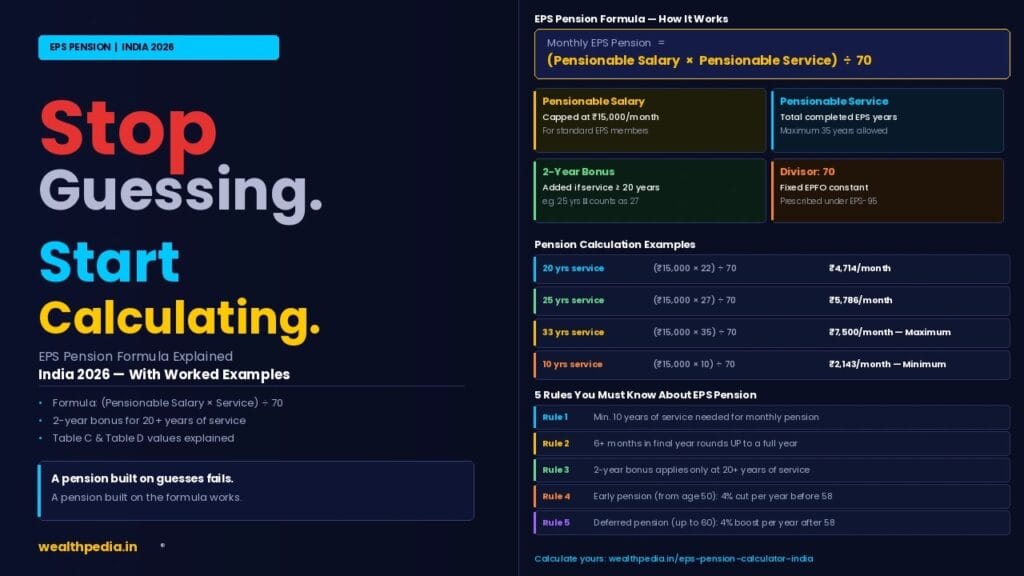
Monthly EPS Pension = (Pensionable Salary × Pensionable Service) ÷ 70
Pensionable service is not simply “years worked” — it follows specific counting rules that can meaningfully change your final number.
How EPFO Counts Pensionable Service — The Basic Method
EPFO counts pensionable service by:
- Summing the total number of months of EPS contribution across all EPF-covered employment
- Converting total months to years and remaining months
- Applying the 6-month rounding rule to the remaining months
The 6-Month Rounding Rule
If the remaining months (after converting to full years) are 6 or more, round UP to the next full year.
If the remaining months are less than 6, DROP them (round down).
| Total Service (Years + Months) | Pensionable Service (Rounded) |
|---|---|
| 22 years 3 months | 22 years (3 < 6, dropped) |
| 22 years 6 months | 23 years (6 ≥ 6, rounded up) |
| 22 years 9 months | 23 years (9 ≥ 6, rounded up) |
| 22 years 5 months | 22 years (5 < 6, dropped) |
| 9 years 6 months | 10 years (crosses pension eligibility threshold) |
| 9 years 5 months | 9 years (remains below 10-year threshold) |
The rounding rule applies only to the final partial year — full years are always counted as full years regardless.
Why the 6-Month Rule Matters So Much
The 6-month rule creates several critical thresholds:
Threshold 1 — The 10-Year Pension Eligibility Line
Service of 9 years and 6+ months rounds up to 10 years — crossing the minimum threshold for monthly pension eligibility. Below this (9 years 5 months or less), the member is limited to Table D withdrawal benefit.
This means an employee with 9 years and 5 months who works just 1 more month (reaching 9 years 6 months) crosses into pension eligibility — converting a one-time Table D payout into a lifetime monthly pension.
See EPS Pension After 10 Years for the full financial comparison.
Threshold 2 — The 20-Year Bonus Line
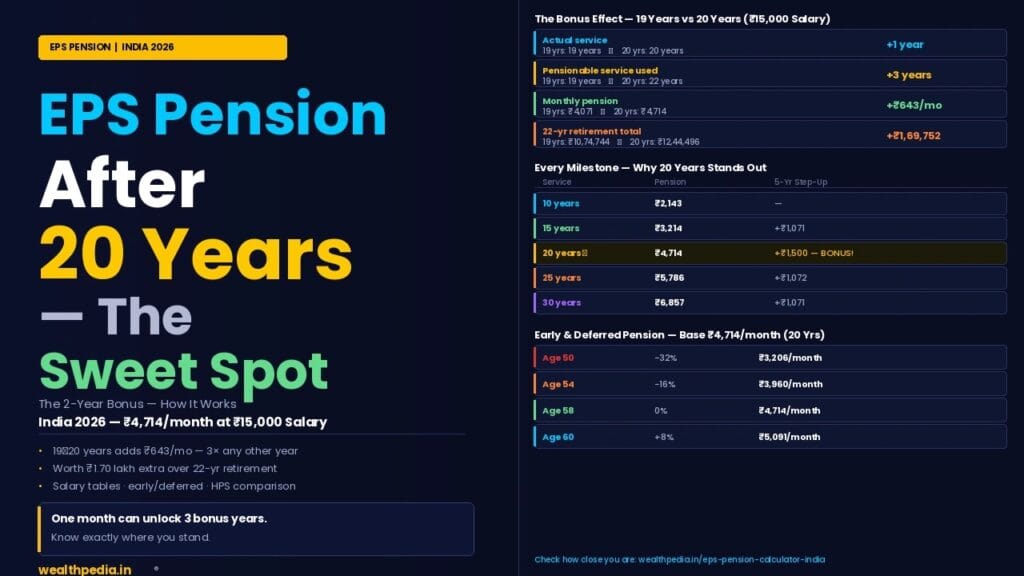
Service of 19 years and 6+ months rounds up to 20 years — triggering the 2-year bonus. This single rounding event can add ₹429/month for life (at ₹15,000 salary).
Threshold 3 — The 33-Year Maximum Pension Line
Service of 32 years and 6+ months rounds up to 33 years, which with the 2-year bonus becomes 35 years — the maximum pensionable service, yielding the maximum standard pension of ₹7,500/month.
The 2-Year Service Bonus
If total pensionable service (after the 6-month rounding) reaches 20 years or more, EPFO adds a bonus of 2 years to the pensionable service before applying the formula. Rounded Service Pensionable Service Used in Formula Bonus Applied? 19 years 19 years No 20 years 22 years Yes (+2) 25 years 27 years Yes (+2) 33 years 35 years Yes (+2, hits maximum) 34 years 35 years Yes (+2, capped at max) 35 years 35 years Yes (+2, capped at max)
Note that once actual service reaches 33 years, the +2 bonus brings the total to 35 — the maximum. Any service beyond 33 years (34, 35, 36…) still results in 35 pensionable years — no further increase.
Maximum Pensionable Service — 35 Years
EPFO recognises a maximum of 35 years of pensionable service for the pension formula — regardless of how many years a member actually worked.
This cap interacts with the 2-year bonus as follows:
- Actual service of 33 years + 2-year bonus = 35 years (exactly at cap)
- Actual service of 40 years + 2-year bonus = 42 years → capped at 35 years
A member with 40 years of EPS-covered service receives the same pension as a member with 33 years of service (both use 35 pensionable years in the formula). The additional 7 years of contributions do not increase the pension.
Monthly Pension at maximum = (15,000 × 35) ÷ 70 = ₹7,500/month
Pensionable Service from Multiple Employers
Service from multiple EPF-covered employers is cumulative — provided the EPS service was properly transferred or preserved via UAN/Scheme Certificate.
Scenario 1 — UAN Transfer Completed
Employee worked at Company A for 6 years, transferred EPF/EPS via UAN when joining Company B, and worked there for 16 years.
- Total pensionable service = 6 + 16 = 22 years
- 2-year bonus applies (≥ 20 years) → 24 years pensionable
Scenario 2 — No Transfer, Scheme Certificate Obtained
Employee worked at Company A for 6 years, left without transferring, obtained a Scheme Certificate, then worked at Company B for 16 years and submitted the Scheme Certificate.
- Total pensionable service = 6 + 16 = 22 years (same as Scenario 1)
- The Scheme Certificate preserved the 6 years for combination
Scenario 3 — No Transfer, No Scheme Certificate, Withdrawal Taken
Employee worked at Company A for 6 years, took the Table D withdrawal benefit on leaving, then worked at Company B for 16 years.
- The 6 years at Company A are permanently forfeited for pension purposes
- Total pensionable service = 16 years only (no 2-year bonus, below 20)
This dramatically illustrates why the choice between Scheme Certificate and withdrawal (covered in Scheme Certificate vs EPS Withdrawal) has lasting consequences on pensionable service.
What Counts as “Service” for Pensionable Service Calculation?
Only months in which actual EPS contributions were made count towards pensionable service. This includes:
- Active employment months — where the employer deducted and deposited EPS contributions (8.33% of pensionable salary)
- Approved leave periods — where EPS contributions continued (e.g., paid leave, maternity leave with continued contributions)
What Does NOT Count
- Unpaid leave / leave without pay — if no EPS contribution was made
- Breaks in employment — gaps between jobs where no EPS contribution occurred
- Periods of non-EPF-covered employment — e.g., working for an exempted establishment that did not route EPS to EPFO’s pool (though this is rare; EPS is centralised)
- Periods before EPF/EPS enrollment — even if employed, if not yet enrolled in EPF
How to Verify Your Pensionable Service
Step 1 — Log in to EPFO Member Portal
Visit passbook.epfindia.gov.in and log in with your UAN. Navigate to the passbook view.
Step 2 — Check the EPS Contribution Column
The passbook shows month-by-month EPS contributions. Count the number of months with a non-zero EPS contribution entry. Divide by 12 to get years, with the remainder as months.
Step 3 — Apply the Rounding Rule
If the remainder is 6+ months, round up to the next full year. If less than 6, drop it.
Step 4 — Check for the 2-Year Bonus
If your rounded total is 20 years or more, add 2 bonus years (capped at 35 total).
Step 5 — Cross-Verify with the Calculator
Use the EPS Pension Calculator India — enter your date of joining EPS and expected/actual exit date, and it will compute pensionable service automatically, including the rounding and bonus rules.
Pensionable Service and Breaks in Employment
A break in employment (period not covered by EPS) reduces total pensionable service by the gap duration.
Example — 3-Year Break Mid-Career
- Employer A: 8 years (2010–2018)
- Break: 3 years (2018–2021, not employed)
- Employer B: 14 years (2021–2035)
Total pensionable service = 8 + 14 = 22 years (the 3-year gap is simply not counted — it neither adds nor subtracts beyond not contributing).
If the employee had instead worked continuously for 25 years (without the break), pensionable service would be 25 years — 3 years more, which (with the bonus) could mean the difference between 24 and 27 pensionable years.
Condonable Breaks
EPFO may condone breaks of up to 2 years under certain conditions (e.g., documented medical leave, approved sabbatical with intent to return). Condoned breaks may be treated as continuous service for pensionable service purposes — but this requires specific documentation and EPFO approval. Breaks beyond 2 years generally cannot be condoned.
Pensionable Service Growth — Year-by-Year Pension Impact
Here is how pensionable service growth translates to pension at ₹15,000 pensionable salary:
| Actual Service | Pensionable Service (with bonus where applicable) | Monthly Pension | Increase from Previous Row |
|---|---|---|---|
| 10 years | 10 | ₹2,143 | — |
| 12 years | 12 | ₹2,571 | +₹428 |
| 15 years | 15 | ₹3,214 | +₹643 |
| 18 years | 18 | ₹3,857 | +₹643 |
| 19 years | 19 | ₹4,071 | +₹214 |
| 20 years | 22 (+2 bonus) | ₹4,714 | +₹643 |
| 25 years | 27 (+2 bonus) | ₹5,786 | +₹1,072 |
| 30 years | 32 (+2 bonus) | ₹6,857 | +₹1,071 |
| 33 years | 35 (+2 bonus, max) | ₹7,500 | +₹643 |
| 35 years | 35 (capped) | ₹7,500 | +₹0 |
Each year of service typically adds ₹214/month (= 15,000 ÷ 70). The jump from 19 to 20 years adds ₹643/month — three times the normal annual increment — because crossing 20 years adds 3 effective pensionable years (the 1 actual year plus the 2-year bonus that newly applies).
For the complete formula breakdown, see EPS Pension Formula Explained.
Pensionable Service for Members Who Joined Before September 2014
Members who joined EPS before September 2014 (when the wage ceiling was ₹6,500) have their pensionable service counted the same way — in years and months with the 6-month rounding rule. The wage ceiling change (₹6,500 to ₹15,000) affects pensionable salary, not pensionable service. A member’s total pensionable service is unaffected by which ceiling era they worked through — only the salary input changes based on retirement date.
Pensionable Service Under the Higher Pension Scheme
The pensionable service rules — 6-month rounding, 2-year bonus, 35-year maximum — are identical under the Higher Pension Scheme. Only the pensionable salary input changes (60-month average instead of ₹15,000 ceiling). See EPS Higher Pension Scheme: Eligibility & Calculation for the full HPS rules.
Common Mistakes in Counting Pensionable Service
Mistake 1 — Counting calendar years instead of EPS contribution months
If you joined mid-year, your first “year” of employment is not a full pensionable year unless EPS contributions started from the joining month.
Mistake 2 — Including non-EPS-covered periods
Some employees mistakenly include periods of employment where they were not enrolled in EPF/EPS (e.g., probation periods at certain employers, or employment with non-EPF-covered establishments).
Mistake 3 — Forgetting to add the 2-year bonus
Many self-calculations stop at the rounded service figure without checking whether it crosses 20 years and adding the bonus.
Mistake 4 — Not capping at 35 years
Members with very long careers (38+ years) sometimes calculate pension using their full actual service plus bonus, exceeding 35 — but EPFO caps the formula input at 35 regardless.
Mistake 5 — Treating each employer’s service independently without checking transfers
If service was not transferred or preserved, separate employer stints may not combine — leading to overestimation of total pensionable service.
Pensionable Service — Quick Reference Summary
Rule Detail Counting unit Completed months → years Rounding rule 6+ months rounds up; under 6 months dropped Minimum for monthly pension 10 years (after rounding) 2-year bonus threshold 20 years (after rounding) Maximum pensionable service 35 years (including bonus) Multiple employers Cumulative if transferred via UAN or Scheme Certificate Breaks in service Reduce total service by gap duration; not penalised beyond that Condonable breaks Up to 2 years, with documentation and EPFO approval Applies to HPS? Yes — identical rules, only salary input differs
Frequently Asked Questions — Pensionable Service Under EPS
What is pensionable service under EPS?
Pensionable service is the total number of years of EPS-covered employment, counted using EPFO’s rounding rules (6+ months rounds up, under 6 months is dropped), used as the service input in the pension formula: (Pensionable Salary × Pensionable Service) ÷ 70.
How does EPFO round pensionable service?
EPFO sums total EPS contribution months, converts to years and remaining months. If the remaining months are 6 or more, the total rounds up to the next full year. If less than 6, the remaining months are dropped. Example: 22 years 7 months → 23 years; 22 years 4 months → 22 years.
What is the 2-year bonus in pensionable service?
If total pensionable service (after rounding) reaches 20 years or more, EPFO adds a bonus of 2 years to the pensionable service used in the pension formula. So 20 years becomes 22, 25 becomes 27, and so on — up to the maximum of 35.
What is the maximum pensionable service?
The maximum pensionable service EPFO recognises is 35 years (including the 2-year bonus). Actual service beyond 33 years (33 + 2 bonus = 35) does not increase pensionable service further — even with 40 years of actual service, the formula uses 35.
Does pensionable service combine across multiple employers?
Yes — if the EPS account was transferred via UAN when switching jobs, or if a Scheme Certificate from a previous employer was submitted to the current employer. If neither was done and the EPS withdrawal benefit was taken at the previous employer, that service is permanently forfeited and does not combine.
What is the pensionable service for 9 years and 7 months?
7 months ≥ 6 months → rounds up to 10 years. This crosses the minimum threshold for monthly pension eligibility — converting a Table D withdrawal scenario into pension eligibility. See EPS Pension After 10 Years.
What is the pensionable service for 19 years and 4 months?
4 months < 6 months → dropped → 19 years. Since 19 < 20, the 2-year bonus does NOT apply. If the employee had worked 2 more months (19 years 6 months → rounds to 20 years), the bonus would apply.
Does a break in employment reduce pensionable service?
Yes. Only months with actual EPS contributions count. A break (no employment, or employment without EPS coverage) does not contribute to pensionable service. The total service is the sum of all EPS-contributing periods, excluding gaps.
Can pensionable service exceed 35 years?
No. 35 years is the absolute maximum used in the pension formula, regardless of actual years worked. A member with 40 years of actual service and the 2-year bonus (42 years) is capped at 35 years for pension calculation purposes.
What is pensionable service for an employee who worked 6 years at Company A and 16 years at Company B with UAN transfer?
Total pensionable service = 6 + 16 = 22 years. Since 22 ≥ 20, the 2-year bonus applies → 24 years used in the formula.
What happens to pensionable service if I take the Table D withdrawal at one employer and then work elsewhere?
The service period for which you took the withdrawal benefit is permanently excluded from future pensionable service calculations. Only the subsequent employer’s service counts toward your pension. This is why choosing Scheme Certificate over withdrawal matters for those planning to continue in EPF employment.
How is pensionable service calculated for someone who joined before September 2014?
The counting method (months, rounding, bonus, maximum) is identical regardless of when the member joined. The wage ceiling change in September 2014 affects pensionable salary, not pensionable service. A member’s total years of EPS contribution — whether earned before or after 2014 — all count toward pensionable service.
Is there a minimum age requirement related to pensionable service?
No — pensionable service is purely about duration of EPS contributions, independent of age. However, to claim monthly pension, you need both 10+ years of pensionable service AND to have reached the eligible age (50 for early pension, 58 for standard).
What is the pensionable service for 32 years and 6 months?
6 months ≥ 6 months → rounds up to 33 years. With the 2-year bonus (≥ 20 years): 33 + 2 = 35 years — the maximum. This member achieves the maximum standard pension of ₹7,500/month (at ₹15,000 pensionable salary).
Does pensionable service stop growing once I reach 33 years?
For pension calculation purposes, yes — 33 actual years + 2 bonus = 35, the maximum. Continuing to work beyond 33 years does not increase your EPS pension, since the formula input is capped at 35 regardless of additional years.
Can EPFO’s pensionable service calculation be wrong?
Yes — if your employer failed to make EPS contributions for certain months, or if multiple UANs exist with split service records, or if transfers were not completed. Always verify via your EPFO passbook and raise a grievance via EPFiGMS (epfigms.gov.in) if discrepancies are found.
What is pensionable service for someone with 2 UANs showing 8 years and 7 years separately?
If the two UANs represent the same person’s service across different employers and have not been merged, EPFO may treat them as separate records — neither reaching the 10-year minimum independently (8 and 7 years). Merging the UANs combines the service to 15 years — above the 10-year minimum. UAN merge requests can be filed via the EPFO Member Portal.
How does pensionable service interact with the EPF withdrawal?
EPF withdrawal (Form 19) does not affect pensionable service — EPF and EPS are independent. Withdrawing your EPF corpus has no impact on your pensionable service count. Only the EPS-specific Form 10C withdrawal (Table D) forfeits that period’s pensionable service.
What if my pensionable service is exactly 20 years — does the bonus apply?
Yes. The 2-year bonus applies when pensionable service is 20 years or more — 20 years exactly qualifies. Pensionable service used in the formula = 20 + 2 = 22 years.
Is pensionable service the same for invalidity pension?
For invalidity pension (permanent disablement during service), EPFO uses the actual pensionable service OR a notional minimum of 2 years, whichever is higher — even if the member’s actual service is very short. The 6-month rounding and 2-year bonus rules apply normally if actual service exceeds the notional minimum.
Disclaimer: The information on this page is for educational purposes only and does not constitute investment or financial advice. EPS rules governing pensionable service are set by EPFO under EPS-95 and may be updated by the Government of India. For personalised guidance, consult a SEBI-registered financial planner or visit your nearest EPFO office. Wealthpedia™ (Trademark Reg. No. 4910385) is not a SEBI-registered investment advisor. All mutual fund references on this site are for Direct Plan, Growth option only.

Vishal Jhaveri is the founder of Wealthpedia and an MBA Finance professional with over 10 years of experience in financial planning, investing, and wealth creation. He specializes in FIRE (Financial Independence, Retire Early), retirement planning, investing, and personal finance education. Through Wealthpedia, he develops financial calculators and publishes evidence-based content to help Indian investors make informed financial decisions. He regularly reviews and updates Wealthpedia articles to reflect changes in tax, laws, investment regulations, and personal finance best practices.
Quick Wrap up