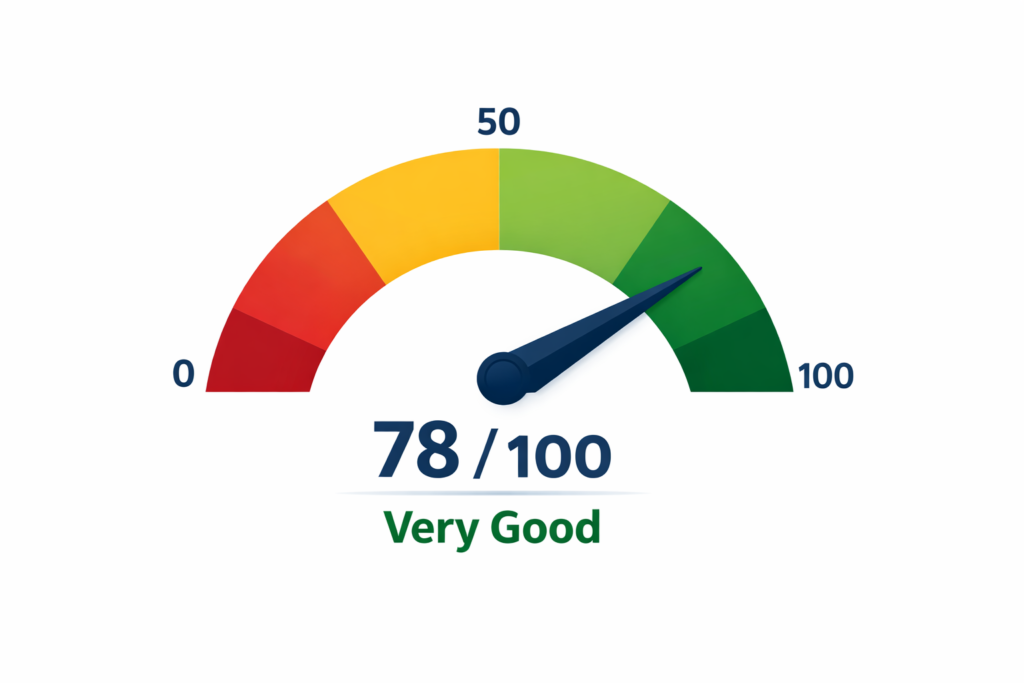

Your CIBIL score tells you if banks trust you. Your Financial Health Score tells you if you should trust your own financial plan. One number. Seven pillars. Fifteen inputs. Calculated in under 15 minutes — and likely the most honest financial diagnosis you have ever received.
The Diagnosis Most Indians Never Get
There is a peculiar gap in how most Indians manage their personal finances.
They track their SIP returns. They watch their mutual fund NAVs. They check their CIBIL score before applying for a loan. They occasionally glance at their bank balance.
But almost nobody tracks their overall financial health — the composite picture of whether their entire financial life is functioning well or quietly failing in ways that will only become visible years from now.
A 2024 survey of 1,727 Indian investors found the average financial fitness score was just 5.29 out of 20. Only 38% were debt-free. 40% lacked a sufficient emergency fund. 65% had not planned adequately for retirement — despite many of them having active SIPs and reasonable incomes.
The problem is not knowledge. The problem is the absence of a diagnostic tool that looks at everything simultaneously.
This is what the Wealthpedia Financial Health Score does. It takes your actual financial numbers — income, expenses, savings, investments, debt, insurance — and produces a single score between 0 and 100 that summarises your entire financial picture. Not one fund’s performance. Not one metric in isolation. Everything.
This guide explains exactly how to calculate your score, what each of the 7 pillars measures, how the weighted calculation works, and what to do with the result — whether it is 82 or 34.
Quick Summary
The Wealthpedia Financial Health Score gives you a single 0–100 number across 7 weighted pillars: savings rate (25%), debt-to-income ratio (20%), emergency fund (15%), investments (15%), cash flow (10%), net worth (10%), and insurance (5%). To calculate it, gather your income, expenses, savings, investments, debt, and insurance details, then complete the 15-step process at wealthpedia.in/financial-health-score. The tool takes 15 minutes, requires no login, and produces a pillar-by-pillar breakdown with specific improvement recommendations. A score above 70 is good; below 50 needs urgent structural change. Recalculate annually and after major life events to track financial progress over time.
Before You Start: What to Gather (15-Minute Prep Checklist)
Short answer: Have your monthly income, all monthly expenses, total savings balance, total investment value, total outstanding debt, monthly EMI total, emergency fund balance, health insurance sum assured, and term life insurance sum assured ready before opening the calculator.
The Financial Health Score tool requires actual numbers — not estimates, not feelings. The quality of your score depends entirely on the accuracy of your inputs. Vague inputs produce misleading scores.
Here is what to collect before you begin:
Income (5 minutes):
- Monthly take-home salary (after tax and PF deductions)
- Any additional monthly income: freelance, rental, dividends, interest
- For business owners: 6-month average of monthly net income (not gross)
Expenses (3 minutes):
- Fixed monthly expenses: rent/EMI, utilities, children’s fees, insurance premiums, subscriptions
- Variable monthly expenses: groceries, dining, transport, clothing, entertainment
- Pro tip: if you are unsure, check the last 3 months of bank statements and average the total
Assets and savings (3 minutes):
- Current savings account + liquid fund balance (total immediately accessible cash)
- Total mutual fund portfolio value (current market value, not investment value)
- EPF and PPF current balance
- NPS current balance (if any)
- Any other investments (stocks, FD, gold — current value)
Liabilities (2 minutes):
- Home loan outstanding principal
- Car loan outstanding principal
- Personal loan outstanding principal
- Credit card outstanding balance
- Total monthly EMI across all loans
Protection (2 minutes):
- Health insurance: sum assured (total coverage), and whether it is personal or only employer group cover
- Term life insurance: sum assured (if no term insurance, enter zero)
Once these are ready, the tool takes approximately 10 minutes to complete.
How the Score Is Calculated: The 7-Pillar Weighted Model
Short answer: The tool scores 7 pillars individually, then combines them using a weighted formula where savings rate (25%) carries the most weight and insurance (5%) the least — but each pillar matters and none can be ignored.
This is the section that transforms the score from a black box into a transparent, understandable framework. Understanding the weights helps you prioritise which pillar to improve first.
The 7 Pillars and Their Weights
Pillar Weight What It Measures Savings Rate 25% % of gross income saved or invested monthly Debt-to-Income Ratio 20% Total monthly EMI ÷ gross monthly income Emergency Fund 15% Months of expenses covered by liquid savings Investments 15% Consistency, diversification, goal alignment Cash Flow 10% Monthly income − total expenses (surplus) Net Worth 10% Total assets − total liabilities Insurance 5% Adequacy of health + term life coverage
Total: 100%
Pillar 1: Savings Rate (25% — The Highest Weight)
What it is: Your total monthly savings and investments as a percentage of gross monthly income.
Formula: Savings Rate = (Monthly savings + investments) ÷ Gross monthly income × 100
Example: Monthly income ₹1,20,000. Monthly SIP + PPF + other investments = ₹28,000. Savings Rate = 28,000 ÷ 1,20,000 × 100 = 23.3%
Benchmark:
- Below 10%: Critical
- 10–20%: Average
- 20–35%: Good
- 35%+: Excellent
Why it carries 25%: Because savings rate is the single most powerful predictor of long-term wealth — independent of income level. As demonstrated in the ideal savings rate in India guide, a household saving 30% of ₹80,000/month builds more retirement wealth than a household saving 8% of ₹2 lakh/month. Discipline, not income, is what the score rewards.
What counts as savings:
- Monthly SIPs (equity, debt, hybrid)
- PPF contributions (₹1.5 lakh/year ÷ 12 = ₹12,500/month equivalent)
- VPF contributions (beyond mandatory EPF)
- NPS additional contributions
- Regular FD deposits
- Recurring deposits
What does NOT count:
- Emergency fund maintenance (that is a separate pillar)
- Mandatory EPF employer contribution (you do not control this)
- Insurance premiums (protection, not savings)
To improve this pillar immediately: automate investments on salary day. As detailed in the how to invest every month guide, automating before discretionary spending is the single most reliable savings rate improvement technique.
Pillar 2: Debt-to-Income Ratio (20% — The Stress Test)
What it is: The percentage of your gross monthly income consumed by all debt repayments combined.
Formula: DTI = Total monthly EMI ÷ Gross monthly income × 100
Example: Total EMIs (home + car + personal loan) = ₹48,000. Gross income = ₹1,50,000. DTI = 48,000 ÷ 1,50,000 × 100 = 32%
Benchmark:
- Below 30%: Healthy
- 30–50%: Caution zone
- Above 50%: Danger — financial stress likely
Why it carries 20%: High debt is the most common destroyer of Indian financial plans. A DTI above 50% means more than half of income is committed before a rupee is spent on lifestyle or invested. The debt-to-income ratio guide explains the cascading effects: high DTI compresses the savings rate, depletes emergency fund capacity, and eliminates the monthly surplus needed for investment step-ups.
The EMI trap for Indians: India’s urbanisation-driven property market has pushed home loan EMIs to 40–55% of income for many young buyers in metros. When a car loan and personal loan are added on top, DTI crosses 60–70% — leaving nothing for savings and making the financial plan structurally fragile.
What to include: All EMIs — home loan, car loan, personal loan, credit card minimum payment, any other EMI-based obligation.
What NOT to include: Insurance premiums (these are expenses, not debt). Rent (not debt, even if it is a large expense).
For reducing DTI, the how much debt is too much guide gives the prioritisation sequence: credit card debt first (18–36% interest), personal loan second, then car loan, then home loan.
Pillar 3: Emergency Fund (15% — The Safety Net)
What it is: How many months of your total monthly expenses your liquid emergency savings can cover.
Formula: Emergency Fund Coverage = Liquid emergency savings ÷ Monthly total expenses
Example: Liquid emergency savings = ₹2,40,000. Monthly expenses (including EMI) = ₹60,000. Emergency fund coverage = 2,40,000 ÷ 60,000 = 4 months
Benchmark:
- Below 3 months: Critical
- 3–6 months: Adequate
- 6–12 months: Good
- Above 12 months: Excellent (ensure it is not sitting in a zero-return account)
Why it carries 15%: The emergency fund is the foundational safety net. Its absence causes every other financial plan to collapse during adverse events. As explored in the why 3 months emergency fund is outdated article, the traditional 3-month benchmark is insufficient for Indian households — particularly those with EMIs, dependents, or variable income. 6 months is the new minimum.
Critical distinction — what qualifies as emergency fund:
- ✅ Savings account (immediately accessible)
- ✅ Liquid mutual fund (1-day redemption, ~7% return)
- ✅ Short-term FD with premature withdrawal facility
- ❌ Equity mutual funds (volatile, wrong instrument)
- ❌ PPF or EPF (locked, slow to access)
- ❌ Gold or property (illiquid)
- ❌ Your retirement corpus (never mix these)
One important nuance: The emergency fund covers expenses, not investments. Do not include your monthly SIP amount in the “monthly expenses” denominator when calculating coverage. The emergency fund is for surviving — paying rent, food, EMI, utilities — not for continuing to invest during a crisis.
Pillar 4: Investments (15% — The Wealth Engine)
What it is: Not just whether you invest, but how well — consistency, diversification, goal alignment, and cost efficiency.
What the tool evaluates:
- Do you invest regularly (SIP discipline)?
- Are investments diversified across asset classes?
- Are they aligned to specific goals (retirement, education, house)?
- Is the equity allocation appropriate for your age and timeline?
- Are expense ratios reasonable (under 1% for large-cap)?
Benchmark:
- No investments: Critical
- Inconsistent, single asset class: Poor
- Regular SIPs at 10–20% of income, limited diversification: Moderate
- Goal-based, diversified, 20%+: Good
- Multi-goal allocation, index fund core, step-up implemented: Excellent
The common Indian failure pattern this catches: Many investors have significant investment balances but with 6–8 overlapping large-cap active funds, no debt allocation, no gold, and no connection to specific financial goals. As we explored in the mutual fund portfolio allocator guide, this is concentration disguised as diversification.
What improves this pillar:
- Consolidate overlapping funds to 4–6 purposefully chosen categories
- Implement the waterfall SIP allocation — separate SIPs for each goal
- Implement 10% annual step-up immediately using the step-up SIP India FIRE guide
- Use the SIP Allocation Optimizer to validate corpus trajectory vs FIRE target
Pillar 5: Cash Flow (10% — The Monthly Foundation)
What it is: Your monthly net surplus — the amount left after all income has been received and all expenses (including EMIs) have been paid.
Formula: Monthly surplus = Total monthly income − Total monthly expenses (fixed + variable + EMIs)
Example: Income ₹1,20,000. Total expenses ₹84,000. Monthly surplus = ₹36,000 (30% surplus rate — Good)
Benchmark:
- Negative (deficit): Critical — spending exceeds income
- 0–10% surplus: Poor
- 10–20%: Average
- 20–35%: Good
- 35%+: Excellent
The Indian lifestyle inflation trap: As income grows, expenses tend to grow proportionally. A professional earning ₹60,000 who lives on ₹52,000 (13% surplus) gets a promotion to ₹1 lakh but now lives on ₹90,000 — still only a 10% surplus rate, despite earning 67% more. The Financial Health Score specifically tracks surplus as a percentage of income, not the absolute number — catching this trap.
To improve cash flow: Track every expense for 30 days using bank statement categorisation. Most people find 10–20% of monthly spend in invisible leaks. As shown in the 12 financial mistakes Indians make guide, lifestyle inflation and discretionary overspending are consistently the two biggest cash flow destroyers.
Pillar 6: Net Worth (10% — The Balance Sheet)
What it is: Total assets minus total liabilities — your financial balance sheet. But more specifically, the tool assesses both total net worth AND liquid net worth (assets you can actually access).
Formula: Net Worth = (Liquid savings + Investments + EPF/PPF + Property value) − (Home loan + Car loan + Personal loan + Credit card outstanding)
The Indian net worth distortion: Many Indians have high total net worth on paper — primarily because of property ownership. But property is illiquid, generates no monthly income (unless rented), and cannot be partially sold for emergency use. A family with ₹1.5 crore home equity, ₹5 lakh in FD, and ₹10 lakh in investments has ₹1.65 crore net worth — but effectively ₹15 lakh in accessible wealth.
The tool distinguishes between these, penalising portfolios that are heavily property-concentrated with little liquid net worth.
Age-based benchmarks (liquid net worth): Age Minimum Target Good Target 30 3–5× annual income 5–8× annual income 35 6–10× annual income 10–15× annual income 40 10–15× annual income 15–25× annual income 45 15–20× annual income 25–40× annual income
For detailed benchmarks, the what should your net worth be at 30 guide provides the full age-by-age framework.
Pillar 7: Insurance (5% — Binary but Critical)
What it is: Whether you have adequate health insurance and term life insurance to protect your financial plan from catastrophic shocks.
Why it is the lowest weight but the highest consequence: Insurance carries only 5% weight because its presence or absence is binary rather than graduated. But its absence is catastrophic — a single uninsured medical emergency or the death of the primary earner can destroy 10–15 years of accumulated wealth overnight.
What “adequate” means in India in 2026:
Health Insurance:
- ₹20–25 lakh family floater (personal policy — NOT employer group insurance alone)
- Employer group insurance counts as “partial” — it lapses the day you leave the job
- At 12–15% medical inflation, a ₹5 lakh policy from 5 years ago has the real coverage value of ₹2.8 lakh today
Term Life Insurance:
- Sum assured of at least 15–20× your annual income
- Running until age 65 minimum
- Pure term (not ULIP, not endowment)
- For ₹12 lakh/year income: minimum ₹1.8–2.4 crore cover
Benchmark:
- No personal health insurance + no term life: Critical (immediate action)
- Only employer group health insurance: Poor
- Personal health ₹5–10L + some term cover: Moderate
- Personal health ₹20L+ + term 15–20× income: Good/Excellent
The healthcare inflation India FIRE guide explains in detail why dropping or underinsuring health coverage — which many Indians do to reduce monthly expenses — is the most expensive false economy in Indian personal finance.
The 15-Step Input Process: Walkthrough
Short answer: The tool walks you through 15 sequential screens. Follow them in order. Do not skip any step. Inputs are cumulative — later screens build on earlier ones.
Here is a complete walkthrough of each step in the Financial Health Score calculator:
Steps 1–3: Income
- Step 1: Primary monthly income (salary/business take-home)
- Step 2: Additional monthly income (rental, freelance, dividends)
- Step 3: Total monthly income confirmation
Steps 4–6: Expenses
- Step 4: Fixed monthly expenses (rent/EMI, utilities, school fees, insurance premiums)
- Step 5: Variable monthly expenses (food, transport, entertainment, clothing)
- Step 6: Total monthly expenses confirmation
Steps 7–8: Savings and Investments
- Step 7: Current total liquid savings (savings account + liquid fund — immediately accessible)
- Step 8: Total investment value (all mutual funds, stocks, PPF, EPF, NPS, FD — current value)
Steps 9–10: Assets
- Step 9: Asset type breakdown (approximate split — equity vs debt vs other)
- Step 10: Any additional assets (property value if applicable, gold value)
Steps 11–12: Liabilities
- Step 11: Total outstanding debt (home loan + car loan + personal loan + credit card outstanding)
- Step 12: Monthly EMI total (all loan repayments combined, per month)
Steps 13–14: Emergency Fund and Insurance
- Step 13: Emergency fund — liquid amount specifically earmarked for emergencies (separate from general savings)
- Step 14: Health insurance sum assured (personal policy cover) and term life insurance sum assured
Step 15: Calculate
- Final review screen
- Click Calculate
- Score + pillar breakdown + recommendations displayed
Time required: 10–15 minutes with data ready. Do not rush Steps 4–5 (expenses) — this is where most people underestimate, and underestimating expenses inflates the savings rate and cash flow scores artificially.
Reading Your Score: What Each Range Means and What to Do
Short answer: A score above 70 means your financial foundation is broadly sound. Below 50 means meaningful vulnerabilities exist that need structural attention. Between 50–70 is the most common range — functional but with clear gaps.
Score 80–100: Excellent
Your financial life is well-structured across most or all seven pillars. You are saving adequately, debt is manageable, emergency fund is solid, investments are goal-aligned, and you are protected.
What to do:
- Validate your FIRE number is accurate using the FIRE Number Calculator
- Check whether the retirement withdrawal strategy is planned — accumulation is only half the picture
- Review whether insurance covers have kept pace with income and inflation growth
- Re-test annually — at this level, you are monitoring, not repairing
Score 70–79: Good — Close Specific Gaps
One or two pillars are pulling the score down. Common culprits:
- Emergency fund at 4 months when 6+ is the target
- DTI at 35–45% due to home loan (manageable, but above optimal)
- Investments solid but not diversified across all categories (missing international, gold, or mid-cap)
What to do:
- Identify the lowest-scoring pillar from the breakdown
- Use the specific guide for that pillar — emergency fund guide, debt-to-income guide, portfolio allocation guide
- Re-test in 6 months
Score 60–69: Moderate — Structured Improvement
Multiple pillars are underperforming. Common patterns:
- High income, but savings rate below 15% due to lifestyle inflation
- Good investments but no emergency fund (two contradictory states)
- Health insurance adequate but zero term life cover
What to do:
- Read the habits of financially healthy people to build the behavioural foundations
- Use the financial health score by age benchmarks to understand where you should be relative to your age group
- Pick the two lowest-scoring pillars and focus exclusively on those for 90 days
- Re-test quarterly
Score 50–59: Weak — Priority Action Required
Structural vulnerabilities exist. The most common profile at this level: high income, high EMI burden, low or zero savings rate, no emergency fund, inadequate insurance.
What to do:
- Read the signs your financial health is poor article for the specific warning indicators
- Priority action sequence: (1) stop accumulating new consumer debt, (2) build ₹1 lakh emergency fund in 60 days, (3) secure health + term insurance immediately, (4) start ₹500/month SIP just to build the habit
- The personal finance mistakes India case studies shows how people at this level got here and the specific path out
Score Below 50: Critical — Urgent Structural Change
Financial vulnerability is not theoretical — it is present and active. One job loss, one medical emergency, one unplanned expense away from a cascade failure.
What to do immediately:
- Do not take any new debt in the next 90 days
- Build ₹50,000 cash reserve in the next 30 days (cut discretionary spending aggressively)
- Get health insurance if you have none — this is non-negotiable
- Read the are you financially healthy guide for the frank diagnosis
- Improvement from below 50 to above 60 is achievable in 12–18 months with consistent behaviour changes — it does not require a salary increase
The Improvement Priority Order: Which Pillar to Fix First
Short answer: Fix them in this order — emergency fund, high-interest debt, insurance, savings rate, cash flow, investments, net worth. This sequence ensures each improvement builds on the one before.
Why This Order?
Emergency fund first: Without it, any adverse event forces you to break other plans or take emergency debt. Build the emergency fund before increasing SIP amounts.
High-interest debt second: Credit card at 36% and personal loans at 18% offer a guaranteed return on repayment that no investment can match. Paying off ₹1 lakh of credit card debt is better than any equity SIP.
Insurance third: Non-negotiable risk management. A single uninsured event can wipe out years of savings. Term life (pure protection) for 30-year-olds costs ₹10,000–₹15,000/year — this is the cheapest financial security available.
Savings rate fourth: Once the above three are in place, aggressively increase the savings rate. Use the automation-first approach from the how to invest every month guide.
Cash flow fifth: Improving cash flow — reducing expenses or increasing income — directly feeds the savings rate improvement above. This is the sustainability work.
Investments sixth: With savings rate improving and cash flow healthy, focus on investment quality — portfolio diversification, goal alignment, step-up implementation. Use the best SIP strategy for retirement 2026.
Net worth last (it takes care of itself): Net worth is a lagging indicator. As savings rate improves and investments compound, net worth grows automatically. You do not need to focus on it directly — it is the output of all other improvements.
Three Worked Examples: How the Score Is Calculated
Example 1: Arun, 32, IT Professional, Pune — Scoring 74
Inputs:
- Monthly income: ₹1.4 lakh
- Monthly expenses: ₹78,000 (including ₹35,000 home loan EMI)
- Monthly savings + SIP: ₹30,000 (21.4%)
- Emergency fund (liquid): ₹1.5 lakh (2.4 months of expenses — below 3 months)
- Total investments: ₹28 lakh
- Outstanding debt: ₹42 lakh (home loan only)
- Total monthly EMI: ₹35,000 (25% of income — healthy DTI)
- Health insurance: ₹20 lakh (personal + spouse)
- Term life: ₹1 crore (7× income — below the 15× target)
Pillar scores (approximate):
- Savings Rate (21.4%): 72/100
- DTI (25%): 85/100
- Emergency Fund (2.4 months — below minimum): 35/100
- Investments (₹28L, some diversification): 68/100
- Cash Flow (44% surplus): 90/100
- Net Worth (₹28L investments − ₹42L loan = −₹14L liquid NW): 48/100
- Insurance (health adequate, term underinsured): 62/100
Weighted composite: (72×0.25) + (85×0.20) + (35×0.15) + (68×0.15) + (90×0.10) + (48×0.10) + (62×0.05) = 18 + 17 + 5.25 + 10.2 + 9 + 4.8 + 3.1 = 67.35 → approximately 67
Why different from the stated 74? The tool uses more granular sub-scoring than this simplified calculation — with additional nuance for investment diversification quality, insurance coverage type, and asset composition. But this worked example demonstrates the mechanics.
Arun’s two biggest improvements: Build emergency fund to 6 months (₹4.7 lakh in liquid fund) and increase term cover to ₹2 crore minimum. These two changes alone would push his score above 76.
Example 2: Priya, 28, Marketing Manager, Mumbai — Scoring 58
Inputs:
- Monthly income: ₹90,000
- Monthly expenses: ₹76,000 (including ₹28K rent + ₹18K personal loan EMI + ₹12K credit card EMI)
- Monthly savings: ₹8,000 (8.9% — below 10%)
- Emergency fund: ₹30,000 (0.4 months — critical)
- Investments: ₹4.5 lakh (equity SIP, no debt allocation)
- Outstanding debt: ₹8.5 lakh personal loan + ₹2.1 lakh credit card
- Monthly EMI: ₹30,000 (33.3% of income — caution zone)
- Health insurance: Only employer group ₹5 lakh
- Term life: None
The score reveals:
Priya appears to be managing — she has ₹4.5 lakh in investments and a decent income. But the score exposes the structural fragility: near-zero emergency fund, high-cost consumer debt consuming 33% of income, savings rate below 10%, and no personal insurance.
A job loss, medical emergency, or unexpected large expense cascades instantly into a financial crisis — there is no buffer.
Priority for Priya:
- Stop the credit card revolving debt immediately — it is costing 36% annual interest
- Build ₹50,000 emergency fund in 45 days (reduce dining and entertainment temporarily)
- Get personal health insurance ₹10 lakh + term life ₹1 crore
- Aggressively pay down personal loan before increasing SIP
With 12 months of focused execution on these three areas, Priya’s score could reach 70+.
Example 3: Vikram & Seema, Both 44, Hyderabad — Scoring 81
Inputs:
- Combined income: ₹3.5 lakh/month
- Monthly expenses: ₹1.2 lakh (including ₹45K home loan EMI)
- Monthly savings + SIPs: ₹1.1 lakh (31.4%)
- Emergency fund: ₹8 lakh (6.7 months — solid)
- Investments: ₹1.85 crore (equity + debt + gold, goal-aligned)
- Outstanding debt: ₹38 lakh (home loan only, 8 years remaining)
- DTI: 12.9% — excellent
- Health insurance: ₹30 lakh family floater (personal) + super top-up ₹50 lakh
- Term life: ₹3 crore (Vikram) + ₹2 crore (Seema)
Strong across all pillars. The 81 score reflects: high savings rate, excellent DTI, adequate emergency fund, well-diversified goal-based investments, strong insurance. Minor deductions for net worth (home loan partially offsets investments) and for investments not being fully index-fund optimised (some high-expense active funds still in portfolio).
To push to 85+: Consolidate the 3 active large-cap funds into a single Nifty 50 index fund (expense ratio reduction improves investment pillar score), and verify the home loan prepayment vs FIRE timeline alignment using the retirement withdrawal strategy framework.
Using the Score as an Annual Review Framework
Short answer: Check your Financial Health Score once per year — on April 1 — and after any major life event. The score provides a structured annual check-up that replaces vague annual financial anxiety with specific, numbered progress.
The Financial Health Score tool is most valuable not as a one-time diagnostic but as an annual tracking mechanism. The protocol:
Annual (April 1):
- Recalculate with updated income, expenses, savings, investments, and debt
- Note which pillars improved vs. declined
- Set one specific improvement goal for the next 12 months
- Integrate with the broader annual review checklist from the multi-goal FIRE planner
After major life events:
- Salary increase: recalculate savings rate (did it increase proportionally?)
- Home purchase: DTI will jump — recalculate and plan debt reduction timeline
- Marriage: joint financial health assessment — combine or assess separately
- First child: emergency fund should increase, insurance cover must increase
- Debt payoff: recalculate DTI improvement and its knock-on savings rate benefit
The progress motivation loop: Seeing a score move from 58 to 65 in 6 months — from a specific, deliberate improvement action — is far more motivating than vague awareness that “my finances are improving.” The score turns financial health into a trackable, improvable metric with a clear feedback loop.
As explored in the improve financial health score India guide, most people see their score improve by 10–20 points within 12 months of focused effort on their two weakest pillars.
Conclusion: The 15-Minute Investment That Could Change Everything
You have spent years tracking your SIP returns, your CIBIL score, and your net worth. The Financial Health Score adds the one dimension all of these miss: the composite picture of whether your entire financial life is structurally sound.
Calculating your score takes 15 minutes. Gathering the inputs takes another 15. The result is an honest, numerical, pillar-by-pillar diagnosis of your complete financial health — probably the most comprehensive and honest financial self-assessment most Indian investors have ever done.
Calculate your Financial Health Score now.
Whether it comes back as 84 (excellent — keep going) or 46 (critical — this is the moment the wake-up happens), both outcomes are valuable. The 84 confirms the plan is working. The 46 tells you precisely what to fix before the financial fragility becomes a financial crisis.
The score is honest. The tool is free. The 15 minutes is the smallest investment you will make this year with the largest diagnostic return.
Frequently Asked Questions
How do I calculate my Financial Health Score?
Open the Wealthpedia Financial Health Score calculator, gather your financial data (income, expenses, savings, investments, debt, insurance), and complete the 15-step input process. The tool calculates your score across 7 weighted pillars and displays the result in approximately 10–15 minutes. No login required.
What is included in the 7 pillars of the Financial Health Score?
The 7 pillars are: Savings Rate (25%), Debt-to-Income Ratio (20%), Emergency Fund (15%), Investments (15%), Cash Flow (10%), Net Worth (10%), and Insurance (5%). Each is scored individually on a 0–100 scale, then combined using the weighted formula into the final composite score.
What is a good Financial Health Score in India?
Above 70 is good. 80+ is excellent. 60–69 is moderate with clear improvement areas. 50–59 is weak and needs structured attention. Below 50 is critical — significant financial vulnerabilities exist. Context matters: a 67 for a 28-year-old with a new home loan is different from a 67 for a 45-year-old with no major debt.
How is the savings rate pillar calculated?
Savings Rate = (Total monthly savings + investments) ÷ Gross monthly income × 100. It includes all SIPs, PPF contributions, NPS, FDs, and any other intentional saving. It excludes emergency fund maintenance and insurance premiums. Target: 20% minimum; 30–40% for FIRE aspirants.
What counts as emergency fund for the score?
Only immediately accessible liquid savings — savings account, liquid mutual fund, or short-term FD with no penalty. Not equity funds (volatile), PPF or EPF (locked), gold (illiquid), or property. The minimum target for a good score is 6 months of total monthly expenses. The emergency fund guide covers the full framework.
Does employer group health insurance count for the insurance pillar?
It counts as partial credit — not full. Employer group insurance lapses the day you leave the job, which is precisely when you may need it most. For a good insurance score, you need personal health insurance (₹20L+ family floater) in addition to any employer cover. The score specifically penalises reliance on employer-only coverage.
How does the debt-to-income ratio affect the score?
DTI = Total monthly EMI ÷ Gross monthly income × 100. Below 30% scores well (healthy range). 30–50% is the caution zone. Above 50% is critical — the score heavily penalises this because it leaves insufficient surplus for savings and emergency fund building. The debt-to-income ratio guide covers strategies to improve this.
Can I have a high income and still score low?
Yes — and this is common. A ₹3 lakh/month earner with 60% DTI, zero emergency fund, no personal insurance, and 5% savings rate will score lower than a ₹75,000/month earner with 30% savings rate, 6-month emergency fund, and adequate insurance. The score rewards financial discipline, not income level.
Should I use gross income or take-home pay?
The tool uses take-home (post-tax, post-EPF-deduction) income as the base for most calculations — this is the most relevant figure for cash flow, savings rate, and DTI calculations, as it represents what you actually receive and control.
How often should I recalculate my score?
Minimum annually (April 1 is ideal — start of Indian financial year). Also recalculate after major life events: salary change, home purchase, marriage, first child, job change, or any significant debt payoff. For those actively improving a low score, quarterly recalculation maintains momentum.
How is the net worth pillar scored?
Net worth = Total assets − Total liabilities. The tool scores both total net worth and liquid net worth (excluding illiquid property). It applies age-based benchmarks — a 35-year-old is expected to have liquid net worth of 6–10× annual income for a good score. Property-heavy portfolios with low liquid assets score lower, even if total net worth is high.
What inputs are most commonly entered incorrectly?
Three most common errors: (1) underestimating variable expenses by 15–20% — check bank statements rather than estimating; (2) conflating general savings with emergency fund — they are separate inputs measuring different things; (3) entering employer group insurance as adequate health cover — it is partial credit only.
What does the score breakdown tell me?
The tool shows a pillar-by-pillar breakdown alongside the overall score — identifying which of the 7 pillars are strong (green), adequate (yellow), or weak (red). This breakdown is the most actionable part of the output: it tells you exactly which pillar to improve first for the highest score improvement per unit of effort.
Is the Financial Health Score the same as the financial freedom index?
No. The financial freedom index (as in the 10 levels of financial freedom guide) measures where you are on the journey from financial dependence to generational wealth. The Financial Health Score measures the structural health of your current financial behaviour — savings discipline, debt management, protection. Both are useful; they measure different dimensions.
How does the score relate to FIRE planning?
A Financial Health Score above 70 is the prerequisite for meaningful FIRE planning. It confirms your savings rate, emergency buffer, debt burden, and insurance are adequately structured. Once the foundation is confirmed, the Multi-Goal FIRE Planner and FIRE Number Calculator can model the long-term corpus with reliable inputs.
How much can my score improve in one year?
Focused effort on the two weakest pillars typically yields 10–20 point improvement in 12 months. The highest-impact actions: building an emergency fund (moves emergency pillar from Critical to Good — large score boost), paying off credit card debt (improves DTI dramatically), and increasing savings rate by 5% (significant savings pillar improvement).
What if my income is variable (business or freelance)?
Use a 6-month average of monthly net income as the base for calculations. For expense purposes, use the highest typical month (not the average) to ensure conservative cash flow analysis. Variable income earners should also target a larger emergency fund — 9–12 months rather than 6 — reflecting higher income uncertainty.
Does the tool store my data?
No. The Financial Health Score calculator processes data client-side (on your device) and does not store personal financial information. No login or account creation is required to access or use the tool.
What is the biggest mistake people make when using the tool?
Entering aspirational numbers rather than actual ones. If you spend ₹95,000/month but enter ₹75,000, your savings rate appears higher and your cash flow looks healthier than reality. The score gives back exactly what you put in — dishonest inputs produce a score that feels good and a plan that fails.
How does the Financial Health Score differ from net worth?
Net worth is a balance sheet number — what you own minus what you owe. The Financial Health Score is a behaviour assessment — how well you manage cash flow, savings, debt, emergency preparedness, and protection. Net worth is a lagging indicator that reflects past decisions; the Financial Health Score is a leading indicator of future financial outcomes.
What should I do after getting a score below 60?
Focus on one pillar at a time, in priority order: emergency fund → high-interest debt → insurance → savings rate. Do not try to improve all pillars simultaneously — the effort is unsustainable. Pick the most critical gap (usually emergency fund or insurance), fix it completely, then move to the next. Re-test after 90 days to confirm progress.
Does the score account for EPF contributions?
EPF employee contribution reduces your take-home pay (it is already deducted before your income input). The EPF balance should be included in the “total investments” field to capture its contribution to net worth. Mandatory EPF is not counted in your personal savings rate (you do not control it), but voluntary PF (VPF) contributions do count.
How do I improve the investments pillar specifically?
The investments pillar rewards consistency (SIP discipline), diversification (equity + debt + gold + international), goal alignment (separate SIPs per goal), and cost efficiency (low expense ratios). Use the SIP Allocation Optimizer to validate your portfolio structure, implement annual step-up, and ensure each goal has its own dedicated SIP with the right risk profile.
Can couples use this tool for joint assessment?
Yes. Enter combined income and combined expenses as the inputs. For investments and debt, include all joint and individual assets/liabilities. For insurance, the sum assured across both health and life policies is what matters. A joint Financial Health Score gives a more accurate picture of household financial health than individual scores for couples with merged finances.
What is the link between the Financial Health Score and the Wealthpedia Personal Finance OS?
The Wealthpedia Personal Finance OS is the complete framework for managing your financial life — goals, budgeting, SIPs, debt, insurance. The Financial Health Score is the diagnostic check-up within that system — the annual “how are we doing?” assessment that gives a number to the state of the entire OS. Use the score as the first step when starting the Personal Finance OS, and as the annual review metric to track whether the OS is working.
Disclaimer: The Financial Health Score calculator is an educational diagnostic tool. All scores and recommendations are indicative based on your inputs and standard financial planning benchmarks. This is not personalised financial advice. Wealthpedia is not a SEBI-registered investment advisor. For major financial decisions, consult a qualified SEBI-registered financial planner. Wealthpedia® is a registered trademark (TM No. 4910385).

Vishal Jhaveri is the founder of Wealthpedia and an MBA Finance professional with over 10 years of experience in financial planning, investing, and wealth creation. He specializes in FIRE (Financial Independence, Retire Early), retirement planning, investing, and personal finance education. Through Wealthpedia, he develops financial calculators and publishes evidence-based content to help Indian investors make informed financial decisions. He regularly reviews and updates Wealthpedia articles to reflect changes in tax, laws, investment regulations, and personal finance best practices.
Quick Wrap up