
“EPF” and “EPS” are terms that appear on every salary slip and EPF passbook — yet most employees use them interchangeably, not realising they are fundamentally different funds with different rules, different purposes, and different retirement outcomes.
This guide draws a clear, complete line between EPF and EPS — covering contributions, corpus vs pension mechanics, withdrawal rules, interest rates, tax treatment, and how both funds work together to form your EPFO-based retirement package.
Use the EPS Pension Calculator India to compute your EPS pension component — and understand how it complements your EPF corpus.
Quick Summary
EPF (Employees’ Provident Fund) and EPS (Employees’ Pension Scheme) are two separate funds under EPFO — both funded by employer contributions but working completely differently. EPF accumulates a personal savings corpus with compound interest, paid as a lump sum at retirement. EPS funds a defined monthly pension for life, calculated using a formula. The employee contributes 12% to EPF; nothing goes directly from the employee to EPS. Of the employer’s 12%, 8.33% goes to EPS (capped at ₹1,250/month) and 3.67% to EPF. This article explains every difference between EPF and EPS with examples, tables, and scenarios. Use the EPS Pension Calculator India to compute your EPS pension.
What Is EPF (Employees’ Provident Fund)?
EPF is a defined-contribution savings scheme under EPFO where both the employee and employer make monthly contributions that accumulate with compound interest, forming a lump-sum corpus paid at retirement.
Key characteristics:
- Personal account — each member has their own EPF balance
- Contributions + interest accumulate over the career
- Paid as a lump sum at retirement or on withdrawal
- Balance earns interest at EPFO-declared rate (8.25% p.a. for FY 2023–24)
- Member can track balance on the EPFO passbook portal
What Is EPS (Employees’ Pension Scheme)?
EPS is a defined-benefit pension scheme under EPFO where employer contributions flow into a pooled pension fund, and EPFO pays the member a monthly pension for life at retirement — calculated using a formula, not corpus size.
Key characteristics:
- No personal account — contributions go into EPFO’s pooled pension fund
- No interest accumulation on EPS contributions
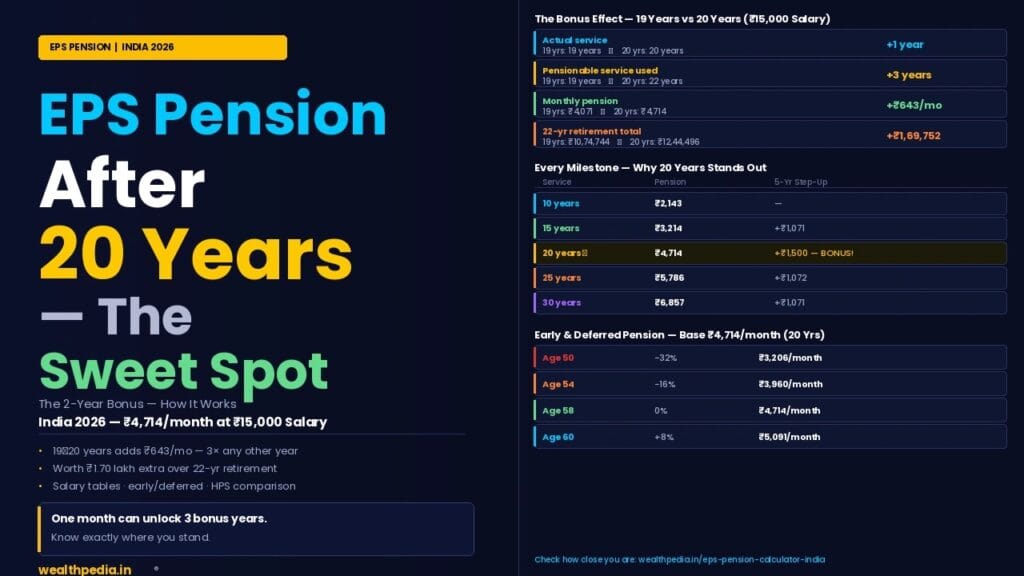
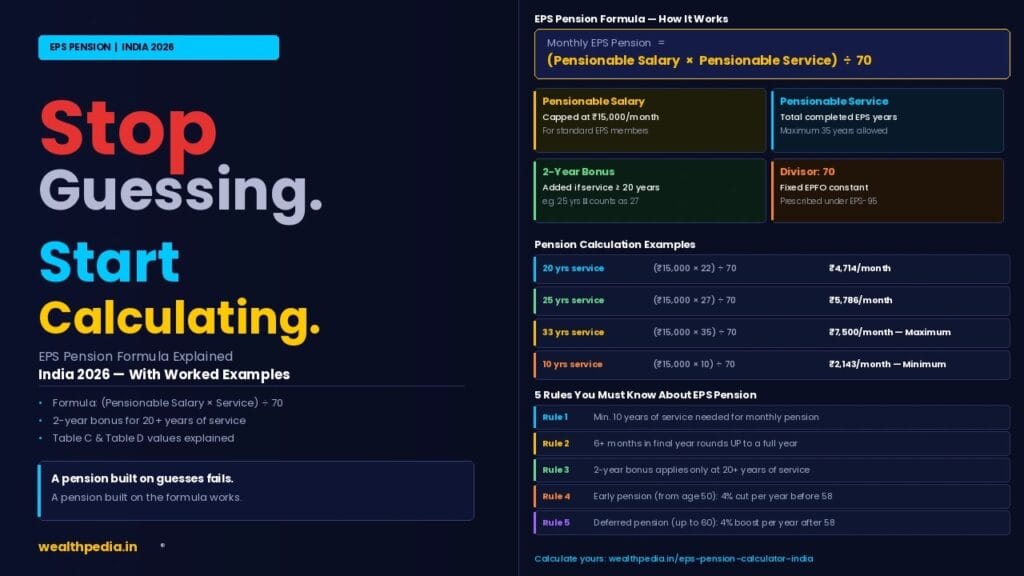
- Paid as a monthly pension for life using the formula: (Pensionable Salary × Pensionable Service) ÷ 70
- Minimum 10 years of service required for monthly pension
- Member cannot withdraw their “EPS balance” after 10 years of service
EPF vs EPS — The Core Difference
The fundamental difference is corpus vs pension:
- EPF → You own a growing pot of money. At retirement, you withdraw the full pot.
- EPS → You do not own a pot. EPFO promises a monthly income for life, calculated by formula.
This distinction has enormous implications for how each fund behaves, what you can do with it, and how it affects your retirement planning.
Contribution Rules — Who Pays What?
This is the most misunderstood aspect of EPF and EPS.
Employee Contribution
- EPF: The employee contributes 12% of basic + DA every month — entirely into their own EPF account
- EPS: The employee contributes 0% — nothing from the employee goes to EPS
Employer Contribution
The employer also contributes 12% of the employee’s basic + DA — but it is split: Employer Contribution Percentage Destination To EPF 3.67% of Basic+DA Employee’s EPF account To EPS 8.33% of Basic+DA (max ₹1,250/month) EPFO pooled pension fund
Total EPF balance per month:
- Employee’s 12% + Employer’s 3.67% = 15.67% of basic+DA goes into your EPF account
EPS per month:
- Employer’s 8.33% (max ₹1,250/month) goes into EPFO’s pension pool — not your personal account
Worked Example at ₹20,000 Basic+DA
| Component | Calculation | Amount |
|---|---|---|
| Employee EPF contribution | 12% × ₹20,000 | ₹2,400 |
| Employer EPF contribution | 3.67% × ₹20,000 | ₹734 |
| Employer EPS contribution | 8.33% × ₹15,000 (capped) | ₹1,250 |
| Total EPF credited to member | ₹2,400 + ₹734 | ₹3,134 / month |
| EPS credited to pool | — | ₹1,250 / month |
Interest Rate — EPF Earns Interest; EPS Does Not
Feature EPF EPS Interest rate 8.25% p.a. (FY 2023–24, declared by EPFO) 0% — no interest Compounding Annual (on monthly average balance) Not applicable Growth Balance grows year on year No corpus growth
Why EPS earns no interest: EPS is a pooled defined-benefit scheme. Contributions are not held individually — they fund current pension payments to existing pensioners. The “return” on EPS contributions is the monthly pension formula, not interest.
This is why EPS contributions do not appear as a growing balance in your passbook — only the EPF portion does.
Retirement Benefit — Lump Sum vs Monthly Pension
| Feature | EPF | EPS |
|---|---|---|
| Benefit type | Lump sum at retirement | Monthly pension for life |
| Amount | Full accumulated corpus + interest | (Pensionable Salary × Pensionable Service) ÷ 70 |
| Payment timing | One-time on withdrawal | Monthly, for life |
| Survivor benefit | Nominee receives full balance | Family pension (50% widow, 25% child) |
| Maximum benefit | No ceiling — grows with contributions | ₹7,500/month (standard) |
Withdrawal Rules — Key Differences
EPF Withdrawal
- Full withdrawal allowed at retirement (age 58) or 2 months after leaving employment
- Partial withdrawal allowed for specific purposes (house purchase, medical, marriage, education) before retirement
- Tax-free if continuous service ≥ 5 years
- Filed via Form 19 online at EPFO UAN portal
EPS Withdrawal
| Service Duration | Option |
|---|---|
| Less than 10 years | Table D lump-sum withdrawal benefit (via Form 10C) OR Scheme Certificate |
| 10 years or more | No withdrawal — monthly pension only (via Form 10D from age 50–60) |
Critical rule: Once you complete 10 years of EPS service, you cannot withdraw EPS. You must take the monthly pension. There is no EPF-style withdrawal for EPS after crossing the 10-year threshold.
For the complete EPS withdrawal rules, see EPS Withdrawal Benefit Calculator.
Tax Treatment
EPF
| Scenario | Tax Treatment |
|---|---|
| Employee contribution | Tax deduction under Section 80C (up to ₹1.5 lakh) |
| Employer contribution | Tax-free up to 12% of salary (excess taxable) |
| Interest earned | Tax-free up to ₹2.5 lakh contribution/year (excess interest taxable) |
| Withdrawal after 5 years | Fully tax-exempt under Section 10(12) |
| Withdrawal before 5 years | Taxable as salary income |
EPS
| Scenario | Tax Treatment |
|---|---|
| Employer EPS contribution | No 80C benefit to employee (it is employer’s contribution) |
| Monthly EPS pension | Taxable as “Income from Other Sources” at slab rate |
| Table D withdrawal (5+ yrs) | Tax-exempt under Section 10(12) |
| Table D withdrawal (below 5 yrs) | Taxable as salary income |
Account Structure — Personal vs Pooled
| Feature | EPF | EPS |
|---|---|---|
| Account type | Personal account | Pooled fund — no personal account |
| Balance visibility | Full balance in EPFO passbook | EPS contribution column shows monthly credit only |
| Interest shown | Yes — annual interest added | No — no interest component |
| Transferable | Yes — via Form 13 on job change | Automatic via UAN transfer (service carries forward) |
| Multiple employer service | Cumulative balance | Cumulative service years |
Minimum Service Requirements
| Feature | EPF | EPS |
|---|---|---|
| For withdrawal | 2 months after leaving | Any — Table D applies below 10 yrs |
| For full benefit | No minimum — withdraw anytime | 10 years minimum for monthly pension |
| Service counting | Not applicable (corpus grows regardless) | Completed years only (rounding rules apply) |
What Happens to Each Fund When You Leave a Job?
EPF on Job Change
- Transfer via Form 13 (online via UAN) to new employer’s PF trust or EPFO account
- Balance carries forward with accumulated interest
- Alternatively, withdraw after 2 months of unemployment (tax implications apply)
EPS on Job Change
- Automatic carry-forward if transferred via UAN to new employer
- If not transferred: apply for Scheme Certificate via Form 10C to preserve service
- OR withdraw lump sum via Form 10C (Table D) — but this permanently ends that service period’s EPS eligibility
See Scheme Certificate vs EPS Withdrawal for the critical decision between preserving and withdrawing EPS on job change.
What Happens at Retirement?
At standard retirement (age 58), you receive both EPF and EPS benefits simultaneously — they are independent: Fund Retirement Benefit How to Claim EPF Full corpus (all contributions + compound interest) Form 19 — one-time lump sum EPS Monthly pension for life Form 10D — monthly credits
You do not have to choose between EPF and EPS at retirement — both are received. Filing Form 19 (EPF) and Form 10D (EPS) can be done simultaneously through the EPFO UAN portal.
EPF Corpus Estimate vs EPS Pension — A 25-Year Career Example
Consider an employee with ₹20,000 basic+DA, who joins at 33 and retires at 58 (25 years of service):
EPF Corpus (Approximate)
- Monthly EPF credit: ₹3,134 (employee ₹2,400 + employer ₹734)
- Annual contribution: ₹37,608
- Over 25 years at 8.25% compound interest:
- Approximate EPF corpus at retirement: ₹30–35 lakh
EPS Monthly Pension
- Pensionable Salary: ₹15,000 (capped)
- Pensionable Service: 25 + 2 bonus = 27 years
- Monthly Pension = (15,000 × 27) ÷ 70 = ₹5,786/month
- Over 22 years of retirement: ₹15.27 lakh total
Combined Retirement Package
- EPF lump sum: ₹30–35 lakh (invest for income)
- EPS pension: ₹5,786/month guaranteed for life
- Together: A substantial retirement foundation — EPF for capital needs, EPS for monthly floor income
Use the EPS Pension Calculator India for your EPS amount and the Financial Health Score to assess your overall retirement readiness.
EPF vs EPS — Complete Comparison Table
| Feature | EPF | EPS |
|---|---|---|
| Full form | Employees’ Provident Fund | Employees’ Pension Scheme |
| Type | Defined contribution | Defined benefit |
| Employee contribution | 12% of Basic + DA | 0% |
| Employer contribution | 3.67% of Basic + DA | 8.33% of Basic + DA (max ₹1,250/month) |
| Account structure | Personal account | Pooled fund |
| Interest | 8.25% p.a. (FY24) | None |
| Retirement benefit | Lump sum corpus | Monthly pension for life |
| Formula | Contributions + interest | (Salary × Service) ÷ 70 |
| Minimum service | None | 10 years (for monthly pension) |
| Withdrawal (< 10 yrs) | Anytime after 2 months | Table D lump sum or Scheme Certificate |
| Withdrawal (10+ yrs) | Yes — full corpus | No — pension only |
| Maximum benefit | No ceiling | ₹7,500/month (standard) |
| Tax on withdrawal | Exempt if 5+ years service | Exempt if 5+ years service |
| Tax on pension | Not applicable | Taxable as income |
| Claim form | Form 19 | Form 10D (pension) / Form 10C (withdrawal) |
| Nominee benefit | Corpus paid to nominee | Family pension (50% widow / 25% child / 75% orphan) |
| Transfer on job change | Form 13 | Automatic via UAN or Scheme Certificate |
| Legal protection | Exempt from attachment | Exempt from attachment |
| Governed by | EPF & MP Act, 1952 | EPS-95 Scheme |
Frequently Asked Questions — EPF vs EPS
What is the difference between EPF and EPS?
EPF is a personal savings fund — your contributions accumulate with compound interest and are paid as a lump sum at retirement. EPS is a pooled pension fund — employer contributions fund a defined monthly pension for life, calculated by formula. Employee contributes 12% to EPF; nothing to EPS. Employer contributes 3.67% to EPF and 8.33% (max ₹1,250) to EPS.
Does the employee contribute to EPS?
No. The employee’s 12% contribution goes entirely into their own EPF account. The employer’s 8.33% of basic+DA (capped at ₹15,000) goes to EPFO’s pooled EPS pension fund — not the employee’s personal account.
Can I withdraw both EPF and EPS at retirement?
You receive both — but differently. EPF is withdrawn as a full lump sum (Form 19). EPS becomes a monthly pension for life (Form 10D) if you have 10+ years of service. If EPS service is below 10 years, you can withdraw a lump sum via Form 10C (Table D). They are separate funds and separate claims.
Which is better — EPF or EPS?
They serve different purposes and are not alternatives — they are complementary. EPF builds capital wealth (lump sum). EPS provides income security (monthly floor). The combination of EPF corpus + EPS pension forms a balanced retirement package. You cannot opt into one and out of the other — both are mandatory for eligible employees.
Does EPS earn interest like EPF?
No. EPF earns interest at the EPFO-declared rate (8.25% p.a. for FY 2023–24). EPS earns no interest — contributions go into a pooled fund and the return is the pension formula, not interest accumulation. This is why your EPFO passbook shows a growing EPF balance but only monthly EPS contribution entries with no interest column.
What is the EPS contribution cap?
The EPS contribution is capped at 8.33% of ₹15,000 = ₹1,250/month. Even if your basic+DA is ₹1,00,000, the employer’s EPS contribution is capped at ₹1,250/month (unless the Higher Pension Scheme applies). The excess above ₹1,250 goes into a government subsidy or EPF, depending on the employer’s structure.
Can I see my EPS balance on the EPFO passbook?
EPS does not have a “balance” — it is a pooled fund with no personal account. Your EPFO passbook shows the monthly EPS contribution made by your employer (₹1,250 maximum). There is no interest column or accumulated balance for EPS. The only way to know your EPS pension entitlement is to use the formula or the EPS Pension Calculator India.
If I withdraw EPF, do I also withdraw EPS?
Not automatically. EPF and EPS are separate claims. Withdrawing EPF via Form 19 does not close your EPS account. For EPS, you must separately file Form 10C (for withdrawal if under 10 years) or Form 10D (for pension if 10+ years and eligible age reached). Many employees withdraw EPF but are unaware they also need to address their EPS separately.
Is EPF corpus included in the EPS pension calculation?
No. The EPF corpus (your savings pot) is completely irrelevant to EPS pension calculation. EPS pension is based solely on pensionable salary and pensionable service — not on how much you saved in EPF. The two funds operate on entirely different principles.
What happens to EPF and EPS if I die while employed?
EPF: The nominee receives the full EPF corpus (employee + employer contributions + interest) via Form 20. EPS: The family receives survivor pension — widow gets 50% of member’s pension, children get 25% each. No minimum service is required for EPS family pension. See EPS Family Pension Rules.
How do I transfer EPF and EPS when switching jobs?
For EPF: File Form 13 online through the EPFO UAN portal — the balance transfers to your new employer’s PF account. For EPS: If you use the same UAN and your new employer links to it, EPS service carries forward automatically. No separate EPS transfer form is needed if UAN is continuous. See EPS Pension Eligibility Rules for service accumulation across employers.
What is the EPF interest rate for 2024?
The EPFO declared EPF interest rate for FY 2023–24 is 8.25% per annum, compounded annually on the monthly average balance. The rate is declared each year by the EPFO Central Board of Trustees and may vary. EPS has no interest rate — it is a defined-benefit scheme.
What is the maximum EPF corpus I can accumulate?
There is no ceiling on EPF corpus — it grows with contributions and compound interest throughout your career. An employee earning ₹50,000 basic+DA for 30 years at 8.25% interest could accumulate ₹1–1.5 crore or more in EPF. EPS, by contrast, has a maximum pension of ₹7,500/month under standard rules.
Can I increase my EPF contribution voluntarily?
Yes — through the Voluntary Provident Fund (VPF), you can contribute more than the mandatory 12% to your EPF account. VPF contributions earn the same interest as EPF (8.25%). You cannot voluntarily increase EPS contributions — the 8.33% employer contribution to EPS is fixed.
Is EPS better than NPS?
They are different instruments for different situations. EPS is mandatory for EPF-covered employees (no choice), formula-based, government-guaranteed, not market-linked, and has no contribution flexibility. NPS is voluntary, market-linked, offers higher potential returns, has tax benefits, and provides more control over fund selection. For FIRE planning that incorporates both, use the Multi-Goal FIRE Planner.
Does EPF include EPS?
Colloquially, people say “EPF” to mean the entire EPFO account — but technically, EPF and EPS are two separate funds within the EPFO framework. When someone says “EPF contribution,” the employer’s 12% actually goes to both EPF (3.67%) and EPS (8.33%), but only the EPF portion (plus employee’s 12%) appears as personal savings in your passbook.
What is Form 19 and Form 10D — and which is for EPF vs EPS?
Form 19 is for claiming the EPF corpus (lump sum withdrawal). Form 10D is for claiming EPS monthly pension. Both are filed online via the EPFO UAN portal and can be submitted simultaneously at retirement. Form 10C is for EPS withdrawal benefit (below 10 years service) or Scheme Certificate.
If I leave a job after 3 years, what happens to my EPF and EPS?
EPF: Transfer to new employer via Form 13, or withdraw via Form 19 after 2 months (taxable if service < 5 years). EPS: Take Table D withdrawal benefit via Form 10C (3-year factor = 3.10 × ₹15,000 = ₹46,500), or take a Scheme Certificate to preserve service. The EPS Withdrawal Benefit Calculator computes your exact Table D amount.
Does EPF include employer contribution?
Yes. Your EPF balance includes: (1) your own 12% contribution, (2) the employer’s 3.67% EPF contribution, and (3) compound interest on both. The employer’s 8.33% goes to EPS (not EPF) and does not appear as your EPF balance — this is why many employees think their EPF balance is “missing” the full 12% employer contribution.
Can I opt out of EPS but stay in EPF?
Generally no — for employees earning up to ₹15,000 at the time of joining, EPS membership is mandatory alongside EPF. Employees earning above ₹15,000 at joining may be categorised as “excluded employees” for EPS but still participate in EPF. Practically, most EPF-enrolled employees are also in EPS.
What is the difference between EPF passbook balance and EPS?
Your EPF passbook shows: (1) employee EPF contributions (12%), (2) employer EPF contributions (3.67%), (3) annual interest on both. The EPS column shows only the monthly employer EPS contribution (max ₹1,250) — no interest, no balance, no corpus. These are two different financial instruments shown on the same passbook.
Can a self-employed person join EPF and EPS?
No. EPF and EPS are mandatory schemes for employees in covered establishments. Self-employed individuals, freelancers, and proprietors cannot join EPF or EPS. Voluntary alternatives include PPF (for savings) and NPS (for pension). See Financial Health Score for retirement planning options across employment types.
What if my employer is not depositing EPS contributions?
Your employer is legally required to deposit EPS contributions (8.33% of basic+DA, max ₹1,250) every month. If EPS contributions are missing from your passbook, raise a complaint via EPFO’s EPFiGMS portal at epfigms.gov.in. EPFO can compel the employer to pay arrears with interest and penalty.
How do EPF and EPS work together in retirement planning?
EPF provides the capital — a lump sum that can be invested to generate income. EPS provides the floor — a guaranteed monthly income regardless of market conditions. Together they form a powerful base: EPF handles large expenses and investment corpus; EPS covers monthly living costs without market risk. The Multi-Goal FIRE Planner can help you model how both fit into your overall retirement plan.
Where can I compute my EPS pension to understand how it compares with my EPF corpus?
Use the free EPS Pension Calculator India on Wealthpedia to compute your monthly EPS pension. For EPF corpus estimation, use the SIP Comparison Calculator at wealthpedia.in with EPF-equivalent inputs. Seeing both numbers together gives you a complete picture of your EPFO retirement benefit.
Disclaimer: The information on this page is for educational purposes only and does not constitute investment or financial advice. EPF and EPS rules are governed by EPFO regulations and may be updated by the Government of India. Interest rates are subject to annual revision by the EPFO Central Board of Trustees. For personalised guidance, consult a SEBI-registered financial planner or visit your nearest EPFO office. Wealthpedia™ (Trademark Reg. No. 4910385) is not a SEBI-registered investment advisor. All mutual fund references on this site are for Direct Plan, Growth option only.

Vishal Jhaveri is the founder of Wealthpedia and an MBA Finance professional with over 10 years of experience in financial planning, investing, and wealth creation. He specializes in FIRE (Financial Independence, Retire Early), retirement planning, investing, and personal finance education. Through Wealthpedia, he develops financial calculators and publishes evidence-based content to help Indian investors make informed financial decisions. He regularly reviews and updates Wealthpedia articles to reflect changes in tax, laws, investment regulations, and personal finance best practices.
Quick Wrap up