
Thirty years of EPS-covered service places an employee within touching distance of the absolute maximum EPS pension. With the 2-year bonus already factored in from the 20-year threshold, 30 actual years translates to 32 pensionable years in the formula — delivering a pension that is over 91% of the maximum achievable under standard EPS rules.
For employees who have reached this milestone, the question shifts from “how much pension will I get” to “is it worth pushing the final 3 years to reach the absolute maximum.” This article answers both questions in full detail.
Use the EPS Pension Calculator India to compute your exact pension based on your real service dates and salary, including the bonus and rounding rules.
Quick Summary
After 30 years of EPS-covered service, the 2-year bonus brings pensionable service to 32 years. At the ₹15,000 wage ceiling, the monthly pension is ₹6,857/month — calculated as (15,000 × 32) ÷ 70. This is just ₹643/month short of the absolute maximum standard pension of ₹7,500/month (achieved at 33 years), making 30 years a near-maximum milestone. Over a 22-year retirement, this delivers approximately ₹18.10 lakh in total nominal pension income. This article explains the calculation, salary-wise tables, early and deferred pension comparisons, the final push to maximum pension, and the complete retirement picture combining EPF and EPS. Use the EPS Pension Calculator India to verify your figure.
Join Now →
EPS Pension After 30 Years — The Calculation
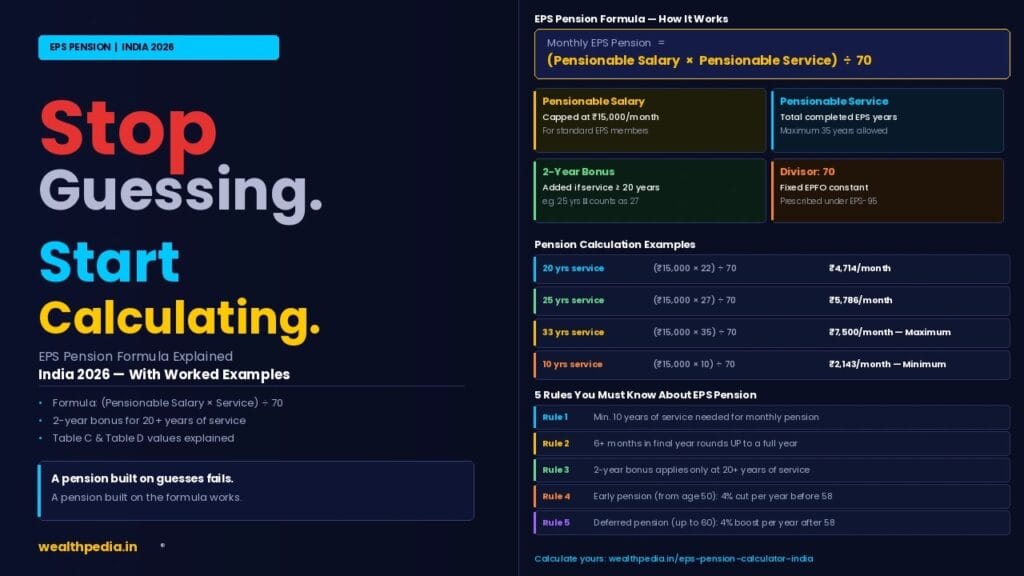
Monthly EPS Pension = (Pensionable Salary × Pensionable Service) ÷ 70
For 30 years of actual service:
- Pensionable Salary: ₹15,000 (wage ceiling for most employees)
- Actual Service: 30 years
- 2-Year Bonus: YES — applies because service ≥ 20 years
- Pensionable Service used in formula: 30 + 2 = 32 years
- Divisor: 70 (fixed)
Monthly Pension = (15,000 × 32) ÷ 70 = ₹6,857.14 ≈ ₹6,857/month
This is one of the strongest standard EPS pension outcomes available — 91.4% of the absolute maximum (₹7,500/month, achieved at 33 years of actual service). For the complete formula breakdown, see EPS Pension Formula Explained.
How Close Is 30 Years to the Maximum?
The maximum standard EPS pension is achieved at 33 years of actual service (which becomes 35 pensionable years with the bonus — the absolute cap). At 30 years, you are:
- 3 actual years away from the maximum
- ₹643/month away from the maximum pension (₹7,500 − ₹6,857)
- 91.4% of the way to the ceiling
| Service | Pensionable Service | Monthly Pension | % of Maximum |
|---|---|---|---|
| 25 years | 27 | ₹5,786 | 77.2% |
| 28 years | 30 | ₹6,429 | 85.7% |
| 30 years | 32 | ₹6,857 | 91.4% |
| 31 years | 33 | ₹7,071 | 94.3% |
| 32 years | 34 | ₹7,286 | 97.1% |
| 33 years | 35 (max) | ₹7,500 | 100% |
The final 3 years (30 to 33) each add ₹214/month — a smaller absolute step compared to earlier milestones, but still a meaningful and guaranteed return for continued service.
EPS Pension After 30 Years — Salary-Wise Calculation Table
For employees whose pensionable salary is below the ₹15,000 ceiling, here is the pension at 30 years of service (32 pensionable years with bonus):
| Monthly Pensionable Salary | Pensionable Service (with bonus) | Monthly EPS Pension |
|---|---|---|
| ₹6,500 | 32 years | ₹2,971/month |
| ₹8,000 | 32 years | ₹3,657/month |
| ₹10,000 | 32 years | ₹4,571/month |
| ₹12,000 | 32 years | ₹5,486/month |
| ₹14,000 | 32 years | ₹6,400/month |
| ₹15,000 | 32 years | ₹6,857/month |
Even at a relatively modest pensionable salary of ₹8,000, 30 years of service delivers ₹3,657/month — a substantial guaranteed monthly income. For context on the EPFO minimum pension guarantee, see What Is the Minimum EPS Pension in India?
EPS Pension After 30 Years — Compared to Neighbouring Milestones
| Actual Service | Pensionable Service (with bonus) | Monthly Pension | Difference from 30 Years |
|---|---|---|---|
| 20 years | 22 | ₹4,714 | −₹2,143 |
| 25 years | 27 | ₹5,786 | −₹1,071 |
| 30 years | 32 | ₹6,857 | — |
| 33 years | 35 (max) | ₹7,500 | +₹643 |
The pattern of ₹214/month per actual year holds consistently from 20 years onward (since the bonus is already baked in). Each 5-year jump (20→25, 25→30) adds approximately ₹1,071–1,072/month — the steady, predictable growth rate that defines the post-bonus phase of EPS pension accumulation.
For the complete 25-year analysis, see EPS Pension After 25 Years.
29 Years vs 30 Years — The Single-Year Step
| Parameter | 29 Years | 30 Years | Difference |
|---|---|---|---|
| Pensionable Service Used | 31 | 32 | +1 year |
| Monthly Pension | ₹6,643 | ₹6,857 | +₹214/month |
| Annual Pension | ₹79,716 | ₹82,284 | +₹2,568/year |
| Over 22-year Retirement | ₹17,53,752 | ₹18,10,248 | +₹56,496 |
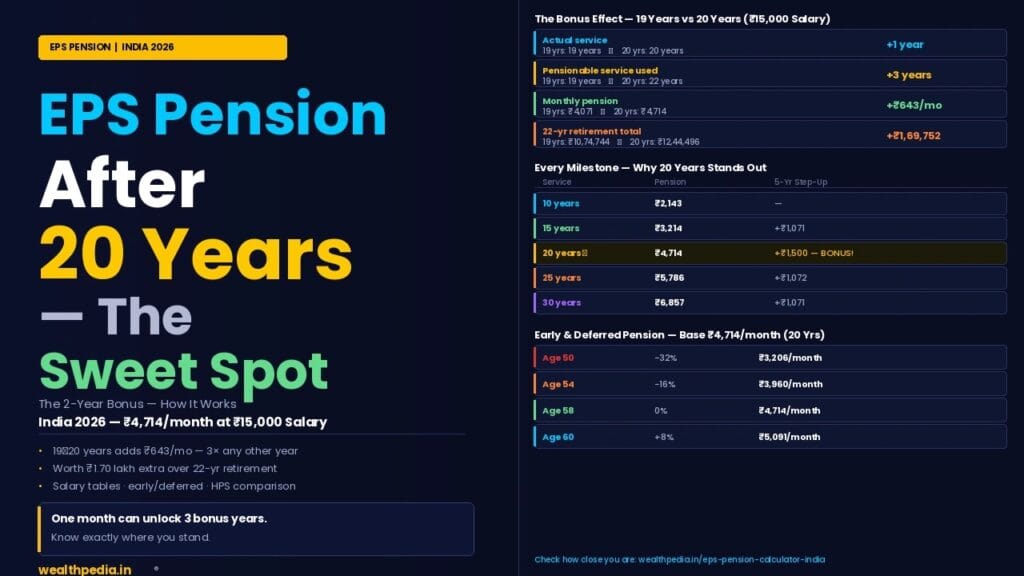
Unlike the dramatic 19→20 year jump (worth ₹643/month due to bonus activation), the 29→30 year step is a standard single-year increment of ₹214/month. By this stage of the career, the bonus has already been “spent” — every additional year now contributes its straightforward proportional share.
EPS Pension After 30 Years — Early Pension Options (Age 50–57)
Members with 30 years of service who have ceased EPF-covered employment can claim pension early from age 50, with a permanent 4% per year reduction before 58.
Early Pension = Base Pension × (1 − 0.04 × years before 58)
Early Pension Table — Base Pension ₹6,857/month (30 Years, ₹15,000 Salary)
| Claim Age | Years Before 58 | Reduction | Monthly Pension | Annual Pension |
|---|---|---|---|---|
| 58 (standard) | 0 | 0% | ₹6,857 | ₹82,284 |
| 57 | 1 | 4% | ₹6,583 | ₹78,996 |
| 56 | 2 | 8% | ₹6,309 | ₹75,708 |
| 55 | 3 | 12% | ₹6,034 | ₹72,408 |
| 54 | 4 | 16% | ₹5,760 | ₹69,120 |
| 53 | 5 | 20% | ₹5,486 | ₹65,832 |
| 52 | 6 | 24% | ₹5,211 | ₹62,532 |
| 51 | 7 | 28% | ₹4,937 | ₹59,244 |
| 50 | 8 | 32% | ₹4,663 | ₹55,956 |
At 30 years of service, even the maximum early pension reduction (32% at age 50) still delivers ₹4,663/month — more than double the un-reduced 10-year pension (₹2,143). This illustrates how a strong service base provides a meaningful floor even under the most aggressive early claim scenario.
For the full early pension break-even analysis, see EPS Early Pension Before 58: Reduction Rules Explained.
EPS Pension After 30 Years — Deferred Pension Options (Age 59–60)
Claim Age Years After 58 Enhancement Monthly Pension Annual Pension 58 (standard) 0 0% ₹6,857 ₹82,284 59 1 4% ₹7,131 ₹85,572 60 2 8% ₹7,405 ₹88,860
This is a particularly significant data point: deferring a 30-year pension to age 60 (₹7,405/month) exceeds the standard, non-deferred maximum pension at 33 years (₹7,500/month) by only ₹95/month — and actually exceeds the standard pension at 30 years claimed at 58 by a wide margin. For an employee at 30 years who can afford to wait 2 more years before claiming, deferral offers a pension nearly equivalent to the absolute career maximum, without needing the additional 3 years of service.
For the complete deferred pension analysis, see Deferred EPS Pension After 58: Benefits Explained.
What If Service Is 30 Years and Some Months?
| Actual Service | Rounded Service | Pensionable Service (with bonus) | Monthly Pension at ₹15,000 |
|---|---|---|---|
| 30 years 3 months | 30 years | 32 | ₹6,857 |
| 30 years 5 months | 30 years | 32 | ₹6,857 |
| 30 years 6 months | 31 years | 33 | ₹7,071 |
| 30 years 9 months | 31 years | 33 | ₹7,071 |
| 29 years 6 months | 30 years | 32 | ₹6,857 |
Crossing 30 years 6 months adds ₹214/month for life — the same standard increment that applies throughout the post-bonus phase. For the complete rounding rules, see What Is Pensionable Service Under EPS?
Lifetime Pension Value at 30 Years
Nominal Lifetime Value by Retirement Duration
| Retirement Duration | Monthly Pension | Total Nominal Pension |
|---|---|---|
| 15 years (age 58–73) | ₹6,857 | ₹12,34,260 |
| 20 years (age 58–78) | ₹6,857 | ₹16,45,680 |
| 22 years (age 58–80) | ₹6,857 | ₹18,10,248 |
| 25 years (age 58–83) | ₹6,857 | ₹20,57,100 |
At ₹6,857/month, an EPS pension built on 30 years of service delivers between ₹12–20 lakh in total nominal lifetime income, depending on longevity — a substantial contribution to retirement security, particularly when combined with EPF corpus and other savings.
Combined Retirement Picture — EPF Corpus + EPS Pension at 30 Years
At 30 years of service with ₹20,000 basic+DA (illustrative):
EPF Corpus (Approximate):
- Monthly EPF credit: ~₹3,134
- Over 30 years at 8.25% compound interest: approximately ₹32–38 lakh
EPS Pension:
- ₹6,857/month for life from age 58
Combined package at 30 years:
- EPF lump sum: ₹32–38 lakh
- EPS pension: ₹6,857/month guaranteed floor income
This combination represents a genuinely strong retirement foundation for a middle-income Indian employee — a substantial lump sum for flexible deployment plus a near-maximum guaranteed pension floor. See EPF vs EPS: Key Differences Explained for the complete breakdown of how both funds interact, and the Financial Health Score tool to assess overall retirement readiness.
Family Pension at 30 Years of Service
On the death of a member with 30 years of EPS service (base pension ₹6,857/month):
| Beneficiary | Rate | Monthly Pension |
|---|---|---|
| Widow / Widower | 50% | ₹3,429/month |
| Each Child (up to 2) | 25% | ₹1,714/month |
| Orphan | 75% | ₹5,143/month |
A widow receiving ₹3,429/month over a typical remaining lifespan represents very substantial financial protection — particularly when the EPF corpus is also available as a lump sum to the family. For the complete family pension rules, see EPS Family Pension Rules Explained.
Should You Push the Final 3 Years to Reach the Maximum?
At 30 years (₹6,857/month), the absolute maximum standard pension (₹7,500/month at 33 years) is only ₹643/month away. This is the smallest remaining gap of any milestone in the entire EPS framework, making the decision relatively low-stakes compared to earlier career decisions (such as the 19-to-20-year threshold).
The Case for Continuing to 33 Years
- ₹643/month for life is still meaningful — over a 22-year retirement, this is approximately ₹1.70 lakh in additional lifetime pension
- Continuing employment for 3 more years also adds substantially to the EPF corpus (potentially ₹4–6 lakh more, depending on salary and tenure)
- If you are already employed and comfortable, there is minimal downside to continuing
The Case for Stopping at 30 Years
- The relative gain (9.4%) is the smallest marginal improvement of any 3-year stretch in the EPS framework
- If health, career opportunities, or personal circumstances favour an earlier exit, the financial cost of stopping at 30 is modest compared to stopping at, say, 18 years (missing the 2-year bonus entirely)
- Deferring the 30-year pension to age 60 (₹7,405/month) achieves nearly the same result as working 3 more years, without the additional employment
The Deferral Alternative
As shown earlier, deferring a 30-year pension claim from 58 to 60 produces ₹7,405/month — higher than continuing to work 3 more years and claiming the 33-year maximum at age 58 (₹7,500/month minus considering you’d be 61 by then in most career timelines). For employees at 30 years who are deciding between “work 3 more years” and “stop now but defer the claim,” deferral often achieves a comparable outcome with less career disruption — though the two are not perfectly substitutable since deferral requires not drawing other EPF-covered income during the deferral period.
For the complete maximum pension analysis at 33+ years, see EPS Pension After 35 Years Service.
Higher Pension Scheme at 30 Years
For HPS-approved members, the pensionable service rules are identical (32 years with bonus). Only the pensionable salary changes:
HPS Examples at 30 Years
| 60-Month Average Salary | Pensionable Service | HPS Monthly Pension | Standard EPS Monthly Pension |
|---|---|---|---|
| ₹30,000 | 32 years | ₹13,714/month | ₹6,857/month |
| ₹50,000 | 32 years | ₹22,857/month | ₹6,857/month |
| ₹75,000 | 32 years | ₹34,286/month | ₹6,857/month |
| ₹1,00,000 | 32 years | ₹45,714/month | ₹6,857/month |
At ₹50,000 average salary, the HPS pension (₹22,857/month) is exactly 3.33× the standard EPS pension for the same 30 years of service — the proportional relationship holds consistently since the formula structure is identical, with only the salary variable changing. For the complete HPS guide, see EPS Higher Pension Scheme: Eligibility & Calculation.
EPS Pension After 30 Years — Quick Reference Summary
| Metric | Value (₹15,000 Salary) |
|---|---|
| Actual Service | 30 years |
| 2-Year Bonus Applies | (+2 years) |
| Pensionable Service Used | 32 years |
| Monthly Pension at 58 | ₹6,857 |
| Monthly Pension at 50 (early, −32%) | ₹4,663 |
| Monthly Pension at 60 (deferred, +8%) | ₹7,405 |
| Annual Pension at 58 | ₹82,284 |
| 22-year retirement total | ₹18,10,248 |
| % of maximum standard pension | 91.4% |
| Remaining to maximum (33 yrs) | +₹643/month |
| Widow pension (50%) | ₹3,429/month |
| Child pension (25% each) | ₹1,714/month |
| Orphan pension (75%) | ₹5,143/month |
Frequently Asked Questions — EPS Pension After 30 Years
How much EPS pension will I get after 30 years of service?
With 30 years of EPS service at the ₹15,000 wage ceiling, your monthly pension is ₹6,857/month. The calculation: 30 years + 2-year bonus = 32 pensionable years; (15,000 × 32) ÷ 70 = ₹6,857. This is 91.4% of the maximum standard EPS pension. Use the EPS Pension Calculator India for your personalised figure.
How close is the 30-year pension to the maximum?
At 30 years, your pension (₹6,857/month) is just ₹643/month short of the absolute maximum standard EPS pension of ₹7,500/month (achieved at 33 years of service). You are at 91.4% of the maximum.
What is the EPS pension for 30 years at ₹10,000 salary?
Pensionable Service = 30 + 2 bonus = 32 years. Monthly Pension = (10,000 × 32) ÷ 70 = ₹4,571/month.
How much more pension do I get by working 3 more years to reach 33 years?
The increase from 30 to 33 years is +₹643/month — from ₹6,857 to ₹7,500. Over a 22-year retirement, this is approximately ₹1.70 lakh in additional lifetime pension income for 3 more years of service.
Can I claim EPS pension at 30 years of service before age 58?
Yes — from age 50, with a 4% reduction per year before 58. At age 50 (8 years early, 32% reduction): ₹6,857 × 0.68 = ₹4,663/month. See EPS Early Pension Before 58 for the full table.
What is the EPS pension for 30 years and 6 months of service?
EPFO rounding: 6 months ≥ 6 → rounds up to 31 years. With the 2-year bonus: 31 + 2 = 33 pensionable years. Monthly Pension = (15,000 × 33) ÷ 70 = ₹7,071/month.
What is the widow pension for a member with 30 years of EPS service?
Widow pension = 50% × ₹6,857 = ₹3,429/month, for life or until remarriage. Each child receives 25% × ₹6,857 = ₹1,714/month (up to 2 children, up to age 25). See EPS Family Pension Rules.
What is the EPS pension at 30 years under the Higher Pension Scheme?
At ₹50,000 average salary (last 60 months): (50,000 × 32) ÷ 70 = ₹22,857/month — over 3.3× the standard EPS pension for the same service. See EPS Higher Pension Scheme.
What is the EPS pension at age 60 (deferred) for 30 years of service?
Base Pension = ₹6,857/month. Deferred to 60 (+8%): ₹6,857 × 1.08 = ₹7,405/month. This is nearly equivalent to the absolute maximum standard pension (₹7,500/month at 33 years), achieved without needing the additional 3 years of service. See Deferred EPS Pension After 58.
Should I stop at 30 years or push to 33 years for maximum pension?
The marginal gain (₹643/month, or 9.4%) is the smallest of any 3-year stretch in the EPS framework. If health, career opportunities, or family circumstances favour stopping at 30, the financial cost is modest. Alternatively, deferring the 30-year pension claim to age 60 achieves nearly the same outcome (₹7,405/month) without the additional 3 years of employment.
What is the EPS pension for 30 years at ₹12,000 salary?
Pensionable Service = 32 years (with bonus). Monthly Pension = (12,000 × 32) ÷ 70 = ₹5,486/month.
Is the 30-year EPS pension taxable?
Yes. Monthly EPS pension is taxable as “Income from Other Sources” under the Income Tax Act at the applicable slab rate. At ₹6,857/month = ₹82,284/year, this may exceed the basic exemption limit depending on other income sources, so some tax liability could apply for retirees with multiple income streams.
What is the total EPS pension income over a 22-year retirement at 30 years of service?
₹6,857/month × 264 months (22 years from age 58 to 80) = ₹18,10,248 in total nominal pension income — one of the strongest standard EPS outcomes available short of the absolute maximum.
What is the EPS pension for 30 years at ₹14,000 salary?
Pensionable Service = 32 years (with bonus). Monthly Pension = (14,000 × 32) ÷ 70 = ₹6,400/month.
Can I withdraw EPS after 30 years of service instead of taking pension?
No. The EPS withdrawal benefit (Table D) is only available for service below 10 years. At 30 years, you must take monthly pension — there is no lump-sum withdrawal option. Pension is payable from age 50 (early, with reduction) or 58 (standard), or 59–60 (deferred, with enhancement).
What is the EPS pension for 30 years and 3 months of service?
EPFO rounding: 3 months < 6 → dropped. Counted as 30 years. Monthly Pension = (15,000 × 32) ÷ 70 = ₹6,857/month — same as exactly 30 years.
How does 30 years compare to working until 35 years (if possible)?
EPFO’s maximum pensionable service cap is 35 years. Since 33 actual years already produces 35 pensionable years (with the 2-year bonus), working beyond 33 years provides no additional pension benefit — the formula input is capped at 35 regardless of additional service. So working from 30 to 33 years adds ₹643/month, but working beyond 33 years (e.g., to 35 or 38 actual years) adds nothing further to the EPS pension.
What is the EPF corpus typically worth alongside 30 years of EPS service?
For an employee with ₹20,000 basic+DA over 30 years, the EPF corpus (employee 12% + employer 3.67%, compounded at approximately 8.25% p.a.) could be approximately ₹32–38 lakh. This is separate from and in addition to the EPS pension of ₹6,857/month. See EPF vs EPS: Key Differences Explained.
If I have 30 years of service across two employers, does the pension calculation change?
No — provided the service was transferred correctly via UAN or preserved via Scheme Certificate, the total combined pensionable service of 30 years (from both employers) qualifies for the same pension of ₹6,857/month, regardless of how many employers contributed to it. See Scheme Certificate vs EPS Withdrawal.
What is the orphan pension for a member with 30 years of EPS service?
If both parents are deceased, orphan pension is 75% of the member’s pension = 75% × ₹6,857 = ₹5,143/month per orphan (maximum 2 orphans simultaneously, up to age 25, or for life if permanently disabled). See EPS Family Pension Rules Explained.
Does my EPS pension at 30 years change if I had a career break earlier in my working life?
Yes — a career break reduces total pensionable service by the gap duration, since only months with actual EPS contributions count. If your career included, for example, a 2-year break, your effective “30 years” of EPS service would have required 32 calendar years of employment to achieve. The pension calculation itself does not penalise you beyond the reduced service count — it simply uses your actual EPS-covered service (30 years in this example) in the formula, regardless of how many calendar years it took to accumulate that service.
What is the EPS pension for 30 years of service if I am a Higher Pension Scheme member with a fluctuating salary in the last 5 years?
Under HPS, pensionable salary is the average of actual basic + DA over the last 60 months — not the final month’s salary. If your salary fluctuated (e.g., due to a promotion mid-period or a temporary pay cut), the 60-month average smooths this out. For example, if your salary was ₹40,000 for 3 years and ₹60,000 for the final 2 years, the weighted 60-month average would be approximately ₹48,000, not ₹60,000. Always verify the exact average using your EPFO salary records.
Is there a difference in how EPFO treats 30 years of pre-2014 service versus post-2014 service for pension calculation?
The pensionable service counting method (months, 6-month rounding rule, 2-year bonus, 35-year cap) is identical regardless of which wage-ceiling era the service falls under. What differs is the pensionable salary — determined by the ceiling applicable at the date of retirement or exit, not a blend across eras. So 30 years of service spanning both the ₹6,500 and ₹15,000 ceiling periods still uses the current ceiling (₹15,000) if the member retires or exits after September 2014, regardless of how many years were under the older, lower ceiling.
How does the 30-year EPS pension compare with a typical NPS annuity for a similar career?
EPS and NPS are structurally different — EPS is a defined-benefit scheme with a fixed formula-based pension, while NPS is a defined-contribution scheme where the final annuity depends on market-linked investment performance and the annuity rate at retirement. A direct comparison depends on individual NPS contribution history and fund performance, but EPS provides a guaranteed, government-backed floor that does not fluctuate with markets — a meaningful complement to NPS or other market-linked retirement instruments. For employees building a comprehensive retirement plan that includes both, the Multi-Goal FIRE Planner on Wealthpedia can help model how guaranteed EPS income interacts with market-linked assets.
Where can I verify my exact pensionable service if I believe I am close to 30 years?
Log in to the EPFO Member Portal at passbook.epfindia.gov.in with your UAN. The EPS contribution column shows monthly credits across your entire career — count the total months and convert to years and months, applying the 6-month rounding rule to determine your exact pensionable service. Alternatively, use the EPS Pension Calculator India by entering your date of joining EPS and your expected or actual exit date — it computes your pensionable service automatically, including the 2-year bonus and rounding rules, and shows your projected monthly pension.
Disclaimer: The information on this page is for educational purposes only and does not constitute investment or financial advice. EPS rules are governed by EPFO regulations under EPS-95 and may be updated by the Government of India. For personalised guidance, consult a SEBI-registered financial planner or visit your nearest EPFO office. Wealthpedia™ (Trademark Reg. No. 4910385) is not a SEBI-registered investment advisor. All mutual fund references on this site are for Direct Plan, Growth option only.

Vishal Jhaveri is the founder of Wealthpedia and an MBA Finance professional with over 10 years of experience in financial planning, investing, and wealth creation. He specializes in FIRE (Financial Independence, Retire Early), retirement planning, investing, and personal finance education. Through Wealthpedia, he develops financial calculators and publishes evidence-based content to help Indian investors make informed financial decisions. He regularly reviews and updates Wealthpedia articles to reflect changes in tax, laws, investment regulations, and personal finance best practices.
Quick Wrap up