
Thirty-five years is the number most associated with “maximum EPS pension” — but the actual mechanics are more nuanced and more important to understand than the headline figure suggests. The maximum pensionable service EPFO recognises is 35 years, and because of the 2-year bonus rule, this ceiling is reached at just 33 actual years of service, not 35.
This distinction matters enormously for career planning: an employee who works exactly 33 years receives the same EPS pension as one who works 38 years. Understanding this cap precisely — what triggers it, what it means, and what continuing to work beyond it actually achieves — is the focus of this article.
Use the EPS Pension Calculator India to compute your exact pension and see exactly when you reach this cap.
Quick Summary
After 35 years of EPS-covered service, members reach the absolute maximum standard EPS pension. However, the critical fact most employees miss is that 33 actual years already produces the maximum — because the 2-year bonus (triggered at 20 years) adds 33 + 2 = 35 pensionable years, hitting EPFO’s hard cap. At the ₹15,000 wage ceiling, this delivers ₹7,500/month, the highest standard EPS pension achievable. Working beyond 33 actual years (to 35, 38, or even 40 years) adds zero additional pension, since the formula input is capped at 35 regardless. This article explains the cap mechanics, salary-wise tables, and what continuing to work beyond 33 years actually gains you (EPF corpus, not EPS pension). Use the EPS Pension Calculator India to verify your figure.
Join Now →
EPS Pension After 35 Years — The Calculation
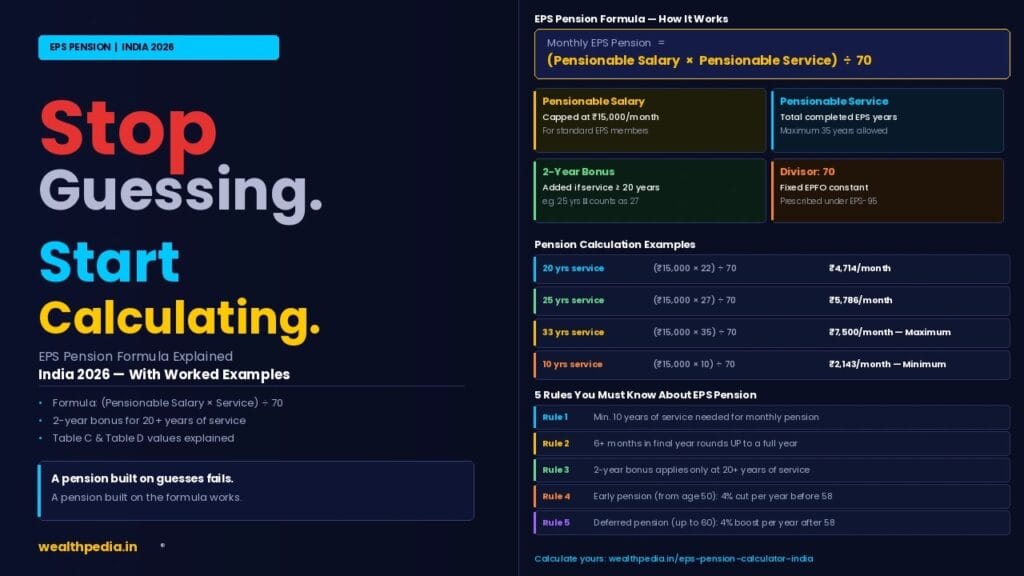
Monthly EPS Pension = (Pensionable Salary × Pensionable Service) ÷ 70
For 35 years of pensionable service (whether achieved via 33 actual years + 2-year bonus, or via 35 actual years with no further headroom):
- Pensionable Salary: ₹15,000 (wage ceiling for most employees)
- Pensionable Service: 35 years (the absolute maximum recognised by EPFO)
- Divisor: 70 (fixed)
Monthly Pension = (15,000 × 35) ÷ 70 = ₹7,500/month
This is the maximum standard EPS pension achievable under the standard wage ceiling. No combination of additional service years or continued contributions beyond this point increases the pension further, since 35 pensionable years is an absolute ceiling under EPS-95.
For the complete formula breakdown, see EPS Pension Formula Explained.
The Critical Insight — 33 Actual Years Already Reaches the Maximum
This is the single most important fact in this article, and one that surprises many long-tenured EPF members:
The 35-year pensionable service cap is reached at just 33 ACTUAL years of service — not 35 — because the 2-year bonus adds 2 more years to any service of 20+ years.
| Actual Years of Service | Pensionable Service (with bonus) | Hits 35-Year Cap? |
|---|---|---|
| 30 years | 32 years | No |
| 31 years | 33 years | No |
| 32 years | 34 years | No |
| 33 years | 35 years | Yes — exactly at cap |
| 34 years | 36 years → capped at 35 | Yes — capped |
| 35 years | 37 years → capped at 35 | Yes — capped |
| 38 years | 40 years → capped at 35 | Yes — capped |
| 40 years | 42 years → capped at 35 | Yes — capped |
Once actual service reaches 33 years, the pension formula input is permanently locked at 35 pensionable years. Every additional year of service beyond 33 — whether it is 1 more year or 10 more years — contributes zero additional EPS pension.
For the complete service-counting rules, see What Is Pensionable Service Under EPS?
Why Does EPFO Cap Pensionable Service at 35 Years?
The 35-year cap exists because EPS is a defined-benefit scheme with finite government and pooled-fund backing. Without a cap, very long-tenured employees (40+ years of service, increasingly common with rising retirement ages) could draw disproportionately large pensions relative to their actual contributions, straining the EPFO pension pool that is shared across all members.
The cap also reflects a practical assumption: most careers, even long ones, rarely exceed 33–35 years of continuous EPF-covered employment when accounting for the typical entry age (22–25) and retirement age (58). The cap was designed to accommodate the vast majority of full careers while preventing edge-case outliers from disproportionately drawing down the pooled fund.
EPS Pension After 35 Years — Salary-Wise Calculation Table
At the maximum 35 pensionable years, here is the pension across different salary levels:
| Monthly Pensionable Salary | Pensionable Service | Monthly EPS Pension |
|---|---|---|
| ₹6,500 | 35 years | ₹3,250/month |
| ₹8,000 | 35 years | ₹4,000/month |
| ₹10,000 | 35 years | ₹5,000/month |
| ₹12,000 | 35 years | ₹6,000/month |
| ₹14,000 | 35 years | ₹7,000/month |
| ₹15,000 | 35 years | ₹7,500/month |
At the maximum pensionable service of 35 years, even an employee with the historical lower ceiling of ₹6,500 still receives ₹3,250/month — and at the current ₹15,000 ceiling, the maximum achievable standard EPS pension is ₹7,500/month. There is no higher standard pension possible beyond this combination of salary ceiling and service cap.
The Complete Path to Maximum Pension
Here is the full progression of pension growth from entry-level service to the maximum, at ₹15,000 pensionable salary:
| Actual Service | Pensionable Service | Monthly Pension | Notes |
|---|---|---|---|
| 10 years | 10 | ₹2,143 | Minimum for pension eligibility |
| 15 years | 15 | ₹3,214 | No bonus yet |
| 19 years | 19 | ₹4,071 | Last year before bonus |
| 20 years | 22 | ₹4,714 | 2-year bonus activates |
| 25 years | 27 | ₹5,786 | Steady post-bonus growth |
| 30 years | 32 | ₹6,857 | 91.4% of maximum |
| 33 years | 35 | ₹7,500 | Maximum reached |
| 35 years | 35 (capped) | ₹7,500 | No further increase |
| 38 years | 35 (capped) | ₹7,500 | No further increase |
| 40 years | 35 (capped) | ₹7,500 | No further increase |
This table reveals the complete shape of EPS pension accumulation: steady linear growth (approximately ₹214/month per year) from 10 years onward, a one-time disproportionate jump at the 20-year bonus threshold, continued steady growth to 33 years, and then a permanent flatline at ₹7,500/month regardless of how many additional years are worked.
For the milestone-specific analyses, see EPS Pension After 20 Years, EPS Pension After 25 Years, and EPS Pension After 30 Years.
What Does Working Beyond 33 Years Actually Achieve?
If EPS pension is fully capped at 33 actual years, what is the financial benefit (if any) of continuing to work in EPF-covered employment for additional years?
1. EPF Corpus Continues to Grow
Unlike EPS, EPF has no cap. Every additional year of employment continues to add to your EPF corpus — both your 12% contribution and the employer’s 3.67% contribution, plus compound interest at the EPFO-declared rate (8.25% p.a. for FY 2023–24). For an employee with ₹20,000 basic+DA, each additional year of work could add approximately ₹45,000–₹55,000 to the EPF corpus (contribution plus interest effects), depending on the corpus size and compounding stage.
See EPF vs EPS: Key Differences Explained for the complete breakdown of how EPF growth is uncapped while EPS is capped.
2. Salary Growth and Career Progression
Continuing employment typically comes with salary increments, promotions, and bonuses — none of which affect EPS pension (which is capped regardless), but all of which improve overall financial position, lifestyle, and savings capacity outside the EPFO system.
3. Deferred Pension Becomes More Valuable
If you reach 33 years of service and your pension is already at the ₹7,500 maximum, deferring the claim from 58 to 60 (rather than continuing to work) adds the 8% enhancement: ₹7,500 × 1.08 = ₹8,100/month — the absolute highest standard EPS pension achievable under any combination of service and deferral. See Deferred EPS Pension After 58: Benefits Explained.
4. No Further EPS-Specific Benefit
Beyond the above, there is no additional EPS pension benefit to working past 33 years. If an employee’s sole motivation for continuing employment is to increase EPS pension, the rational stopping point — from a pure EPS perspective — is 33 actual years of pensionable service.
EPS Pension After 35 Years — Early Pension Options (Age 50–57)
Members at the maximum 35 pensionable years who claim pension before age 58 still face the standard 4% per year reduction.
Early Pension = Maximum Pension × (1 − 0.04 × years before 58)
Early Pension Table — Base Pension ₹7,500/month (Maximum, ₹15,000 Salary)
| Claim Age | Years Before 58 | Reduction | Monthly Pension | Annual Pension |
|---|---|---|---|---|
| 58 (standard) | 0 | 0% | ₹7,500 | ₹90,000 |
| 57 | 1 | 4% | ₹7,200 | ₹86,400 |
| 56 | 2 | 8% | ₹6,900 | ₹82,800 |
| 55 | 3 | 12% | ₹6,600 | ₹79,200 |
| 54 | 4 | 16% | ₹6,300 | ₹75,600 |
| 53 | 5 | 20% | ₹6,000 | ₹72,000 |
| 52 | 6 | 24% | ₹5,700 | ₹68,400 |
| 51 | 7 | 28% | ₹5,400 | ₹64,800 |
| 50 | 8 | 32% | ₹5,100 | ₹61,200 |
Even at the maximum 32% reduction (claiming at age 50), a member with the maximum pensionable service still receives ₹5,100/month — more than double the standard 10-year pension. For the full early pension break-even analysis, see EPS Early Pension Before 58: Reduction Rules Explained.
EPS Pension After 35 Years — Deferred Pension Options (Age 59–60)
Deferred Pension = Maximum Pension × (1 + 0.04 × years after 58)
| Claim Age | Years After 58 | Enhancement | Monthly Pension | Annual Pension |
|---|---|---|---|---|
| 58 (standard) | 0 | 0% | ₹7,500 | ₹90,000 |
| 59 | 1 | 4% | ₹7,800 | ₹93,600 |
| 60 | 2 | 8% | ₹8,100 | ₹97,200 |
₹8,100/month is the absolute highest standard EPS pension achievable under any combination of rules — maximum service (35 years), maximum salary (₹15,000), and maximum deferral (to age 60). No other combination of EPS-95 provisions produces a higher standard pension. For the full deferred pension analysis, see Deferred EPS Pension After 58: Benefits Explained.
Lifetime Value of the Maximum Pension
Nominal Lifetime Value by Retirement Duration
| Retirement Duration | Monthly Pension | Total Nominal Pension |
|---|---|---|
| 15 years (age 58–73) | ₹7,500 | ₹13,50,000 |
| 20 years (age 58–78) | ₹7,500 | ₹18,00,000 |
| 22 years (age 58–80) | ₹7,500 | ₹19,80,000 |
| 25 years (age 58–83) | ₹7,500 | ₹22,50,000 |
At the maximum standard pension, total nominal pension income over a typical 22-year retirement reaches nearly ₹20 lakh — a substantial guaranteed income stream that requires no investment management, carries no market risk, and continues regardless of how financial markets perform during retirement.
Combined Retirement Picture — EPF Corpus + Maximum EPS Pension
At 33+ years of service with ₹20,000 basic+DA (illustrative):
EPF Corpus (Approximate):
- Monthly EPF credit: ~₹3,134
- Over 33 years at 8.25% compound interest: approximately ₹38–45 lakh
EPS Pension:
- ₹7,500/month for life from age 58 (maximum standard pension)
Combined package at maximum service:
- EPF lump sum: ₹38–45 lakh
- EPS pension: ₹7,500/month guaranteed floor income — the highest standard amount possible
This represents the strongest possible standard-EPS retirement outcome for a typical full-career EPF member — without Higher Pension Scheme approval. See EPF vs EPS: Key Differences Explained and the Financial Health Score for a comprehensive retirement readiness assessment.
Family Pension at Maximum Service (35 Years)
On the death of a member with maximum pensionable service (base pension ₹7,500/month):
| Beneficiary | Rate | Monthly Pension |
|---|---|---|
| Widow / Widower | 50% | ₹3,750/month |
| Each Child (up to 2) | 25% | ₹1,875/month |
| Orphan | 75% | ₹5,625/month |
This represents the highest possible standard EPS family pension achievable. For the complete family pension rules, see EPS Family Pension Rules Explained.
Maximum Pension Under the Higher Pension Scheme
For HPS-approved members, the 35-year cap rule is identical — but the salary ceiling is removed, dramatically raising the achievable maximum:
HPS Maximum Examples (35 Pensionable Years)
| 60-Month Average Salary | Pensionable Service | HPS Monthly Pension |
|---|---|---|
| ₹30,000 | 35 years | ₹15,000/month |
| ₹50,000 | 35 years | ₹25,000/month |
| ₹75,000 | 35 years | ₹37,500/month |
| ₹1,00,000 | 35 years | ₹50,000/month |
| ₹1,50,000 | 35 years | ₹75,000/month |
Under HPS, the maximum achievable pension scales directly with salary — a member with ₹1,50,000 average salary and full 35-year service could receive ₹75,000/month, ten times the standard EPS maximum. For the complete HPS guide, see EPS Higher Pension Scheme: Eligibility & Calculation.
What If Service Slightly Exceeds 33 Years?
A common question: does it matter at all whether a member works 33, 35, or 40 years, given the cap?
For EPS pension specifically: no, it does not matter. The pension is identical at ₹7,500/month (standard ceiling) regardless of whether actual service is 33, 35, 38, or 40 years.
For total retirement wealth: yes, it matters significantly. Every additional year of EPF-covered employment continues to:
- Add to the uncapped EPF corpus
- Provide ongoing salary income (which can be saved or invested separately)
- Potentially include continued employer benefits (gratuity calculation base, insurance, etc.)
The decision to continue working past 33 years should be evaluated based on overall career and financial goals — not on the mistaken belief that EPS pension will continue to grow. For employees specifically targeting the maximum EPS pension, 33 actual years is the target, not 35.
EPS Pension After 35 Years — Quick Reference Summary
| Metric | Value (₹15,000 Salary) |
|---|---|
| Pensionable Service Cap | 35 years (absolute maximum) |
| Actual Years Needed to Reach Cap | 33 years (due to 2-year bonus) |
| Monthly Pension at Maximum | ₹7,500 |
| Monthly Pension at 50 (early, −32%) | ₹5,100 |
| Monthly Pension at 60 (deferred, +8%) | ₹8,100 (absolute highest standard pension) |
| Annual Pension at 58 | ₹90,000 |
| 22-year retirement total | ₹19,80,000 |
| Widow pension (50%) | ₹3,750/month |
| Child pension (25% each) | ₹1,875/month |
| Orphan pension (75%) | ₹5,625/month |
| Benefit of working beyond 33 years (EPS only) | None — pension is fully capped |
Frequently Asked Questions — EPS Pension After 35 Years
How much EPS pension will I get after 35 years of service?
The maximum standard EPS pension at 35 pensionable years (achieved with 33+ actual years of service, due to the 2-year bonus) is ₹7,500/month at the ₹15,000 wage ceiling. This is the absolute maximum achievable under standard EPS rules. Use the EPS Pension Calculator India to verify.
Do I need to work 35 actual years to get the maximum pension?
No. Due to the 2-year bonus (triggered at 20+ years of service), only 33 actual years are needed to reach the 35-year pensionable service cap. Working 35, 38, or even 40 actual years produces the exact same EPS pension as working 33 years.
What is the EPS pension for 35 years at ₹10,000 salary?
At the maximum 35 pensionable years: Monthly Pension = (10,000 × 35) ÷ 70 = ₹5,000/month.
Does EPS pension increase if I work more than 33 years?
No. Once pensionable service reaches the 35-year cap (at 33 actual years), additional years of service do not increase the EPS pension further. The formula input is permanently fixed at 35 pensionable years regardless of additional employment.
What is the absolute maximum EPS pension possible?
The absolute maximum standard EPS pension is ₹8,100/month — achieved by combining maximum pensionable service (35 years, reached at 33 actual years), maximum pensionable salary (₹15,000 ceiling), and maximum deferral (to age 60, +8% enhancement): ₹7,500 × 1.08 = ₹8,100.
Why does the 2-year bonus mean I only need 33 years instead of 35?
The 2-year bonus is added to pensionable service once total service reaches 20+ years. At 33 actual years: 33 + 2 (bonus) = 35 pensionable years — already at the cap. This means the bonus effectively “saves” 2 years of work compared to a system without the bonus.
What is the widow pension for a member with maximum EPS service?
Widow pension = 50% × ₹7,500 = ₹3,750/month, for life or until remarriage. Each child receives 25% × ₹7,500 = ₹1,875/month (up to 2 children, up to age 25). See EPS Family Pension Rules.
What is the maximum EPS pension under the Higher Pension Scheme?
There is no fixed maximum under HPS — pension scales directly with actual salary. At 35 pensionable years and ₹1,00,000 average salary: (1,00,000 × 35) ÷ 70 = ₹50,000/month. At ₹1,50,000 average salary: ₹75,000/month. See EPS Higher Pension Scheme.
Is it worth continuing to work past 33 years of EPS service?
For EPS pension specifically, no additional benefit exists — the pension is fully capped. However, continuing employment still grows your uncapped EPF corpus, provides ongoing salary income, and may offer deferred pension benefits if you delay your claim to age 60 instead of continuing to work. Evaluate the decision based on overall financial goals, not EPS pension growth alone.
What is the EPS pension for 33 years and 34 years of service — is there a difference?
No difference. At 33 actual years: 33 + 2 bonus = 35 pensionable years (the cap). At 34 actual years: 34 + 2 bonus = 36, but capped at 35. Both produce the identical pension of ₹7,500/month (at ₹15,000 salary).
Can I claim the maximum EPS pension before age 58?
Yes — from age 50, with a 4% reduction per year before 58. At age 50 (32% reduction): ₹7,500 × 0.68 = ₹5,100/month. See EPS Early Pension Before 58 for the full table.
What is the EPS pension at age 60 (deferred) for maximum service?
Base Pension (maximum) = ₹7,500/month. Deferred to 60 (+8%): ₹7,500 × 1.08 = ₹8,100/month — the absolute highest standard EPS pension achievable.
Is the maximum EPS pension taxable?
Yes. Monthly EPS pension is taxable as “Income from Other Sources” under the Income Tax Act at the applicable slab rate. At ₹7,500/month = ₹90,000/year, this may attract some tax liability depending on the retiree’s total income from all sources, though it remains modest in absolute terms.
What is the total lifetime value of the maximum EPS pension?
Over a 22-year retirement (age 58 to 80): ₹7,500 × 264 months = ₹19,80,000 in total nominal pension income — the highest total achievable under standard EPS rules for a typical retirement duration.
What is the EPS pension for 33 years at ₹12,000 salary?
At 35 pensionable years (33 actual + 2 bonus): Monthly Pension = (12,000 × 35) ÷ 70 = ₹6,000/month.
Does the 35-year cap apply under the Higher Pension Scheme too?
Yes. The pensionable service cap of 35 years applies identically under HPS — only the pensionable salary changes (actual 60-month average instead of ₹15,000 ceiling). The service-counting rules, including the 2-year bonus and the 35-year cap, are unchanged.
What is the EPS pension for 33 years at ₹14,000 salary?
At 35 pensionable years: Monthly Pension = (14,000 × 35) ÷ 70 = ₹7,000/month.
If I have 33 years of service across two employers, do I still reach the maximum?
Yes — provided the service was transferred correctly via UAN or preserved via Scheme Certificate. The total combined pensionable service of 33 years (from both employers, plus the 2-year bonus) reaches the 35-year cap and qualifies for the maximum pension of ₹7,500/month, regardless of how many employers contributed to the total service.
What is the orphan pension at maximum EPS service?
If both parents are deceased, orphan pension is 75% of the member’s pension = 75% × ₹7,500 = ₹5,625/month per orphan (maximum 2 orphans simultaneously, up to age 25, or for life if permanently disabled). See EPS Family Pension Rules Explained.
How much EPF corpus typically accompanies the maximum EPS pension?
For an employee with ₹20,000 basic+DA over 33+ years, the EPF corpus (employee 12% + employer 3.67%, compounded at approximately 8.25% p.a.) could be approximately ₹38–45 lakh. This is separate from and in addition to the maximum EPS pension of ₹7,500/month. See EPF vs EPS: Key Differences Explained.
What if my service crosses 33 years but I want to retire at exactly 35 years for personal reasons?
There is no EPS pension penalty or benefit either way — both 33 and 35 actual years of service produce the identical ₹7,500/month standard pension. Your decision to work until 35 years (rather than stopping at 33) should be based on EPF corpus growth, career goals, and personal financial planning rather than any EPS-specific consideration.
Can pensionable service ever exceed 35 years for calculation purposes?
No. EPFO’s EPS-95 rules cap pensionable service at exactly 35 years for the formula calculation, regardless of how many actual years a member has contributed. Even an employee with 45 years of continuous EPF-covered service would still use 35 pensionable years in the formula.
What is the EPS pension at 33 years for someone on the pre-2014 wage ceiling of ₹6,500?
EPFO uses the pensionable salary ceiling applicable at the date of retirement or exit from EPF-covered employment — not a blend across different ceiling eras. If the member retires after September 2014, the ₹15,000 ceiling applies regardless of how many years were under the earlier ₹6,500 ceiling, giving the maximum pension of ₹7,500/month (not ₹3,250/month, which would apply only if retirement occurred before September 2014).
Is there any way to exceed ₹8,100/month under standard EPS rules?
No. ₹8,100/month (35 pensionable years × ₹15,000 ceiling × 1.08 deferred enhancement) is the absolute mathematical maximum achievable under standard EPS-95 rules. The only way to exceed this figure is through the Higher Pension Scheme, which removes the ₹15,000 salary ceiling entirely for eligible, approved members.
Where can I check exactly how many actual years I need to reach the maximum pension?
Use the EPS Pension Calculator India on Wealthpedia. Enter your date of joining EPS and your salary details — the calculator shows your current pensionable service (including the 2-year bonus if applicable) and projects exactly when you will reach the 35-year cap, typically at 33 actual years for most members who crossed the 20-year bonus threshold.
Disclaimer: The information on this page is for educational purposes only and does not constitute investment or financial advice. EPS rules — including the maximum pensionable service cap — are governed by EPFO regulations under EPS-95 and may be updated by the Government of India. For personalised guidance, consult a SEBI-registered financial planner or visit your nearest EPFO office. Wealthpedia™ (Trademark Reg. No. 4910385) is not a SEBI-registered investment advisor. All mutual fund references on this site are for Direct Plan, Growth option only.

Vishal Jhaveri is the founder of Wealthpedia and an MBA Finance professional with over 10 years of experience in financial planning, investing, and wealth creation. He specializes in FIRE (Financial Independence, Retire Early), retirement planning, investing, and personal finance education. Through Wealthpedia, he develops financial calculators and publishes evidence-based content to help Indian investors make informed financial decisions. He regularly reviews and updates Wealthpedia articles to reflect changes in tax, laws, investment regulations, and personal finance best practices.
Quick Wrap up