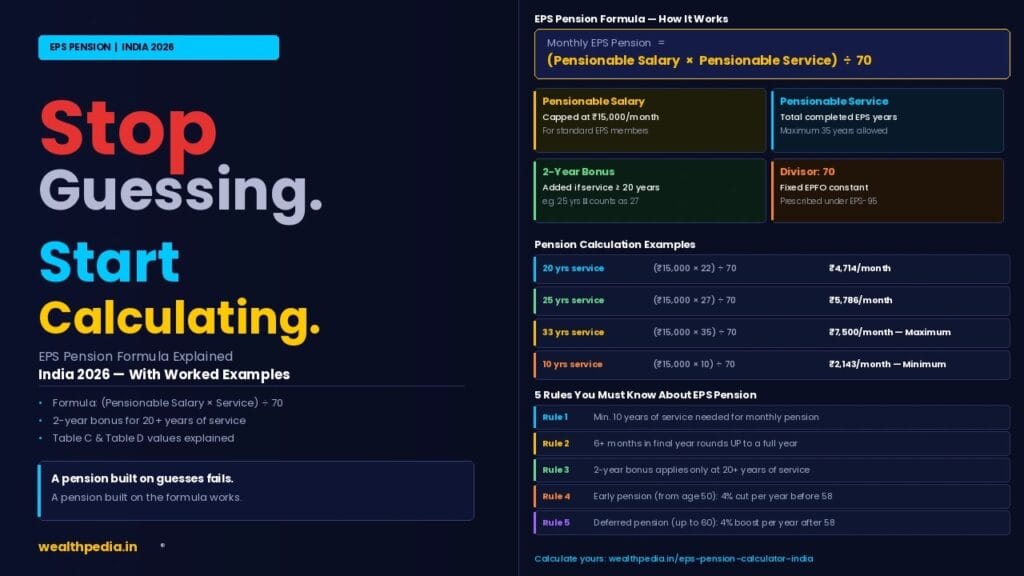

If there is one number that determines the EPS pension for the overwhelming majority of India’s EPF-covered workforce, it is ₹15,000. This is the wage ceiling — the maximum pensionable salary recognised under standard EPS-95 rules — and it applies regardless of whether an employee’s actual basic+DA is ₹15,000, ₹50,000, or ₹2,00,000.
Understanding the pension calculation at this specific salary figure is therefore the single most broadly applicable EPS calculation example in India. This guide walks through exactly how the formula works at ₹15,000, at every important service milestone, with early and deferred pension variations.
Use the EPS Pension Calculator India to compute your pension instantly using your actual service dates.
Quick Summary
₹15,000 is the EPS wage ceiling that applies to the vast majority of Indian EPF-covered employees — meaning their EPS pension is calculated using this figure regardless of their actual salary, as long as it is ₹15,000 or above. At this pensionable salary, monthly EPS pension ranges from ₹2,143/month (10 years service) to ₹7,500/month (maximum, 33+ years service). This article walks through the complete calculation at every major service milestone using the ₹15,000 ceiling, explains why this number matters more than your actual salary for EPS purposes, and covers early and deferred pension options. Use the EPS Pension Calculator India to compute your exact figure.
Join Now →
Why ₹15,000 Is the Most Important Number in EPS
The EPS wage ceiling has been ₹15,000 per month since September 1, 2014. For any EPS member whose basic salary + Dearness Allowance (DA) is ₹15,000 or above, the pensionable salary used in the pension formula is capped at ₹15,000 — regardless of how much higher their actual salary is.
This means:
- An employee earning ₹15,000 basic+DA
- An employee earning ₹50,000 basic+DA
- An employee earning ₹2,00,000 basic+DA
…all have exactly the same pensionable salary (₹15,000) for standard EPS pension calculation purposes, assuming the same service years. Only members approved under the Higher Pension Scheme escape this ceiling — see EPS Higher Pension Scheme: Eligibility & Calculation for that separate calculation track.
For the complete explanation of what counts as pensionable salary and the historical ceiling changes, see What Is Pensionable Salary Under EPS?
The EPS Pension Formula at ₹15,000 Salary
Monthly EPS Pension = (₹15,000 × Pensionable Service) ÷ 70
Since the salary variable is fixed at ₹15,000 for the majority of EPS members, the entire pension calculation simplifies to a function of pensionable service alone. This is why service years — not salary negotiations — are the dominant lever most EPS members have to influence their pension.
Each pensionable year at ₹15,000 salary is worth:
₹15,000 ÷ 70 = ₹214.29 per month
This single number — ₹214.29 — is the building block for every EPS pension calculation at the ₹15,000 ceiling. Multiply it by your pensionable service (including the 2-year bonus, if applicable) to get your monthly pension.
Complete Calculation Table — Every Service Milestone at ₹15,000
| Actual Service | 2-Year Bonus? | Pensionable Service | Monthly Pension Calculation | Monthly Pension |
|---|---|---|---|---|
| 10 years | No | 10 | 10 × ₹214.29 | ₹2,143 |
| 12 years | No | 12 | 12 × ₹214.29 | ₹2,571 |
| 15 years | No | 15 | 15 × ₹214.29 | ₹3,214 |
| 18 years | No | 18 | 18 × ₹214.29 | ₹3,857 |
| 19 years | No | 19 | 19 × ₹214.29 | ₹4,071 |
| 20 years | Yes (+2) | 22 | 22 × ₹214.29 | ₹4,714 |
| 22 years | Yes (+2) | 24 | 24 × ₹214.29 | ₹5,143 |
| 25 years | Yes (+2) | 27 | 27 × ₹214.29 | ₹5,786 |
| 28 years | Yes (+2) | 30 | 30 × ₹214.29 | ₹6,429 |
| 30 years | Yes (+2) | 32 | 32 × ₹214.29 | ₹6,857 |
| 33 years | Yes (+2) | 35 (max) | 35 × ₹214.29 | ₹7,500 |
| 35 years | Yes (+2, capped) | 35 (max) | 35 × ₹214.29 | ₹7,500 |
This table covers virtually every scenario an EPS member at the ₹15,000 ceiling will encounter across a full career. The pattern from 20 years onward is a steady ₹214.29/month increase per additional year, until the 35-year cap is reached at 33 actual years.
For deep dives into each individual milestone, see: EPS Pension After 10 Years, EPS Pension After 15 Years, EPS Pension After 20 Years, EPS Pension After 25 Years, EPS Pension After 30 Years, and EPS Pension After 35 Years.
Worked Example 1 — Entry-Level Pension Eligibility (10 Years)
An employee with exactly 10 years of EPS-covered service at ₹15,000 pensionable salary:
- Pensionable Service: 10 years (no bonus, since service < 20 years)
- Monthly Pension = (15,000 × 10) ÷ 70 = ₹2,143/month
- Annual Pension = ₹25,716
- Over a 22-year retirement (age 58–80): ₹5,65,752 total
This represents the minimum service threshold for monthly pension eligibility — below 10 years, the member would receive only the Table D withdrawal benefit instead.
Worked Example 2 — The 2-Year Bonus Threshold (20 Years)
An employee with exactly 20 years of EPS-covered service at ₹15,000 pensionable salary:
- Actual Service: 20 years
- 2-Year Bonus: Applies (service ≥ 20 years)
- Pensionable Service: 20 + 2 = 22 years
- Monthly Pension = (15,000 × 22) ÷ 70 = ₹4,714/month
- Annual Pension = ₹56,568
- Over a 22-year retirement: ₹12,44,496 total
This is more than double the 10-year pension, despite only doubling the actual service — a direct consequence of the 2-year bonus.
Worked Example 3 — Mid-Career Strength (25 Years)
An employee with 25 years of EPS-covered service at ₹15,000 pensionable salary:
- Actual Service: 25 years
- Pensionable Service: 25 + 2 (bonus) = 27 years
- Monthly Pension = (15,000 × 27) ÷ 70 = ₹5,786/month
- This represents 77.2% of the maximum standard EPS pension
Worked Example 4 — Maximum Standard Pension (33+ Years)
An employee with 33 or more years of EPS-covered service at ₹15,000 pensionable salary:
- Actual Service: 33 years (or more)
- Pensionable Service: capped at 35 years (the absolute maximum)
- Monthly Pension = (15,000 × 35) ÷ 70 = ₹7,500/month
This is the highest standard EPS pension achievable at the ₹15,000 wage ceiling — no combination of additional service years increases this further. See EPS Pension After 35 Years Service for the complete cap mechanics.
Early Pension at ₹15,000 Salary — Reduction Table
Members can claim pension early from age 50, with a 4% reduction per year before 58. Here is the early pension at ₹15,000 salary, 25 years of service (base ₹5,786/month):
| Claim Age | Reduction | Monthly Pension |
|---|---|---|
| 58 (standard) | 0% | ₹5,786 |
| 56 | 8% | ₹5,323 |
| 54 | 16% | ₹4,860 |
| 52 | 24% | ₹4,397 |
| 50 | 32% | ₹3,934 |
For the full early pension analysis at any service level, see EPS Early Pension Before 58: Reduction Rules Explained.
Deferred Pension at ₹15,000 Salary — Enhancement Table
Members can defer their pension claim to age 59 or 60, with a 4% enhancement per year. Here is the deferred pension at ₹15,000 salary, 25 years of service (base ₹5,786/month):
| Claim Age | Enhancement | Monthly Pension |
|---|---|---|
| 58 (standard) | 0% | ₹5,786 |
| 59 | 4% | ₹6,017 |
| 60 | 8% | ₹6,249 |
For the full deferred pension analysis, see Deferred EPS Pension After 58: Benefits Explained.
Why Actual Salary Above ₹15,000 Doesn’t Change Your Pension
This is the most counter-intuitive aspect of EPS for many employees. Consider three employees, all with 25 years of EPS-covered service:
| Employee | Actual Basic + DA | Pensionable Salary | Monthly EPS Pension |
|---|---|---|---|
| Employee A | ₹15,000 | ₹15,000 | ₹5,786 |
| Employee B | ₹40,000 | ₹15,000 (capped) | ₹5,786 |
| Employee C | ₹1,00,000 | ₹15,000 (capped) | ₹5,786 |
All three receive identical EPS pensions despite vastly different salaries. This is because the EPS contribution itself is capped at 8.33% × ₹15,000 = ₹1,250/month for all three employees — none of them are contributing more to EPS despite earning more, so none of them receive a higher pension.
The only way Employee B or C could receive a higher EPS pension is if they had successfully applied for the Higher Pension Scheme before the application window closed, which would use their actual salary instead of the ₹15,000 ceiling.
₹15,000 Salary — Combined with EPF for Full Retirement Picture
While EPS pension is capped at ₹15,000 pensionable salary, EPF has no such cap — it grows based on the employee’s actual basic+DA. This creates an important asymmetry:
For an employee with ₹15,000 actual basic+DA (no ceiling effect on EPF either, since their salary equals the ceiling):
- EPF contribution: 12% (employee) + 3.67% (employer) = 15.67% × ₹15,000 = ₹2,350/month
- Over 25 years at 8.25% compound interest: approximately ₹22–26 lakh
For an employee with ₹50,000 actual basic+DA (EPF uncapped, EPS capped):
- EPF contribution: 15.67% × ₹50,000 = ₹7,835/month
- Over 25 years at 8.25% compound interest: approximately ₹73–87 lakh
- EPS pension: Still capped at ₹5,786/month (identical to the ₹15,000 earner)
This demonstrates why EPF becomes the dominant wealth-building vehicle for higher earners, while EPS provides an identical pension floor regardless of salary level (for standard, non-HPS members). See EPF vs EPS: Key Differences Explained for the complete comparison.
₹15,000 Salary — Family Pension Implications
Family pension is a percentage of the member’s pension — so it follows the same ₹15,000-ceiling logic. At 25 years of service (₹5,786/month base): Beneficiary Rate Monthly Pension Widow / Widower 50% ₹2,893/month Each Child (up to 2) 25% ₹1,447/month Orphan 75% ₹4,340/month
These amounts are identical for any member at the ₹15,000 ceiling, regardless of their actual salary — reinforcing the same “salary above ₹15,000 doesn’t matter” principle for survivor benefits as well. See EPS Family Pension Rules Explained for the complete rules.
What If Your Salary Is Below ₹15,000?
For employees whose actual basic+DA is below ₹15,000, the actual salary (not ₹15,000) is used as the pensionable salary. This results in a proportionally lower pension:
| Actual Salary | Pensionable Service | Monthly Pension |
|---|---|---|
| ₹8,000 | 27 years | ₹3,086/month |
| ₹10,000 | 27 years | ₹3,857/month |
| ₹12,000 | 27 years | ₹4,629/month |
| ₹15,000 | 27 years | ₹5,786/month |
The gap between ₹12,000 and ₹15,000 salary (a ₹3,000 difference) results in a ₹1,157/month difference in pension — illustrating that for employees below the ceiling, every rupee of basic salary matters for EPS purposes.
₹15,000 Salary — Quick Reference Summary
| Service Years | Monthly Pension at ₹15,000 |
|---|---|
| 10 years | ₹2,143 |
| 15 years | ₹3,214 |
| 20 years | ₹4,714 |
| 25 years | ₹5,786 |
| 30 years | ₹6,857 |
| 33+ years (maximum) | ₹7,500 |
| 33+ years, deferred to 60 | ₹8,100 (absolute ceiling) |
Frequently Asked Questions — EPS Pension for ₹15,000 Salary
What is the EPS pension for ₹15,000 salary with 20 years of service?
Pensionable Service = 20 + 2 (bonus) = 22 years. Monthly Pension = (15,000 × 22) ÷ 70 = ₹4,714/month. Use the EPS Pension Calculator India for any service period.
Why is ₹15,000 used even if my actual salary is higher?
₹15,000 is the EPS wage ceiling in effect since September 2014. EPS contributions and pension calculations are capped at this amount for all standard (non-HPS) members, regardless of actual salary. This is because the employer’s EPS contribution itself (8.33%) is capped at 8.33% × ₹15,000 = ₹1,250/month.
What is the maximum EPS pension at ₹15,000 salary?
The maximum is ₹7,500/month, achieved at 33+ years of actual service (which becomes 35 pensionable years with the 2-year bonus). With deferral to age 60, this can reach ₹8,100/month — the absolute ceiling of standard EPS pension.
What is the EPS pension for ₹15,000 salary with 10 years of service?
Monthly Pension = (15,000 × 10) ÷ 70 = ₹2,143/month. This is the minimum service threshold for EPS pension eligibility.
Does my EPS pension increase if my salary rises above ₹15,000?
No — once your basic+DA reaches or exceeds ₹15,000, your pensionable salary is capped at ₹15,000 for standard EPS. Further salary increases have no effect on your EPS pension (though they do increase your EPF corpus, which has no ceiling).
What is the EPS pension for ₹15,000 salary at age 50 (early pension)?
This depends on your service years. For 25 years of service: Base Pension = ₹5,786/month. At age 50 (32% reduction): ₹5,786 × 0.68 = ₹3,934/month. See EPS Early Pension Before 58 for the complete table at any service level.
How is the per-year value of ₹214.29 calculated?
₹214.29 = ₹15,000 ÷ 70. This is the EPS pension formula’s divisor (70) applied to the ₹15,000 ceiling — representing the monthly pension contribution of each single pensionable year at this salary level.
What is the EPS pension for ₹15,000 salary with 30 years of service?
Pensionable Service = 30 + 2 (bonus) = 32 years. Monthly Pension = (15,000 × 32) ÷ 70 = ₹6,857/month — 91.4% of the maximum.
Is the ₹15,000 ceiling likely to be raised soon?
The ceiling has been raised twice historically (₹5,000 to ₹6,500 in 2001, then ₹6,500 to ₹15,000 in 2014). Trade unions and policy committees periodically recommend raising it further, but as of 2026, it remains at ₹15,000. Monitor EPFO notifications for future changes.
What is the widow pension for a member with ₹15,000 salary and 25 years of service?
Widow pension = 50% × ₹5,786 = ₹2,893/month, for life or until remarriage. See EPS Family Pension Rules Explained.
What is the EPS pension for ₹15,000 salary with 15 years of service?
Pensionable Service = 15 years (no bonus, below 20 years). Monthly Pension = (15,000 × 15) ÷ 70 = ₹3,214/month. See EPS Pension After 15 Years.
Can I get a higher EPS pension despite the ₹15,000 ceiling?
Yes — only through the Higher Pension Scheme (HPS), which was available to members who were EPFO contributors before November 1, 2022 and whose employer contributed on actual salary above ₹15,000. The application window has closed. See EPS Higher Pension Scheme for eligibility details.
What is the EPS pension for ₹15,000 salary with 19 years of service (just before the bonus)?
Pensionable Service = 19 years (no bonus yet, since service < 20 years). Monthly Pension = (15,000 × 19) ÷ 70 = ₹4,071/month. Just 1 more year (to 20 years) would push this to ₹4,714/month — a jump of ₹643 due to the bonus activating.
What is the EPF contribution at ₹15,000 salary?
Employee contribution: 12% × ₹15,000 = ₹1,800/month. Employer EPF contribution: 3.67% × ₹15,000 = ₹551/month. Total EPF credit: ₹2,351/month. Employer EPS contribution: 8.33% × ₹15,000 = ₹1,250/month (separate from EPF). See EPF vs EPS: Key Differences Explained.
What is the EPS pension at ₹15,000 salary deferred to age 60, with 30 years of service?
Base Pension (30 years) = ₹6,857/month. Deferred to 60 (+8%): ₹6,857 × 1.08 = ₹7,405/month — very close to the absolute maximum (₹7,500), without needing the additional 3 years of service. See Deferred EPS Pension After 58.
Is ₹15,000 the gross salary or basic salary?
Neither, technically — it refers specifically to basic salary + Dearness Allowance (DA), not gross salary. HRA, conveyance, special allowances, and bonuses are excluded from this calculation. See What Is Pensionable Salary Under EPS? for the complete component breakdown.
What is the EPS pension for ₹15,000 salary with exactly 33 years of service?
Pensionable Service = 33 + 2 (bonus) = 35 years (the absolute maximum). Monthly Pension = (15,000 × 35) ÷ 70 = ₹7,500/month — the highest standard EPS pension achievable. See EPS Pension After 35 Years.
How does the ₹15,000 ceiling compare across pre-2014 and post-2014 retirees?
Members retiring after September 2014 use the ₹15,000 ceiling regardless of how many years of their career were spent under the older ₹6,500 ceiling. EPFO uses the ceiling applicable at the date of retirement or exit, not a blended average across ceiling eras.
What is the total lifetime EPS pension value at ₹15,000 salary and 25 years of service?
Monthly Pension = ₹5,786. Over a 22-year retirement (age 58–80): ₹5,786 × 264 months = ₹15,27,504 in total nominal pension income.
Where can I compute my exact EPS pension if my salary is at or above ₹15,000?
Use the free EPS Pension Calculator India on Wealthpedia. Since the ₹15,000 ceiling applies to the vast majority of EPF-covered employees, entering your service dates alone (regardless of your exact salary above ₹15,000) gives you an accurate pension projection using the formula explained in this article.
Disclaimer: The information on this page is for educational purposes only and does not constitute investment or financial advice. EPS rules and the ₹15,000 wage ceiling are governed by EPFO regulations under EPS-95 and may be updated by the Government of India. For personalised guidance, consult a SEBI-registered financial planner or visit your nearest EPFO office. Wealthpedia™ (Trademark Reg. No. 4910385) is not a SEBI-registered investment advisor. All mutual fund references on this site are for Direct Plan, Growth option only.

Vishal Jhaveri is the founder of Wealthpedia and an MBA Finance professional with over 10 years of experience in financial planning, investing, and wealth creation. He specializes in FIRE (Financial Independence, Retire Early), retirement planning, investing, and personal finance education. Through Wealthpedia, he develops financial calculators and publishes evidence-based content to help Indian investors make informed financial decisions. He regularly reviews and updates Wealthpedia articles to reflect changes in tax, laws, investment regulations, and personal finance best practices.
Quick Wrap up