
The Employees’ Pension Scheme (EPS-95) is one of India’s most important but least understood retirement benefits. With over 6 crore active members and millions more receiving pension, EPS affects a vast portion of India’s organised-sector workforce — yet many members retire without fully understanding what they are entitled to, or make avoidable mistakes that permanently reduce their pension.
This FAQ hub brings together 50 of the most commonly asked questions about EPS pension in India, with accurate, concise answers and links to the relevant deep-dive articles in Wealthpedia’s EPS content cluster.
Use the EPS Pension Calculator India to compute your personal pension figure instantly.
Quick Summary
This is the complete EPS pension FAQ hub for Wealthpedia’s 30-article EPS content cluster — 50 of the most commonly asked questions about the Employees’ Pension Scheme, answered concisely and accurately in one place. Questions cover the pension formula, eligibility rules, the 2-year bonus, withdrawal rules, family pension, Form 10C, Form 10D, early and deferred pension, the ₹15,000 wage ceiling, the Higher Pension Scheme, service counting, and more. Each answer links to the relevant deep-dive article in the cluster for readers who want the full explanation. Use the EPS Pension Calculator India to compute your personal pension figure.
Join Now →
Section 1 — EPS Basics & Formula (Q1–Q10)
What is EPS pension?
EPS (Employees’ Pension Scheme) is a defined-benefit pension scheme run by EPFO under EPS-95. It provides a guaranteed monthly pension to EPF-covered employees who have completed at least 10 years of pensionable service, payable from age 58 (or from 50 with reduction). See EPS Pension Rules 2026.
What is the EPS pension formula?
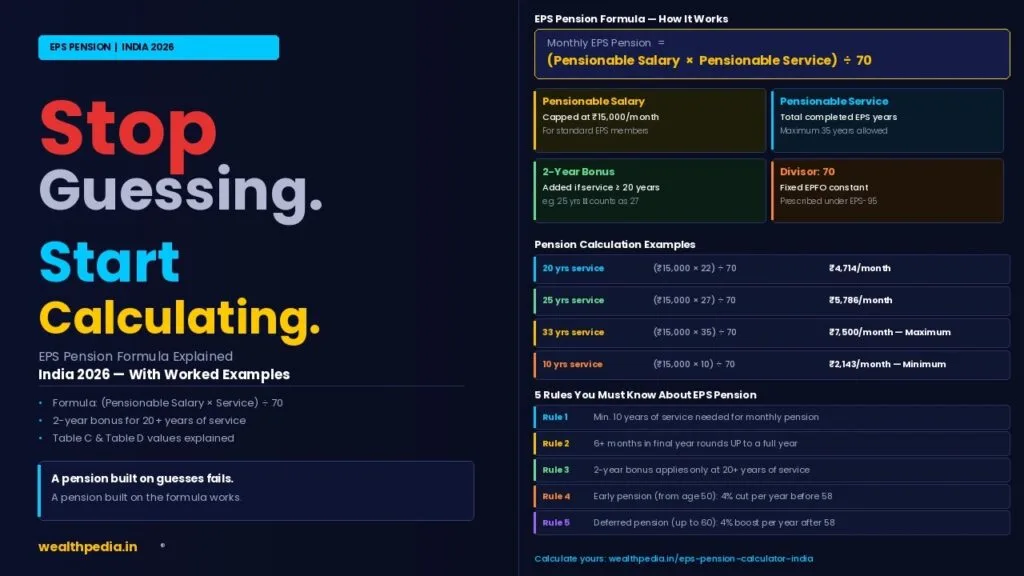
Monthly EPS Pension = (Pensionable Salary × Pensionable Service) ÷ 70. The pensionable salary is capped at ₹15,000 for most members; pensionable service is total EPS-covered years (with the 2-year bonus and 35-year cap applied). See EPS Pension Formula Explained.
What is the EPS wage ceiling?
₹15,000 per month since September 2014 (previously ₹6,500). This cap applies to pensionable salary in the formula regardless of actual salary. See What Is Pensionable Salary Under EPS?
What is pensionable service?
Total years of EPS-covered employment, counted in months and rounded to full years using the 6-month rule (6+ months rounds up, under 6 drops). The 2-year bonus applies at 20+ years. See What Is Pensionable Service Under EPS?
What is the maximum EPS pension?
₹7,500/month at the standard ₹15,000 ceiling, achieved at 33+ actual years of service (35 pensionable years with the 2-year bonus). With deferral to age 60, this rises to ₹8,100/month. See EPS Pension After 35 Years Service.
What is the minimum EPS pension?
₹1,000/month, guaranteed by the Central Government for all qualifying pension beneficiaries (member, widow, child, orphan, dependent parent) regardless of the formula result. See What Is the Minimum EPS Pension in India?
How much EPS pension will I get at ₹15,000 salary with 20 years of service?
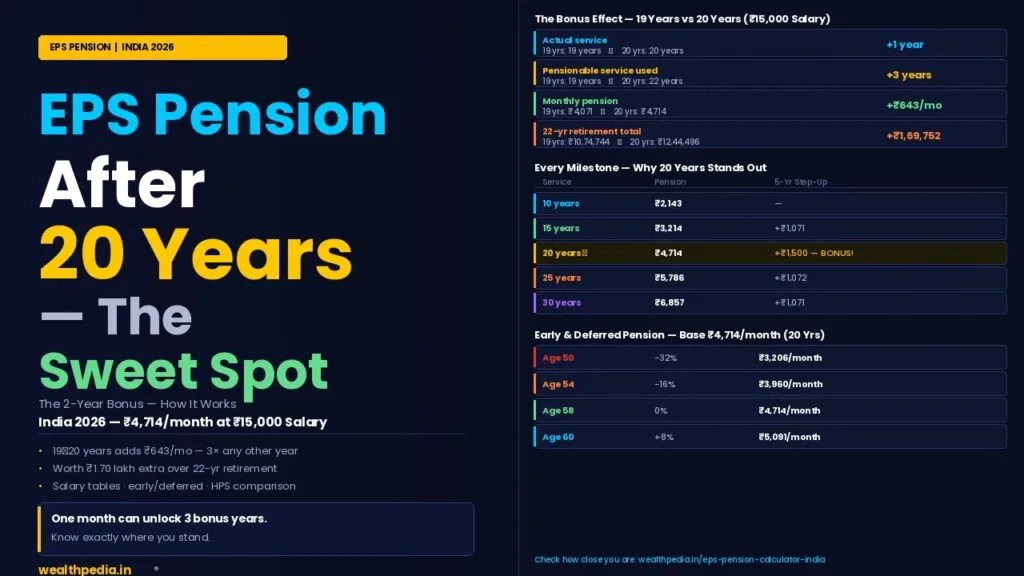
(15,000 × 22) ÷ 70 = ₹4,714/month. The 22 pensionable years include the 2-year bonus (which applies because service ≥ 20 years). See EPS Pension Calculator India.
What does the divisor 70 in the EPS formula represent?
70 is a fixed constant prescribed under EPS-95 rules for the pension formula. It does not represent years of service or a rate — it is simply the denominator that scales the pension relative to salary and service. See EPS Pension Formula Explained.
How much does each year of EPS service add to my pension?
At ₹15,000 pensionable salary: ₹15,000 ÷ 70 = ₹214.29/month per pensionable year. Exception: the 19→20 year transition adds ₹643/month (3× normal) due to the 2-year bonus activating. See Impact of Service Years on EPS Pension.
Is EPS pension calculated on basic salary or CTC?
On basic salary + Dearness Allowance (DA) only, capped at ₹15,000. HRA, special allowances, bonuses, equity, and commissions are excluded. See What Is Pensionable Salary Under EPS?
Section 2 — Eligibility & Service Rules (Q11–Q20)
What is the minimum service for EPS pension?
10 years of pensionable service (or 9 years 6 months, which rounds up under the 6-month rule). Below this, only the Table D withdrawal benefit or a Scheme Certificate is available. See EPS Pension After 10 Years.
What is the 2-year bonus in EPS?
If total pensionable service reaches 20 years or more, EPFO adds 2 bonus years to the service used in the formula. This is a one-time permanent addition — not compounding. See EPS Pension After 20 Years.
What is the maximum pensionable service?
35 years — reached at just 33 actual years of service (33 + 2 bonus = 35). Working beyond 33 years adds zero additional EPS pension. See EPS Pension After 35 Years Service.
How does service count for members who changed jobs?
Service from multiple employers is cumulative if transferred via UAN or preserved via Scheme Certificate. If the withdrawal benefit (Form 10C) was taken at a previous employer, that service is permanently forfeited. See What Is Pensionable Service Under EPS?
Does unpaid leave count toward EPS service?
No. Only months in which actual EPS contributions were made count. Unpaid leave with no EPS credit is excluded from pensionable service. See EPS Pension Eligibility Rules.
What is the 6-month rounding rule?
After calculating total service in full years and remaining months: 6+ remaining months rounds UP to the next full year; under 6 months is dropped. This rule creates critical thresholds at 9yr 6mo (pension eligibility) and 19yr 6mo (2-year bonus). See What Is Pensionable Service Under EPS?
At what age can I claim EPS pension?
Standard pension: age 58. Early pension: from age 50 (with permanent 4% reduction per year before 58). Deferred pension: age 59 or 60 (with 4% enhancement per year after 58). See EPS Pension Rules 2026.
What is the EPS pension for private sector employees?
Identical to any other EPF-covered employee — eligibility, formula, and rules are the same. The key challenges for private sector employees are job-hopping (which can fragment service) and salary structuring (which can lower pensionable salary below ₹15,000). See EPS Pension for Private Sector Employees.
Can I combine EPS service from two different employers?
Yes, provided the EPS account was transferred via UAN when switching jobs, or a Scheme Certificate from the previous employer was submitted to the new employer. See Scheme Certificate vs EPS Withdrawal Benefit.
What happens if I join EPF but my salary is above ₹15,000?
EPS contributions and pension calculation are capped at ₹15,000 regardless of actual salary. Employees with salary above ₹15,000 who join EPF for the first time may have the option to opt out of EPS, but those already enrolled continue at the capped salary. See EPS Pension Eligibility Rules.
Section 3 — Withdrawal & Scheme Certificate (Q21–Q28)
Can I withdraw EPS before retirement?
Only if you have less than 10 years of EPS service at the time of leaving employment. With 10+ years, EPS cannot be withdrawn as a lump sum — monthly pension only. See Can I Withdraw EPS Before Retirement?
What is the EPS withdrawal benefit?
A one-time lump sum calculated as Table D Factor × Pensionable Salary. For example, 7 years of service at ₹15,000 salary: 7.46 × 15,000 = ₹1,11,900. See EPS Withdrawal Benefit Calculator.
What is a Scheme Certificate?
A document issued by EPFO that preserves your EPS service record when leaving a job before 10 years of service. It can be submitted to a future employer to combine service, working toward pension eligibility. See Scheme Certificate vs EPS Withdrawal Benefit.
Should I take EPS withdrawal or a Scheme Certificate?
If you plan to continue in EPF-covered employment, a Scheme Certificate almost always delivers more value long-term — even a few more years of service can convert a lump sum into a lifetime pension. See Scheme Certificate vs EPS Withdrawal Benefit.
What is Form 10C?
The EPFO form used to either claim the Table D EPS withdrawal benefit or apply for a Scheme Certificate. Filed online via the UAN Member Portal after a 2-month waiting period from the last working day. See Form 10C Explained.
Is EPS withdrawal taxable?
Tax-exempt if combined EPF+EPS service was 5 years or more. Taxable as salary income if service was less than 5 years. See Form 10C Explained.
How long do I wait before filing Form 10C?
A minimum of 2 months after your last working day before filing Form 10C for the withdrawal benefit. See Form 10C Explained.
If I withdrew EPS at a previous job, can I still get pension from a later job?
Yes — but only from the service accumulated at subsequent employers, not the forfeited period. If the later employment alone reaches 10 years, you qualify for pension on that service. See Can I Withdraw EPS Before Retirement?
Section 4 — Claiming Pension: Form 10D & Arrears (Q29–Q35)
What is Form 10D?
The EPFO form used by EPS members with 10+ years of service to claim monthly pension. Filed at or after the eligible pension age (50 for early, 58 for standard). Can also be filed by family members for survivor pension. See Form 10D Explained.
When should I file Form 10D?
File as soon as you become eligible — on your 58th birthday for standard pension, or from age 50 for early pension. Delaying filing results in permanently lost pension income (not paid retroactively). See EPS Pension Arrears: Meaning and Calculation.
What are EPS pension arrears?
Arrears are the backdated lump-sum payment covering the gap between your Form 10D submission date and the date your first regular monthly pension credit begins (due to EPFO processing time). They do NOT cover any period before you filed Form 10D. See EPS Pension Arrears: Meaning and Calculation.
If I delay claiming pension by 5 years, will I get 5 years of arrears?
No. Pension is paid only from the date of Form 10D submission — not retroactively from age 58 if you file later. A 5-year delay results in 5 years of permanently lost pension income. See EPS Pension Arrears: Meaning and Calculation.
How long does EPFO take to process an EPS pension claim?
Typically 10–45 working days depending on claim type (standard member pension, family pension, invalidity pension). Arrears covering the processing gap are paid as a lump sum alongside or before the first regular credit. See Form 10D Explained.
Is EPS pension taxable?
Yes — taxable as “Income from Other Sources” at the applicable slab rate. Most retirees with EPS as their only income pay little or no tax due to the basic exemption limit. See EPS Pension Rules 2026.
Can I claim EPS pension if my employer never updated my exit date in EPFO records?
File Form 10D and raise a grievance via EPFiGMS (epfigms.gov.in) if the employer is unresponsive. EPFO can administratively update exit dates with supporting documentation (resignation letter, salary slips). See Form 10D Explained.
Section 5 — Early & Deferred Pension (Q36–Q40)
Can I claim EPS pension before age 58?
Yes — from age 50, with a permanent 4% reduction per year for each year before 58. Maximum reduction is 32% (at age 50). See EPS Early Pension Before 58.
What is the early pension reduction for claiming at age 54?
4 years before 58 × 4% = 16% permanent reduction. A pension of ₹5,786/month becomes ₹4,860/month at age 54. See EPS Early Pension Before 58.
Can I defer EPS pension beyond age 58?
Yes — to age 59 (4% enhancement) or 60 (8% enhancement, the maximum). See Deferred EPS Pension After 58.
What is the maximum EPS pension with deferral?
₹8,100/month — achieved with maximum service (33+ years), maximum salary (₹15,000 ceiling), and maximum deferral (to age 60, +8%): ₹7,500 × 1.08. See EPS Pension After 35 Years Service.
Does claiming early pension affect my family’s widow/child pension?
Yes. Widow and child pension are calculated as 50% and 25% of the member’s actual pension — including any early pension reduction. If the member claimed with a 32% reduction, the widow also receives 50% of the reduced amount, not 50% of the original base. See EPS Family Pension Rules Explained.
Section 6 — Family Pension (Q41–Q46)
What is widow pension under EPS?
50% of the member’s monthly pension, paid to the surviving spouse for life or until remarriage. No minimum service required. Minimum ₹1,000/month. See Widow Pension Under EPS.
What is child pension under EPS?
25% of the member’s pension per child, up to 2 children simultaneously, until each child turns 25. Permanently disabled children receive pension for life. Minimum ₹1,000/month per child. See Child Pension Under EPS Explained.
What is orphan pension under EPS?
75% of the member’s pension per child when both parents are deceased, up to 2 children, until age 25 (or lifetime for permanently disabled children). See Child Pension Under EPS Explained.
Does widow pension stop if the widow remarries?
Yes — immediately upon remarriage. The widow is required to inform EPFO. There is no reinstatement provision even if the second marriage ends. Children’s pension continues unaffected. See Widow Pension Under EPS.
Is there a minimum service requirement for family pension?
No. Family pension is payable regardless of how briefly the member was EPS-covered. Even very short service qualifies the family, subject to the ₹1,000/month minimum per beneficiary. See EPS Family Pension Rules Explained.
Can widow pension and child pension be received simultaneously?
Yes. Both are paid independently. A family with a widow and 2 eligible children can receive 50% + 25% + 25% = 100% of the member’s pension in total combined family benefits. See Child Pension Under EPS Explained.
Section 7 — Higher Pension Scheme & Special Cases (Q47–Q50)
What is the Higher Pension Scheme (HPS)?
A special option for EPFO members whose employer contributed on actual salary above ₹15,000. HPS removes the salary ceiling, using the actual 60-month average salary instead — dramatically increasing the pension. The application window is now closed. See EPS Higher Pension Scheme: Eligibility & Calculation.
What is the EPS pension under HPS at ₹50,000 average salary with 25 years of service?
(50,000 × 27) ÷ 70 = ₹19,286/month — over 3× the standard EPS pension for the same service. See EPS Higher Pension Scheme: Eligibility & Calculation.
What is the difference between EPF and EPS?
EPF is a savings fund (employee + employer contributions, with interest, paid as a lump sum). EPS is a pension scheme (employer contributes 8.33% of ₹15,000 max, pooled by EPFO, pays monthly pension). No interest accrues in EPS; the benefit is the formula-based pension. See EPF vs EPS: Key Differences Explained.
Where can I calculate my exact EPS pension?
Use the free EPS Pension Calculator India on Wealthpedia. Enter your date of joining EPS and expected exit date — it computes your pensionable service (with the 6-month rounding rule, 2-year bonus, and 35-year cap), and shows your projected monthly pension at standard age, early claim age, and deferred claim age.
Additional Resources — Wealthpedia’s Complete EPS Guide
For deep-dive articles on any of the topics above, explore the full EPS guide:
- EPS Pension Formula Explained
- EPS Pension Calculator India
- EPS Pension Rules 2026
- EPS Pension Eligibility Rules
- What Is Pensionable Salary Under EPS?
- What Is Pensionable Service Under EPS?
- EPS Pension After 10 Years
- EPS Pension After 15 Years
- EPS Pension After 20 Years
- EPS Pension After 25 Years
- EPS Pension After 30 Years
- EPS Pension After 35 Years
- EPS Pension for ₹15,000 Salary
- EPS Early Pension Before 58
- Deferred EPS Pension After 58
- EPS Family Pension Rules Explained
- Widow Pension Under EPS
- Child Pension Under EPS
- EPS Higher Pension Scheme
- EPF vs EPS: Key Differences Explained
- EPS Withdrawal Benefit Calculator
- Scheme Certificate vs EPS Withdrawal Benefit
- Form 10C Explained
- Form 10D Explained
- Can I Withdraw EPS Before Retirement?
- EPS Pension Arrears: Meaning and Calculation
- What Is the Minimum EPS Pension in India?
- EPS Pension for Private Sector Employees
- Impact of Service Years on EPS Pension
Disclaimer: The information on this page is for educational purposes only and does not constitute investment or financial advice. EPS rules are governed by EPFO regulations under EPS-95 and may be updated by the Government of India. For personalised guidance, consult a SEBI-registered financial planner or visit your nearest EPFO office. Wealthpedia™ (Trademark Reg. No. 4910385) is not a SEBI-registered investment advisor. All mutual fund references on this site are for Direct Plan, Growth option only.

Vishal Jhaveri is the founder of Wealthpedia and an MBA Finance professional with over 10 years of experience in financial planning, investing, and wealth creation. He specializes in FIRE (Financial Independence, Retire Early), retirement planning, investing, and personal finance education. Through Wealthpedia, he develops financial calculators and publishes evidence-based content to help Indian investors make informed financial decisions. He regularly reviews and updates Wealthpedia articles to reflect changes in tax, laws, investment regulations, and personal finance best practices.
Quick Wrap up